Toilet Seat Inventory and Replenishment Planning for Distributors
Toilet seat distributors need enough stock to support customer demand without filling the warehouse with slow-moving models, colors and hinge variations.
This balance is difficult because a toilet seat range may contain several materials, shapes, price tiers and fixing systems. Two products that appear similar may serve different ceramics or customer groups and cannot always replace each other.
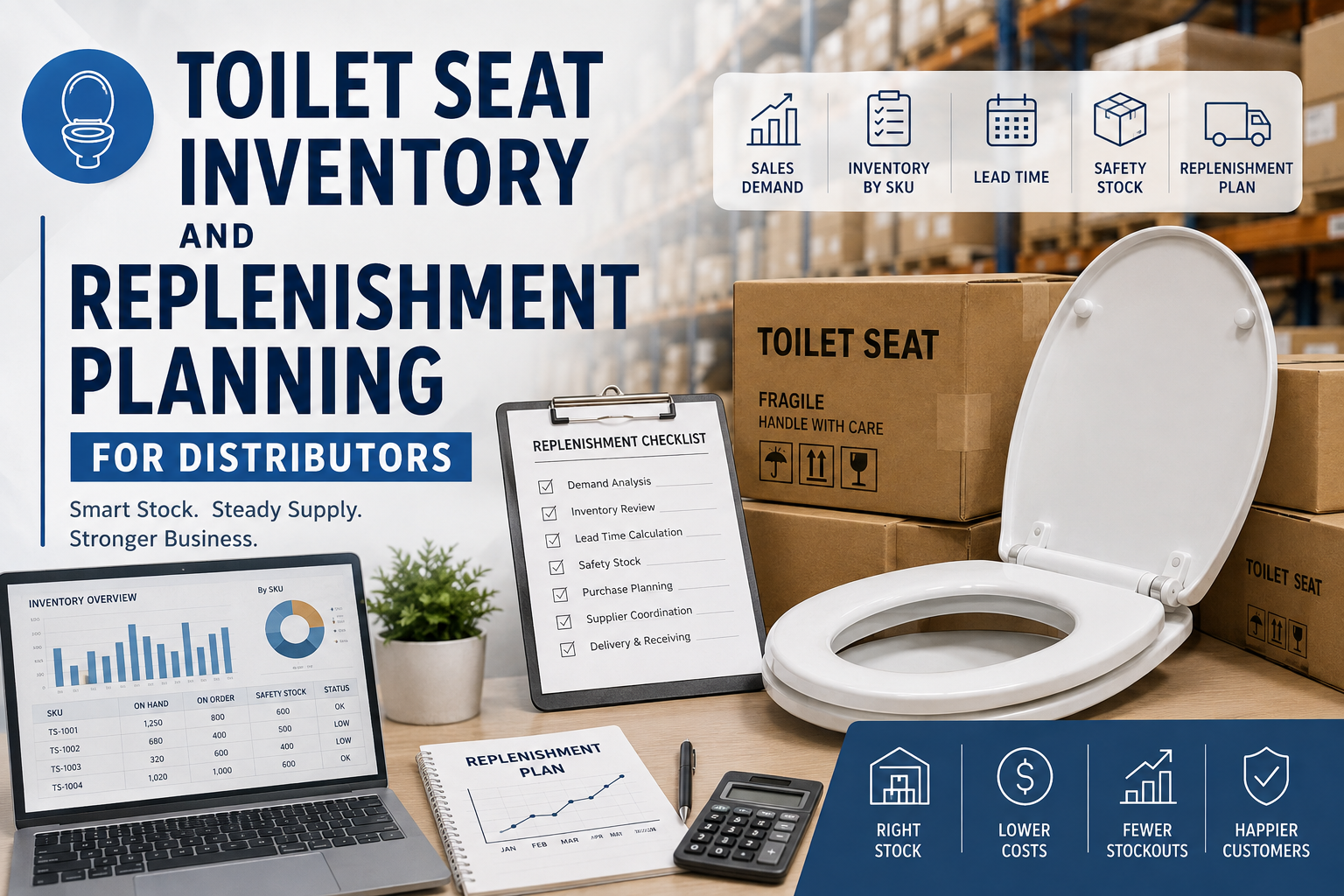
A practical replenishment plan connects:
- Sales demand
- Inventory by SKU
- Purchase-order quantities
- Supplier lead time
- Production MOQ
- Packaging MOQ
- Shipping time
- Safety stock
- Product revisions
- Claims and return data
The purpose is not to forecast demand perfectly. It is to make stock decisions using consistent information and visible assumptions.
Build a Controlled SKU Master
Replenishment planning begins with accurate product identification.
For every SKU, record:
| Field | Information |
|---|---|
| Buyer SKU | Distributor’s commercial code |
| Factory model | Manufacturer’s product model |
| Material | PP, UF, MDF or other approved material |
| Shape | Round, elongated, D-shape or model-specific |
| Dimensions | Approved size and adjustment range |
| Hinge | Standard, soft close, fixed or quick release |
| Fixing kit | Top fix or bottom fix |
| Color | Approved color reference |
| Packaging | Neutral, retail, e-commerce or project |
| Units per carton | Approved case quantity |
| MOQ | Minimum for the configuration |
| Lead time | Current confirmed production basis |
| Revision | Current approved specification |
Avoid treating several different products as one generic stock item such as “white soft-close toilet seat.”
If the hinge or fixing kit differs, the product may require a separate SKU even when the seat body is similar.
Separate the Main Sources of Demand
Not all sales should be forecast in the same way.
Regular distributor demand
Repeat wholesale orders from dealers, plumbers and bathroom retailers may provide the most stable baseline.
Retail-chain demand
Retail orders may follow planned promotions, store resets, seasonal campaigns or warehouse ordering cycles.
Project demand
Hotels, apartments and commercial buildings may create large but irregular orders tied to construction phases.
E-commerce demand
Online sales may respond quickly to price changes, reviews, advertising, platform rankings or promotional events.
Replacement demand
Existing installations may require full-seat replacements, hinges, fixing kits or related service parts.
New-product demand
A new material, color or feature has limited sales history and should be treated as a controlled trial rather than a proven forecast.
Separating these demand types prevents one large project order from being mistaken for normal monthly consumption.
Establish a Historical Baseline
Where reliable data exist, review:
- Monthly sales by SKU
- Monthly orders by customer
- Promotion periods
- Project orders
- Stockout periods
- Returns
- Cancelled orders
- Lost sales
- Price changes
- Product replacements
- New-store openings
- Discontinued products
A simple average can be misleading.
If a product was unavailable for two months, recorded sales during that period do not represent true demand. If one customer placed a one-time project order, that volume should not automatically increase the regular baseline.
Annotate unusual events before calculating future requirements.
Measure the Complete Replenishment Lead Time
Supplier production time is only one part of replenishment.
The total cycle may include:
- Internal demand review
- Purchase-order approval
- Specification confirmation
- Deposit or payment processing
- Material and component preparation
- Packaging production
- Toilet seat production
- Assembly and inspection
- Export documentation
- Booking and loading
- International transport
- Customs clearance
- Destination delivery
- Warehouse receiving
The distributor should plan from the date a stock decision is made until saleable inventory is available in its warehouse.
Lead time may also vary by:
- Product material
- Custom color
- Non-standard hinge
- Printed packaging
- Order volume
- Production season
- Shipping route
- Destination
- Inspection requirement
Do not use one generic lead time for every SKU without verifying the differences.
Calculate a Reorder Point
A basic planning formula is:
Reorder Point = Expected Demand During Replenishment Lead Time + Safety Stock
For example, if a core SKU sells an average of 100 units per week and the complete replenishment cycle is 10 weeks, expected lead-time demand is 1,000 units.
The distributor would then add an appropriate safety-stock quantity based on demand variation, lead-time reliability and acceptable stockout risk.
This is a planning method rather than a universal rule. The figures should be adjusted for:
- Seasonality
- Promotions
- Project demand
- Supplier shutdowns
- Shipping uncertainty
- MOQ
- Container optimization
- Product transition
- Current open orders
Use Different Stock Policies by SKU Role
Not every product deserves the same inventory level.
Core SKUs
These products generate repeat sales and should normally receive the strongest stock protection.
Shape-coverage SKUs
These cover important ceramic shapes but may sell more slowly. Stock should reflect the local installed base and substitution options.
Premium SKUs
Higher-value UF, decorative or advanced hinge products may require more selective inventory.
Project SKUs
Stock should be linked to confirmed project phases rather than general warehouse assumptions.
Test SKUs
New colors, finishes or functions should have a defined test quantity and review date.
Discontinued SKUs
Purchasing should stop through a controlled process while spare products and components remain available where necessary.
BOFAN’s Wholesale Toilet Seat Buying Guide for Distributors explains how value, core and upgraded products can be assigned different roles within a distributor range.
Apply ABC Inventory Classification
A simple ABC analysis can help prioritize management attention.
A items
High-value or high-volume products that materially affect revenue and customer service.
Review frequently and maintain accurate demand, lead-time and open-order data.
B items
Important products with moderate demand or value.
Review regularly but with less intensive control than A items.
C items
Low-volume variants, test colors or specialized products.
Avoid holding excessive stock simply to maintain a large catalogue.
ABC classification should not rely only on revenue. A low-volume SKU may still be strategically important if it supports a key ceramic range or contract customer.
Coordinate MOQ With Reorder Quantities
The calculated requirement may be below the factory or packaging MOQ.
MOQ may apply to:
- Product model
- Color
- Hinge configuration
- Surface decoration
- Logo process
- Retail box
- Instruction language
- Master-carton print
- Spare-part package
If the commercial reorder is smaller than MOQ, review possible options:
- Combine demand from several customers
- Increase the order to a realistic coverage period
- Use neutral packaging with controlled labels
- Standardize hinges or fixing kits
- Reduce low-volume colors
- Consolidate orders across related products
- Replace a weak SKU with a stronger alternative
- Schedule less frequent replenishment
The correct choice depends on inventory cost, product role and customer commitment.
Plan Safety Stock Rationally
Safety stock protects against uncertainty, but excessive safety stock can hide poor assortment decisions.
Consider:
- Demand variability
- Forecast accuracy
- Complete replenishment lead time
- Supplier delivery consistency
- Shipping reliability
- Cost of a stockout
- Availability of substitute products
- Product value
- Storage cost
- Risk of revision or discontinuation
- Customer service commitment
Core PP replacement products may justify different coverage from a low-volume decorative MDF seat.
Safety stock should be reviewed when demand, lead time or product strategy changes.
Account for Promotions and Seasonality
Before a campaign or retail promotion, confirm:
- Participating SKUs
- Forecast quantity
- Store or platform coverage
- Promotion period
- Expected uplift
- Current stock
- Open purchase orders
- Required arrival date
- Packaging requirement
- Post-promotion inventory plan
A promotional order should not arrive after the sales window.
Likewise, the distributor should not commit to a promotion before confirming whether the factory can supply the exact hinge, packaging and quantity on time.
For e-commerce programs, review historical advertising periods, platform events and listing performance separately from normal sales.
Share a Rolling Forecast With the Supplier
A forecast is not necessarily a purchase order, but it helps the supplier understand expected demand.
A rolling forecast may show:
- Confirmed purchase orders
- Likely next order
- Expected quantity by SKU
- Required shipment month
- Promotion demand
- Project demand
- New-product trials
- Products likely to be discontinued
- Packaging changes
- Required component reservations
Clearly distinguish:
- Confirmed
- Highly likely
- Planning estimate
- Opportunity only
The supplier should not treat an unconfirmed forecast as authorization to produce finished goods unless both parties have agreed to that arrangement.
Control Forecast and Purchase-Order Revisions
When a forecast becomes a purchase order, confirm:
- Final SKU
- Quantity
- Product revision
- Hinge and fixing kit
- Color
- Packaging
- Barcode
- Price
- Trade term
- Destination
- Required shipment date
- Inspection requirement
- Documentation
If quantities change after production planning, review the effect on:
- MOQ
- Material purchases
- Packaging quantities
- Production schedule
- Container loading
- Unit price
- Delivery date
Frequent small changes can create shortages in one SKU and unwanted surplus in another.
Prevent Stockouts During Product Changes
Product revisions require a controlled inventory transition.
Review:
- Remaining old-version inventory
- Open purchase orders
- Goods in transit
- New-version approval status
- Packaging changes
- Barcode changes
- Spare-parts compatibility
- Customer notification
- Effective change date
- Whether old and new products can be mixed
If the versions are not fully interchangeable, use separate product codes or clear revision identification.
BOFAN’s article on transferring an existing toilet seat program to a new supplier provides a related framework for inventory cutover and specification continuity.
Include Spare Products and Components
Replenishment planning should cover after-sales requirements as well as new sales.
Depending on the program, plan:
- Complete replacement seats
- Fixing kits
- Hinges
- Dampers
- Quick-release components
- Buffers
- Installation tools
Spare-component demand should be based on product model and hinge code, not a generic description.
BOFAN’s toilet seat spare-parts planning guide explains how products and service components can be mapped for repeat supply.
Review Slow-Moving Inventory
Slow stock should be classified before action is taken.
Possible reasons include:
- Incorrect shape for the local market
- Uncompetitive price
- Weak product listing
- Too many similar SKUs
- Inadequate sales training
- Unpopular color
- Packaging problem
- Compatibility confusion
- Product quality issue
- End of a project
- New replacement model
- Excessive original order quantity
Possible responses may include:
- Repositioning the product
- Improving compatibility information
- Combining stock with a project offer
- Reducing future order quantities
- Replacing the SKU
- Using controlled promotional pricing
- Updating packaging or listing content
- Discontinuing the product
Do not reorder automatically because a SKU remains in the catalogue.
Track Inventory and Supplier KPIs
Useful measurements include:
| KPI | Purpose |
|---|---|
| Stock on hand | Current saleable quantity |
| Weeks of cover | How long current stock may support demand |
| Sell-through | Sales compared with available inventory |
| Stockout rate | Frequency of unavailable products |
| Forecast accuracy | Difference between forecast and actual demand |
| Supplier lead time | Actual order-to-availability period |
| On-time shipment | Supplier delivery performance |
| Inventory turnover | Speed at which stock is sold |
| Return rate | Product or channel risk |
| Slow-stock value | Capital tied up in weak SKUs |
| Fill rate | Ability to supply customer orders completely |
| Revision exposure | Inventory affected by product changes |
Review these metrics by SKU rather than only at total-category level.
Create a Regular Replenishment Review
A practical review meeting may cover:
- Current stock
- Sales since the previous review
- Open customer orders
- Open supplier orders
- Goods in transit
- Forecast changes
- Stockout risks
- Slow-moving products
- Promotions
- Project demand
- Product revisions
- Claims and returns
- Proposed purchase quantities
- Required supplier decisions
Assign one person to maintain the SKU and lead-time data. Decisions based on several conflicting spreadsheets are difficult to control.
Toilet Seat Replenishment Checklist
Before placing a repeat order, confirm:
- SKU and factory-model records are current.
- Sales history has been adjusted for unusual events.
- Project demand is separated from regular demand.
- Complete replenishment lead time is known.
- Reorder points have been reviewed.
- Safety stock reflects actual uncertainty.
- MOQ is confirmed by configuration.
- Promotions and seasonal requirements are included.
- Old and new product revisions are controlled.
- Packaging and barcodes remain current.
- Open orders and goods in transit are included.
- Spare products and components are planned.
- Slow-moving inventory has been reviewed.
- The forecast is separated from confirmed orders.
- The final purchase order uses the approved specification.
How BOFAN Supports Repeat-Order Planning
BOFAN can coordinate product and order information for approved distributor and OEM toilet seat programs.
Depending on the selected products, support may include:
- Model and material identification
- Hinge and fixing-kit confirmation
- MOQ review
- Packaging coordination
- Carton information
- Production-planning discussions
- Mixed-model order review
- Repeat-order specification control
- Product-change communication
- Spare-component identification
Final availability and lead time depend on the selected model, configuration, quantity, packaging and production schedule.
BOFAN works with distributors and importers requiring structured PP, UF and MDF toilet seat ranges and repeat-order support.
CTA
Reviewing your next toilet seat replenishment order? Send BOFAN your current SKU list, sales priorities, required quantities, hinge configurations, packaging formats and desired shipment window. The team can help review the order structure against model and MOQ requirements.
Request a Replenishment Planning Review
FAQ
What is a toilet seat reorder point?
It is the inventory level at which a replenishment decision should be triggered, based on expected demand during the complete lead time plus appropriate safety stock.
Should every toilet seat SKU use the same safety stock?
No. Safety stock should reflect demand variability, product role, lead time, stockout cost, substitution options and inventory value.
How should distributors forecast project orders?
Separate confirmed or probable project quantities from normal wholesale demand. Record the project phase, required delivery date and probability rather than adding the full quantity to the regular baseline.
Why can a reorder quantity be below the supplier MOQ?
The commercial requirement may be smaller than the production, color, hinge or packaging minimum. The buyer should review standardization, consolidation or a longer coverage period.
How often should toilet seat inventory be reviewed?
Core and high-risk SKUs should be reviewed more frequently than low-volume items. The cadence should reflect sales speed, lead time and customer commitments.
Should goods in transit be included in replenishment calculations?
Yes. Existing purchase orders and goods in transit must be included to prevent unnecessary duplicate orders.
How should a distributor handle a product revision?
Review old stock, open orders, packaging, barcodes, spare-parts compatibility and the effective change date. Use separate identification where the versions are not interchangeable.
Can BOFAN support mixed-model repeat orders?
BOFAN can review suitable model, quantity, packaging and production arrangements. Feasibility depends on the exact configurations, MOQ and required delivery timing.
Table of Contents
- Toilet Seat Inventory and Replenishment Planning for Distributors
- Build a Controlled SKU Master
- Separate the Main Sources of Demand
- Establish a Historical Baseline
- Measure the Complete Replenishment Lead Time
- Calculate a Reorder Point
- Use Different Stock Policies by SKU Role
- Apply ABC Inventory Classification
- Coordinate MOQ With Reorder Quantities
- Plan Safety Stock Rationally
- Account for Promotions and Seasonality
- Share a Rolling Forecast With the Supplier
- Control Forecast and Purchase-Order Revisions
- Prevent Stockouts During Product Changes
- Include Spare Products and Components
- Review Slow-Moving Inventory
- Track Inventory and Supplier KPIs
- Create a Regular Replenishment Review
- Toilet Seat Replenishment Checklist
- How BOFAN Supports Repeat-Order Planning
-
FAQ
- What is a toilet seat reorder point?
- Should every toilet seat SKU use the same safety stock?
- How should distributors forecast project orders?
- Why can a reorder quantity be below the supplier MOQ?
- How often should toilet seat inventory be reviewed?
- Should goods in transit be included in replenishment calculations?
- How should a distributor handle a product revision?
- Can BOFAN support mixed-model repeat orders?