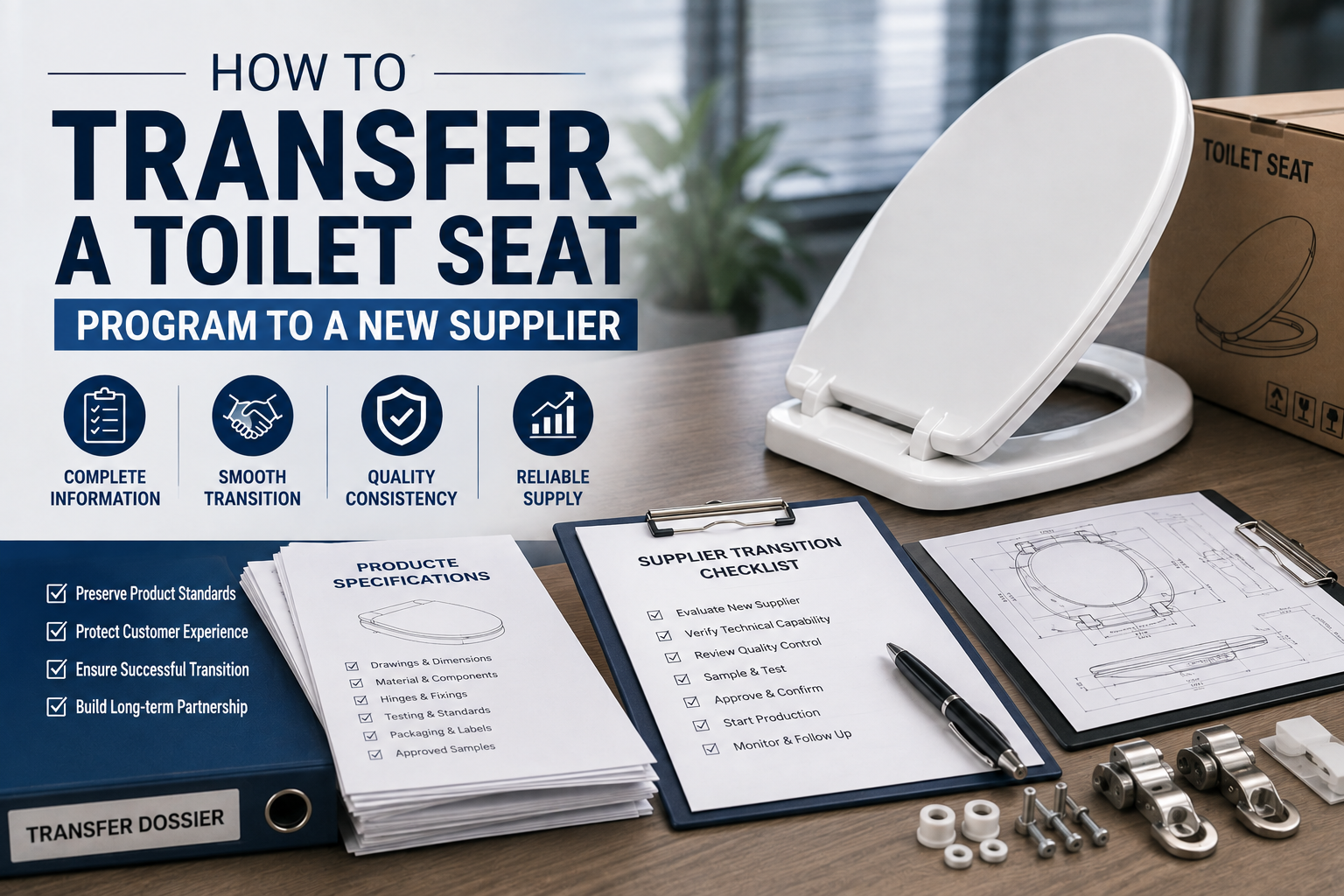
How to Transfer a Toilet Seat Program to a New Supplier
Changing a toilet seat supplier is not simply a matter of sending the new factory a product photograph and asking for the same item at a different price.
An established program may contain years of accumulated decisions about ceramic fit, dimensions, materials, hinges, dampers, fixings, buffers, colors, logos, packaging, test methods, spare parts, and customer expectations. Some of these decisions may never have been consolidated into a formal specification.
If the new supplier receives incomplete information, it may reproduce the general appearance of the product while missing details that affect installation, performance, retail presentation, or repeat-order consistency.
A controlled supplier-transfer process helps distributors, OEM brands, sanitary ware companies, and retail vendors reduce these risks.
1. Define Why the Program Is Being Transferred
The sourcing team should first document the reason for the change.
Common objectives include:
- Improving delivery reliability
- Establishing a second source
- Increasing production capacity
- Improving quality consistency
- Reducing claims or return rates
- Upgrading hinges or fixing systems
- Consolidating several models with one manufacturer
- Introducing new packaging
- Supporting expansion into another market
- Replacing a discontinued product
- Improving technical or OEM support
The objective determines how the potential supplier should be evaluated.
For example, a buyer seeking lower cost may focus on material, design, and packaging alternatives. A buyer responding to product returns should first identify the failure modes. Transferring an unresolved defect to a new factory will not solve the underlying problem.
Before selecting a replacement, use a structured process such as How to Evaluate a Toilet Seat Manufacturer Before Placing a Bulk Order.
2. Build a Complete Transfer Dossier
The transfer dossier should describe the product as it is supposed to be—not only as one random market sample happens to appear.
Include:
- Current model and SKU numbers
- Product drawings and dimensions
- Compatible ceramic models
- Material specifications
- Product weight or relevant tolerances
- Color standards
- Surface-finish requirements
- Hinge and damper specifications
- Fixing-system details
- Buffer positions and materials
- Logo artwork and application method
- Current packaging dielines
- Instruction sheets
- Barcode and label data
- Master-carton configuration
- Inspection criteria
- Test reports
- Claims and return history
- Spare-parts requirements
- Approved reference samples
- Annual volume and order pattern
- Destination markets
Each file should carry a date or revision number. Outdated drawings, old packaging artwork, and current specifications should not be mixed in the same uncontrolled folder.
Where formal documentation is missing, the buyer should identify the gap instead of asking the new supplier to guess.
3. Confirm Intellectual Property and Tooling Rights
Before requesting a supplier to reproduce an existing product, the buyer should confirm that it has the necessary rights to use the design, branding, drawings, packaging, and tooling.
Important questions include:
- Who owns the product design?
- Who owns the production mold?
- Can the mold legally and practically be transferred?
- Is the tooling dedicated to the buyer?
- Are drawings owned by the buyer or the previous supplier?
- Does the product use patented or protected mechanisms?
- Can the brand artwork be shared with the proposed factory?
- Does the existing agreement restrict transfer or duplication?
A new manufacturer should not be asked to copy protected third-party designs or use tooling without authorization.
If the original mold cannot be transferred, the parties must decide whether to select an existing alternative, modify an available platform, or develop an authorized new mold.
4. Establish a Controlled Benchmark Sample
A physical sample is valuable, but it must be selected carefully.
A used product may be worn. A market-return unit may contain a defect. A random production unit may not match the latest approved revision.
The preferred benchmark is:
- An approved golden sample, or
- A recent conforming production sample supported by drawings and specifications
The sample should be labeled with its model, revision, approval date, and purpose.
The buyer should also clarify which attributes must be reproduced and which may be improved. For example:
- The external shape must remain compatible with existing ceramics.
- The hinge finish must match the current range.
- The fixing system may be upgraded.
- Packaging dimensions must remain unchanged.
- The soft-close performance may be improved.
- Product weight may vary only within an agreed range.
This distinction prevents the supplier from treating every feature of the benchmark—including known weaknesses—as mandatory.
5. Revalidate Ceramic Fit
Existing market history does not eliminate the need for compatibility verification at the new factory.
The replacement seat should be checked for:
- Overall length and width
- Hinge-hole spacing
- Front and side alignment
- Overhang and underhang
- Hinge adjustment range
- Mounting access
- Seat stability
- Contact between buffers and ceramic
- Lid clearance
- Visual alignment with the ceramic
If one seat SKU is sold with multiple toilet models, create a ceramic compatibility matrix. Each combination should record the ceramic model, relevant dimensions, approved fixing configuration, and validation status.
Even small changes in hinge position, buffers, molding geometry, or shrinkage can affect the installed result.
6. Compare the Complete Bill of Materials
Two toilet seats with a similar appearance may use different internal and external components.
The comparison should include:
| Area | Items to compare | Procurement risk |
|---|---|---|
| Seat and lid | Material, dimensions, weight, finish and color | Appearance, strength or range inconsistency |
| Hinges | Material, coating, geometry and adjustment | Fit, corrosion appearance or installation |
| Dampers | Configuration and operating behavior | Closing performance and claims |
| Release system | Buttons, plates and locking mechanism | Removal difficulty or looseness |
| Fixings | Top/bottom fixing, bolts, nuts, washers and plugs | Installation failure or missing compatibility |
| Buffers | Material, hardness, position and quantity | Movement, noise or ceramic contact |
| Accessories | Tools, caps, instruction sheets and spare parts | Incomplete packs and service complaints |
| Packaging | Carton, inserts, bags, labels and master cartons | Transit damage or retail non-compliance |
The agreed bill of materials should assign a part number or clear description to every critical component. Unapproved substitutions should require written review.
7. Review Historical Claims and Returns
A supplier transfer is an opportunity to correct recurring problems.
Collect evidence from:
- Warranty records
- Retailer deductions
- E-commerce reviews
- Installer feedback
- Customer service tickets
- Product returns
- Spare-parts requests
- Warehouse inspections
Classify the issues by failure mode, such as:
- Incorrect ceramic fit
- Loose fixings
- Soft-close failure
- Quick-release difficulty
- Surface damage
- Color mismatch
- Missing accessories
- Packaging damage
- Unclear installation instructions
- Incorrect labeling
Then connect each failure mode to a preventive control in the new program.
For example, repeated missing components may require a component-counting or weight-check process. Installation complaints may require revised instructions or a different fixing set. Transit damage may require packaging validation rather than a product-design change.
See How to Reduce Toilet Seat Returns in Retail and E-Commerce Programs.
8. Verify Testing and Documentation
Existing certificates should not automatically be transferred to the replacement product.
The buyer should confirm:
- Which exact model was tested
- Which material was covered
- Which hinge and fixing configuration was included
- Which test method and version were used
- Which laboratory issued the report
- Whether the report remains valid
- Whether the destination market or retailer accepts it
- Whether a change requires retesting
A product that looks similar but uses a different material, damper, fixing system, or manufacturing process may require additional validation.
BOFAN’s available documentation can be reviewed through:
Final testing responsibilities should be written into the transfer plan, including who arranges the test, who pays, which samples are submitted, and what constitutes approval.
9. Rebuild and Verify the Packaging Specification
Packaging continuity is especially important when the buyer wants to preserve existing retail listings, warehouse processes, or e-commerce data.
Confirm:
- Unit-carton dimensions
- Packaging material
- Protective structure
- Product orientation
- Accessory location
- Instruction sheet
- Barcode
- SKU and model name
- Product claims
- Country-of-origin statement
- Certification marks
- Master-carton quantity
- Gross and net weight
- Shipping marks
- Pallet pattern where applicable
The physical product should be checked against the actual packaging, not only the artwork file. Changes to hinge height, product profile, accessory packs, or protective inserts can affect carton fit and transport performance.
For packaging risk controls, refer to the Toilet Seat Packaging Guide for Retail and E-Commerce Buyers.
10. Conduct a Formal Gap Analysis
Before sampling, compare the current product requirement with the proposed solution from the new supplier.
Classify each item as:
- Exact match
- Acceptable equivalent
- Proposed improvement
- Deviation requiring approval
- Information missing
- Not applicable
The gap analysis should cover product geometry, material, color, components, packaging, tests, documents, capacity, order quantities, and service requirements.
A deviation is not automatically negative. An alternative hinge or packaging material may provide an improvement. The key is to make the difference visible and obtain approval before it enters production.
Verbal statements such as “same as the current product” should be replaced by measurable or inspectable requirements wherever possible.
11. Approve Samples Through Defined Stages
A practical transfer may require several approval levels:
Engineering sample
Used to confirm geometry, ceramic fit, hinge position, and major component selection.
Appearance sample
Used to confirm color, finish, logo, visible surfaces, and decorative components.
Functional sample
Used to verify soft-close behavior, quick release, fixing stability, and installation.
Packaging sample
Used to approve the carton, inserts, instructions, labels, accessories, and product orientation.
Pre-production or reference sample
Represents the final configuration authorized for the trial or mass-production order.
The approval record should state which specification revision and packaging revision apply. An approved appearance sample should not be treated as approval of untested packaging or a different fixing system.
12. Place a Controlled Trial Order
The first order from the new supplier should validate the manufacturing and order-management system.
The trial should check:
- Component consistency
- Production dimensions
- Assembly quality
- Function
- Color and appearance
- Logo execution
- Packaging accuracy
- Barcode readability
- Carton contents
- Inspection reporting
- Export documentation
- Shipment condition
- Installation feedback
A controlled trial order is particularly important when several SKUs or ceramic combinations are involved. Buyers can use the framework in How to Structure a Trial Order Before Scaling an OEM Toilet Seat Program.
Any issues discovered during the trial should be documented, corrected, and incorporated into the specification before the next order.
13. Plan the Inventory Transition
Supplier transitions can create either a stockout or duplicated inventory if the cutover is not coordinated.
The transition plan should account for:
- Remaining stock from the previous supplier
- Open purchase orders
- Goods already in transit
- Safety-stock requirements
- Launch timing for the replacement product
- Retailer or distributor notification
- Old and new packaging versions
- Spare-parts compatibility
- Mixed inventory in warehouses
- Effective date for new specifications
- Traceability by batch or supplier
Where the old and new versions are not fully interchangeable, they should have clear revision identifiers or separate SKUs.
The buyer should also decide how long spare parts for the previous version must remain available. BOFAN’s article on Toilet Seat Spare Parts Planning provides a useful framework.
14. Control the First Repeat Orders
A successful trial order does not mean the transfer process is complete.
During the first repeat orders, monitor:
- Dimensional consistency
- Color consistency
- Component sources
- Functional test results
- Packaging revisions
- Claims and returns
- On-time delivery
- Corrective-action closure
- Unapproved substitutions
- Spare-parts availability
The supplier should retain the approved sample, drawings, bill of materials, inspection criteria, packaging files, and revision history.
For repeat-order control principles, see How to Ensure Quality Consistency in OEM Toilet Seat Production.
Supplier-Transfer Checklist
Before authorizing the first production order, confirm:
- The reason for the transfer is documented.
- Product and tooling rights have been checked.
- A controlled transfer dossier exists.
- The benchmark sample is representative.
- Ceramic compatibility has been revalidated.
- The bill of materials is approved.
- Historical defects have preventive controls.
- Testing requirements are confirmed.
- Packaging and labeling are approved.
- All deviations have written acceptance.
- Trial-order inspection criteria are defined.
- Inventory cutover dates are planned.
- Spare-parts compatibility is understood.
- Specification revisions are controlled.
- First repeat orders will receive enhanced monitoring.
Conclusion
The safest way to switch toilet seat manufacturers is to treat the transfer as a controlled product-qualification project.
Price and visual similarity are only part of the decision. The new supplier must understand the ceramic interface, product specification, components, performance requirements, packaging system, compliance evidence, quality controls, and continuity plan.
A documented transfer process allows buyers to preserve the knowledge already built into an established program while creating an opportunity to correct weaknesses and improve future supply.
BOFAN works with international distributors and importers as well as OEM brands and sanitary ware companies.
CTA
Considering a new manufacturing source for an existing toilet seat range? Send BOFAN the available drawings, ceramic information, reference samples, annual volume, component requirements, packaging files, and current quality concerns. The team can help prepare a structured product and supplier-transfer review.
Request a Supplier-Transfer Review
FAQ
Can a new factory reproduce a toilet seat from a physical sample?
A sample is useful, but it is rarely sufficient on its own. Drawings, ceramic information, component specifications, packaging files, testing requirements, and ownership rights should also be confirmed.
Should the new supplier use exactly the same components?
Not necessarily. Exact continuity may be required for some programs, while an approved equivalent or improved component may be acceptable for others. Every difference should be documented and validated.
Can the existing test report be used for the new product?
Only if the report is confirmed to cover the actual product, material, components, manufacturing arrangement, and destination-market requirements. A similar appearance does not prove equivalent test coverage.
How should a buyer select the benchmark sample?
Use an approved golden sample or a recent conforming production unit. Avoid relying on a worn product, an unidentified sample, or a returned unit with a possible defect.
Is a trial order necessary when the product is already established?
It is strongly recommended. The product may be established, but the new supplier’s materials, processes, assembly, packaging, inspection, and documentation still need to be validated.
How can buyers avoid stockouts during the transition?
Review remaining inventory, open orders, goods in transit, demand forecasts, safety stock, trial-order timing, and the planned cutover date before ending supply from the previous source.
What should be monitored after the first order?
Monitor dimensions, fit, function, color, components, packaging, claims, delivery performance, corrective actions, and specification changes during the first repeat orders.
Table of Contents
- How to Transfer a Toilet Seat Program to a New Supplier
- 1. Define Why the Program Is Being Transferred
- 2. Build a Complete Transfer Dossier
- 3. Confirm Intellectual Property and Tooling Rights
- 4. Establish a Controlled Benchmark Sample
- 5. Revalidate Ceramic Fit
- 6. Compare the Complete Bill of Materials
- 7. Review Historical Claims and Returns
- 8. Verify Testing and Documentation
- 9. Rebuild and Verify the Packaging Specification
- 10. Conduct a Formal Gap Analysis
- 11. Approve Samples Through Defined Stages
- 12. Place a Controlled Trial Order
- 13. Plan the Inventory Transition
- 14. Control the First Repeat Orders
- Supplier-Transfer Checklist
- Conclusion
-
FAQ
- Can a new factory reproduce a toilet seat from a physical sample?
- Should the new supplier use exactly the same components?
- Can the existing test report be used for the new product?
- How should a buyer select the benchmark sample?
- Is a trial order necessary when the product is already established?
- How can buyers avoid stockouts during the transition?
- What should be monitored after the first order?