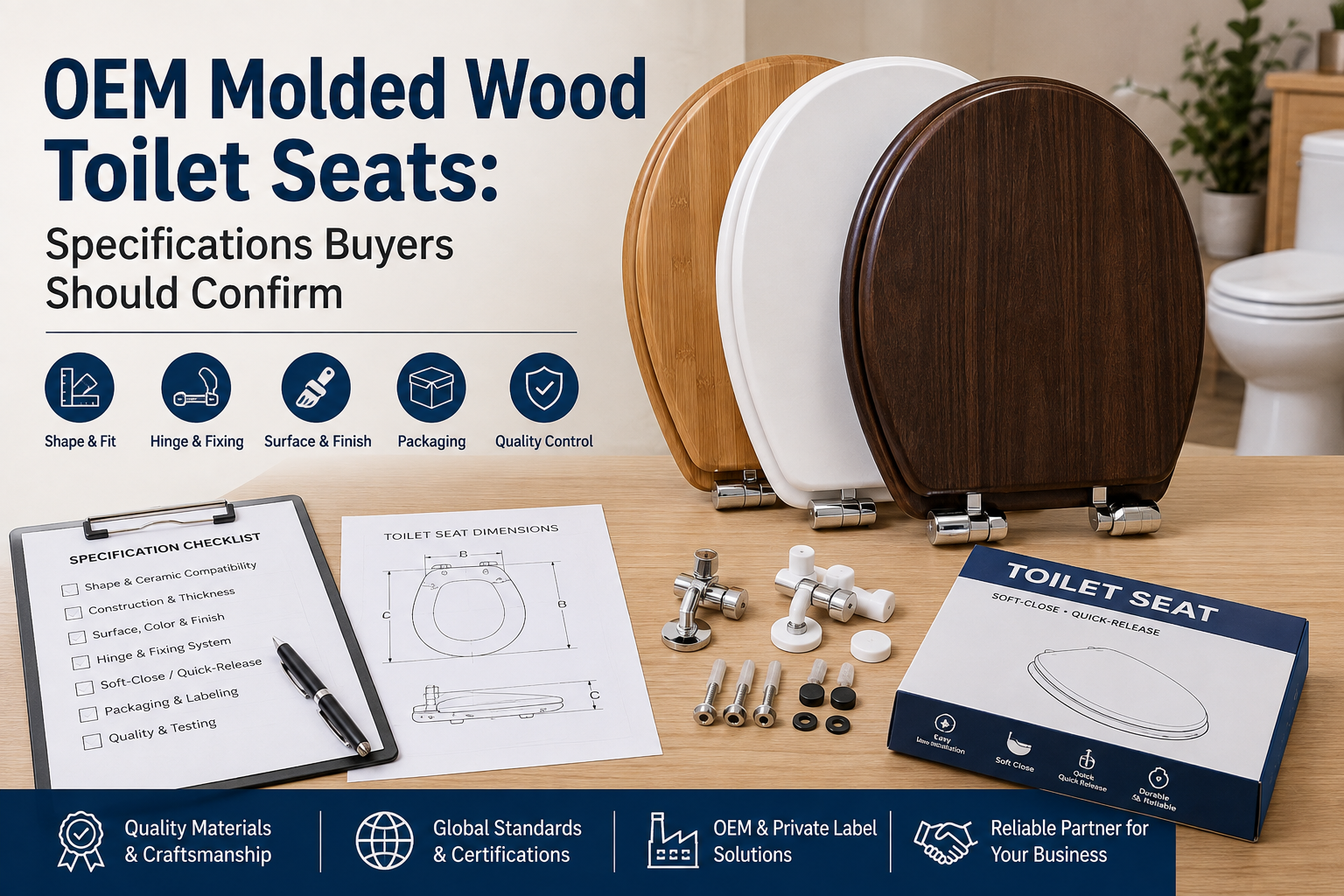
Toilet Seat Spare Parts Planning for Distributors and Project Buyers
Spare-parts planning is often discussed only after toilet seats have already been sold or installed.
By that stage, the buyer may discover that several visually similar products use different hinges, bolts, dampers or release mechanisms. The original component may no longer be easy to identify, and maintenance teams may not know which replacement part belongs to which seat.
For distributors, hotel groups, residential developments and commercial projects, a simple spare-parts plan can reduce downtime, prevent unnecessary full-seat replacement and make repeat orders easier to control.
The plan should begin when the product is selected—not when the first after-sales complaint appears.
[Image 1 — Cover Image, 16:9]
Brief: Organized toilet seat spare-parts kit containing hinges, dampers, bolts, washers, expansion plugs and caps, displayed beside a product-code chart.
Alt text: Toilet seat spare parts planning for distributors and project buyers.
Suggested filename: toilet-seat-spare-parts-planning.jpg
Why Spare-Parts Planning Matters
A toilet seat is a complete assembly, but not every service issue requires replacing the entire product.
Depending on the model and construction, serviceable components may include:
- Fixing bolts
- Nuts and washers
- Expansion plugs
- Hinge bases
- Decorative caps
- Standard hinges
- Soft-close hinges
- Dampers
- Quick-release components
- Seat buffers
- Installation tools
The availability and replaceability of these parts depend on the exact product design. Buyers should not assume that every component can be replaced separately or that a hinge from one model will fit another.
A controlled spare-parts plan helps the buyer answer four questions:
- Which parts can be replaced?
- Which part belongs to each product SKU?
- How many parts should be ordered?
- How will service teams identify and install them?
Map Every Product SKU to Its Components
Each approved toilet seat should have a component record.
| Control field | Information to record |
|---|---|
| Product SKU | Buyer or distributor product code |
| Factory model | Manufacturer’s seat model |
| Material | PP, UF or MDF |
| Shape | Round, elongated, D-shape or model-specific |
| Hinge code | Exact approved hinge identification |
| Fixing kit | Top-fix or bottom-fix component code |
| Damper | Approved soft-close damper code where applicable |
| Quick-release system | Release structure and component reference |
| Buffers | Quantity, position and part reference |
| Packaging version | Box and instruction revision |
| Approval sample | Dated or signed reference |
| Production revision | Current approved specification version |
The goal is to avoid descriptions such as “white hinge,” “metal screws” or “the old soft-close part.” These names are too vague for reliable replacement.
[Image 2 — Component Mapping]
Brief: Exploded view of a toilet seat showing seat, lid, hinge, damper, fixing bolt, washer, expansion plug, buffer and component codes.
Alt text: OEM toilet seat component and spare-parts identification.
Suggested filename: toilet-seat-spare-parts-component-map.jpg
Decide Which Parts Should Be Serviceable
Not every component needs to be offered as a field replacement.
The decision should consider:
- Product value
- Installation environment
- Expected service life
- Ease of replacement
- Safety and stability
- Technician capability
- Customer-support model
- Cost of a complete replacement
- Availability of the original component
- Risk of installing the wrong part
For an entry-level retail seat, replacing the whole unit may sometimes be simpler than maintaining many individual parts. For a hotel renovation or multi-unit residential project, keeping compatible fixing kits and hinges may be commercially sensible.
The buyer and manufacturer should agree which parts are intended for after-sales use and which repairs require complete product replacement.
Treat Hinges as Model-Specific Components
A toilet seat hinge is not automatically interchangeable with another hinge that looks similar.
Compatibility depends on:
- Seat material
- Seat and lid weight
- Hinge-mounting structure
- Mounting-hole spacing
- Adjustment range
- Top-fix or bottom-fix installation
- Damper torque
- Quick-release structure
- Opening angle
- Hinge finish
- Fixing dimensions
A damper designed for a lightweight PP seat may not produce the correct closing behavior on a heavier MDF seat. A replacement hinge may also have the correct external appearance while using a different mounting structure.
Buyers should record the exact hinge code used in the approved sample and purchase order. BOFAN’s guide to choosing the right toilet seat hinge explains the main compatibility decisions.
Standardize Fixing Kits Where Practical
Distributors and project buyers often manage several toilet seat models. If every SKU uses a completely different fixing kit, after-sales service and inventory become more complicated.
Where product compatibility permits, buyers can discuss whether selected models can share:
- Bolt dimensions
- Washers
- Expansion plugs
- Decorative caps
- Installation tools
- Top-fix components
- Bottom-fix components
Standardization should never override installed performance. A common fixing kit is useful only when it remains suitable for every approved seat and ceramic combination.
For each kit, confirm:
- Component dimensions
- Material
- Finish
- Quantity
- Installation method
- Compatible product codes
- Packaging identification
- Revision number
Estimate Spare-Part Quantities Rationally
There is no universal spare-part percentage for every order.
The appropriate quantity depends on:
- Number of installed units
- Product model
- Usage intensity
- Project duration
- Local service capability
- Reordering lead time
- Component failure history
- Risk of losing small parts during installation
- Whether the product will remain in the range
- Whether several SKUs share the same component
A useful planning method is to separate parts into three groups.
Installation-consumable parts
These are small components that may be lost, damaged or incorrectly installed during initial installation, such as bolts, washers, nuts and expansion plugs.
Functional replacement parts
These include model-specific hinges, dampers or quick-release components. Quantities should be based on product design, service policy and actual performance data.
Appearance-related parts
These may include caps or buffers. The buyer should determine whether replacing them is practical and whether color matching will remain acceptable.
Start with a documented assumption, then revise future quantities using actual installation and after-sales records.
[Image 3 — Spare-Parts Quantity Planning]
Brief: Distributor inventory board separating installation kits, functional hinge parts and appearance components with SKU labels and reorder points.
Alt text: Toilet seat spare-parts quantity planning and inventory control.
Suggested filename: toilet-seat-spare-parts-inventory.jpg
Package Spare Parts for Easy Identification
Loose components stored without labels quickly become difficult to use.
A spare-parts package should identify:
- Part name
- Part code
- Compatible seat models
- Quantity
- Production revision
- Installation method
- Required tools
- Supplier contact
- Storage guidance where relevant
For distributors, individual kits may be more practical than bulk bags containing mixed parts. For project maintenance teams, labeled compartment boxes or model-specific service packs may improve identification.
The label should use both the buyer’s SKU and the manufacturer’s component reference when possible.
Provide Replacement Instructions
A replacement part is useful only if the service team can install it correctly.
Instructions should show:
- How to identify the compatible seat
- How to remove the existing component
- Which tools are required
- Correct part orientation
- Tightening sequence
- Alignment procedure
- Functional check after installation
- Stability check
- When the entire product should be replaced instead
For soft-close and quick-release systems, do not instruct an untrained user to dismantle sealed or non-serviceable mechanisms. The manufacturer should define which components are intended for replacement.
Plan for Hotels and Multi-Unit Projects
Hotels, apartments and commercial buildings benefit especially from component control because the same product may be installed across many rooms or phases.
Project buyers should retain:
- Approved product sample
- Ceramic information
- Product and hinge codes
- Fixing-kit specification
- Installation instructions
- Spare-part list
- Initial installation records
- Inspection reports
- Replacement history
- Later-order revision records
BOFAN provides product options for hotels and hospitality and apartments and residential projects. Final model and spare-part arrangements should be confirmed for the individual project.
When a project is delivered in phases, verify that later orders continue to use the approved components or document any approved change.
Prepare Distributors for After-Sales Identification
A distributor receiving a complaint should first identify the product correctly.
Useful information to request includes:
- Product SKU
- Purchase date
- Batch or carton information
- Photograph of the complete seat
- Photograph of the hinge
- Photograph of the underside
- Ceramic mounting area
- Description or video of the problem
- Whether the product was recently installed
- Whether any parts have already been changed
This helps distinguish between:
- Incorrect installation
- Loose fixing
- Wrong replacement part
- Fit incompatibility
- Damper issue
- Surface damage
- Structural product failure
BOFAN’s distributor and importer solutions support product-range and OEM discussions that can include component identification and repeat-order planning.
Protect Repeat-Order Compatibility
A component change can affect old inventory and future service obligations.
Before approving a change to the hinge, damper or fixing kit, ask:
- Does the new component fit existing products?
- Does it require a new installation instruction?
- Does it change the adjustment range?
- Does it change soft-close performance?
- Does it change packaging dimensions?
- Can the old and new versions be visually distinguished?
- Should a new SKU or revision number be created?
- Which replacement part supports each production batch?
Do not assume that a “new improved hinge” can be substituted without reviewing the complete assembly.
Track Spare-Parts Usage
Usage data helps improve future purchasing decisions.
Record:
- Product SKU
- Component supplied
- Reason for replacement
- Installation date
- Production batch
- Confirmed root cause
- Whether replacement solved the problem
- Quantity remaining
- Reorder requirement
If the same part is requested repeatedly, investigate the installation method, ceramic compatibility and production batch before simply increasing spare-parts inventory.
[Image 4 — After-Sales Tracking]
Brief: B2B after-sales dashboard showing product SKU, hinge code, issue category, replacement part, batch number and resolution status.
Alt text: Toilet seat spare-parts usage and after-sales tracking.
Suggested filename: toilet-seat-after-sales-parts-tracking.jpg
Toilet Seat Spare-Parts Planning Checklist
Before placing the bulk order, confirm:
- Product SKU and factory model
- Exact hinge and fixing-kit codes
- Components intended to be replaceable
- Compatible models for every spare part
- Initial spare-part quantities
- Individual or bulk packaging format
- Part labels and identification
- Replacement instructions
- Inventory and reorder responsibility
- Revision and substitution control
- After-sales data collection
- Long-term availability to be confirmed with the supplier
How BOFAN Supports Spare-Parts Planning
BOFAN can help distributors and project buyers identify the hinge, fixing and component configuration used with selected toilet seat models.
Depending on the product and project, support may include:
- Seat and hinge specification review
- Fixing-kit identification
- Top-fix and bottom-fix options
- Soft-close and quick-release configuration
- Model-specific component records
- Packing and labeling discussions
- Installation guidance
- Repeat-order change control
Spare-part availability, MOQ and compatibility should be confirmed for the selected model before the bulk order.
To request a spare-parts plan, send:
- Selected seat models
- Order quantity by SKU
- Target application
- Ceramic information
- Hinge and fixing requirements
- Installation or maintenance approach
- Expected reorder period
[Image 5 — BOFAN Spare-Parts Review]
Brief: BOFAN project team reviewing toilet seat samples, labeled hinge kits, fixing components and a project maintenance list with a distributor.
Alt text: BOFAN toilet seat spare-parts planning for distributors and projects.
Suggested filename: bofan-toilet-seat-spare-parts-review.jpg
FAQ
Which toilet seat parts can be replaced?
Depending on the design, replaceable parts may include fixing bolts, washers, expansion plugs, caps, hinges, dampers and buffers. Availability and replaceability must be confirmed for the exact model.
Are toilet seat hinges interchangeable?
Not necessarily. Hinges must match the seat structure, material, product weight, fixing method, adjustment range and required functions.
How many spare fixing kits should a distributor order?
There is no universal percentage. The quantity should reflect order size, installation conditions, local reordering time, service policy and actual historical usage.
Should spare parts have separate product codes?
Yes. Separate codes help distributors identify compatible components, manage inventory and prevent the wrong part from being supplied.
Can soft-close dampers be replaced separately?
Some designs may allow component replacement, while others use mechanisms that should not be dismantled in the field. Confirm the service method with the manufacturer.
What information is needed to identify a replacement hinge?
Provide the seat model, product SKU, photographs of the complete hinge and mounting area, fixing method, dimensions and production-batch information where available.
How can project buyers maintain compatibility across several phases?
Freeze the approved product, hinge and fixing specifications; record all component codes; and review any proposed substitution before later production begins.
Can BOFAN prepare model-specific spare-part kits?
BOFAN can review suitable component and packaging arrangements for selected models. Final feasibility, compatibility, MOQ and supply conditions depend on the approved product configuration.
Table of Contents
- Toilet Seat Spare Parts Planning for Distributors and Project Buyers
- Why Spare-Parts Planning Matters
- Map Every Product SKU to Its Components
- Decide Which Parts Should Be Serviceable
- Treat Hinges as Model-Specific Components
- Standardize Fixing Kits Where Practical
- Estimate Spare-Part Quantities Rationally
- Package Spare Parts for Easy Identification
- Provide Replacement Instructions
- Plan for Hotels and Multi-Unit Projects
- Prepare Distributors for After-Sales Identification
- Protect Repeat-Order Compatibility
- Track Spare-Parts Usage
- Toilet Seat Spare-Parts Planning Checklist
- How BOFAN Supports Spare-Parts Planning
-
FAQ
- Which toilet seat parts can be replaced?
- Are toilet seat hinges interchangeable?
- How many spare fixing kits should a distributor order?
- Should spare parts have separate product codes?
- Can soft-close dampers be replaced separately?
- What information is needed to identify a replacement hinge?
- How can project buyers maintain compatibility across several phases?
- Can BOFAN prepare model-specific spare-part kits?