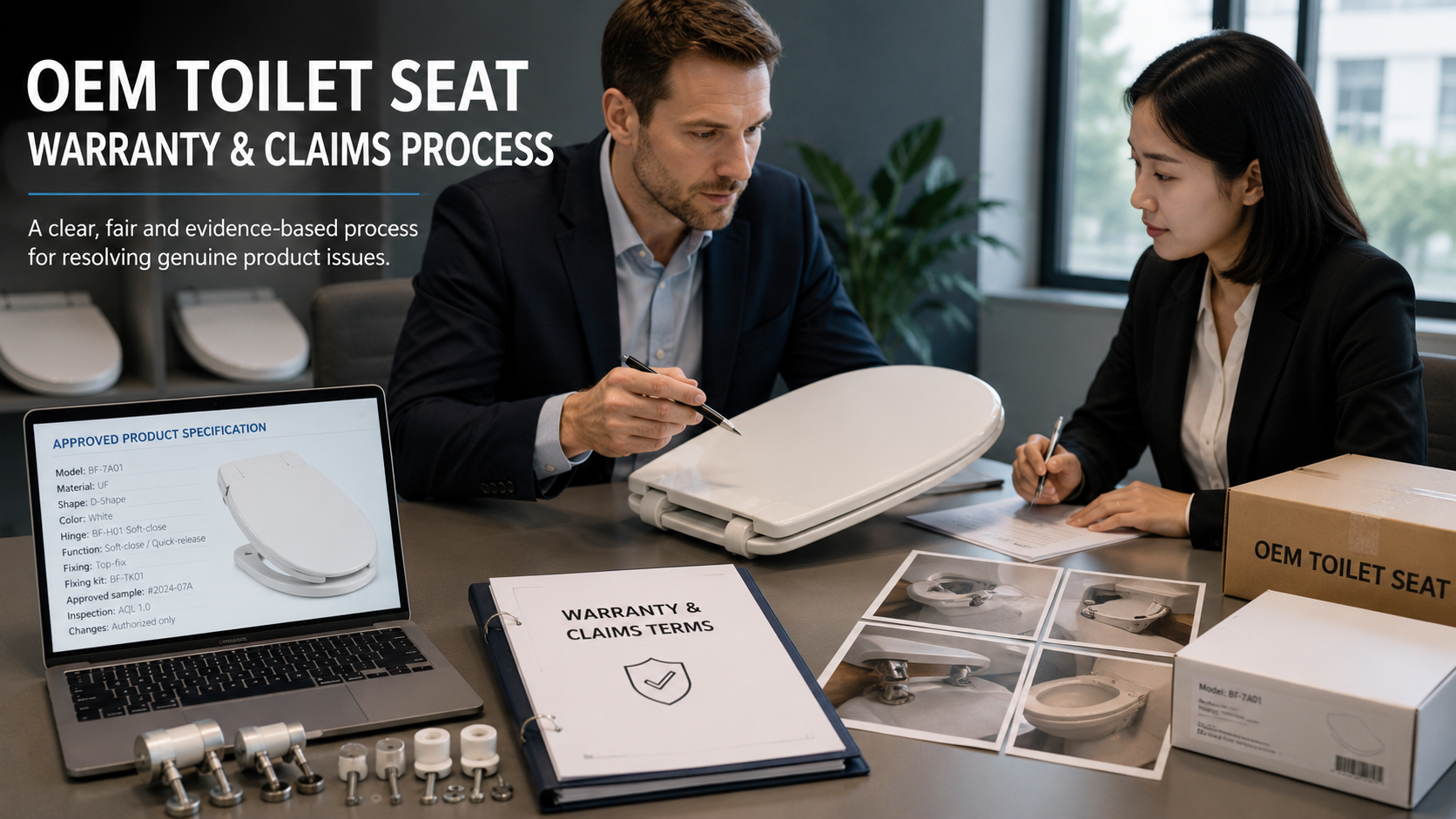
How to Define Warranty and Claims Terms for an OEM Toilet Seat Program
An OEM toilet seat warranty should not begin with a vague promise such as “all quality problems will be covered.”
A commercially useful warranty defines the approved product, covered defects, excluded situations, evidence requirements, claim period, investigation method and available remedies. It should also explain how confirmed issues will affect existing inventory and future production.
This is particularly important for private-label brands, distributors and retail buyers. The end customer may contact the brand or retailer first, while the manufacturer receives the claim later through the supply chain.
If the process is not agreed before the first order, both parties may evaluate the same problem differently. A buyer may consider movement after installation a product defect, while the supplier may suspect incorrect fitting or an incompatible ceramic bowl.
The objective is not to promise that every complaint will automatically result in compensation. The objective is to create a fair, evidence-based process for resolving genuine product issues.
Start With the Approved Product Specification
A warranty can only be applied consistently when the supplied product is clearly defined.
The controlled specification should identify:
- Buyer SKU
- Factory model
- Product material
- Shape and dimensions
- Color and surface finish
- Hinge code
- Standard-close or soft-close function
- Fixed or quick-release structure
- Top-fix or bottom-fix hardware
- Fixing-kit contents
- Product markings
- Packaging version
- Approved sample reference
- Inspection requirements
- Authorized product changes
A description such as “white UF soft-close toilet seat” is insufficient. The same seat model may use different hinges, dampers, fixing kits and packaging arrangements.
BOFAN’s OEM solutions for brands and sanitary ware companies provide a framework for matching the product, ceramic, hinge and branding requirements before production.
Separate Product Defects From Other Complaints
Not every problem reported by a customer is a manufacturing defect.
Claims should first be classified into categories.
| Claim category | Questions to investigate |
|---|---|
| Product defect | Does the product differ from the approved specification? |
| Functional defect | Does the hinge, damper or release system fail under correct use? |
| Fit problem | Was the seat approved for the reported ceramic? |
| Installation problem | Were the correct components and instructions used? |
| Transport damage | Was the product damaged before or after delivery? |
| Missing component | Was the hardware omitted during packing or lost after opening? |
| Surface complaint | Is the condition outside the agreed appearance standard? |
| Incorrect product | Do the product, packaging, barcode and purchase record match? |
| Misuse or accidental damage | Was the product used outside the intended conditions? |
| Normal wear | Is the reported condition consistent with expected use over time? |
The classification determines what evidence is needed and which party should investigate.
Define What the Warranty Covers
Coverage should refer to measurable product requirements.
Depending on the selected model and agreement, covered issues may include confirmed deviations involving:
- Material or product identity
- Product dimensions
- Structural condition
- Seat and lid alignment
- Surface condition at delivery
- Hinge assembly
- Soft-close operation
- Quick-release operation
- Fixing-kit completeness
- Product markings
- Packaging accuracy
- Barcode or label accuracy
The warranty should not apply automatically to every subjective preference. For example, “the seat feels too light” is not a manufacturing defect if the supplied product matches the approved sample and specification.
Likewise, a general statement such as “soft close is too slow” needs an agreed performance reference before it can be evaluated.
Define Exclusions Clearly
Common exclusions may include:
- Incorrect installation
- Use on an incompatible ceramic bowl
- Unauthorized modification
- Use of non-approved replacement parts
- Damage caused by excessive force or impact
- Cleaning with unsuitable chemicals
- Damage after delivery caused by storage or handling
- Normal wear
- Color change caused by conditions outside the approved use
- Claims without sufficient product identification
- Issues already accepted as an approved deviation
- Damage caused by incorrect maintenance
Exclusions should reflect the actual product and target market. They should also be aligned with any obligations the buyer has toward end customers under applicable local rules.
The commercial agreement between buyer and manufacturer does not automatically replace the retailer’s or brand owner’s consumer obligations.
Establish the Claim Period
The parties should distinguish among several dates:
- Production date
- Shipment date
- Arrival date
- Warehouse-receipt date
- Retail-sale date
- Installation date
- Date the issue was discovered
- Date the claim was submitted
A manufacturer may not know when every individual unit is sold or installed. Therefore, an OEM agreement should state which date starts the supplier claim period and what supporting records are required.
Different issues may also require different notification rules. Visible shipping damage or incorrect packaging should normally be reported much earlier than a functional problem discovered during use.
Avoid publishing a consumer-facing warranty period until the brand has confirmed:
- Applicable local requirements
- Distributor and retailer obligations
- Supplier claim conditions
- Proof-of-purchase requirements
- Replacement procedure
- Customer-service responsibility
Specify the Evidence Required
Evidence helps both parties determine the actual cause.
A useful claim file may include:
- Buyer SKU
- Factory model
- Purchase order
- Shipment reference
- Carton label
- Production or batch code
- Quantity received
- Quantity affected
- Date the issue was discovered
- Clear description of the problem
- Photograph of the complete product
- Close-up photograph of the affected area
- Photograph of the hinge and fixings
- Photograph of the ceramic mounting area
- Installation video where relevant
- Packaging photographs
- Inspection report
- Samples retained from the shipment
The evidence requirement should be proportional. A claim concerning one missing washer does not need the same investigation as a repeated hinge failure across several batches.
Use Quantities Correctly
The buyer should distinguish among:
- Quantity shipped
- Quantity inspected
- Quantity sold or installed
- Quantity reported by customers
- Quantity physically verified
- Quantity suspected
- Quantity confirmed defective
One confirmed case does not prove that the complete shipment is defective. At the same time, repeated cases with the same failure pattern should not be dismissed as unrelated without investigation.
If the issue may affect a wider batch, agree on a verification method. This may involve:
- Increased warehouse sampling
- Joint sample review
- Return of selected components
- Video inspection
- Third-party inspection
- Laboratory or functional testing
- Production-record review
The method should match the value and severity of the claim.
Distinguish Critical, Major and Minor Issues
A defect-classification system helps prioritize claims.
Critical issues
These may involve an unacceptable safety risk or a product that cannot be used as intended. Critical issues require immediate containment and investigation.
Major issues
These materially affect installation, function, appearance or saleability. Examples may include an incorrect hinge, missing fixing kit, nonfunctional soft close or significant surface damage.
Minor issues
These do not normally prevent installation or intended use but may fall outside the agreed appearance or packaging standard.
The final classification must be based on the buyer’s approved specification, inspection agreement and intended channel. It should not be decided only after a complaint occurs.
BOFAN’s quality-control process can support model-specific discussions covering product, hinge, surface and packaging inspection.
Investigate Root Cause Before Choosing a Remedy
A successful claim process identifies why the problem happened.
Potential root causes include:
- Incorrect product specification
- Wrong component used in production
- Material variation
- Assembly error
- Inadequate functional inspection
- Packaging failure
- Incorrect installation instruction
- Ceramic incompatibility
- Transport handling
- Warehouse storage
- End-user installation
- Product misuse
For example, a moving toilet seat may be caused by:
- Incorrect hinge adjustment
- Insufficient tightening
- Wrong expansion plug
- Poor buffer contact
- An incompatible ceramic platform
- A component outside the approved specification
Replacing the complete seat without identifying the cause may not solve the problem.
Agree on Available Remedies
The commercial agreement should define possible remedies without assuming that every claim will use the same solution.
Depending on the confirmed cause and agreement, remedies may include:
- Technical installation guidance
- Replacement fixing kits
- Replacement hinges or components
- Replacement complete products
- Parts included with the next shipment
- Reworking existing inventory
- Packaging or label correction
- Commercial credit
- Agreed refund
- Corrective action in future production
The selected remedy should consider:
- Severity
- Confirmed quantity
- Product value
- Freight cost
- Local labor cost
- Spare-part availability
- Customer impact
- Existing inventory
- Repeat-order timing
BOFAN’s guide to toilet seat spare-parts planning explains why components should be identified before an after-sales issue occurs.
Define Who Pays for Each Cost
A quality claim can create costs beyond the product unit price.
Potential costs include:
- Replacement product
- Replacement components
- International freight
- Local delivery
- Inspection
- Sorting
- Repacking
- Relabeling
- Installation labor
- Disposal
- Retail penalties
- Customer refunds
The buyer and manufacturer should agree which direct costs may be considered and what approval is required before third-party work begins.
A buyer should not arrange unlimited rework and assume that every cost will automatically be accepted. The supplier should also not assume that providing a low-cost component fully resolves a confirmed issue when significant local costs are involved.
Create a Corrective-Action Record
For a repeated or significant issue, the supplier should prepare a corrective-action record containing:
- Problem description
- Affected product and batch
- Immediate containment
- Root-cause analysis
- Corrective action
- Preventive action
- Responsible person
- Completion date
- Verification method
- Repeat-order follow-up
Any approved correction should be added to the current product specification.
If the hinge, fixing kit, instruction or packaging changes, the new revision should be identified so that old and new versions are not mixed accidentally.
Connect Claims to Repeat-Order Control
Claims provide useful information for product improvement, but only if the correction reaches the next production order.
Before releasing a repeat order, review:
- Previous claims
- Confirmed root causes
- Approved corrective actions
- Updated component codes
- Updated drawings
- New packaging revisions
- Updated inspection points
- Replacement commitments
- Remaining old inventory
BOFAN’s guide on reducing toilet seat returns provides a related framework for connecting customer feedback with fit, instructions, packaging and quality control.
OEM Toilet Seat Warranty Checklist
Before confirming a warranty arrangement, define:
- Approved product specification
- Warranty start date and claim period
- Covered product areas
- Excluded conditions
- Required claim evidence
- Minimum product identification
- Quantity-verification method
- Defect classification
- Root-cause investigation process
- Available remedies
- Responsibility for related costs
- Corrective-action requirements
- Repeat-order change control
- Applicable local legal review
How BOFAN Supports Warranty and Claims Discussions
BOFAN can help OEM buyers identify the selected product, hinge, fixing, packaging and inspection configuration before an order is placed.
Project-specific discussions may cover:
- Approved product records
- Sample confirmation
- Component identification
- Inspection requirements
- Claim-evidence review
- Replacement-component feasibility
- Corrective action
- Repeat-order specification updates
Available certificates and test reports should always be matched to the specific product, material, factory and intended market.
Warranty terms, remedies and responsibilities must be agreed for the individual customer, product and purchase contract.
Recommended Warranty-to-Claim Workflow
- Freeze the approved product specification.
- Define coverage, exclusions and claim period.
- State evidence and notification requirements.
- Record product and batch identification.
- Classify the reported issue.
- Verify the affected quantity.
- Contain potentially affected stock.
- Investigate the root cause.
- Agree on an appropriate remedy.
- Document corrective action.
- Update the production specification.
- Verify the correction during the next order.
FAQ
What should an OEM toilet seat warranty include?
It should define the approved product, covered defects, exclusions, claim period, required evidence, investigation process, available remedies and responsibility for related costs.
Does every customer complaint prove a manufacturing defect?
No. The issue may involve product quality, ceramic fit, installation, transport, storage, normal wear or misuse. Evidence and root-cause review are required.
What evidence is needed for a toilet seat quality claim?
Useful evidence includes the SKU, purchase order, carton label, batch code, affected quantity, product photographs, hinge photographs, installation images and a clear description or video of the issue.
Who provides the warranty to the end customer?
That depends on the sales structure and applicable local requirements. The brand, importer or retailer should define its consumer warranty separately from its commercial claim agreement with the manufacturer.
Can a supplier replace only the hinge instead of the complete seat?
Possibly, if the hinge is confirmed as the problem, a compatible replacement is available and field replacement is appropriate. The remedy depends on the model and verified root cause.
How should repeated claims affect future orders?
Confirmed corrective actions should update the drawings, component codes, instructions, packaging or inspection requirements used for repeat production.
Does BOFAN offer one standard warranty for every toilet seat?
Warranty scope and commercial remedies should be confirmed for the selected model, order and customer agreement. Buyers should not assume that one general condition applies to every product configuration.
Table of Contents
- How to Define Warranty and Claims Terms for an OEM Toilet Seat Program
- Start With the Approved Product Specification
- Separate Product Defects From Other Complaints
- Define What the Warranty Covers
- Define Exclusions Clearly
- Establish the Claim Period
- Specify the Evidence Required
- Use Quantities Correctly
- Distinguish Critical, Major and Minor Issues
- Investigate Root Cause Before Choosing a Remedy
- Agree on Available Remedies
- Define Who Pays for Each Cost
- Create a Corrective-Action Record
- Connect Claims to Repeat-Order Control
- OEM Toilet Seat Warranty Checklist
- How BOFAN Supports Warranty and Claims Discussions
- Recommended Warranty-to-Claim Workflow
-
FAQ
- What should an OEM toilet seat warranty include?
- Does every customer complaint prove a manufacturing defect?
- What evidence is needed for a toilet seat quality claim?
- Who provides the warranty to the end customer?
- Can a supplier replace only the hinge instead of the complete seat?
- How should repeated claims affect future orders?
- Does BOFAN offer one standard warranty for every toilet seat?