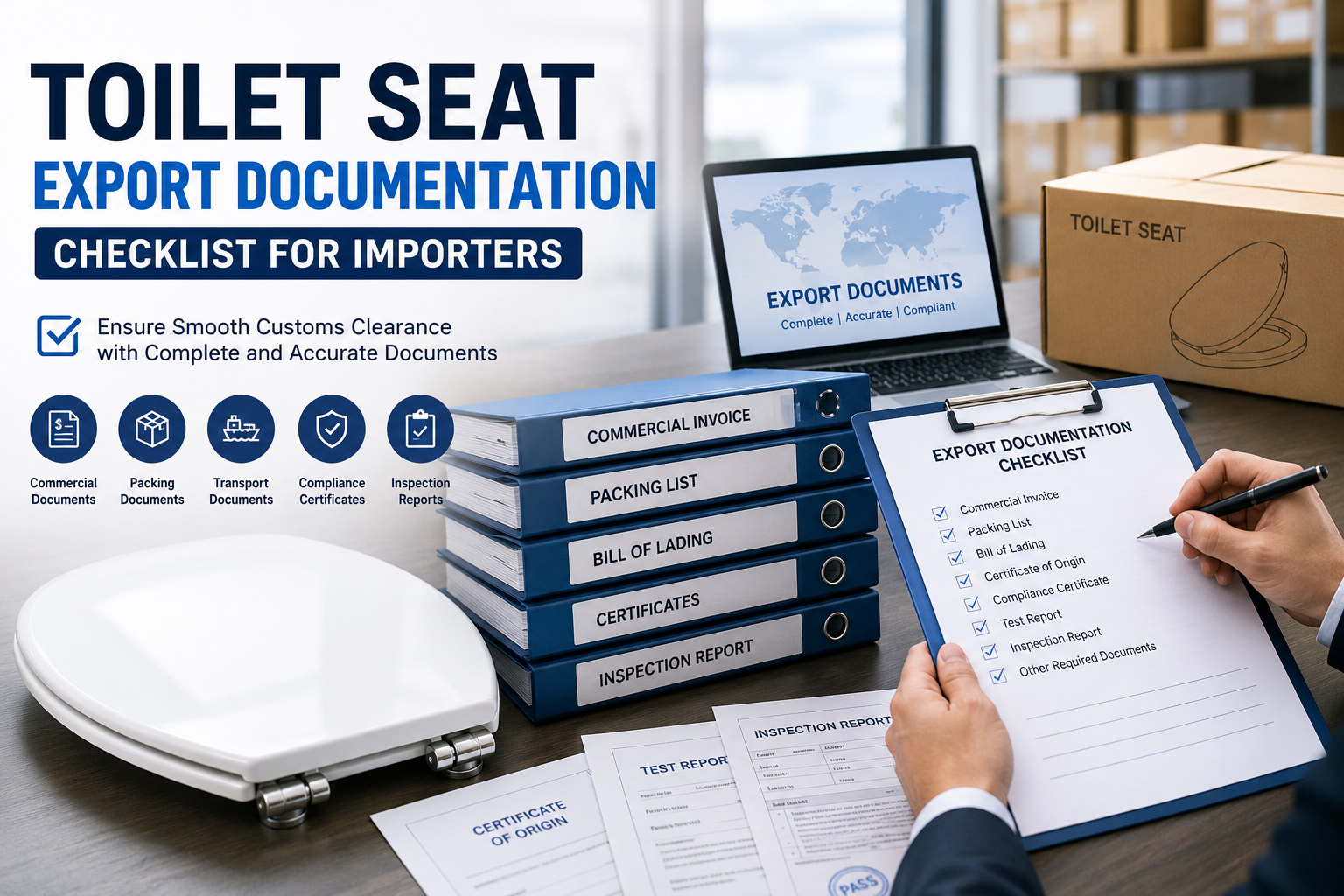
Toilet Seat Export Documentation Checklist for Importers
A toilet seat shipment can be manufactured correctly and still face delays if the documentation is incomplete, inconsistent or submitted too late.
Importers may need commercial documents, packing information, transport documents, origin records, product test information, inspection reports and retailer-specific files. The exact requirement depends on the destination, product, trade term, customer and customs process.
The supplier should not guess which documents the importer needs. The importer should not assume that every certificate shown on a factory website applies automatically to the ordered model.
Document requirements should be confirmed during quotation and finalized before shipment—not requested for the first time after the container has departed.
Separate Commercial, Transport and Product Documents
A complete order file may contain several document groups.
| Document group | Main purpose |
|---|---|
| Commercial documents | Describe the seller, buyer, products, prices and transaction |
| Packing documents | State cartons, quantities, weights, dimensions and marks |
| Transport documents | Record carriage and shipment information |
| Customs and origin documents | Support import declaration and origin handling |
| Product and compliance documents | Provide model-specific test or conformity information |
| Quality documents | Record inspection and shipment-release results |
| Retail documents | Support barcodes, labels, product data and warehouse receipt |
| Internal approval records | Control drawings, samples, artwork and product revisions |
These documents serve different purposes. A factory certificate does not replace a commercial invoice, and a product test report does not replace an inspection record.
Create a Document Matrix Before Ordering
The importer should prepare a document matrix showing:
- Document name
- Required format
- Issuing party
- Required language
- Draft deadline
- Final deadline
- Original or electronic copy
- Number of originals
- Authentication requirement
- Product or model covered
- Destination requirement
- Person responsible for approval
The matrix should be shared before the purchase order is finalized.
A document request such as “provide all certificates” is not sufficiently precise. The supplier needs to know which document, for which model, issued by whom and required at what stage.
Confirm the Commercial Invoice Content
The commercial invoice commonly records:
- Seller’s legal name and address
- Buyer’s legal name and address
- Consignee where different
- Invoice number and date
- Purchase-order reference
- Product description
- Product model or SKU
- Quantity
- Unit price
- Total value
- Currency
- Trade term and named place
- Country of origin where required
- Payment information where appropriate
- Authorized signature or stamp where required
Descriptions should be consistent with the purchase order, packing list and import declaration.
Avoid overly vague wording such as “bathroom accessories” if the importer or customs broker requires a more specific description.
The importer should confirm the final declaration wording and classification with its qualified customs adviser.
Prepare an Accurate Packing List
The packing list should reflect the shipment as physically packed.
Useful fields include:
- Product SKU
- Product description
- Quantity per carton
- Number of cartons
- Total quantity
- Net weight
- Gross weight
- Carton dimensions
- Total volume
- Pallet quantity
- Pallet dimensions
- Shipping marks
- Container number when available
- Seal number when available
If several models are loaded together, each SKU should be traceable to its carton and quantity.
The totals on the packing list should match the invoice and actual shipment. Late packing changes must be reflected in the final documents.
BOFAN’s toilet seat packaging guide explains how individual packaging, carton weight, barcode data and master-carton requirements should be approved before production.
Review the Transport Document Draft
Depending on the shipment method, the transport document may be a bill of lading, sea waybill, air waybill, courier document or another carrier record.
Before release, check:
- Shipper
- Consignee
- Notify party
- Port or place of loading
- Port or place of discharge
- Final destination where relevant
- Product description
- Number and type of packages
- Gross weight
- Volume
- Freight terms
- Container number
- Seal number
- Original or release method
- Required references
The importer, exporter and freight forwarder should confirm the draft before the carrier issues the final document.
Small errors in company names, consignee information or release instructions can cause delays and additional amendment costs.
Match Documents to the Agreed Trade Term
The trade term determines which party manages specific logistics activities and costs.
The purchase order and invoice should identify:
- Agreed Incoterm
- Named port or place
- Version of the agreed Incoterm where appropriate
- Inland delivery responsibility
- Export-clearance responsibility
- Main-carriage responsibility
- Insurance responsibility
- Destination handling
- Import clearance
- Duty and tax responsibility
BOFAN’s OEM toilet seat cost-structure guide explains why EXW, FOB, CIF and delivered quotations should not be compared as if they contain the same cost elements.
Commercial documents must use the agreed basis consistently.
Confirm Origin Documentation Early
Some shipments may require a certificate or declaration of origin. The required format depends on the destination, trade arrangement, product and importer’s customs process.
Before production or shipment, confirm:
- Whether origin documentation is required
- Issuing authority
- Applicable form
- Product description
- HS classification used by the importer
- Manufacturer and exporter information
- Country-of-origin basis
- Need for legalization or authentication
- Required originals
- Submission deadline
Origin should reflect the actual manufacturing arrangement. Packaging location, exporter location and manufacturing origin are not necessarily the same thing.
Where BOFAN’s China or Thailand supply options are being considered, the importer must confirm origin and customs treatment for the specific product and shipment with its customs professional.
Distinguish Factory Certificates From Product Reports
Importers should verify exactly what each document covers.
Review:
- Document title
- Certificate holder
- Manufacturer
- Factory location
- Product model
- Material
- Test standard
- Test method
- Report date
- Validity period where applicable
- Laboratory or issuing body
- Destination-market relevance
A report for one toilet seat, hinge or material should not automatically be applied to every product in the order.
BOFAN’s Certificates & Test Reports page provides available factory and product information for initial review. Buyers should request confirmation that the required document applies to the proposed model and production source.
Include Quality and Inspection Records
Commercial documentation confirms what was shipped. Quality documentation records how the shipment was checked.
Depending on the agreement, the file may include:
- Approved product specification
- Product drawing
- Approved sample record
- In-process inspection report
- Final inspection report
- Functional test record
- Packaging inspection
- Carton-label photographs
- Quantity confirmation
- Third-party inspection report
- Corrective-action record
- Shipment-release approval
The inspection report should identify the product, order, quantity, sample size, checkpoints, findings and result.
A generic factory quality statement is not equivalent to an order-specific inspection report.
BOFAN’s quality-control process can be used as a starting point for defining the inspection stages required for the selected program.
Control Retail and Private-Label Files
Retail shipments often require additional product and warehouse information.
Confirm:
- Buyer SKU
- UPC, EAN or other barcode
- Barcode verification requirement
- Product title
- Material description
- Color code
- Product dimensions
- Case-pack quantity
- Inner and master-carton data
- Retail-box artwork
- Instruction revision
- Carton label
- Pallet label
- Country-of-origin marking
- Retailer purchase-order reference
- Warehouse appointment or advance-shipment information where applicable
Every file should match the actual product inside the box.
A packaging image showing a metal quick-release hinge is unacceptable if the supplied product uses a different plastic fixed hinge, even if the seat body looks similar.
Manage Languages and Translations
The importer should identify all required languages before artwork and document approval.
Language control may apply to:
- Retail packaging
- Installation instructions
- Product labels
- Warning statements
- Warranty information
- Commercial documents
- Certificates
- Customs documents
Use one approved translation per market. Do not allow different suppliers or departments to create separate translations of the same technical statement without version control.
Product names, materials, functions and installation terms should remain consistent across the invoice, packaging and instructions.
Use Version Control
Document errors often occur because an old artwork, drawing or packing list remains in circulation.
Every controlled file should include:
- File name
- Product code
- Revision number
- Issue date
- Approval status
- Approver
- Replacement history
Mark drafts clearly. Separate obsolete versions from approved production files.
A simple status system may use:
- Draft
- Under review
- Approved for sample
- Approved for production
- Approved for shipment
- Obsolete
Set a Document Approval Timeline
Document preparation should follow the order schedule.
Before quotation
Confirm required certificates, origin expectations, trade term and destination.
Before sample approval
Confirm product drawings, materials, hinges, packaging concept and required testing.
Before production
Freeze product specification, artwork, barcode, labels and inspection requirements.
Before shipment
Review invoice, packing list, transport-document instructions, inspection report and carton data.
After loading
Complete final container, seal, transport and shipment information.
Before arrival
Provide the importer and customs broker with the required final documents in the agreed format.
Leaving document approval until after loading increases the risk of discrepancies that cannot be corrected easily.
Common Documentation Mistakes
Importers and suppliers should watch for:
- Different company names across documents
- Invoice and packing-list quantity mismatch
- Incorrect carton count
- Incorrect gross or net weight
- Wrong consignee
- Vague product description
- Unconfirmed HS classification
- Incorrect origin statement
- Certificate for a different model
- Expired or irrelevant document
- Old packaging artwork
- Incorrect barcode
- Wrong product dimensions
- Missing signature or stamp where required
- Late couriering of originals
- Unapproved changes after document release
Use one final cross-document review before shipment.
Toilet Seat Export Document Checklist
Confirm whether the order requires:
- Commercial invoice
- Packing list
- Bill of lading, sea waybill or air waybill
- Certificate or declaration of origin
- Insurance document where applicable
- Customs or broker instructions
- Product certificates or test reports
- Factory certificates
- Final inspection report
- Product drawing and approved specification
- Retail artwork and barcode record
- Carton and pallet labels
- Installation instructions
- Fumigation or pallet documentation where applicable
- Buyer-specific warehouse documents
- Shipment photographs or loading record
This is a planning checklist, not a universal legal requirement. The final list should be confirmed with the importer, customs broker, freight forwarder and relevant authorities.
How BOFAN Supports Export Documentation
BOFAN can coordinate available commercial, packing, product and quality information for approved toilet seat orders.
Depending on the order, support may include:
- Commercial invoice data
- Packing-list data
- Carton dimensions and weights
- Product specifications
- Packaging and label records
- Available certificates and test reports
- Inspection coordination
- Shipment information
- Factory and product documents
- Export packing information
Buyers can also review BOFAN’s Download Center for available product and company materials.
Final import, customs, origin and market-access requirements remain the importer’s responsibility and should be verified before ordering.
Recommended Document Workflow
- Importer issues the document matrix.
- Supplier confirms availability and lead time.
- Buyer resolves product and market requirements.
- Product, packaging and label files are approved.
- Draft commercial and transport instructions are prepared.
- Order-specific inspection records are completed.
- Invoice, packing list and transport draft are cross-checked.
- Final loading data are added.
- Required documents are issued and delivered.
- Both parties retain the approved shipment file.
FAQ
What export documents are normally used for a toilet seat shipment?
Common documents include the commercial invoice, packing list and transport document. Origin, inspection, product, insurance or retailer documents may also be needed depending on the destination and transaction.
Does every toilet seat shipment require a certificate of origin?
Not necessarily. Requirements depend on the destination, trade arrangement, product and importer’s customs process. Confirm this before shipment.
Can one toilet seat test report cover every model?
Not automatically. Verify the tested model, material, hinge, factory, standard, date and market relevance.
Who should confirm the HS code?
The importer should confirm classification with its qualified customs broker or relevant authority. The supplier can provide product information but should not replace the importer’s classification review.
Why must invoice and packing-list data match?
Inconsistent quantities, weights, descriptions or carton counts can delay customs clearance and create amendment costs.
When should shipping documents be reviewed?
Requirements should be confirmed before ordering. Draft invoice, packing and transport information should be reviewed before final documents are issued.
Can BOFAN provide product certificates and inspection documents?
BOFAN can provide available documents and coordinate order-specific information. Buyers must confirm which documents apply to the selected model, factory and destination.
Are electronic copies always sufficient?
Not always. Some transactions, banks, customs processes or destination authorities may require originals or authenticated documents. Confirm the format before shipment.
Table of Contents
- Toilet Seat Export Documentation Checklist for Importers
- Separate Commercial, Transport and Product Documents
- Create a Document Matrix Before Ordering
- Confirm the Commercial Invoice Content
- Prepare an Accurate Packing List
- Review the Transport Document Draft
- Match Documents to the Agreed Trade Term
- Confirm Origin Documentation Early
- Distinguish Factory Certificates From Product Reports
- Include Quality and Inspection Records
- Control Retail and Private-Label Files
- Manage Languages and Translations
- Use Version Control
- Set a Document Approval Timeline
- Common Documentation Mistakes
- Toilet Seat Export Document Checklist
- How BOFAN Supports Export Documentation
- Recommended Document Workflow
-
FAQ
- What export documents are normally used for a toilet seat shipment?
- Does every toilet seat shipment require a certificate of origin?
- Can one toilet seat test report cover every model?
- Who should confirm the HS code?
- Why must invoice and packing-list data match?
- When should shipping documents be reviewed?
- Can BOFAN provide product certificates and inspection documents?
- Are electronic copies always sufficient?