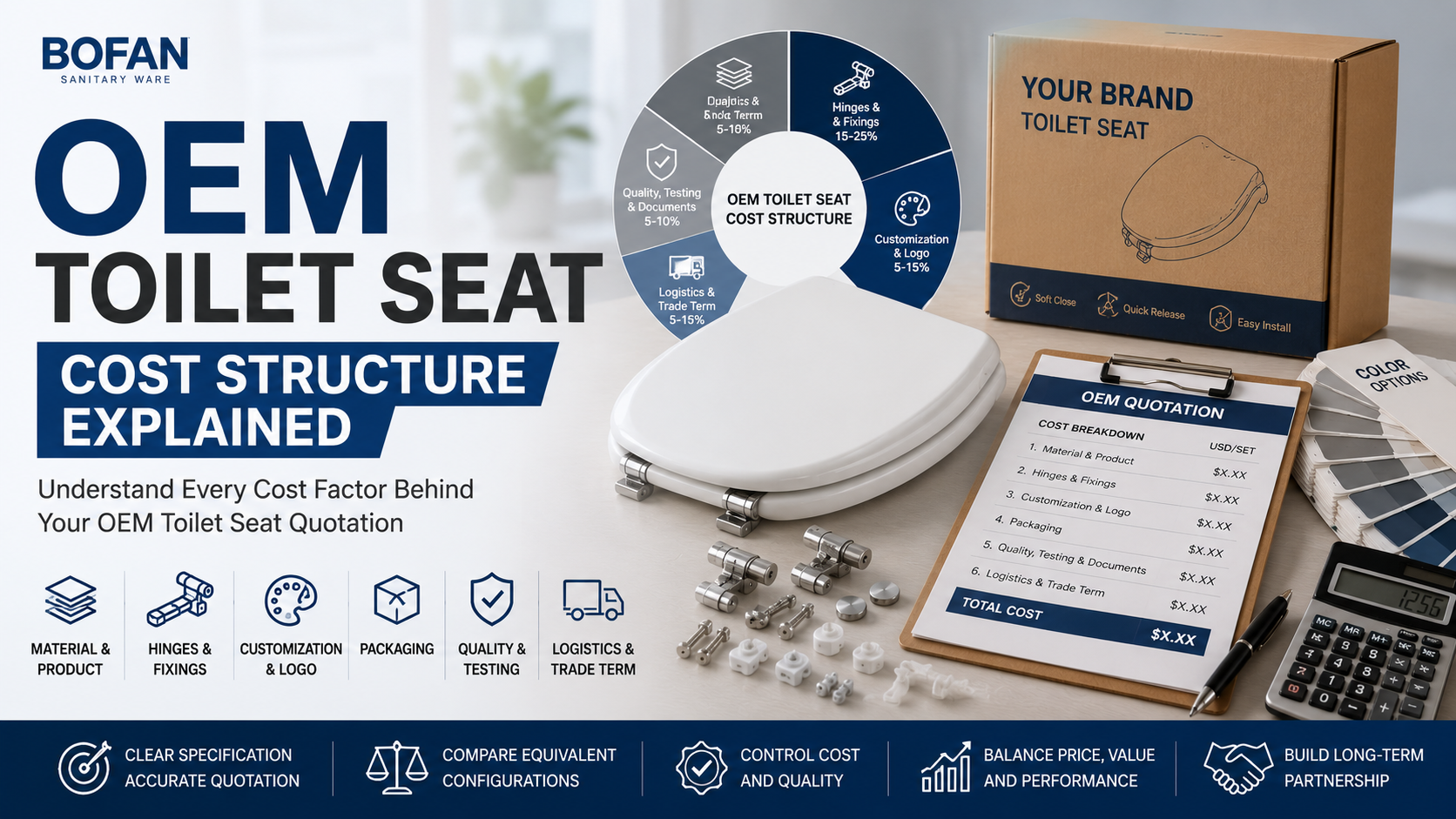
OEM Toilet Seat Cost Structure Explained
OEM toilet seat cost is determined by the complete approved configuration, not by the seat material alone. The quotation may reflect the PP, UF or MDF product, seat structure, hinges, fixings, color, logo, packaging, MOQ, testing, inspection, tooling and trade term. A low price may exclude branded boxes, upgraded dampers, required documents or complete hardware. Buyers should therefore issue one written specification to every supplier and compare equivalent quotations line by line. The most useful cost decision balances market position, ceramic fit, functional reliability, packaging and repeat-order control rather than selecting the lowest initial unit price.
Why Is One OEM Toilet Seat Price Not Enough?
Two suppliers may quote products with similar photographs but different specifications.
Differences may include:
- PP, UF or MDF material
- Product dimensions
- Seat and lid structure
- Product weight
- Surface finish
- Hinge type
- Damper construction
- Quick-release mechanism
- Top-fix or bottom-fix hardware
- Logo method
- Packaging
- Inspection
- Documents
- Trade term
A quotation that does not identify these elements cannot be compared reliably.
The buyer should separate:
- Base product cost
- Functional-component cost
- Customization cost
- One-time development cost
- Packaging cost
- Quality and document cost
- Logistics-related cost
This structure makes it easier to understand why prices differ and where responsible changes can be made.
How Does Material Affect OEM Toilet Seat Cost?
Material influences the manufacturing process, product structure, appearance and commercial position.
PP products
PP toilet seats are often used for practical and cost-controlled ranges.
Relevant quotation factors include:
- Product size
- Structural design
- Material quantity
- Mold complexity
- Surface texture
- Color
- Seat and lid construction
- Assembly method
- Hinge configuration
- Production quantity
PP is a material category, not one standard product. A reinforced or feature-rich PP seat may cost differently from a simple entry model.
UF products
UF toilet seats use a different molding process and can support a hard, smooth surface.
Cost factors may include:
- Product dimensions
- Material formulation
- Surface requirements
- Color
- Product weight
- Edge and finish requirements
- Hinge mounting
- Soft-close or quick-release configuration
- Packaging protection
UF should not be compared with PP by material price alone because the products may serve different market positions.
MDF products
MDF and wooden toilet seats may involve forming or machining, surface preparation, coating and decorative finishing.
Relevant factors include:
- Core structure
- Product thickness
- Coating system
- Number of finishing stages
- Solid color or printed design
- Wood-effect surface
- Edge finishing
- Hinge attachment
- Surface protection
- Packaging
A decorative MDF product with several finishing operations has a different cost structure from a neutral standard product.
How Do Shape and Product Structure Affect Cost?
Overall shape is only one part of the structure.
The factory may need to consider:
- Round, elongated, D-shaped or custom outline
- Seat opening
- Product thickness
- Ring profile
- Lid design
- Buffer arrangement
- Hinge mounting
- Reinforcement
- Product weight
- Mold utilization
- Assembly complexity
A heavier product is not automatically better, and a lighter product is not automatically lower quality. Structure should follow the application and agreed performance requirement.
Buyers should compare drawings, samples and components rather than using product weight as the only quality or cost indicator.
How Much Do Hinges and Fixings Influence the Quotation?
The hinge system can create a substantial difference between two otherwise similar seats.
Quotation variables include:
- Standard or soft-close movement
- One or two damped components
- Quick-release mechanism
- Hinge material
- Decorative finish
- Adjustment range
- Top-fix or bottom-fix system
- Bolts, washers and expansion components
- Release buttons
- Mounting bases
- Replacement-component requirements
- Functional testing
A soft-close hinge must be compatible with the seat and lid weight. A quick-release mechanism adds components and assembly requirements. Metal appearance does not alone prove better function, but material and finishing can affect cost.
Buyers should request the hinge code and complete fixing-kit description.
A quotation that states only “soft-close hinge included” leaves important questions unanswered.
Which Customization Choices Affect OEM Cost?
Customization may be light or extensive.
Light customization
This can include:
- Standard factory color
- Existing compatible hinge
- Logo label
- Neutral box
- Buyer SKU label
- Standard instructions
Medium customization
This may include:
- Custom color
- Product logo
- Upgraded hinge
- Branded instruction sheet
- Printed sleeve
- Retail box
- Dedicated barcode and artwork
- Market-specific fixing kit
Deep customization
This may include:
- New dimensions
- Modified structure
- New hinge interface
- Dedicated ceramic fit
- Exclusive finish
- New mold
- Product testing
- Multiple sample revisions
BOFAN’s OEM versus ODM guide explains why an established manufacturer-developed model usually has a different development burden from a buyer-led custom product.
The buyer should ask which costs are:
- Included in the unit price
- Charged once
- Charged by sample round
- Charged by artwork version
- Amortized over an agreed quantity
- Repeated on future orders
How Does Custom Mold Development Affect the Project Cost?
New tooling is normally a separate project decision.
Cost can depend on:
- Product material
- Mold size
- Seat and lid complexity
- Number of parts
- Surface texture
- Hinge interface
- Quick-release structure
- Ceramic data quality
- Prototype requirements
- Tool trials
- Corrections
- Testing
- Ownership or exclusivity arrangements
The lowest tooling quotation may not include the same scope as another proposal.
Buyers should confirm whether the proposal covers:
- Product design
- Mold design
- Tool construction
- Initial trials
- Sample quantities
- Defined corrections
- Testing
- Production validation
- Maintenance
- Ownership
- Storage
- Transfer conditions
No universal tooling price applies to every toilet seat. The factory must review the actual product and development scope.
How Do Logo and Color Requirements Affect Cost?
A logo may be applied to:
- The product
- Hinge cap
- Label
- Instruction sheet
- Retail box
- Sleeve
- Master carton
Different methods involve different preparation, equipment and MOQ conditions.
Color can affect:
- Material preparation
- Production setup
- Sample revisions
- Coating
- Cleaning between colors
- Color-specific components
- Inspection
- Remaining custom material
A recognized color reference or approved physical sample helps reduce repeated development.
Each additional color may create another SKU and production minimum. A range of five colors is not always commercially equivalent to the same quantity in one color.
What Packaging Costs Should Buyers Include?
Packaging cost is more than the price of an empty box.
The complete package may contain:
- Product protection
- Hardware bag
- Internal separators
- Printed box
- Neutral carton
- Sleeve
- Label
- Barcode
- Instructions
- Installation guide
- Master carton
- Shipping marks
- Project labels
- Pallet materials
BOFAN’s packaging customization guide explains the relationship between branding, protection, channel and approval.
Retail packaging may require more artwork and print control. E-commerce packaging may require stronger individual protection. Project packaging may need location or phase labels.
The buyer should also account for:
- Artwork preparation
- Printing setup
- Physical proof
- Packed sample
- Separate language versions
- Old packaging inventory
- Packaging inspection
A cheaper box is not a saving if it allows hinges or bolts to damage the product.
Why Does MOQ Affect the Unit Cost?
Production has activities that occur whether the order contains a small or large quantity.
These may include:
- Material preparation
- Machine setup
- Color change
- Tool installation
- Hinge-component preparation
- Artwork setup
- Printing setup
- Inspection preparation
- Production records
- Packing-line arrangement
When these activities are distributed across more identical units, the cost structure may differ from a fragmented order.
The BOFAN MOQ guide for toilet seat importers explains how minimum quantities may apply by model, material, color, hinge and packaging.
The buyer should ask:
- What is the total-order MOQ?
- What is the MOQ per model?
- What is the MOQ per color?
- What is the MOQ per hinge?
- What is the MOQ for each printed package?
- Can models be combined in one shipment?
A large total quantity divided among many small SKUs may still have an inefficient cost structure.
How Does SKU Fragmentation Affect the Program?
Every configuration needs control.
A new SKU may require:
- Separate specification
- Separate material or color
- Separate hinge
- Separate barcode
- Separate artwork
- Separate carton label
- Separate inspection record
- Separate warehouse inventory
- Separate repeat-order planning
| Order structure | Operational effect | Main buyer question |
|---|---|---|
| One model, one color, one box | Lowest complexity | Does it cover enough market demand? |
| One model, several colors | Color setup and stock fragmentation | Is demand proven for every color? |
| Several models, common package format | More product control with some packaging efficiency | Are SKUs clearly identified? |
| Several models and packages | Higher production and inventory complexity | Does each variation have a commercial role? |
| Custom model and custom box | Strong differentiation | Is expected volume sufficient? |
| Market-test assortment | Lower initial commitment but less unit efficiency | Which features require validation first? |
The best range is not automatically the range with the fewest products. It is the range in which every SKU has a defined commercial purpose.
What Quality-Control Costs Should Be Considered?
Quality control is part of the product cost structure.
Relevant activities may include:
- Incoming-material inspection
- Dimensional checks
- Surface inspection
- Hinge and fixing verification
- Soft-close checks
- Quick-release checks
- Assembly inspection
- Color comparison
- Logo inspection
- Packaging inspection
- Final random inspection
- Inspection reports
- Third-party inspection coordination
BOFAN’s quality-control process covers material, dimensions, surfaces, hinges, functions and packing.
A very low quotation may assume a simpler inspection scope than the buyer expects. Buyers should state inspection requirements before comparing prices.
If an AQL system, cycle test or third-party inspection is required, define the method, sample plan and responsibility.
How Do Testing and Documents Affect Cost?
Testing and documentation should be relevant to the selected model.
Potential requirements include:
- Material information
- Dimensional report
- Hinge-function testing
- Soft-close cycle testing
- Quick-release testing
- Load or stability testing
- Surface or coating evaluation
- Packaging testing
- Factory audits
- Product reports
- Destination-market documentation
Available BOFAN certificates and test reports should be reviewed for product, material, factory and market applicability.
A buyer should not pay for unnecessary documentation, but it should not remove a mandatory test merely to reduce the quotation.
Tests requested after production has started can create additional cost and risk. Required evidence should be defined during the RFQ stage.
How Do Samples Affect the Project Budget?
Samples may involve:
- Standard product sample
- Custom color sample
- Hinge alternatives
- Logo sample
- Printed package proof
- Packed sample
- Mold trial
- Revised product sample
- Test samples
- Shipping
The buyer should confirm:
- Number of sample rounds included
- Which components the sample will use
- Whether the sample is handmade or production-equivalent
- Sample charge
- Freight responsibility
- Whether sample charges are credited under any agreed conditions
- Approval method
- Revision responsibility
An attractive sample is useful only when it represents the quoted production configuration.
Why Must Trade Terms Be Normalized?
Two unit prices may use different trade terms.
The quotation should state whether it is based on:
- EXW
- FOB
- CIF
- Another agreed term
The trade term changes which costs and responsibilities are included.
The buyer should also compare:
- Port or named place
- Export packing
- Inland transport
- Export documentation
- Freight assumptions
- Insurance where relevant
- Duties and taxes
- Destination handling
- Pallet requirements
This article does not estimate freight, duties or destination costs because they depend on shipment, route, market and timing.
The buyer should compare suppliers on the same commercial basis.
What Should a Complete OEM Quotation Show?
| Quotation section | Required information |
|---|---|
| Product | Model, material, structure and dimensions |
| Hinge | Code, function, material and adjustment |
| Fixings | Top/bottom fix and included hardware |
| Appearance | Color, surface and logo |
| Packaging | Individual package, carton quantity and artwork |
| MOQ | Total and per-SKU conditions |
| Tooling | Scope, ownership and one-time charges |
| Samples | Configuration, charge and revision assumptions |
| Quality | Inspection stages and acceptance basis |
| Documents | Included reports and buyer-required evidence |
| Trade term | Named basis and location |
| Carton data | Quantity, dimensions and weight |
| Commercial terms | Currency, validity and payment conditions |
| Open assumptions | Items requiring confirmation |
A supplier should state exclusions rather than hide them behind an attractive headline price.
How Should Buyers Normalize Competing Quotations?
Use one written specification and create a comparison sheet.
For each supplier:
- Confirm the same material.
- Confirm the same product dimensions and structure.
- Confirm the same hinge and fixings.
- Confirm the same color and finish.
- Confirm the same logo method.
- Confirm the same packaging.
- Confirm the same MOQ basis.
- Confirm the same inspection scope.
- Confirm the same tests and documents.
- Convert quotations to the same trade term.
- Separate one-time costs from recurring unit costs.
- Record every assumption and exclusion.
BOFAN’s guide on how to compare toilet seat suppliers provides a broader weighted supplier-assessment method.
Price should be one scoring category rather than the entire decision.
How Can Buyers Reduce Cost Responsibly?
Responsible cost reduction begins with the commercial requirement.
Possible approaches include:
- Use an established model
- Reduce unnecessary SKUs
- Use an established factory color
- Select the simplest hinge that meets the need
- Standardize fixings across compatible products
- Share packaging structures across models
- Use labels or sleeves for controlled market tests
- Consolidate language versions where appropriate
- Improve forecasts
- Plan repeat orders
- Remove unsupported decorative details
- Match inspection to actual risk
- Separate essential features from optional features
Cost should not be reduced by:
- Substituting an unapproved material
- Using a different hinge without approval
- Removing necessary fixings
- Making unsupported fit claims
- Weakening surface protection
- Removing mandatory documents
- Skipping agreed inspections
- Reusing incorrect artwork
- Accepting uncontrolled component changes
The question is not simply “How can the unit price be lower?” It is “Which specification produces the required market result with the least unnecessary complexity?”
What Buyer Selection Criteria Matter Beyond Price?
Evaluate:
- Ceramic fit
- Product and hinge consistency
- Sample-to-production equivalence
- Quality-control capability
- Change control
- Packaging execution
- Documentation
- Communication
- Repeat-order records
- Commercial transparency
- Corrective-action capability
- Ability to support the intended range
A factory that identifies missing requirements may provide more value than one that immediately returns the lowest quotation.
The buyer should also consider the cost of:
- Returns
- Installation problems
- Repacking
- Incorrect barcodes
- Replacement components
- Specification changes
- Stock fragmentation
- Delayed product approval
These risks are difficult to reduce to one unit-price figure but remain commercially important.
How Does BOFAN Prepare OEM Quotations?
BOFAN’s OEM toilet seat solutions support existing-model, light-customization and custom-development programs.
Quotation preparation may consider:
- Target market and channel
- Product range position
- PP, UF or MDF material
- Ceramic fit
- Hinge and fixing configuration
- Color and finish
- Logo
- Individual packaging
- Master cartons
- MOQ per SKU
- Sample requirements
- Testing and inspection
- Required documents
- Trade term
- Repeat-order expectations
Exact prices, MOQ, tooling, samples and production arrangements depend on the confirmed specification.
What Is the Best Way to Request an OEM Price?
Send every shortlisted factory the same RFQ.
Include:
- Product or ceramic drawings
- Material
- Dimensions
- Hinge and fixing system
- Color and finish
- Quantity per SKU
- Logo
- Packaging
- Inspection
- Tests and documents
- Trade term
- Sample requirement
Ask the supplier to separate unit costs, one-time development charges and optional features.
Send BOFAN this controlled specification to receive a quotation that can be compared against equivalent offers. A transparent quotation is more useful than an initially low price built on undefined assumptions.
4. FAQ
What determines the cost of an OEM toilet seat?
Cost depends on the product material, structure, dimensions, hinges, fixings, color, branding, packaging, quantity, testing and trade term. The complete approved configuration must be compared.
Is PP always the lowest-cost OEM toilet seat material?
PP often supports cost-controlled programs, but structure, product weight, hinges, color and quantity also affect the quotation. A feature-rich PP seat may not be comparable with a simple product using another configuration.
Why do soft-close toilet seats cost more than standard seats?
Soft-close products require compatible dampers, hinge components, assembly and functional checks. The exact difference depends on the seat model and hinge system.
Does custom packaging affect the toilet seat MOQ?
It can. Printed boxes, sleeves, labels and language versions may have minimum production quantities separate from the toilet seat itself.
Should mold cost be included in the unit price?
It may be charged separately or handled through another agreed commercial structure. Buyers should clarify tooling scope, ownership, corrections, maintenance and whether any amount is included in recurring prices.
How should buyers compare OEM toilet seat quotations?
Use one written specification and compare equivalent material, structure, hinges, fixings, packaging, inspection, documents and trade terms. Separate one-time charges from recurring unit costs.
Can BOFAN prepare an itemized OEM quotation?
BOFAN can prepare a project-specific proposal after the product, quantity, customization, packaging, inspection and commercial basis are defined. Final cost depends on the selected configuration.
Table of Contents
- OEM Toilet Seat Cost Structure Explained
- Why Is One OEM Toilet Seat Price Not Enough?
- How Does Material Affect OEM Toilet Seat Cost?
- How Do Shape and Product Structure Affect Cost?
- How Much Do Hinges and Fixings Influence the Quotation?
- Which Customization Choices Affect OEM Cost?
- How Does Custom Mold Development Affect the Project Cost?
- How Do Logo and Color Requirements Affect Cost?
- What Packaging Costs Should Buyers Include?
- Why Does MOQ Affect the Unit Cost?
- How Does SKU Fragmentation Affect the Program?
- What Quality-Control Costs Should Be Considered?
- How Do Testing and Documents Affect Cost?
- How Do Samples Affect the Project Budget?
- Why Must Trade Terms Be Normalized?
- What Should a Complete OEM Quotation Show?
- How Should Buyers Normalize Competing Quotations?
- How Can Buyers Reduce Cost Responsibly?
- What Buyer Selection Criteria Matter Beyond Price?
- How Does BOFAN Prepare OEM Quotations?
- What Is the Best Way to Request an OEM Price?
-
4. FAQ
- What determines the cost of an OEM toilet seat?
- Is PP always the lowest-cost OEM toilet seat material?
- Why do soft-close toilet seats cost more than standard seats?
- Does custom packaging affect the toilet seat MOQ?
- Should mold cost be included in the unit price?
- How should buyers compare OEM toilet seat quotations?
- Can BOFAN prepare an itemized OEM quotation?