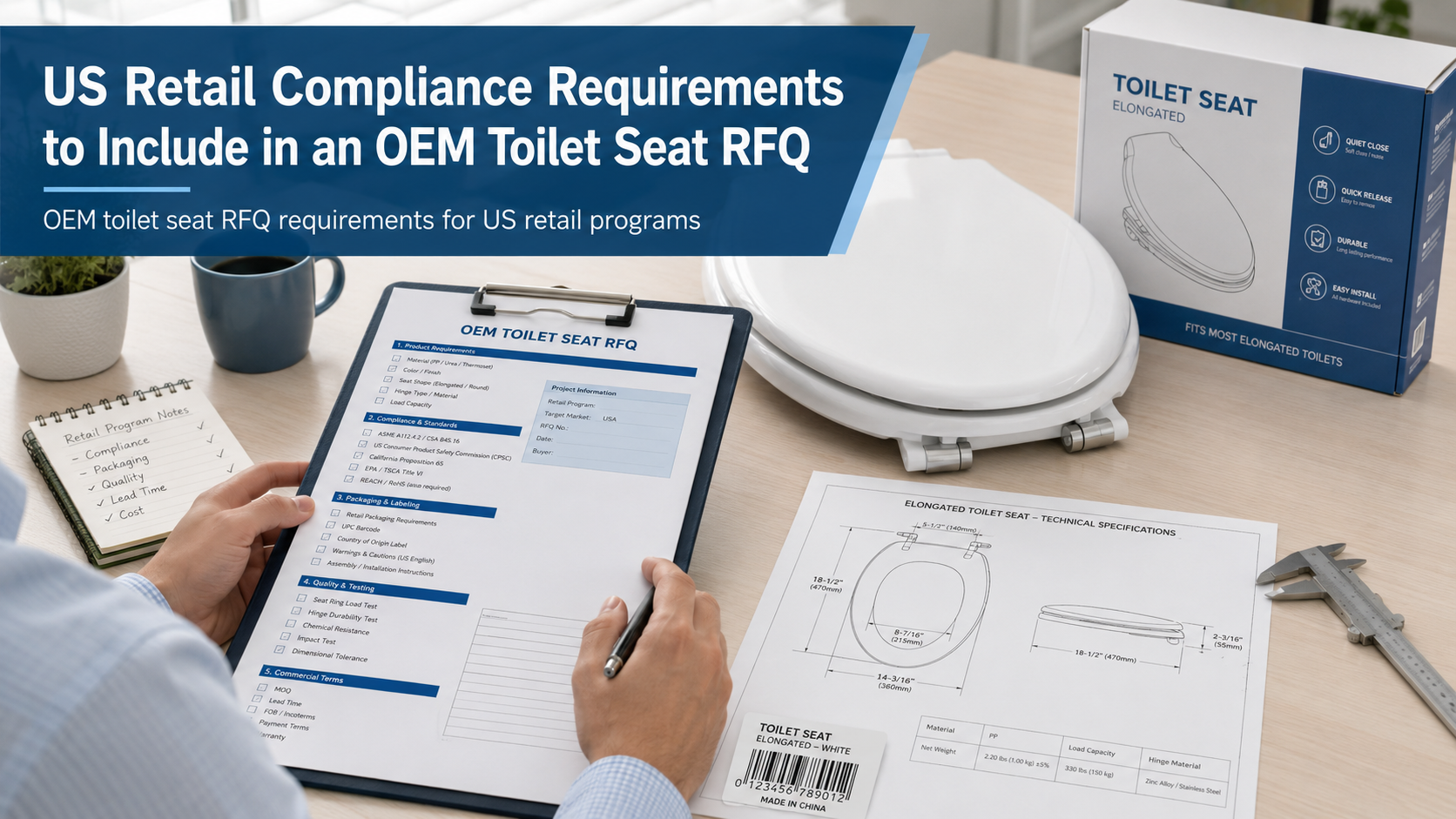
US Retail Compliance Requirements to Include in an OEM Toilet Seat RFQ
For a US retail toilet seat program, an RFQ should do more than request a unit price. It should give every supplier the same product, packaging, quality and documentation requirements so quotations can be compared on an equivalent basis.
A complete OEM toilet seat RFQ normally identifies the target channel, product specification, ceramic fit, hinge and fixing system, packaging, labeling, quality checks, required evidence and delivery basis. If these points are missing, suppliers may quote different configurations while appearing to offer the same product.
Start With the Retail Channel and Product Role
The first requirement is commercial context. A product for a national DIY chain, an e-commerce brand, a sanitary ware collection or a replacement-seat distributor may need different packaging, price positioning and approval procedures.
State:
- Target country and sales channel
- Retailer, distributor or e-commerce program type
- Product price tier
- Planned launch timing
- Expected annual quantity
- Initial order quantity
- Repeat-order expectations
- Whether the product is a standard, premium or promotional SKU
For example, a product intended for a shelf retail program may need printed packaging and a barcode-ready structure, while an online product may need more protective parcel packaging and clear compatibility instructions.
BOFAN supports programs for supermarkets and retail chains, online brands and e-commerce sellers, and OEM brands and sanitary ware companies.
Define the Product Before Asking for Price
A photograph alone is not a controlled product specification. The RFQ should identify the selected product or explain the intended market need so the factory can recommend suitable existing models.
Include:
- Material: PP, UF/duroplast, MDF or molded wood
- Seat shape: round, elongated, D-shape or other outline
- Overall length, width and height
- Seat-ring opening dimensions
- Product thickness and weight range where relevant
- Gloss, matte, textured, printed or wood-effect finish
- Color reference
- Seat and lid design
- Buffer arrangement
- Required installation range
- Target ceramic model or compatibility range
PP toilet seats can suit cost-controlled and high-volume programs. UF toilet seats support a hard, smooth retail presentation. MDF and wooden toilet seats can support decorative, painted and printed collections.
Material should be selected according to the market position and product use—not only a target purchase price.
Include Ceramic Fit and Installation Data
Fit problems create returns, negative reviews and retail complaints. For a toilet seat intended to fit a defined toilet bowl or a specific collection, provide ceramic information early.
The RFQ should include:
- Toilet brand and model, if known
- Technical drawing or dimensioned sketch
- Bowl length and maximum width
- Mounting-hole spacing
- Hole diameter
- Distance from mounting holes to the bowl front
- Bowl shape
- Rear mounting platform size
- Top-view and underside photographs
- Whether the underside of the ceramic is accessible
- Any restricted installation area
A seat described as “universal” may not fit every bowl. The factory must assess the seat dimensions, hinge-adjustment range, buffer contact and fixing access against the intended ceramic.
Specify the Hinge and Fixing System
The hinge is not a minor accessory. It influences user experience, fit, assembly, service life and price.
Confirm:
- Standard-close or soft-close function
- Quick-release requirement
- Top-fix or bottom-fix installation
- Hinge material and finish
- Adjustment range
- Release method
- Opening angle where relevant
- Fixing-kit content
- Replacement-hardware expectations
- Required function or cycle testing
Soft-close toilet seats and quick-release toilet seats require compatible hinge systems and should be quoted with a clear hinge code and fixing description.
If the ceramic underside cannot be accessed, the RFQ should state this clearly. A bottom-fix solution may not be suitable for every toilet.
[Image 2 — fit and hinge review]
Brief: Technical comparison of a toilet bowl drawing, top-fix hardware, bottom-fix hardware and an adjustable soft-close hinge.
Alt text: Toilet seat ceramic fit, hinge and fixing requirements.
State Packaging, Labeling and Artwork Requirements
Retail readiness includes the complete package, not only the seat.
Specify:
- Neutral, sleeve, printed box or full retail-box requirement
- Individual product protection
- Hardware-bag position
- Installation-instruction requirement
- Barcode format and placement
- Product label and carton-label information
- Retailer SKU or internal SKU
- Product name and feature icons
- Required languages
- Master-carton quantity
- Carton dimensions and maximum-weight requirement
- Pallet requirements
- Shipping marks
- Drop-test or parcel-protection expectations where applicable
Use controlled branding files: vector logo, approved colors, fonts, barcode data and current artwork version. Do not approve a production box only from a screen mock-up; approve a packed physical sample where possible.
Identify Quality, Testing and Documentation Requirements
“High quality” is not an inspection standard. The RFQ should define measurable expectations.
Key checks may include:
- Product dimensions
- Surface finish
- Color consistency
- Seat and lid alignment
- Hinge operation
- Soft-close performance
- Quick-release function
- Fixing completeness
- Installed stability
- Product markings
- Packaging condition
- Carton labeling
- Final inspection method
Where applicable, identify required documents before product approval. Requirements may vary by the selected model, material, retailer and market.
A factory should confirm whether any available certificate or test report actually applies to the selected configuration. BOFAN’s Certificates & Test Reports center and quality process can be used as a starting point for this review.
Separate Fixed Requirements From Preferences
A useful RFQ distinguishes three types of information:
| Type | Examples |
|---|---|
| Fixed requirement | Required fit, mandatory label, approved material, test evidence |
| Preferred option | Hinge finish, carton artwork style, target lead time |
| Open decision | Final color, sample quantity, alternative packaging route |
This prevents a supplier from treating an essential retail condition as optional—or adding unnecessary cost for a feature that is still under discussion.
US Retail OEM RFQ Checklist
Before requesting a final quotation, confirm that your RFQ contains:
- Target channel and price position
- Product material and shape
- Ceramic dimensions or compatibility range
- Hinge and fixing system
- Color, surface and branding requirements
- Quantity by SKU
- Packaging, barcode and label requirements
- Quality and inspection standard
- Required tests and documents
- Trade term and delivery destination
- Sample and approval plan
- Clear list of open decisions
How BOFAN Supports Retail RFQs
BOFAN can review the buyer’s target channel, product role, ceramic data, material, hinge, packaging and quantity structure before preparing an OEM proposal. The aim is not simply to quote a low unit price; it is to create a production-ready specification that reduces approval changes and retail execution risk.
Submit your market, target quantity, ceramic information, product requirements and packaging brief to receive a more comparable OEM toilet seat quotation.
FAQ
What should an OEM toilet seat RFQ include for US retail?
It should include the sales channel, product material, dimensions, ceramic fit, hinge, packaging, barcode, quality requirements, quantity per SKU, documents and delivery basis.
Do US retail toilet seat programs need barcode information before quotation?
The factory can quote a preliminary package without it, but barcode format, placement and final SKU information should be confirmed before packaging approval and production.
Should testing requirements be discussed before samples?
Yes. Required testing and documents should be identified early so the factory can verify that they apply to the selected product configuration.
Can one toilet seat fit every US toilet?
No. Buyers should provide the intended bowl type and measurements. Fit depends on the seat shape, dimensions, mounting-hole spacing and hinge-adjustment range.
What is the best way to compare OEM quotations?
Send each supplier one controlled RFQ and compare the same material, dimensions, hinge, fixing kit, packaging, inspection scope, documentation and trade term.