What Information an OEM Toilet Seat Factory Needs from You
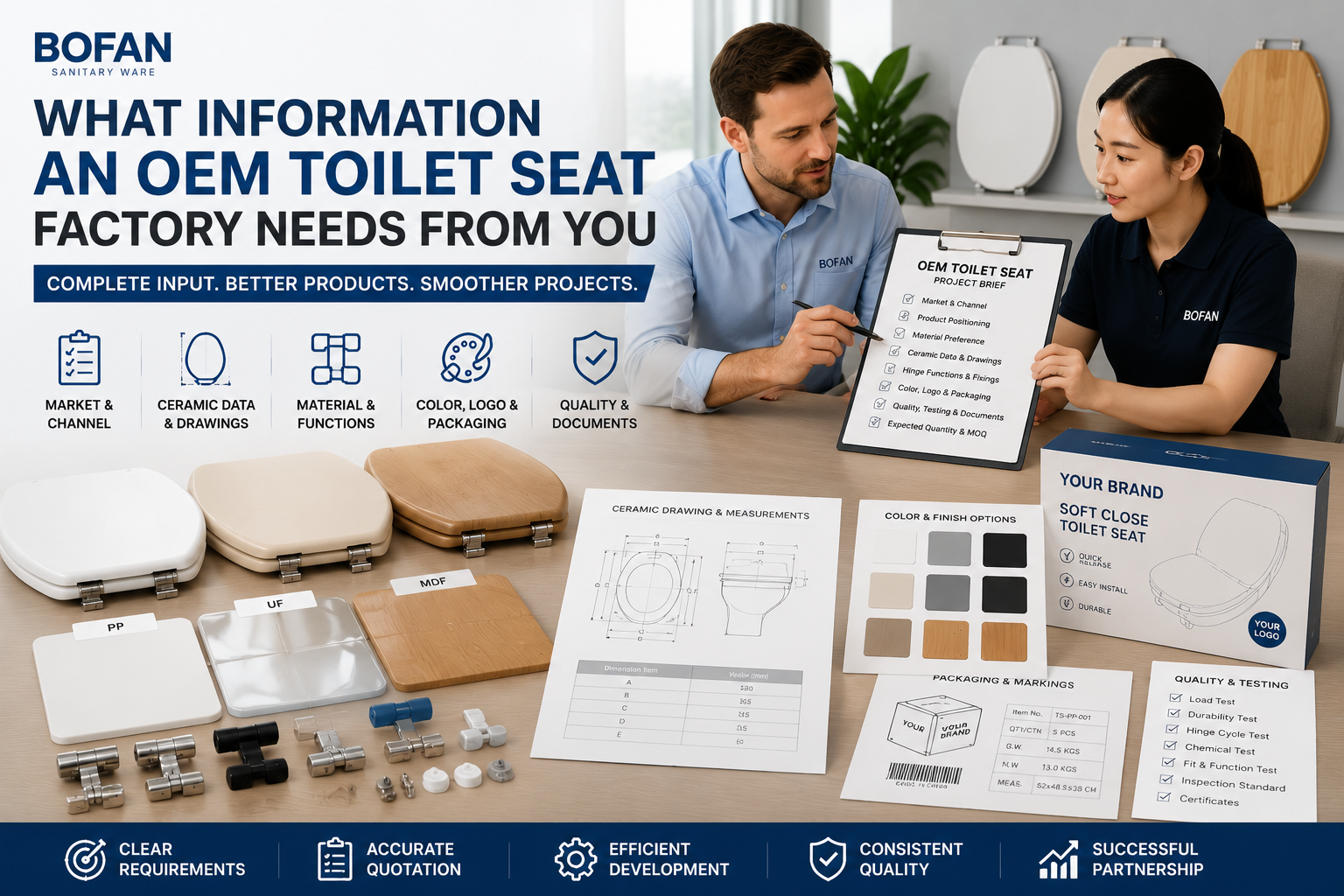
An OEM toilet seat factory needs a clear commercial and technical brief before it can recommend products or prepare a comparable quotation. Buyers should provide the target market, sales channel, product position, expected quantity, preferred material, ceramic drawings or measurements, hinge functions, fixing access, color, logo, packaging and required inspection or documents. The factory also needs to know whether the buyer wants an established model, a modified product or new tooling. Complete information reduces unsuitable recommendations, repeated sampling, quotation changes and compatibility problems later in the project.
Why Does an OEM Factory Need a Detailed Project Brief?
A request such as “Please quote a white soft-close toilet seat” does not define one product.
Many different configurations can fit that description. They may vary in:
- Material
- Shape
- Dimensions
- Product structure
- Hinge construction
- Adjustment range
- Fixing hardware
- Quick-release function
- Color tone
- Packaging
- Inspection
- Destination requirements
Without a controlled brief, the factory must either make assumptions or send a broad catalogue. Neither approach produces a reliable comparison.
A complete project brief helps the factory:
- Remove technically unsuitable models
- Match the product to the correct market position
- Review ceramic compatibility
- Select compatible hinges and fixings
- Identify customization requirements
- Clarify MOQ by SKU
- Prepare representative samples
- Quote the complete configuration
- Identify missing documents or tests
- Plan repeat-order specification control
Buyers new to the cooperation model can review what an OEM toilet seat is before preparing the detailed brief.
What Company and Market Information Should the Buyer Provide?
The factory first needs to understand who will sell or use the product.
Provide:
- Company type
- Target country or region
- Main customer groups
- Sales channels
- Existing product categories
- Intended launch market
- Brand positioning
- Expected price level
- Current toilet seat range, if any
- Main competing product references
- Planned number of SKUs
- Approximate annual or project volume
The sales channel changes the product requirement.
A sanitary ware company may need a seat matched precisely to its own ceramic toilets. A distributor may require several adjustable models covering common local bowls. An e-commerce brand may prioritize clear fit information, installation instructions and parcel protection.
A retail chain may need shelf-ready packaging and barcodes, while a construction buyer may prioritize project labels, installation consistency and spare-product identification.
Market information should guide product selection before detailed customization begins.
How Should Buyers Explain Product Positioning?
The factory needs to know the role of each proposed model.
A simple range may contain:
| Product position | Possible starting specification | Main buyer objective |
|---|---|---|
| Entry | Standard PP model | Practical cost control |
| Mainstream | PP or UF soft-close model | Broad market appeal |
| Premium | UF quick-release or upgraded hinge model | Finish and functional differentiation |
| Decorative | Selected MDF model | Color, print or traditional styling |
| Project | Standardized PP or UF configuration | Installation and repeatability |
| Ceramic-specific | Model matched to the buyer’s toilet | Exact fit and collection consistency |
These are starting points rather than fixed rules.
For each model, state:
- Intended customer
- Target sales position
- Essential features
- Optional features
- Features that should not be included
- Reference products
- Expected quantity
- Planned repeat-order role
This prevents the factory from proposing several products that look different but occupy the same commercial position.
Which Material Information Does the Factory Need?
The buyer may specify a material or ask the factory to recommend one.
Common choices include:
PP
PP toilet seats can support practical, lightweight and cost-controlled product ranges.
The buyer should state whether PP is selected because of:
- Target price position
- Product weight
- Market familiarity
- Project standardization
- Required shape
- Available hinge functions
UF
UF toilet seats can support a hard, smooth surface and modern product presentation.
Relevant buyer priorities may include:
- Refined appearance
- Ceramic-like surface
- Soft-close function
- Quick-release function
- Showroom or retail positioning
- Coordination with sanitary ware
MDF
MDF and wooden toilet seats can support decorative colors, printed surfaces and traditional product positioning.
The buyer should explain:
- Intended finish
- Color or printed design
- Expected bathroom environment
- Surface-protection requirements
- Hinge style
- Packaging presentation
If the buyer is uncertain, it should describe the application and commercial target instead of selecting material only by price.
What Ceramic Information Is Required?
Ceramic fit is one of the most important technical inputs.
Where the seat is intended for a particular toilet bowl, provide:
- Ceramic brand and model
- Technical drawing
- Overall bowl length
- Maximum bowl width
- Mounting-hole spacing
- Hole diameter
- Distance from mounting holes to the bowl front
- Bowl shape
- Rear platform dimensions
- Cistern or wall clearance
- Top and underside photographs
- Fixing access
- 3D data where available
- Physical ceramic sample where practical
A top-view photograph cannot show every relevant condition. It may not reveal changes in bowl height, sloped mounting surfaces, buffer contact or restricted underside access.
For replacement-seat programs, provide the dimensional range the product should cover. Avoid relying only on terms such as round, elongated or universal.
The factory should explain:
- Proposed seat dimensions
- Hinge adjustment range
- Required mounting-hole conditions
- Fixing limitations
- Areas requiring installation verification
The final sample should be installed on the intended ceramic before bulk approval.
Which Hinge and Fixing Details Must Be Confirmed?
Hinge requirements affect product function, ceramic compatibility and price.
The buyer should specify:
- Standard or soft-close movement
- Quick-release requirement
- Top-fix or bottom-fix installation
- Preferred hinge material or finish
- Mounting-hole spacing
- Adjustment range
- Opening angle where relevant
- Required release method
- Replacement-component expectations
- Existing hinge reference, if any
- Applicable functional-test requirements
BOFAN’s guide on how to choose the right toilet seat hinge explains the relationship between the seat, ceramic, dampers and fixings.
The factory also needs to know whether the underside of the ceramic is accessible.
Top-fix systems may suit enclosed or restricted mounting areas. Bottom-fix systems require access below the holes. The expansion fixing, bolt, washer and nut must be compatible with the ceramic.
The buyer should not request soft close, quick release or a metal hinge merely because it appears more premium. Every feature should serve a defined market or operating need.
What Appearance and Color Information Is Needed?
Appearance requirements should be measurable where possible.
Provide:
- Target color
- Physical color reference
- Ceramic color sample
- Recognized color-system reference
- Gloss, matte or textured finish
- Decorative pattern
- Wood effect
- Logo position
- Logo method
- Hinge-cap color
- Visible metal finish
- Surface-quality expectations
Do not rely only on a phone photograph or verbal description such as “European white” or “premium beige.”
The final color can be influenced by the material, finish and lighting. A color approved on PP should not automatically control UF or coated MDF.
If the product must match a ceramic collection, state whether an exact visual match or coordinated appearance is required.
What Branding Files Should the Buyer Submit?
For a branded program, provide controlled files rather than informal references.
Useful inputs include:
- Vector logo
- Brand guidelines
- Approved brand colors
- Minimum logo size
- Clear-space rules
- Trademark symbols
- Buyer product name
- SKU structure
- Barcode data
- Product photographs
- Feature icons
- Instruction content
- Contact information
- Required languages
The factory should know which file is approved and which files are drafts.
If the logo will appear on both the product and packaging, define each application separately. A method suitable for a box may not be suitable for the seat surface.
Which Packaging Information Is Required?
Packaging should follow the product and channel.
The buyer should state:
- Individual packaging type
- Retail, wholesale, project or e-commerce use
- Neutral or branded box
- Printed box, sleeve or label
- Product-protection expectations
- Hardware-bag position
- Installation instructions
- Barcode
- Languages
- Master-carton quantity
- Carton labels
- Shipping marks
- Project or destination codes
- Pallet requirements where applicable
BOFAN’s guide to packaging customization for OEM toilet seat orders provides a detailed packaging approval framework.
Packaging cannot be finalized safely until the product, hinge and hardware have been selected. The buyer should approve a packed sample rather than artwork alone.
What Quantity and SKU Information Does the Factory Need?
The factory needs quantities at configuration level.
Provide:
- Total order quantity
- Quantity per model
- Quantity per material
- Quantity per color
- Quantity per hinge
- Quantity per package
- Number of languages
- Expected repeat-order volume
- Forecast pattern
- Sample quantity
- Spare-product requirement
One order containing 1,000 identical seats is different from 1,000 units divided among multiple models, colors, hinges and boxes.
MOQ may apply separately to:
- Product model
- Color
- Surface design
- Hinge
- Logo process
- Printed packaging
- Language version
The MOQ guide for toilet seat importers explains why a total order quantity does not automatically satisfy every SKU requirement.
Which Commercial Details Should Be Included in the RFQ?
A comparable RFQ should identify:
- Required trade term
- Destination port or delivery point
- Currency
- Requested quotation validity
- Sample requirement
- Product quantity
- Packaging scope
- Branding scope
- Inspection arrangement
- Required documents
- Tooling requirement
- Payment expectations
- Desired shipment structure
- Whether different models may be combined
The buyer should distinguish a target from a fixed requirement.
For example, a requested launch date may be a planning target, while a required regulatory document may be a fixed condition. This helps the factory identify what is negotiable and what must be confirmed before quotation.
What Quality-Control Information Should Buyers Provide?
Quality should not be described only as “high quality.”
Provide model-specific expectations for:
- Material
- Dimensions
- Surface
- Color
- Seat and lid alignment
- Chips, cracks or scratches
- Hinge function
- Soft-close behavior
- Quick-release operation
- Fixing completeness
- Installed stability
- Logo position
- Packaging
- Barcode
- Carton quantity
BOFAN’s published quality-control process covers incoming materials, dimensions, surfaces, hinges, functions and packaging.
The buyer should also state:
- Inspection stages
- Sampling method
- Defect categories
- Acceptance criteria
- Required report format
- Third-party inspection plans
- Shipment-release responsibility
An approved drawing and physical sample should support the written checklist.
Which Tests and Documents Should Be Identified?
Requirements vary by product and destination.
The buyer may request:
- Product drawing
- Material information
- Dimensional report
- Hinge-function test
- Cycle-test information
- Stability or load-test information
- Surface or coating evaluation
- Packaging test
- Factory documentation
- Product reports
- Inspection report
- Country-of-origin documentation
Available BOFAN certificates and test reports should be checked against the selected model, material, factory and intended market.
A report for one seat or hinge should not automatically be applied to another configuration.
The buyer should identify the required document early. Discovering a mandatory requirement after sample approval can force product, testing or supplier changes.
What Information Is Needed for Different OEM Scenarios?
| Buyer scenario | Most important inputs | Main approval |
|---|---|---|
| Sanitary ware brand | Ceramic drawings, collection colors and target hinge | Installed fit |
| Distributor | Market shapes, range tiers, MOQ and packaging | Assortment and samples |
| Retail chain | Product level, branded box, barcode and inspection | Packed retail sample |
| E-commerce brand | Fit range, instructions and parcel packaging | Compatibility and package |
| Hotel supplier | Ceramic, cleaning routine and hinge function | Pilot installation |
| Project contractor | Quantity by phase, site labels and fixing access | Installation sample |
| Custom-mold project | 3D ceramic data, material, ownership and tests | Drawing and tooling stages |
| Market-test program | Existing models, limited SKUs and neutral branding | Controlled first range |
The factory should receive the information relevant to the buyer’s actual business model rather than a generic checklist with no priorities.
How Should Sample Approval Responsibilities Be Divided?
The factory should prepare a sample against the written requirement. The buyer should verify that the requirement reflects its market and application.
The sample review should record:
- Factory model
- Buyer SKU
- Material
- Dimensions
- Ceramic fit
- Color
- Hinge
- Fixings
- Functions
- Logo
- Packaging
- Open corrections
- Approval date
- Drawing revision
If the buyer changes a requirement after approval, the sample and quotation may need revision.
A verbal statement such as “sample is generally acceptable” does not explain which details are approved and which remain open.
What Common Information Gaps Delay OEM Projects?
Common gaps include:
- No target market
- No ceramic dimensions
- Only one product photograph
- Unclear material
- Unspecified hinge
- No fixing-access information
- No quantity per SKU
- Color approved only from a screen
- Logo supplied as a low-resolution image
- Packaging requested before product selection
- No barcode or language data
- Undefined quality standard
- Certificates requested without identifying the market
- Custom mold requested without expected volume
- Conflicting instructions from several buyer contacts
A controlled input sheet and one current specification reduce these problems.
How Should Buyers Check Project Readiness?
Before requesting a final quotation, confirm:
- Target market and channel are defined.
- Product role and price position are clear.
- Ceramic data are available where required.
- Material is selected or the application is explained.
- Hinge and fixing requirements are defined.
- Quantity is divided by SKU.
- Color and appearance references are controlled.
- Logo files are current.
- Packaging format is identified.
- Required tests and documents are listed.
- Inspection expectations are stated.
- Open decisions are clearly marked.
Not every project must have every answer on day one. The important point is to distinguish known requirements, preferences and unresolved questions.
How Does BOFAN Support OEM Project Preparation?
BOFAN’s OEM toilet seat solutions support sanitary ware companies, private-label brands, importers and distributors.
Project support may include:
- Existing-model shortlisting
- PP, UF and MDF material discussion
- Ceramic drawing and measurement review
- Hinge and fixing selection
- Product specification coordination
- Color and finish discussion
- Sample preparation
- Logo and packaging coordination
- Quality inspection
- Applicable document review
- Export packing
- Repeat-order specification records
Exact models, MOQ, customization, tests, production conditions and documentation depend on the completed buyer brief.
What Should You Send BOFAN First?
Send a structured first brief containing:
- Target country and channel
- Buyer type
- Required product tiers
- Expected quantity per model
- Ceramic drawings or measurements
- Material preferences
- Hinge and fixing requirements
- Color and finish
- Logo and packaging
- Inspection and document requirements
BOFAN can then identify missing information, recommend suitable product routes and prepare a more comparable proposal.
A complete brief does not only help the factory work faster. It helps the buyer prevent assumptions from becoming expensive product decisions.
4. FAQ
What information does an OEM toilet seat factory need first?
The factory first needs the target market, sales channel, product position, expected quantity and basic product requirements. Ceramic, hinge, packaging and inspection information can then be organized around that commercial brief.
Are ceramic measurements necessary for an OEM toilet seat?
They are necessary when the product must fit a particular toilet or defined compatibility range. Buyers should provide bowl length, width, mounting-hole spacing, hole diameter, shape and fixing access.
Should the buyer select PP, UF or MDF before requesting a quote?
The buyer may select a material or explain the application and target position so the factory can recommend one. A final comparable quotation requires the material and product structure to be confirmed.
Why does the factory need quantities by SKU?
Different models, colors, hinges and packages may have separate production minimums. A total order quantity does not show whether each configuration is commercially feasible.
What branding files should an OEM buyer provide?
The buyer should provide a vector logo, brand colors, approved fonts, barcode data, product names, languages and current artwork requirements. Draft and approved files should be clearly separated.
When should tests and certificates be discussed?
Required tests and market documents should be identified before the product and quotation are finalized. The factory must verify that available reports apply to the selected model, material and configuration.
Can BOFAN help complete an incomplete OEM specification?
BOFAN can review the buyer’s market, ceramic, product, hinge, branding and quantity information and identify open requirements. Final feasibility and quotation depend on confirming the selected configuration.
Table of Contents
- What Information an OEM Toilet Seat Factory Needs from You
- Why Does an OEM Factory Need a Detailed Project Brief?
- What Company and Market Information Should the Buyer Provide?
- How Should Buyers Explain Product Positioning?
- Which Material Information Does the Factory Need?
- What Ceramic Information Is Required?
- Which Hinge and Fixing Details Must Be Confirmed?
- What Appearance and Color Information Is Needed?
- What Branding Files Should the Buyer Submit?
- Which Packaging Information Is Required?
- What Quantity and SKU Information Does the Factory Need?
- Which Commercial Details Should Be Included in the RFQ?
- What Quality-Control Information Should Buyers Provide?
- Which Tests and Documents Should Be Identified?
- What Information Is Needed for Different OEM Scenarios?
- How Should Sample Approval Responsibilities Be Divided?
- What Common Information Gaps Delay OEM Projects?
- How Should Buyers Check Project Readiness?
- How Does BOFAN Support OEM Project Preparation?
- What Should You Send BOFAN First?
-
4. FAQ
- What information does an OEM toilet seat factory need first?
- Are ceramic measurements necessary for an OEM toilet seat?
- Should the buyer select PP, UF or MDF before requesting a quote?
- Why does the factory need quantities by SKU?
- What branding files should an OEM buyer provide?
- When should tests and certificates be discussed?
- Can BOFAN help complete an incomplete OEM specification?