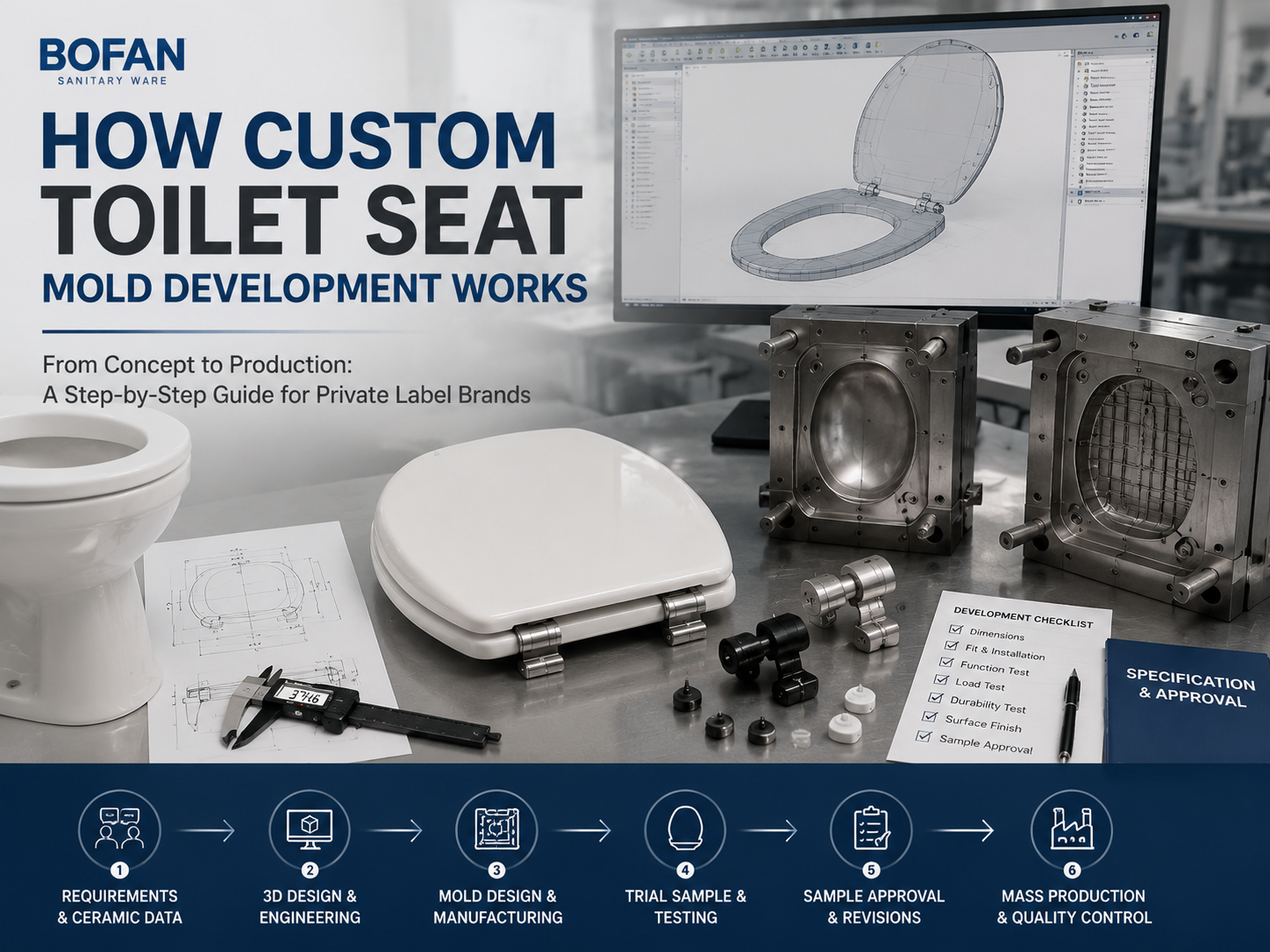
How Custom Toilet Seat Mold Development Works
A custom mold toilet seat project begins with a defined commercial need, ceramic dimensions and a controlled product specification. The manufacturer first determines whether an existing model or hinge adjustment can meet the requirement. If new tooling is justified, the buyer and factory confirm the material, shape, seat opening, mounting area, hinges, buffers, appearance and test criteria before mold construction. Initial molded samples must then be measured, installed on the intended ceramic and tested as a complete assembly. Bulk production should begin only after the product, mold revisions, hinge, finish, packaging and acceptance criteria have been formally approved.
When Does a Buyer Need a Custom Toilet Seat Mold?
A new mold should solve a clear technical or commercial problem.
Possible reasons include:
- No existing seat fits the buyer’s ceramic
- A sanitary ware brand needs a dedicated seat
- The target market uses a different shape or dimension
- The buyer requires a distinctive product appearance
- Existing models do not provide the required opening or profile
- The mounting structure needs a dedicated hinge interface
- A product family requires stronger visual consistency
- The expected business supports deeper development
- The buyer needs controlled differentiation from standard catalogue products
A custom mold may not be necessary when:
- An existing model already fits
- A hinge adjustment solves the compatibility issue
- Only color, logo or packaging needs to change
- The required quantity does not support the development burden
- The project is an early market test
- The buyer has not finalized the ceramic
- Product ownership and sales strategy remain unclear
BOFAN’s OEM versus ODM toilet seat guide helps buyers distinguish deeper OEM development from using a factory’s established product base.
What Information Is Needed Before Design Begins?
The manufacturer needs technical and commercial input.
Ceramic information
Provide:
- Ceramic drawing
- 3D data where available
- Physical ceramic sample where practical
- Overall bowl length
- Maximum width
- Mounting-hole spacing
- Hole diameter
- Bowl profile
- Distance from the holes to the front
- Rear clearance
- Top and underside access
- Cistern or wall position
Product requirements
Define:
- PP, UF, MDF or other proposed material
- Round, elongated, D-shaped or custom geometry
- Seat opening
- Seat and lid profile
- Target product position
- Standard or soft-close hinge
- Quick-release requirement
- Top-fix or bottom-fix hardware
- Opening angle
- Buffers
- Color and finish
- Logo
- Packaging
Project requirements
State:
- Target market
- Sales channel
- Expected volume
- Required tests
- Applicable documents
- Ownership expectations
- Sample-approval process
- Inspection requirements
- Intended launch sequence
A manufacturer cannot design a reliable mold from one top-view photograph and a rough length measurement.
Can an Existing Mold Be Modified Instead?
Before creating a new mold, compare three routes.
| Development route | Appropriate when | Main limitation |
|---|---|---|
| Existing model | Shape, fit and functions are already suitable | Limited differentiation |
| Existing model with component adjustment | Hinge, fixing, color or packaging needs change | Core geometry remains unchanged |
| Existing mold modification | A controlled change is technically feasible | May affect the original product and require validation |
| New custom mold | Dedicated dimensions or structure are required | Higher development commitment |
| New product family | Several coordinated models are planned | Greater specification and tooling complexity |
The factory should explain what can be changed safely.
A mold modification should not be treated as a simple shortcut without reviewing:
- Product dimensions
- Material flow or forming
- Strength
- Surface
- Assembly
- Hinge mounting
- Compatibility with existing production
- Effect on the original model
If the change compromises both the old and new products, separate tooling may be the better decision.
How Does Material Affect Mold Development?
PP, UF and MDF products follow different manufacturing routes.
PP mold development
PP toilet seats commonly use injection-molding processes.
Development needs to consider:
- Product structure
- Material distribution
- Mold filling
- Shrinkage
- Deformation
- Surface texture
- Ejection
- Mounting areas
- Seat and lid alignment
- Assembly components
The final result must be evaluated on molded parts, not only in a 3D drawing.
UF mold development
UF toilet seats use a thermosetting molding process.
Relevant considerations may include:
- Molded shape
- Surface quality
- Edges
- Product thickness
- Mounting areas
- Stress concentration
- Seat and lid alignment
- Handling during later operations
A PP design should not automatically be transferred to UF without a material-specific engineering review.
MDF or molded-wood development
MDF and wooden toilet seats may require forming, machining or compression tooling depending on the selected product structure.
Development also needs to consider:
- Core geometry
- Edge shape
- Coating allowance
- Hinge attachment
- Surface preparation
- Printed or decorative finish
- Moisture-protection details
The material decision should be frozen before the final tooling route is approved.
What Are the Main Stages of Custom Mold Development?
A controlled project can follow this sequence:
- Commercial and technical brief
- Ceramic-data review
- Existing-model compatibility check
- Development-route decision
- Concept drawing
- Hinge and fixing selection
- Detailed product drawing
- Design review
- Mold proposal
- Tooling authorization
- Mold construction
- Initial trial
- Sample measurement
- Ceramic installation
- Function and performance testing
- Mold or product correction
- Final sample approval
- Pilot or initial production
- Production validation
- Specification release
Each stage should produce a controlled output.
For example, the tooling authorization should not rely on an outdated concept drawing. The first trial should identify the current mold revision. The approved production sample should be connected to the final product drawing.
How Is Ceramic Fit Designed Into the Product?
The seat must coordinate with the bowl in three dimensions.
Important areas include:
- Front profile
- Side overhang
- Rear alignment
- Seat opening
- Hinge position
- Mounting-hole relationship
- Buffer contact
- Bowl curvature
- Lid clearance
- Opening angle
A top-view outline is useful but may not show:
- Bowl height changes
- Raised ceramic areas
- Sloped mounting surfaces
- Cistern interference
- Uneven buffer contact
- Restricted access below the holes
Where practical, the manufacturer should use reliable ceramic drawings, 3D information or a physical sample.
After the first product trial, install it on the actual ceramic and check:
- Centering
- Front alignment
- Side alignment
- Buffer contact
- Rocking
- Hinge adjustment
- Lid opening
- Rear clearance
- Fixing access
- User-facing appearance
The ceramic reference should be retained with the product-development record.
How Should the Hinge Be Integrated Into the Mold Design?
The hinge is part of the product architecture.
The designer needs to know:
- Hinge model
- Mounting interface
- Seat and lid connection
- Hinge spacing
- Adjustment range
- Damper size
- Quick-release structure
- Top-fix or bottom-fix hardware
- Opening angle
- Product weight
- Required clearances
BOFAN’s guide on how to choose the right toilet seat hinge explains the main hinge and fixing decisions.
The buyer should avoid approving a mold while treating the hinge as an unspecified accessory.
A late hinge change can affect:
- Mounting dimensions
- Rear profile
- Seat and lid movement
- Soft-close behavior
- Product stress
- Assembly
- Ceramic alignment
The production hinge and fixing kit should be used during sample approval.
What Should Be Reviewed Before Mold Construction?
Before tooling authorization, review:
- Product drawing
- Ceramic reference
- Overall dimensions
- Seat opening
- Product thickness
- Seat and lid relationship
- Hinge mounting
- Buffer position
- Opening angle
- Surface texture
- Logo area
- Parting or process-related areas
- Material
- Color approach
- Assembly method
- Test requirements
- Packaging constraints
The buyer should distinguish between:
- Required dimensions
- Target dimensions
- Manufacturer-defined engineering details
- Cosmetic preferences
- Open questions
Every unresolved critical point creates a risk of later mold correction.
The approval record should identify the drawing revision used to authorize tooling.
Is a Prototype Required Before Tooling?
The need for a prototype depends on the project.
A prototype or model may help review:
- Overall shape
- Visual proportion
- Seat opening
- Ceramic relationship
- Hinge concept
- Clearance
- Basic ergonomics
- Packaging dimensions
However, a prototype may not reproduce:
- Final material behavior
- Molded surface
- Production shrinkage
- Product strength
- Soft-close performance
- Exact assembly
- Mass-production appearance
A prototype should therefore be treated as one development reference, not automatic production approval.
The manufacturer and buyer should agree what the prototype is intended to validate.
What Should Be Checked in the First Molded Sample?
The first molded sample is a technical trial.
Inspect:
- Material
- Overall dimensions
- Seat opening
- Flatness or deformation
- Surface
- Edges
- Seat and lid alignment
- Hinge mounting
- Buffer contact
- Assembly
- Opening and closing
- Ceramic fit
- Weight where specified
- Visible molding or forming defects
The sample should be compared with:
- Approved drawing
- Ceramic
- Hinge specification
- Visual requirements
- Test plan
Problems should be classified as:
- Mold-related
- Product-design-related
- Material-related
- Process-related
- Hinge-related
- Assembly-related
- Ceramic-data-related
This helps determine whether the correction belongs in the mold, process, component or drawing.
How Should Corrections Be Controlled?
Each correction should be documented.
The record should state:
- Problem
- Evidence
- Affected dimension or function
- Proposed correction
- Mold area affected
- Drawing revision
- Responsible party
- New trial requirement
- Verification result
Avoid making several undocumented changes between sample rounds.
If the mold is changed, the drawing and sample references should reflect the new revision. If only the process changes, the process condition should be controlled without incorrectly changing the product drawing.
Major corrections can affect other areas. For example, moving the hinge position may change front alignment, lid clearance and buffer contact.
Which Tests Should Be Completed Before Approval?
Testing depends on the product, target market and buyer requirement.
The plan may include:
- Dimensional checks
- Ceramic-fit inspection
- Installed stability
- Opening and closing
- Soft-close function
- Quick-release function
- Hinge cycles
- Structural or load testing
- Lateral movement or stability testing
- Surface inspection
- Cleaning or stain evaluation
- Coating checks for MDF
- Packaging evaluation
Every test should identify:
- Product model
- Material
- Hinge
- Fixings
- Method
- Sample quantity
- Acceptance criteria
- Result
BOFAN’s available certificates and test reports should be reviewed for applicability. An existing report for another model does not automatically validate a new custom-mold product.
How Should Production Validation Work?
An approved first sample shows that the mold can produce an acceptable product under trial conditions.
Production validation asks whether the complete process can repeat that result.
The initial production review should cover:
- Dimensional consistency
- Surface consistency
- Color
- Deformation
- Seat and lid alignment
- Hinge assembly
- Functional performance
- Fixing completeness
- Logo
- Packaging
- Production inspection records
BOFAN’s quality-control process covers incoming materials, dimensions, surfaces, hinges, functions and packing.
The approved sample and final drawing should become the reference for production inspection.
Who Owns the Mold and Product Design?
Ownership should be agreed in writing before tooling authorization.
The agreement may address:
- Who pays for the mold
- Legal owner of the mold
- Physical storage location
- Design ownership
- Use by other customers
- Exclusivity
- Maintenance responsibility
- Repair approval
- Mold-life assumptions
- Modification rights
- Transfer conditions
- End-of-project handling
- Confidentiality
Commercial practices vary. Buyers should not assume that paying a development charge automatically answers every ownership or exclusivity question.
If the product uses the factory’s pre-existing hinge, component or design knowledge, the agreement should distinguish those elements from buyer-specific development.
Legal questions should be reviewed by the parties’ qualified advisers.
What Determines Mold Cost and Development Time?
Custom development is affected by:
- Product material
- Seat and lid complexity
- Mold size
- Number of parts
- Surface requirements
- Hinge integration
- Quick-release structure
- Product geometry
- Ceramic-data quality
- Prototype needs
- Number of sample revisions
- Required testing
- Mold corrections
- Packaging development
- Buyer approval speed
There is no reliable universal cost or timeline.
A simple modification to an established concept differs from a complete new PP or UF product family. The manufacturer should prepare a project-specific proposal after reviewing the ceramic, product and commercial requirements.
Buyers should compare proposals on the same scope. A lower tooling quotation may exclude samples, corrections, testing or ownership conditions included by another supplier.
What Are the Main Custom-Mold Risks?
Common risks include:
- Starting before the ceramic is finalized
- Incomplete measurements
- Approving only a top-view shape
- Leaving the hinge unspecified
- Choosing material too late
- Changing requirements after tooling starts
- Assuming the first trial will be final
- Failing to define acceptance criteria
- Unclear mold ownership
- Insufficient market demand
- Using packaging before dimensions are frozen
- Treating one sample as proof of batch consistency
A stage-gate approval process helps control these risks.
The buyer should authorize tooling only after the commercial case and technical inputs are sufficiently stable.
What Should Buyers Include in a Mold-Development RFQ?
Provide:
- Company and target market
- Buyer type
- Product positioning
- Expected annual or project quantity
- Ceramic drawing, 3D data or physical sample
- Material
- Product shape
- Required dimensions
- Hinge function
- Fixing method
- Opening angle
- Color and finish
- Logo
- Packaging
- Required tests
- Applicable documents
- Ownership expectations
- Exclusivity requirements
- Sample-approval process
- Inspection criteria
- Target project stages
The supplier should respond with:
- Feasibility observations
- Missing information
- Proposed development route
- Key technical risks
- Tooling scope
- Sample stages
- Commercial assumptions
- Ownership terms
- Required approvals
How Does BOFAN Support Custom Toilet Seat Development?
BOFAN’s OEM toilet seat solutions support sanitary ware brands, importers and private-label buyers requiring product development.
Support may include:
- Ceramic drawing and measurement review
- Existing-model compatibility assessment
- Material and product-platform discussion
- PP, UF and MDF development options
- Hinge and fixing selection
- Product drawing coordination
- Mold-development discussion
- Sample preparation
- Ceramic-fit verification
- Functional and quality inspection
- Logo and packaging coordination
- Production specification control
BOFAN’s company and manufacturing overview provides additional background for factory evaluation.
Exact feasibility, tooling, costs, development stages, testing and production arrangements depend on the individual project.
When Should a Buyer Approve Bulk Production?
Bulk production should begin only after the buyer and manufacturer have approved:
- Final product drawing
- Mold revision
- Material
- Color and finish
- Production hinge
- Fixing kit
- Ceramic-fit result
- Functional tests
- Approved sample
- Packaging
- Inspection criteria
- Ownership and change-control terms
Send BOFAN the ceramic information, target material, hinge functions, expected volume and ownership requirements to begin a custom-mold feasibility review.
4. FAQ
When is a custom toilet seat mold necessary?
A custom mold is appropriate when no existing product fits the ceramic or when the buyer needs dedicated dimensions, structure or appearance. Existing models and hinge adjustments should be evaluated first.
What information is needed to develop a toilet seat mold?
The manufacturer needs ceramic drawings or samples, material, shape, dimensions, hinge requirements, fixings, target market, quantity and testing expectations. Complete three-dimensional ceramic information provides stronger support than a top-view photograph alone.
Can the same mold make PP and UF toilet seats?
Not normally without a specific engineering assessment. PP and UF use different materials and molding processes, so tooling and product design must follow the selected material.
Should the hinge be selected before mold construction?
Yes. Hinge mounting, adjustment, dampers, quick-release structures and opening angles can affect the product design. Late hinge changes may require substantial correction.
Is the first molded sample ready for mass production?
Not automatically. The first trial must be measured, installed, function-tested and reviewed for mold, material and process issues. Corrections and another trial may be necessary.
Who owns a custom toilet seat mold?
Ownership depends on the written commercial agreement. Buyers should clarify payment, legal ownership, storage, exclusivity, maintenance, modification and transfer before tooling authorization.
Can BOFAN develop custom molds for toilet seat projects?
BOFAN can review ceramic information and discuss suitable custom-development routes for PP, UF and MDF projects. Final feasibility, tooling, testing and commercial arrangements depend on the specific product.
Table of Contents
- How Custom Toilet Seat Mold Development Works
- When Does a Buyer Need a Custom Toilet Seat Mold?
- What Information Is Needed Before Design Begins?
- Can an Existing Mold Be Modified Instead?
- How Does Material Affect Mold Development?
- What Are the Main Stages of Custom Mold Development?
- How Is Ceramic Fit Designed Into the Product?
- How Should the Hinge Be Integrated Into the Mold Design?
- What Should Be Reviewed Before Mold Construction?
- Is a Prototype Required Before Tooling?
- What Should Be Checked in the First Molded Sample?
- How Should Corrections Be Controlled?
- Which Tests Should Be Completed Before Approval?
- How Should Production Validation Work?
- Who Owns the Mold and Product Design?
- What Determines Mold Cost and Development Time?
- What Are the Main Custom-Mold Risks?
- What Should Buyers Include in a Mold-Development RFQ?
- How Does BOFAN Support Custom Toilet Seat Development?
- When Should a Buyer Approve Bulk Production?
-
4. FAQ
- When is a custom toilet seat mold necessary?
- What information is needed to develop a toilet seat mold?
- Can the same mold make PP and UF toilet seats?
- Should the hinge be selected before mold construction?
- Is the first molded sample ready for mass production?
- Who owns a custom toilet seat mold?
- Can BOFAN develop custom molds for toilet seat projects?