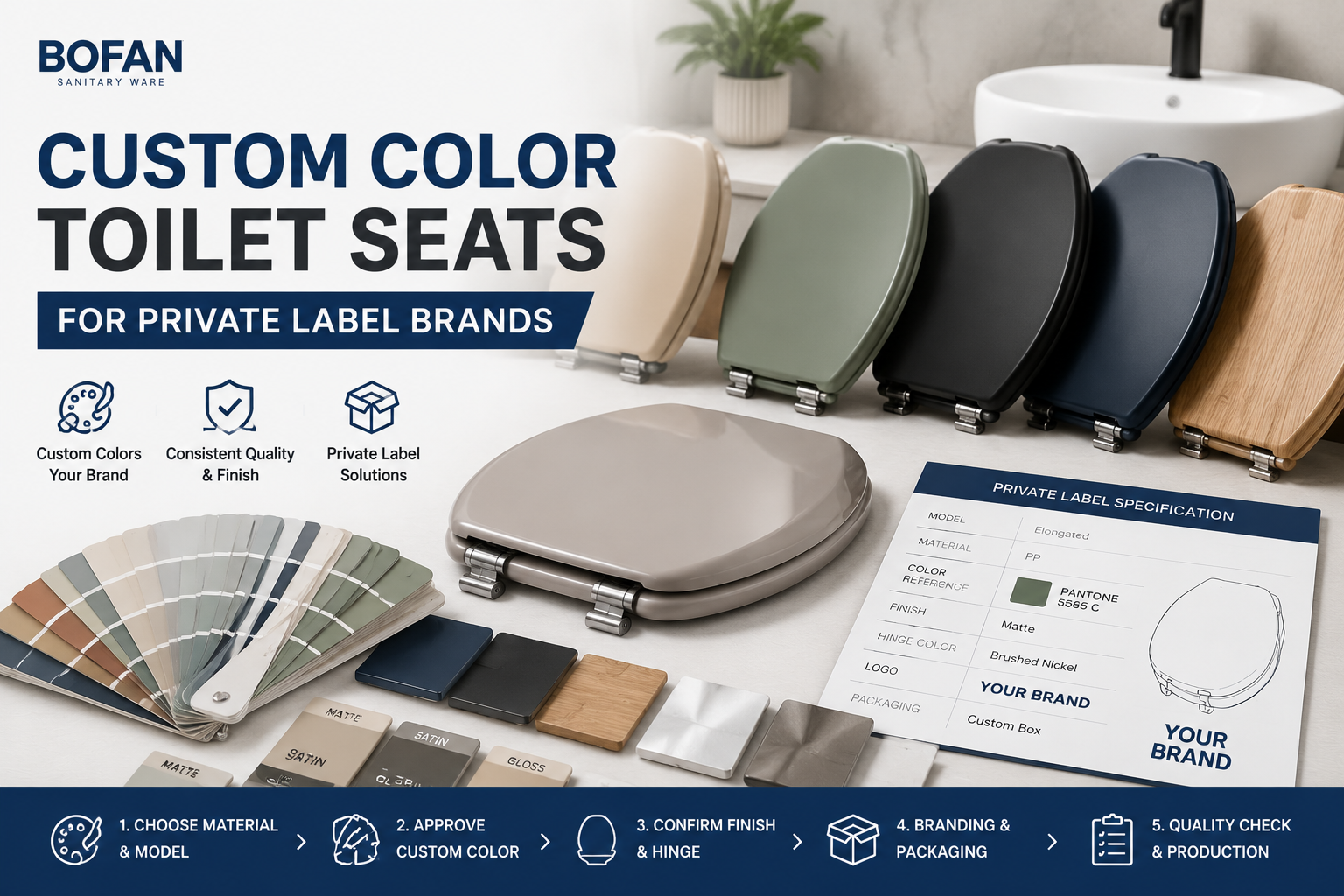
Custom Color Toilet Seats for Private Label Brands
A custom color toilet seat should be developed from a controlled physical or numerical color reference, not from a photograph or an informal description such as beige, grey or matte black. The final result also depends on the seat material, production process, surface finish, lighting and approved tolerance. Private-label buyers should first select the product model and material, then approve a color sample using the intended gloss or texture. The production specification should record the color reference, sample number, finish, hinge color, logo and packaging so that bulk and repeat orders can be compared with the same standard.
Why Is a Custom Color More Than a Visual Choice?
Color is part of the complete product specification.
A custom-colored toilet seat must coordinate with:
- The ceramic toilet
- Bathroom furniture
- Faucets or accessories
- The brand’s product collection
- The intended price position
- The retail or project environment
- The hinge and fixing appearance
- Packaging photography and artwork
A color that looks appropriate on a computer screen may appear different on PP, UF or coated MDF. The same nominal color can also look different under warm showroom light, daylight and cool commercial lighting.
For this reason, a buyer should not approve color only from:
- A mobile-phone photograph
- A website image
- A screenshot
- A verbal color name
- A printed catalogue without a controlled reference
- A sample made from a different material or finish
BOFAN’s private-label toilet seat manufacturing guide explains how material, color, hinges, branding and packaging form one connected private-label program.
Which Toilet Seat Materials Support Custom Colors?
PP, UF and MDF can all support color-related customization, but they do not use the same production or finishing process.
PP toilet seats
PP toilet seats may use colored material prepared for the molding process. The selected color therefore needs to be evaluated on the final molded product.
Buyers should inspect:
- Overall color
- Molding consistency
- Visible flow or surface variation
- Seat and lid color agreement
- Hinge color
- Buffers and plastic accessories
- Appearance at edges and recessed areas
Product structure and surface texture can influence how the same color appears.
UF toilet seats
UF toilet seats can support selected colors depending on the product and production arrangement.
The hard, smooth surface can create a clean and refined appearance. However, the buyer should confirm the color on the actual UF material rather than applying a PP or printed reference automatically.
Check:
- Surface uniformity
- Seat-to-lid color consistency
- Edge appearance
- Chips or exposed areas
- Hinge coordination
- Gloss level
- Agreement with the approved sample
MDF and wooden toilet seats
MDF and wooden toilet seats can support painted, printed, wood-effect and decorative surfaces.
For MDF, inspect:
- Paint or coating color
- Gloss
- Edge coverage
- Underside color
- Hinge-area finish
- Printed-pattern position
- Surface particles or paint defects
- Exposed core material
The color reference must be connected to the coating and finishing process. A painted MDF color should not be assumed to match a molded PP color perfectly.
How Should a Buyer Define the Target Color?
A useful color specification should include more than a name.
The buyer may provide:
- A physical color chip
- A recognized color-system reference
- A ceramic sample
- A furniture or accessory sample
- A signed painted panel
- An approved previous product
- Numerical color data where the parties agree on the method
The specification should also identify:
- Material
- Surface finish
- Gloss or matte appearance
- Viewing conditions
- Acceptable comparison method
- Whether the seat and lid must be evaluated separately
- Whether accessories must match or coordinate
- Which physical sample has final authority
A reference called “warm grey” remains subjective. Two people may interpret it differently.
If the product must coordinate with a ceramic toilet, send the actual ceramic color sample where practical. White ceramics can vary in tone, and a seat that is technically white may still appear warmer, cooler or brighter than the bowl.
How Do Matte and Gloss Finishes Change Color?
Finish changes how light is reflected and therefore changes perceived color.
Gloss finish
A gloss surface may appear:
- Brighter under direct light
- Darker in reflections
- More sensitive to visible surface variation
- More aligned with glossy ceramic or furniture
Matte finish
A matte surface may appear:
- Softer
- Less reflective
- Slightly different in color depth
- More dependent on texture consistency
Textured finish
Texture can create highlights and shadows that affect perceived color. A textured PP surface should be approved on the final product rather than from a flat printed card alone.
| Finish | Main visual effect | Suitable starting application | Main inspection point |
|---|---|---|---|
| High gloss | Reflective and decorative | Glossy ceramic or premium retail | Surface uniformity and visible defects |
| Standard gloss | Balanced commercial appearance | Mainstream bathroom ranges | Batch consistency |
| Matte | Soft, contemporary appearance | Modern private-label collections | Texture and cleaning evaluation |
| Wood effect | Decorative and traditional | MDF or selected coated products | Pattern and edge consistency |
| Printed design | Strong visual differentiation | Themed or retail collections | Registration and repeatability |
The finish should follow the brand concept and cleaning environment, not only current design trends.
Which Colors Fit Different Private-Label Scenarios?
| Buyer scenario | Practical color direction | Main commercial consideration |
|---|---|---|
| Mainstream retail | White, off-white or controlled neutrals | Broad compatibility |
| Premium bathroom brand | Coordinated white, black or modern neutral | Brand and ceramic alignment |
| Boutique hospitality | Warm neutrals or decorative finish | Interior-design consistency |
| E-commerce brand | Visually distinctive but clearly photographed colors | Screen-to-product expectation |
| Sanitary ware brand | Exact or coordinated ceramic colors | Physical matching |
| Children’s collection | Selected bright or soft colors | Market positioning and claim control |
| Heritage collection | Cream, wood effect or traditional finish | Decorative appearance |
| Modern matte range | Black, grey or muted color | Surface and cleaning validation |
| Project program | Small standardized color range | Replacement and batch control |
| Market test | Existing factory color before full customization | Lower development complexity |
A private-label brand does not necessarily need many colors. Every additional color may create separate sampling, MOQ, inventory and repeat-order requirements.
A controlled core palette is usually easier to purchase and manage than a large collection of similar shades.
How Should a Custom-Color Sample Be Developed?
A structured sample process reduces subjective decisions.
Step 1: Freeze the product platform
Confirm:
- Product model
- Material
- Seat and lid structure
- Hinge
- Fixings
- Buffers
- Intended finish
Changing the product or material after color approval may change the appearance.
Step 2: Submit the color reference
Identify the controlling reference and whether it is a target match or a coordinated color.
Step 3: Prepare the first sample
The factory prepares the color using the proposed material and process.
Step 4: Review under controlled conditions
Compare the sample under neutral lighting and, where relevant, the intended showroom or bathroom lighting.
Step 5: Install beside the ceramic
If ceramic coordination is important, install or position the sample beside the actual bowl.
Step 6: Record corrections
Avoid comments such as “a little nicer.” Use more precise feedback, such as warmer, cooler, lighter, darker, less gloss or more neutral.
Step 7: Approve the physical reference
Record the sample number, date, material, finish and approving person.
Why Can the Same Color Look Different Under Different Light?
Color appearance depends partly on light.
A product may be viewed under:
- Daylight
- Warm residential lighting
- Cool showroom lighting
- Retail lighting
- Warehouse lighting
- Photography lights
Two samples that appear similar under one light source may appear less similar under another.
Buyers should therefore define the most relevant viewing environment.
For a sanitary ware brand, the important comparison may be the seat beside the ceramic in a showroom. For an e-commerce brand, photography and realistic image editing also matter. For a hotel project, the actual bathroom lighting may influence approval.
This does not mean the manufacturer can control every viewing condition. It means the approval method should be documented and commercially relevant.
How Should Hinge and Accessory Colors Be Coordinated?
The seat color is only one visible part of the product.
Review:
- Hinge caps
- Release buttons
- Plastic bases
- Metal finish
- Buffers
- Fixing covers
- Logo
- Labels
- Installation components visible after fitting
Possible approaches include:
- Matching the seat color
- Using a standard neutral
- Using a coordinated metal finish
- Creating intentional contrast
The selected hinge must also remain technically compatible with the seat model. A buyer should not change the hinge only to improve color coordination without checking fit, function and stability.
Photographs of the complete installed product provide a stronger approval reference than isolated material samples.
What Determines MOQ and Custom-Color Cost?
Custom color may affect:
- Material preparation
- Production setup
- Cleaning between colors
- Coating preparation
- Sample revisions
- Color-specific components
- Packaging photography
- Separate SKU labels
- Inspection
- Production quantity per color
- Remaining custom material
The BOFAN MOQ guide for toilet seat importers explains how material, model, color and packaging can affect minimum quantities.
Buyers should ask separately:
- What is the MOQ for the product model?
- What is the MOQ for each custom color?
- Does the hinge color create another MOQ?
- Does branded packaging have a separate MOQ?
- Can colors be combined in one shipment?
- How will each color be identified?
There is no universal custom-color price or MOQ. It depends on the material, process, quantity and selected model.
How Should Bulk Color Consistency Be Inspected?
The approved sample must become a controlled production reference.
Inspection should cover:
- Correct color code
- Material
- Finish
- Gloss
- Seat and lid agreement
- Visible color variation
- Hinge and accessory color
- Surface defects
- Edges and underside
- Logo
- Packaging label
- SKU identification
BOFAN’s quality-control process provides the wider dimensional, surface, hinge, functional and packaging framework.
The buyer and manufacturer should agree:
- Comparison lighting
- Viewing distance
- Physical reference
- Instrumental method, if required
- Sampling method
- Acceptance criteria
- Defect classification
Photographs can document a problem but should not replace the approved physical color reference because screens and cameras alter appearance.
How Should Custom-Color Packaging Be Managed?
The packaging must show and identify the correct product.
Check:
- Product photograph
- Color name
- Color code
- Buyer SKU
- Barcode
- Box or label artwork
- Master-carton marking
- Mixed-color carton rules
- Hardware kit
- Instructions
An e-commerce or retail image should represent the actual product without excessive editing. If color may vary under different screens or lighting, the brand can provide an appropriate notice without weakening the product presentation.
Inside the package, protect the finished surface from:
- Metal hinges
- Loose bolts
- Abrasive carton surfaces
- Movement
- Contact between stacked parts
This is especially important for decorative and coated finishes.
How Can Brands Maintain Color Across Repeat Orders?
Repeat-order color should not depend on memory.
Retain:
- Product model
- Material
- Color code
- Physical approved sample
- Finish and gloss
- Hinge code
- Accessory colors
- Logo
- Packaging artwork
- Inspection method
- Previous batch references
- Approved changes
Before production, confirm whether the same material, finish and components remain available.
If the process or component changes, the buyer may need to approve a new sample.
No manufacturer should promise that visual color can never vary. The practical objective is to define the reference, control the process and keep variation within the agreed acceptance method.
For long-term programs, the brand should also decide whether new production must match an original reference or a recent approved production sample.
What Should Buyers Include in a Custom-Color RFQ?
Provide:
- Target market
- Sales channel
- Product model
- Material
- Quantity per color
- Physical or numerical color reference
- Finish
- Gloss requirement
- Ceramic sample or reference
- Hinge color
- Logo
- Packaging
- Barcode and SKU
- Required color-comparison method
- Sample-revision process
- Inspection criteria
- Repeat-order expectations
A vague request for “a premium beige seat” does not give the manufacturer enough information to quote or sample accurately.
How Does BOFAN Support Custom-Color Private-Label Projects?
BOFAN’s OEM toilet seat solutions support suitable PP, UF and MDF private-label programs.
Support may include:
- Product-platform selection
- Material and finish discussion
- Color-reference review
- Ceramic coordination
- Hinge and accessory selection
- Sample preparation
- Logo and packaging coordination
- Surface and color inspection
- Export packing
- Specification records for repeat orders
The BOFAN guide to choosing a custom toilet seat supplier for private-label brands provides additional supplier-selection context.
Exact colors, finishes, MOQ, sample arrangements and production feasibility depend on the selected model and process.
What Is the Best Way to Start a Custom-Color Project?
Start with one approved product platform and one controlling color reference.
Confirm the material, hinge and finish before requesting multiple color samples. Review the sample beside the intended ceramic and under commercially relevant lighting.
Send BOFAN the product model, material, color reference, finish, quantity, hinge requirements and packaging information to receive a custom-color feasibility review.
4. FAQ
Can toilet seats be manufactured in custom colors?
Suitable PP, UF and MDF toilet seat models can support selected colors or decorative finishes. Feasibility depends on the material, product, process, quantity and required appearance.
What is the best way to specify a toilet seat color?
Use a physical color standard, recognized color-system reference, ceramic sample or approved product. The specification should also identify the material, finish and gloss.
Why does a toilet seat color look different from a screen image?
Screens, cameras and lighting alter perceived color. The final decision should therefore use an approved physical sample made from the intended material and finish.
Can PP, UF and MDF use the same color?
They may use coordinated colors, but the final appearance can differ because the materials and production processes are different. Each material should be sampled and approved separately.
Does a custom color increase the MOQ?
It may. Color-specific material preparation, production setup, components and packaging can create separate minimum quantities. The buyer should confirm MOQ per product, color and hinge.
How should color consistency be checked during production?
Compare sampled production units with the approved physical reference under agreed viewing conditions. Check the seat, lid, hinges, accessories, finish and packaging identification.
Can BOFAN support custom-color private-label toilet seats?
BOFAN supports suitable PP, UF and MDF programs with color, finish, hinge, logo and packaging options. Final feasibility and MOQ depend on the selected model and requirements.
Table of Contents
- Custom Color Toilet Seats for Private Label Brands
- Why Is a Custom Color More Than a Visual Choice?
- Which Toilet Seat Materials Support Custom Colors?
- How Should a Buyer Define the Target Color?
- How Do Matte and Gloss Finishes Change Color?
- Which Colors Fit Different Private-Label Scenarios?
- How Should a Custom-Color Sample Be Developed?
- Why Can the Same Color Look Different Under Different Light?
- How Should Hinge and Accessory Colors Be Coordinated?
- What Determines MOQ and Custom-Color Cost?
- How Should Bulk Color Consistency Be Inspected?
- How Should Custom-Color Packaging Be Managed?
- How Can Brands Maintain Color Across Repeat Orders?
- What Should Buyers Include in a Custom-Color RFQ?
- How Does BOFAN Support Custom-Color Private-Label Projects?
- What Is the Best Way to Start a Custom-Color Project?
-
4. FAQ
- Can toilet seats be manufactured in custom colors?
- What is the best way to specify a toilet seat color?
- Why does a toilet seat color look different from a screen image?
- Can PP, UF and MDF use the same color?
- Does a custom color increase the MOQ?
- How should color consistency be checked during production?
- Can BOFAN support custom-color private-label toilet seats?