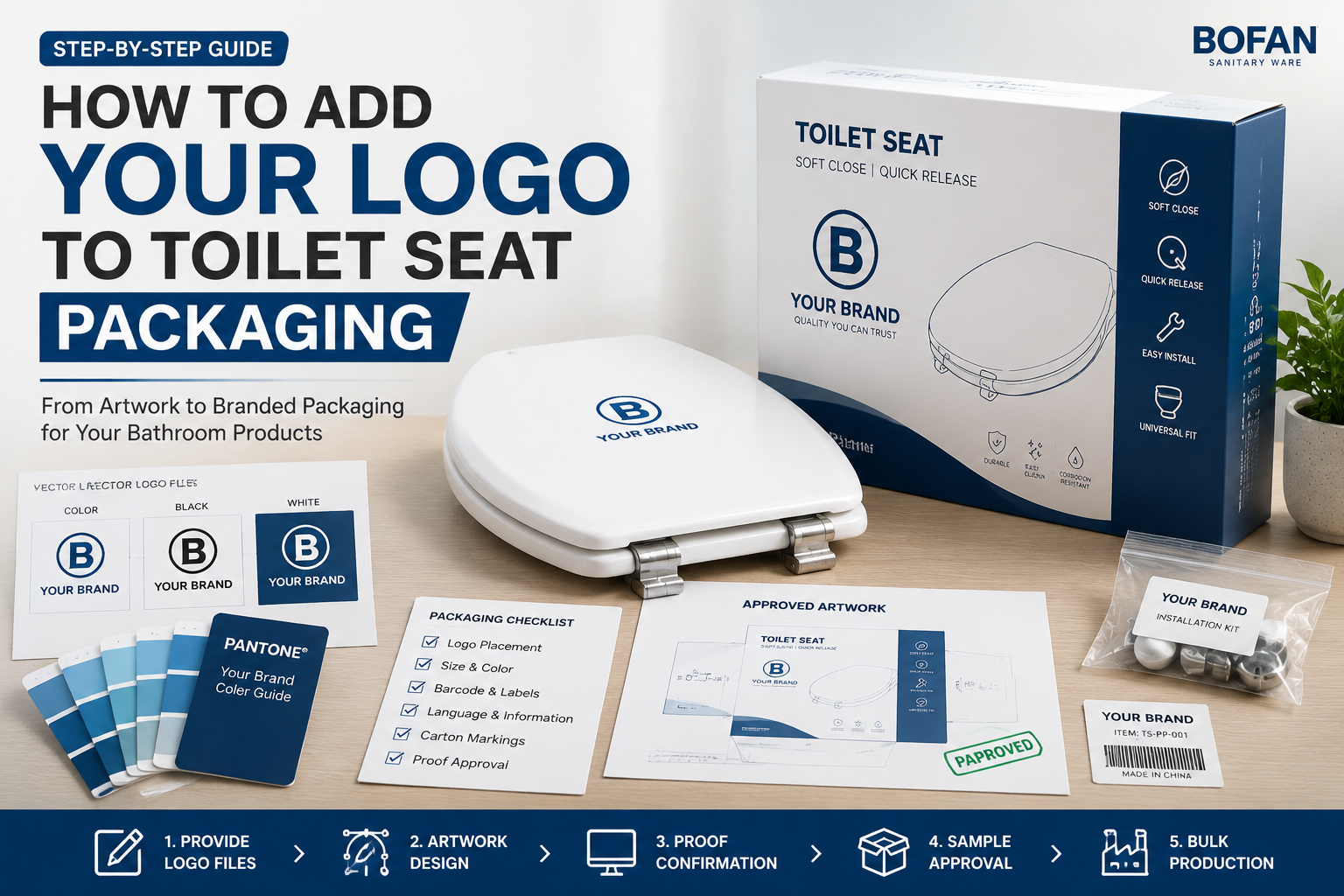
How to Add Your Logo to Toilet Seat Packaging
To add a logo to toilet seat packaging, first confirm the product model, sales channel and packaging format. Provide the manufacturer with a vector logo, brand colors, minimum-size rules and approved artwork. The logo may appear on a printed retail box, sleeve, label, instruction sheet or master carton, depending on the program. Buyers should review a digital proof and approve a physical packed sample before bulk production. The final specification must identify the logo version, position, dimensions, color reference, barcode, languages and carton markings so that future orders reproduce the approved result.
Why Should Packaging Branding Begin With the Product and Channel?
Logo placement should not be designed in isolation.
The packaging must first suit:
- The toilet seat model
- Product dimensions
- Product weight
- Hinge and fixing components
- Surface protection
- Retail, wholesale, project or e-commerce handling
- Local information requirements
- The buyer’s brand position
A premium UF quick-release seat may use a different packaging presentation from a cost-controlled PP wholesale product. An e-commerce package may prioritize parcel protection, while a retail package must communicate the product clearly on a shelf.
BOFAN’s private-label toilet seat manufacturing guide explains how product, branding and packaging form one commercial specification.
Before developing artwork, confirm:
- Factory model
- Material
- Shape
- Dimensions
- Hinge and hardware
- Individual package
- Master-carton quantity
- Target market
- Sales channel
Otherwise, the buyer may create artwork for a box that does not fit the approved product.
Where Can a Logo Appear?
The logo can appear on several packaging layers.
Individual retail box
A printed box provides the strongest visual brand presentation. It may carry the logo, product name, photographs, features, fit information, instructions and barcode.
Printed sleeve
A sleeve can add brand identity around a neutral or standardized box. It may be useful when the product requires branded presentation but the complete box does not need custom printing.
Adhesive label
A label may carry a logo, product code and barcode. It can be suitable for controlled wholesale, market tests or programs with several product variations, subject to the packaging and quantity requirements.
Instruction sheet
The logo can appear on installation or care instructions. This reinforces the buyer’s identity after the package is opened.
Hardware bag
A small label or printed insert can identify the brand, product or installation kit. The method must not interfere with the hardware or product surface.
Master carton
The outer carton may use a logo, shipping mark, item number and handling information. Buyers should consider whether displaying the retail brand externally is commercially appropriate for the shipment.
One project can combine several of these methods, but every printed element must use the same approved brand identity.
Which Logo Application Method Should Buyers Choose?
| Method | Main advantage | Suitable use | Main limitation to check |
|---|---|---|---|
| Full printed retail box | Strong shelf presentation | Retail chains and branded stores | Artwork, print quantity and color control |
| Printed sleeve | Branded appearance with a standardized box | Mid-volume or multi-model programs | Sleeve fit and movement |
| Printed label | Flexible SKU and barcode control | Wholesale, trials and mixed assortments | Adhesion, position and perceived value |
| One-color carton print | Clear trade identification | Wholesale and project cartons | Limited graphic detail |
| Branded instruction sheet | Brand visibility after opening | All channels requiring instructions | Language and revision control |
| Printed insert or card | Adds features and brand story | Retail and e-commerce | Must remain secure in the package |
| Neutral package plus label | Lower-complexity brand entry | Market testing | Less differentiated presentation |
The correct method depends on quantity, channel, brand position and available packaging process.
The supplier should confirm which printing and labeling methods are available for the chosen box material and order configuration. Buyers should not assume that every logo technique is suitable for every carton surface.
What Logo Files Should the Buyer Provide?
A clear artwork package reduces errors.
Provide:
- Vector logo file
- Approved color logo
- Black version
- White or reversed version
- Minimum permitted size
- Clear-space requirement
- Brand color references
- Approved fonts
- Trademark symbols where required
- Prohibited logo treatments
- Brand guideline document
Common design files may include AI, EPS, editable PDF or another vector format accepted by the packaging supplier. A high-resolution raster file may support reference, but it is not always suitable as the master artwork.
Avoid sending only:
- A logo copied from a website
- A screenshot
- A low-resolution JPEG
- A photograph of existing packaging
- An unapproved social-media logo
- Several files with unclear version names
The manufacturer should identify the file used in the proof. The buyer should control which logo is current.
How Should Logo Size and Position Be Specified?
Instructions such as “make the logo larger” are too subjective for production.
The artwork approval should identify:
- Panel or surface
- Horizontal and vertical position
- Logo width and height
- Distance from box edges
- Orientation
- Background color
- Color version
- Relationship to product name
- Relationship to barcode and regulatory text
- Minimum clear space
For a retail box, common logo locations may include the main display panel, top flap and side panels. The buyer should decide which panel customers will see first.
For a wholesale carton, the logo should not reduce the clarity of the SKU, quantity or shipping mark.
The physical box structure matters. Avoid placing critical logo elements over:
- Folds
- Cutting lines
- Glue areas
- Carton closures
- Barcode quiet zones
- Areas commonly covered by shipping labels
The manufacturer should prepare a dieline or artwork template for the approved packaging format.
What Other Information Should Appear on the Package?
A logo alone does not create market-ready packaging.
Depending on the channel and target market, the package may need:
- Brand name
- Product name
- Model number
- Material
- Shape
- Product dimensions
- Hinge features
- Fixing method
- Package contents
- Installation instructions
- Care guidance
- Compatibility information
- Barcode
- Batch or traceability field
- Country-of-origin information where required
- Importer or responsible-party information where required
- Recycling or disposal information where applicable
- Warnings required by the buyer’s market
The buyer is responsible for defining the legally required market information with appropriate local advice. The manufacturer can support artwork execution but should not be expected to determine every legal statement automatically.
Avoid unsupported claims such as:
- Fits every toilet
- Unbreakable
- Chemical-proof
- Lifetime durability
- Certified for every market
- Antibacterial, unless specifically supported
- Load claims without model-specific evidence
Every feature statement should match the supplied product.
Which Packaging Format Fits Each Sales Channel?
| Sales channel | Recommended starting format | Branding priority |
|---|---|---|
| Retail chain | Printed color box | Shelf recognition and feature communication |
| Bathroom showroom | Branded box or sleeve | Premium presentation |
| Wholesale distributor | Neutral or branded individual protection | SKU identification and handling |
| E-commerce | Protective parcel-ready box | Product protection and clear instructions |
| Construction project | Protective package with project labels | Building, floor or SKU identification |
| Hotel renovation | Protective carton with room or phase coding | Site distribution |
| Sanitary ware brand | Coordinated branded box | Match the ceramic product family |
| Market test | Standard box with controlled branded label | Lower-complexity validation |
| Premium private label | Full-color box with brand system | Differentiation and unboxing experience |
These are commercial starting points. The packed sample and logistics route must still be evaluated.
How Should Product Material Influence Packaging?
Different products create different protection and presentation requirements.
PP products
PP toilet seats are generally lower in weight, but the product surface, hinges and fixing components still require separation and protection.
UF products
UF toilet seats have a hard surface that should be protected from impact and contact with loose metal parts.
MDF products
MDF and wooden toilet seats may require careful surface, edge and hinge-area protection. Decorative finishes should not rub against hardware or abrasive carton surfaces.
For every material:
- Secure the hinge and fixing kit.
- Prevent metal-to-surface contact.
- Separate instructions from damaging components.
- Confirm movement inside the box.
- Check the closing method.
- Review the packed product rather than the empty carton.
Logo quality is irrelevant if the product arrives scratched or incomplete.
How Should Brand Colors Be Controlled?
Screens do not display color consistently. A buyer should not approve an exact packaging color from an informal screenshot alone.
The artwork process may use:
- Defined spot-color reference
- CMYK values
- Approved printed sample
- Brand color standard
- Signed proof
The buyer should state which reference controls the final decision.
Color can vary according to:
- Carton material
- White or kraft background
- Coating
- Printing process
- Ink
- Lighting
- Print batch
The manufacturer should explain what can be controlled and what normal production variation may occur.
If exact brand consistency is commercially important, the physical proof or approved printed reference should form part of the packaging specification.
What Is the Difference Between a Digital Proof and a Physical Sample?
A digital proof confirms layout content. It can show:
- Logo position
- Text
- Product images
- Barcode placement
- Panel order
- Dieline alignment
It does not fully confirm:
- Printed color
- Carton feel
- Surface finish
- Box strength
- Folding accuracy
- Product fit
- Hardware protection
- Final shelf appearance
A physical packed sample provides stronger validation.
The approval process should include:
- Review the artwork against the brief.
- Check spelling, dimensions and feature claims.
- Verify logo version and color references.
- Scan the barcode where possible.
- Review a physical printed sample.
- Pack the final seat and hardware.
- Check movement and protection.
- Confirm the master carton.
- Record the approved artwork revision.
How Should Barcodes and SKU Labels Be Managed?
Barcode and SKU errors can make an otherwise acceptable order unusable for the buyer’s warehouse or retail system.
The buyer should provide:
- Barcode number
- Barcode type
- Buyer SKU
- Product description
- Color
- Size or shape
- Hinge configuration
- Country or channel assignment
- Label dimensions
- Placement
- Required human-readable text
The proof should be checked visually and scanned where practical.
Similar-looking seats require clear differentiation. Two white products may use different lengths, hinge ranges or fixing systems.
Do not rely on product appearance alone. Each package and master carton should identify the exact SKU.
A master label may also need:
- Purchase-order number
- Factory model
- Buyer item number
- Quantity
- Net and gross weight
- Carton dimensions
- Carton sequence
- Destination or project code
How Should Multiple Languages Be Controlled?
Multilingual packaging requires controlled source text.
The buyer should provide or approve the translations. The artwork reviewer should check:
- Correct language
- Complete sentences
- Special characters
- Line breaks
- Font support
- Product terminology
- Safety information
- Installation steps
- Contact details
Machine-translated text should not be placed into production without buyer review.
Keep one master language table showing the approved text for each panel. If a translation changes, update the artwork revision and confirm whether existing printed materials may still be used.
How Should Product Photographs and Feature Icons Be Approved?
Product images must represent the actual configuration inside the box.
Confirm that photographs show the correct:
- Seat shape
- Material
- Color
- Hinge
- Release button
- Lid design
- Fixing system
- Product proportions
Do not show a quick-release button on packaging when the supplied model uses a fixed hinge. Do not use a UF surface image to represent an MDF product.
Feature icons should also be specific. Terms such as soft close, quick release, top fix and bottom fix must match the production configuration.
The buyer should retain the approved image files and identify them in the artwork folder.
How Should the Logo Be Checked During Bulk Production?
Logo and packaging checks should be included in the production inspection.
BOFAN’s quality-control process provides the broader product-inspection framework.
Packaging checkpoints should cover:
- Correct artwork revision
- Correct logo
- Logo position
- Print clarity
- Approved colors
- Spelling
- Product image
- Feature claims
- Barcode
- SKU
- Instructions
- Box dimensions
- Box closure
- Hardware protection
- Quantity per carton
- Shipping marks
Inspectors should compare production with the approved physical sample or controlled artwork.
How Should Artwork Revisions Be Controlled?
Packaging errors often occur when an old file enters production.
Use a clear naming and approval system containing:
- Brand
- Product SKU
- Packaging type
- Language
- Revision number
- Approval date
- Status
For example, the file name should distinguish a draft from an approved production file.
The controlled record should identify:
- Superseded artwork
- Current artwork
- Approved logo
- Barcode data
- Product images
- Instruction revision
- Approving person
- Effective order
Old printed packaging should be counted and separated. The buyer and manufacturer should agree whether it may be used, modified or discarded.
A repeat order should always reference the current artwork revision.
What Packaging Mistakes Should Buyers Avoid?
Common mistakes include:
- Sending only a low-resolution logo
- Approving artwork before confirming the product
- Using the wrong product photograph
- Omitting the hinge or fixing configuration
- Placing the logo across a fold
- Failing to test the barcode
- Using unsupported product claims
- Omitting installation instructions
- Leaving hardware loose inside the box
- Using identical labels for different models
- Approving color only from a phone screen
- Failing to retain the approved revision
- Assuming one package works for retail and e-commerce
Each mistake can be prevented through a controlled proof and packed-sample process.
What Should Buyers Send for a Packaging Quotation?
Provide:
- Product model
- Product dimensions
- Quantity by SKU
- Sales channel
- Destination market
- Existing or new packaging format
- Logo vector file
- Brand guidelines
- Color references
- Required languages
- Barcode information
- Product photographs
- Feature text
- Individual package requirement
- Master-carton requirement
- Instructions
- Labeling requirements
- Sample-approval process
- Inspection criteria
BOFAN’s detailed guide to packaging customization for OEM toilet seat orders can be used as a broader project checklist.
How Does BOFAN Support Branded Toilet Seat Packaging?
BOFAN’s OEM toilet seat solutions support suitable private-label, OEM and ODM programs.
Packaging support may include:
- Product and box matching
- Logo-file review
- Artwork-template coordination
- Color and position confirmation
- Barcode and SKU coordination
- Instruction-sheet preparation
- Retail, wholesale or project packaging options
- Packed-sample approval
- Packaging inspection
- Master-carton identification
- Repeat-order artwork records
Exact packaging formats, printing processes, MOQ, sampling arrangements and production requirements depend on the selected product and artwork.
What Is the Best Way to Start?
First freeze the toilet seat model, hinge and fixing kit. Then select the packaging format that suits the sales channel.
Send BOFAN:
- The product model or required product level
- Logo vector files
- Brand colors
- Sales channel
- Target market
- Packaging reference
- Quantity
- Barcode and language requirements
BOFAN can review the information and confirm a suitable product-and-packaging development process before artwork moves into production.
4. FAQ
What file format is best for a packaging logo?
A vector file such as AI, EPS or editable PDF is normally preferable because it can be resized without losing clarity. The buyer should also provide approved colors and logo-spacing rules.
Can a logo be added to a standard toilet seat box?
A logo may be added through a printed label, sleeve, insert or other approved method, depending on the box and project requirements. The manufacturer should confirm feasibility before artwork approval.
Does private-label toilet seat packaging require a printed color box?
No. Wholesale, project or market-test programs may use neutral boxes with controlled branded labels or inserts. Retail brands often benefit from fuller printed presentation.
What should be approved before printing toilet seat boxes?
Approve the product model, box dimensions, artwork, logo version, colors, photographs, claims, barcode, languages and instructions. A physical packed sample provides stronger validation than a digital proof alone.
How can buyers prevent the wrong logo from being printed?
Use a controlled artwork revision with a clear filename, approval date and product SKU. Old files and printed materials should be separated from the current approved version.
Should the barcode be tested before production?
Yes. The buyer should verify the barcode data and scan the proof or sample where practical. Barcode position and print clarity should also be checked during bulk inspection.
Can BOFAN support branded packaging for PP, UF and MDF seats?
BOFAN supports suitable product programs with logo, label, instruction and packaging options. The available format, MOQ and production arrangement depend on the seat model, quantity and artwork.
Table of Contents
- How to Add Your Logo to Toilet Seat Packaging
- Why Should Packaging Branding Begin With the Product and Channel?
- Where Can a Logo Appear?
- Which Logo Application Method Should Buyers Choose?
- What Logo Files Should the Buyer Provide?
- How Should Logo Size and Position Be Specified?
- What Other Information Should Appear on the Package?
- Which Packaging Format Fits Each Sales Channel?
- How Should Product Material Influence Packaging?
- How Should Brand Colors Be Controlled?
- What Is the Difference Between a Digital Proof and a Physical Sample?
- How Should Barcodes and SKU Labels Be Managed?
- How Should Multiple Languages Be Controlled?
- How Should Product Photographs and Feature Icons Be Approved?
- How Should the Logo Be Checked During Bulk Production?
- How Should Artwork Revisions Be Controlled?
- What Packaging Mistakes Should Buyers Avoid?
- What Should Buyers Send for a Packaging Quotation?
- How Does BOFAN Support Branded Toilet Seat Packaging?
- What Is the Best Way to Start?
-
4. FAQ
- What file format is best for a packaging logo?
- Can a logo be added to a standard toilet seat box?
- Does private-label toilet seat packaging require a printed color box?
- What should be approved before printing toilet seat boxes?
- How can buyers prevent the wrong logo from being printed?
- Should the barcode be tested before production?
- Can BOFAN support branded packaging for PP, UF and MDF seats?