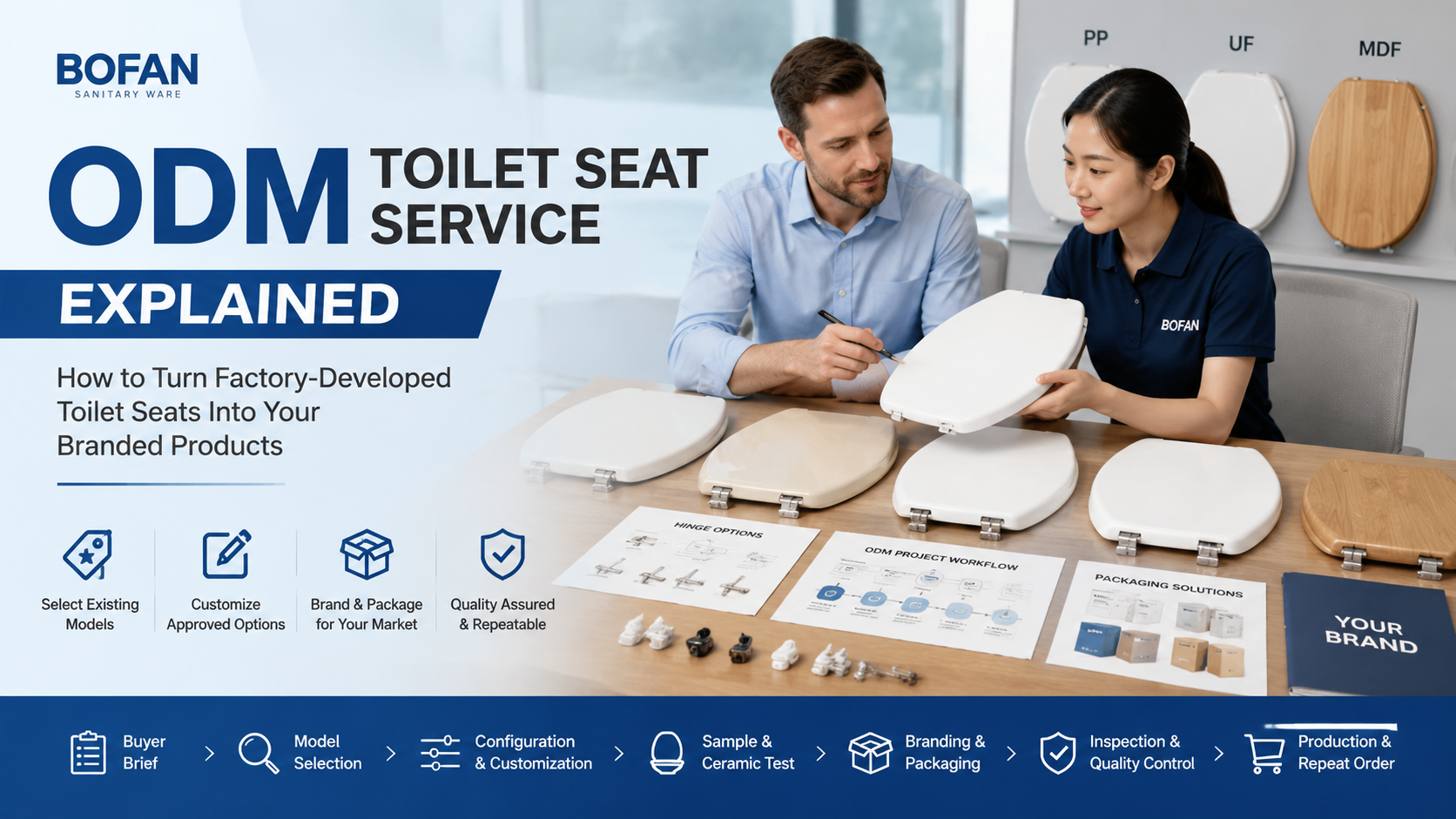
ODM Toilet Seat Service Explained
An ODM toilet seat service allows a buyer to select a factory-developed product and adapt it for a target market through approved options such as material, hinge, color, logo, instructions and packaging. Because the core product structure or mold already exists, ODM can reduce development complexity compared with creating a new product from the beginning. However, it is not an uncontrolled catalogue purchase. Buyers must still verify ceramic fit, approve the production configuration, test samples, review packaging and document quality criteria. A successful ODM program turns an existing factory model into a repeatable, market-appropriate branded product.
What Is an ODM Toilet Seat Service?
ODM means original design manufacturing. In a toilet seat ODM project, the manufacturer provides an existing product design, structure or mold that the buyer can select and adapt.
The buyer does not normally begin with a completely new engineering concept. Instead, the project starts from a product that the factory has already developed.
Depending on the available model, an ODM service may support choices involving:
- PP, UF or MDF material
- Round, elongated, D-shaped or other established shapes
- Standard or soft-close hinges
- Quick-release options
- Top-fix or bottom-fix hardware
- Approved colors and finishes
- Logo application
- Instruction sheets
- Barcode and product labels
- Retail or wholesale packaging
The exact customization boundary depends on the model. Changing the core geometry, mounting structure or mold may move the project beyond standard ODM and into deeper OEM or custom development.
BOFAN’s existing OEM versus ODM toilet seat guide explains the general difference between the two cooperation models.
Who Should Choose an ODM Toilet Seat Program?
ODM is often practical for buyers who need an established product base without creating every technical element themselves.
Suitable buyers may include:
- Importers entering a new toilet seat category
- Distributors adding a private-label range
- Retailers testing a new price tier
- E-commerce brands expanding into bathroom products
- Sanitary ware companies needing a compatible existing seat
- Project suppliers requiring a controlled standard model
- Brands that need a shorter development path
- Buyers that do not require exclusive product geometry
ODM can also support market testing. A buyer may begin with one or two factory-developed models, collect sales and fit feedback, and then decide whether deeper product development is commercially justified.
ODM is less suitable when the buyer requires:
- A unique shape
- A dedicated ceramic-to-seat design
- Exclusive product architecture
- A new mold
- A proprietary hinge system
- Material or structural changes outside established options
In these situations, an OEM or custom mold-development process may be more appropriate.
What Information Does an ODM Manufacturer Need?
A factory catalogue is not enough to select the correct product. The manufacturer needs a commercial and technical brief.
The buyer should provide:
- Target country
- Buyer type
- Wholesale, retail, project or e-commerce channel
- Intended price level
- Expected quantity by model
- Common ceramic shapes
- Bowl drawings or measurements where available
- Material preference
- Required hinge functions
- Color and finish
- Branding requirements
- Individual packaging
- Master-carton requirements
- Installation instructions
- Required documents
- Inspection expectations
- Estimated repeat-order model
This information helps the supplier reduce the product list to commercially relevant options.
For example, an online replacement-seat brand may prioritize adjustable fit, clear instructions and parcel protection. A sanitary ware company may prioritize exact compatibility with its ceramic collections. A retail importer may need a clear good, better and best product structure.
How Does the ODM Toilet Seat Process Work?
A controlled ODM program normally follows several stages.
| Stage | Main buyer decision | Required output |
|---|---|---|
| Project brief | Define market, channel and product position | Written requirements |
| Product shortlist | Select suitable existing factory models | Model list and drawings |
| Configuration | Confirm material, hinge, fixings and color | Controlled specification |
| Sample | Review the complete physical product | Approved sample record |
| Ceramic test | Verify fit and installation | Installed photographs and comments |
| Branding | Approve logo, labels and packaging | Artwork proof |
| Quality planning | Define inspection and function criteria | Inspection checklist |
| Commercial confirmation | Confirm quantity, MOQ, terms and packing | Final quotation and order |
| Production | Manufacture against approved references | Production records |
| Final inspection | Check product and packaging | Inspection result |
| Repeat order | Reconfirm the approved configuration | Current specification revision |
Each stage should be completed before the next important commitment. Product, packaging and commercial discussions should not remain mixed in uncontrolled message threads.
How Should Buyers Select an Existing ODM Model?
The manufacturer should recommend products based on the application rather than simply send every available model.
BOFAN’s complete toilet seat range provides PP, UF, MDF, shape and hinge categories for an initial shortlist.
The buyer should compare:
- Product dimensions
- Inner opening
- Bowl shape
- Hinge-center range
- Mounting-hole requirements
- Fixing access
- Product material
- Product structure
- Hinge options
- Buffers
- Product and carton weight
- Packaging options
- Existing production status
- Required MOQ
- Repeat-order suitability
A model should have a clear commercial role. Selecting several visually similar products may fragment purchasing quantities and create unnecessary inventory.
For a first ODM range, a buyer might consider:
- A practical PP standard model
- A mainstream soft-close PP or UF model
- A differentiated UF quick-release model
- A decorative MDF product where the market supports it
The final assortment should follow actual channel demand.
Which Material Should an ODM Buyer Choose?
Material selection affects positioning, appearance, product structure and inspection.
PP
PP toilet seats can support cost-controlled, lightweight and practical product programs. Available factory models may use standard, soft-close or quick-release hinges.
ODM buyers should compare structure, molding, surface, alignment and installed stability—not only the PP material name.
UF
UF toilet seats provide a hard, smooth surface and a modern, ceramic-like appearance.
UF may suit mid-range and premium retail, sanitary ware collections, hotels and upgraded residential products. Buyers should inspect edges, chips, alignment, hinge mounting and packaging protection.
MDF
MDF and wooden toilet seats can support decorative colors, printed designs and traditional product positioning.
The ODM review should cover coating, edges, printed-pattern alignment, hinge areas and expected bathroom conditions.
No material is automatically best for every channel. The selected model should match market expectations, cleaning conditions, selling position and replacement strategy.
What Can Be Customized in an ODM Project?
Customization should be divided into established options and changes requiring new development.
Common established options
Depending on the selected model, these may include:
- Existing hinge alternatives
- Standard or soft-close function
- Quick-release option
- Top-fix or bottom-fix hardware
- Approved colors
- Logo application
- Labels
- Instructions
- Barcode placement
- Individual packaging
- Master-carton markings
Changes requiring further assessment
These may include:
- New dimensions
- New seat geometry
- Changed mounting structure
- Major product-weight changes
- New material combinations
- New hinge interfaces
- Exclusive surface processes
- Custom tooling
The manufacturer should explain whether the requested change remains within the established model or requires engineering, tooling, new samples or separate testing.
A buyer should not assume that every catalogue model supports every hinge or material combination.
Which ODM Approach Fits Different Buyer Scenarios?
| Buyer scenario | Practical ODM starting point | Main decision |
|---|---|---|
| New importer | One PP and one UF model | Reduce launch complexity |
| Regional distributor | Good/better/best assortment | Balance coverage and inventory |
| E-commerce brand | Adjustable soft-close model | Fit communication and parcel packaging |
| Retail chain | Established model with branded box | Shelf presentation and consistency |
| Sanitary ware brand | Existing model tested on brand ceramics | Exact compatibility |
| Hotel supplier | UF or PP soft-close model | Cleaning and guest experience |
| Project contractor | Standardized established model | Installation and repeatability |
| Decorative brand | Existing MDF finish platform | Surface design and packaging |
| Market test | Small controlled model range | Collect demand before deeper development |
These are starting frameworks. Quantity, MOQ, packaging and model availability must still be confirmed.
How Should Ceramic Compatibility Be Verified?
An existing ODM model is not automatically universal.
Buyers should provide:
- Bowl length
- Maximum width
- Mounting-hole spacing
- Hole diameter
- Distance from mounting holes to the front
- Bowl shape
- Rear clearance
- Top or underside access
- Photographs of the ceramic
Install the complete sample using the proposed production hinge and fixing kit.
Check:
- Front and side alignment
- Overhang
- Buffer contact
- Hinge adjustment
- Lateral stability
- Lid opening clearance
- Fixing access
- Soft-close operation
- Quick-release operation, if applicable
For a sanitary ware program, retain the ceramic model and installed photographs with the seat specification.
How Should the ODM Sample Be Approved?
The sample should represent the proposed production configuration.
Confirm:
- Factory model
- Material
- Color
- Dimensions
- Seat and lid structure
- Hinge code
- Fixing kit
- Buffers
- Logo
- Labels
- Instructions
- Packaging
A sample fitted with an upgraded presentation hinge should not approve a quotation based on a different production component.
The buyer should record:
- Sample number
- Review date
- Drawing revision
- Approved deviations
- Ceramic test result
- Packaging status
- Required corrections
- Final approval decision
If the product, hinge or packaging changes after approval, the supplier should provide a revised confirmation. The original sample cannot represent an altered configuration automatically.
How Should ODM Packaging Be Developed?
ODM packaging can turn an existing factory model into a buyer-specific commercial product.
Possible formats include:
- Neutral individual box
- Private-label retail box
- Product sleeve
- Printed insert
- Barcode label
- E-commerce package
- Protective wholesale package
- Project carton with site labels
BOFAN’s guide to packaging customization for OEM toilet seat orders also applies to many ODM branding projects.
Packaging should protect surfaces, separate metal hardware and keep instructions and fixings complete.
The buyer should approve:
- Box dimensions
- Logo position
- Artwork
- Product photographs
- Feature statements
- Fit information
- Barcode
- Languages
- Hardware position
- Master-carton quantity
- Shipping marks
Market claims and legally required information remain subject to the buyer’s destination-market review.
How Should ODM Quality Be Controlled?
Using an existing product does not remove the need for model-specific inspection.
BOFAN’s quality-control process covers material, dimensions, surfaces, hinges, functions and packaging.
An ODM inspection checklist should include:
- Correct model
- Approved material
- Dimensions
- Color and surface
- Chips, cracks or scratches
- Seat and lid alignment
- Hinge code
- Fixing completeness
- Soft-close performance
- Quick-release operation
- Logo position
- Packaging artwork
- Barcode and labels
- Carton quantity
- Shipping marks
The buyer and manufacturer should agree which checks are performed during production and which are part of final random inspection.
How Should Changes and Repeat Orders Be Managed?
ODM products can still change over time if components, packaging or production arrangements are revised.
The controlled file should contain:
- Buyer item number
- Factory model number
- Drawing revision
- Material
- Color
- Hinge code
- Fixing kit
- Logo file
- Packaging artwork
- Approved sample
- Inspection checklist
- Authorized changes
Before a repeat order, both parties should confirm that the approved configuration remains available.
Any proposed change to the material, hinge, fixings, color, logo process or packaging should be reviewed before production. If the change affects fit, function or appearance, a new sample may be required.
What Commercial Terms Should ODM Buyers Clarify?
Commercial confirmation should cover more than unit price.
Ask about:
- MOQ per model
- MOQ per color
- MOQ per hinge
- MOQ for branded packaging
- Sample arrangement
- Artwork preparation
- Packaging cost
- Tooling or setup requirements, if any
- Trade term
- Carton quantity
- Carton dimensions and weight
- Inspection arrangement
- Required documents
- Payment terms
- Production conditions
- Repeat-order requirements
No standard ODM price or schedule applies to every model. The manufacturer should quote after the product and customization scope are defined.
How Should Buyers Evaluate an ODM Manufacturer?
A suitable ODM toilet seat manufacturer should provide evidence in several areas.
| Evaluation area | Questions to ask |
|---|---|
| Product base | Are suitable existing models available? |
| Technical data | Are drawings and hinge ranges accurate? |
| Ceramic fit | Can samples be tested on the intended bowl? |
| Configuration | Are compatible materials and hinges clearly defined? |
| Samples | Does the sample match the quotation? |
| Packaging | Can the factory control artwork, labels and hardware? |
| Quality | Are model-specific inspections documented? |
| Change control | Are substitutions communicated before production? |
| Repeat orders | Are approved specifications retained? |
| Communication | Are risks and open points explained clearly? |
The best ODM partner is not the factory with the largest catalogue. It is the factory that can turn a relevant existing model into a controlled product for the buyer’s market.
How Does BOFAN Support ODM Toilet Seat Projects?
BOFAN’s OEM and ODM toilet seat solutions support brands, sanitary ware companies, importers and distributors.
ODM support may include:
- Existing-model shortlisting
- PP, UF and MDF material options
- Ceramic and dimensional review
- Hinge and fixing recommendations
- Color and finish selection
- Sample preparation
- Logo and packaging coordination
- Quality inspection
- Export packing
- Specification records for repeat orders
Exact products, customization, MOQ, testing, production arrangements and documentation depend on the selected model and market requirements.
Is ODM the Right Route for Your Toilet Seat Brand?
ODM is a practical route when the buyer wants to use an established product foundation while controlling market position, hinge configuration, branding and packaging.
It can reduce development complexity, but it still requires technical approval and specification control.
Send BOFAN your target market, sales channel, desired product level, ceramic information, quantity, hinge functions and packaging requirements. BOFAN can then prepare an existing-model shortlist for sample review.
4. FAQ
What is an ODM toilet seat service?
An ODM toilet seat service uses a product design or structure already developed by the manufacturer. The buyer selects a suitable model and may customize approved options such as hinges, colors, logos and packaging.
What is the difference between OEM and ODM toilet seats?
OEM is generally more buyer-led and may involve deeper product development. ODM begins with an existing manufacturer-developed model and normally offers a simpler customization path.
Can an ODM toilet seat carry my brand?
Yes, suitable ODM programs may support logo application, branded packaging, labels and instructions. The available methods and MOQ depend on the selected product and packaging format.
Does an ODM toilet seat fit every ceramic bowl?
No. Existing models and adjustable hinges still have defined dimensional ranges. Buyers should provide ceramic measurements and install the sample before bulk approval.
What should be checked in an ODM sample?
Check the model, material, dimensions, ceramic fit, surface, hinges, fixings, functions, logo and packaging. The sample should use the same configuration quoted for production.
Can an ODM product be modified?
Established options may include hinges, colors, branding and packaging. Changes to core dimensions, structure or mounting areas may require OEM development or a new mold.
Can BOFAN support ODM and private-label toilet seats?
BOFAN supports suitable PP, UF and MDF models with different hinge, color, logo and packaging options. Final availability, MOQ and production arrangements depend on the selected model.
Table of Contents
- ODM Toilet Seat Service Explained
- What Is an ODM Toilet Seat Service?
- Who Should Choose an ODM Toilet Seat Program?
- What Information Does an ODM Manufacturer Need?
- How Does the ODM Toilet Seat Process Work?
- How Should Buyers Select an Existing ODM Model?
- Which Material Should an ODM Buyer Choose?
- What Can Be Customized in an ODM Project?
- Which ODM Approach Fits Different Buyer Scenarios?
- How Should Ceramic Compatibility Be Verified?
- How Should the ODM Sample Be Approved?
- How Should ODM Packaging Be Developed?
- How Should ODM Quality Be Controlled?
- How Should Changes and Repeat Orders Be Managed?
- What Commercial Terms Should ODM Buyers Clarify?
- How Should Buyers Evaluate an ODM Manufacturer?
- How Does BOFAN Support ODM Toilet Seat Projects?
- Is ODM the Right Route for Your Toilet Seat Brand?
-
4. FAQ
- What is an ODM toilet seat service?
- What is the difference between OEM and ODM toilet seats?
- Can an ODM toilet seat carry my brand?
- Does an ODM toilet seat fit every ceramic bowl?
- What should be checked in an ODM sample?
- Can an ODM product be modified?
- Can BOFAN support ODM and private-label toilet seats?