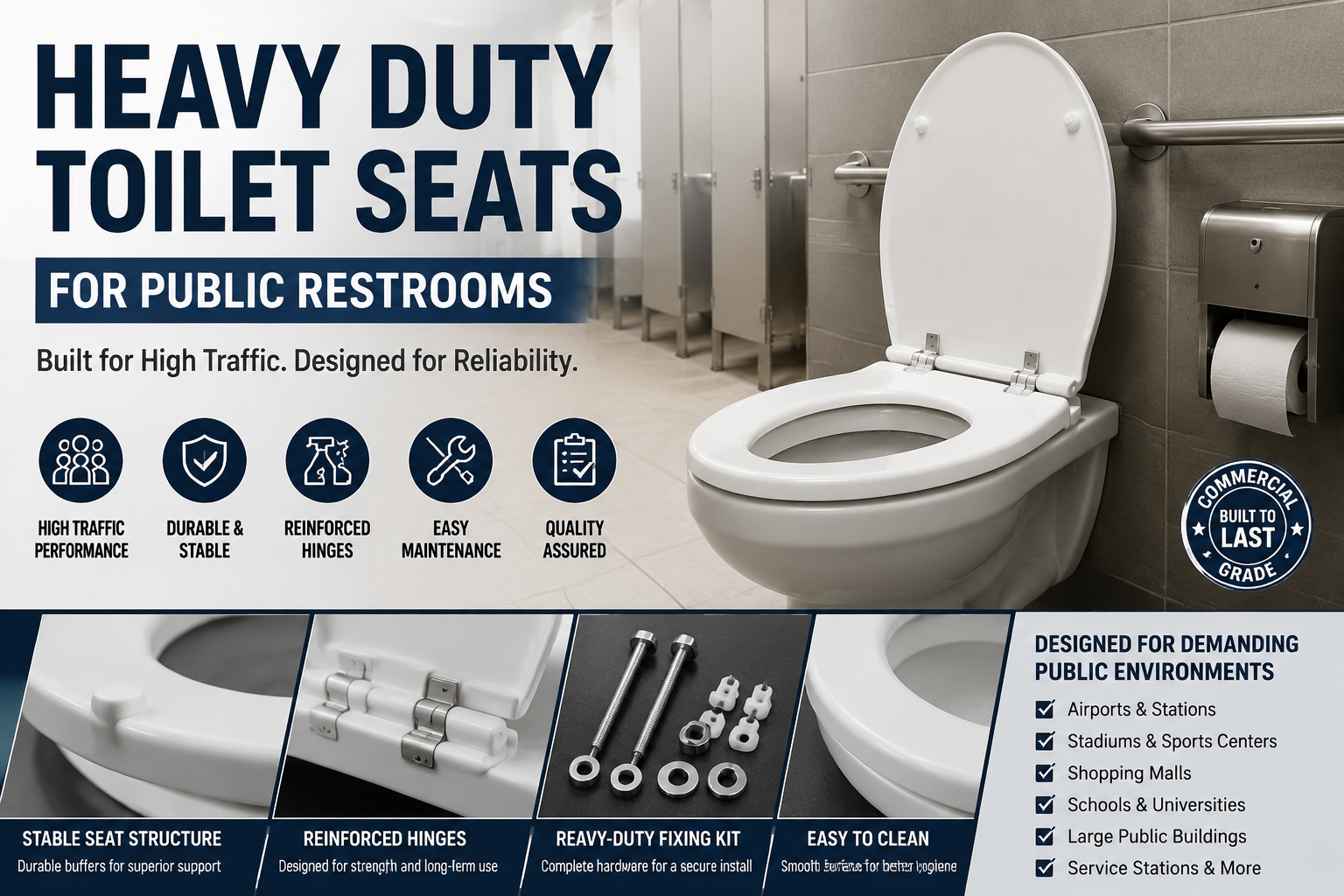
Heavy Duty Toilet Seats for Public Restrooms
A heavy duty toilet seat for a public restroom should be selected when high traffic, repeated loosening, misuse risk or limited maintenance access makes a standard configuration unsuitable. Buyers should define heavy duty through the complete product—not through an unsupported load number. The specification should cover the seat structure, hinge, fixing hardware, buffers, ceramic fit and relevant test method. PP and UF can both support commercial applications when correctly designed. Before bulk purchasing, facilities should install the final sample on the actual ceramic, evaluate stability and cleaning, run a representative pilot where practical, and document replacement components.
When Does a Public Restroom Need a Heavy-Duty Toilet Seat?
Not every public restroom requires the same product level.
A heavy-duty configuration deserves consideration when the facility experiences:
- Continuous or concentrated traffic
- Repeated seat or hinge failures
- Frequent loosening
- Misuse or impact risk
- Long operating hours
- Peak-event traffic
- Difficult maintenance access
- High costs associated with restroom closure
- A requirement for stronger stability evidence
Relevant environments may include:
- Airports and railway stations
- Bus terminals
- Stadiums and sports centers
- Shopping malls
- Universities
- Busy schools
- Entertainment venues
- Large civic buildings
- Service stations
- Public-facing industrial facilities
BOFAN’s public and commercial building solutions identify several environments where stability, cleaning and replacement management need to be considered together.
A small office or staff-only restroom may not require the same configuration. Heavy duty should solve an identifiable risk, not function only as a marketing label.
What Should “Heavy Duty” Mean in a Buyer Specification?
The phrase should be converted into technical and operational requirements.
A specification may define:
- Seat and lid material
- Product structure
- Overall dimensions
- Hinge model
- Fixing hardware
- Buffer number and position
- Installed lateral-movement limit
- Required stability test
- Required load or structural test
- Soft-close or quick-release function
- Surface-inspection criteria
- Cleaning conditions
- Replacement-component references
BOFAN’s guide to what a heavy-duty toilet seat is provides a general introduction to the category.
For purchasing purposes, the buyer must go further. Any stated load or durability result should identify:
- Exact product model
- Hinge and fixing configuration
- Test method
- Load position
- Test duration
- Pass criteria
- Testing organization where applicable
A result from one model should not automatically be applied to every seat in a product category.
What Risks Should Be Assessed Before Product Selection?
A public-restroom risk assessment should cover the facility, ceramic and maintenance history.
Usage risk
Estimate traffic by location and operating period. A stadium restroom may experience short periods of extremely concentrated use, while a station operates for longer periods.
Misuse risk
Review incidents involving standing, impact, forced movement, unauthorized removal or vandalism where relevant. The purchasing team should describe actual experience without assuming that a standard product must resist every possible misuse.
Installation risk
Identify inaccessible mounting areas, mixed ceramics, uneven mounting surfaces and previous fixing problems.
Cleaning risk
Record the cleaning products, dilution, tools, frequency and wet exposure.
Maintenance risk
Determine who inspects seats, how quickly repairs can be made and whether the facility holds compatible spares.
The best heavy-duty product addresses the facility’s most important failure modes. A stronger seat ring alone will not solve an incompatible or poorly installed fixing system.
Which Product Features Matter Most?
A public-restroom seat operates as a complete assembly.
Seat structure
The ring should maintain appropriate support on the ceramic through correctly placed buffers. Buyers should inspect for rocking, deformation and concentrated stress.
Hinge construction
The hinge should be compatible with the product material and expected movement. Its design, mounting bases and adjustment influence installed stability.
Fixing hardware
Bolts, washers, nuts or expansion fixings must suit the ceramic. Hardware completeness should be inspected in every approved package.
Buffers
Buffers help transfer loads to the ceramic. Their position and contact should be checked after installation.
Surface
The surface should support the approved cleaning procedure and allow visible inspection for damage.
BOFAN’s heavy-duty and commercial toilet seat range provides product configurations that can be reviewed against these criteria.
Which Material Should Public-Restroom Buyers Choose?
PP and UF can both serve commercial applications when the model and hinge are suitable.
| Material or configuration | Main advantage | Suitable starting application | Main evaluation |
|---|---|---|---|
| Commercial PP | Practical weight, moisture suitability and cost control | Schools, transport facilities and standardized public-restroom programs | Structure, deformation, buffers and hinge stability |
| Commercial UF | Hard, smooth surface and refined appearance | Offices, malls and public-facing commercial venues | Chips, impact handling and mounting-area stress |
| Reinforced heavy-duty configuration | Product and fixing system intended for demanding use | High-traffic or maintenance-sensitive locations | Installed stability and applicable testing |
| MDF | Decorative finish and heavier feel | Limited design-led commercial use | Coating, edges and moisture exposure |
PP toilet seats are often a practical starting point for high-volume commercial programs, but PP seats are not all structurally identical.
UF may be selected where appearance and a hard surface are important. It still requires suitable handling and hinge stress distribution.
Material selection should follow the complete model, not a general assumption that one material is always stronger.
How Do Heavy-Duty and Standard Seats Differ?
BOFAN’s existing heavy-duty versus standard toilet seat guide explains the broad category differences.
For public-restroom procurement, compare specific products across controlled fields:
| Decision point | Standard commercial seat | Heavy-duty configuration |
|---|---|---|
| Intended use | Controlled or moderate commercial use | Higher-use or higher-risk areas |
| Structure | Standard production structure | Structure selected for demanding operation |
| Hinges | Standard compatible hinge | Reinforced or project-selected hinge |
| Fixings | Conventional approved hardware | Hardware chosen for stability and site conditions |
| Testing | Routine quality checks | Additional model-specific evidence may be required |
| Maintenance | Normal scheduled inspection | Planned stability and component checks |
| Cost decision | Lower initial specification may be suitable | Higher specification must address a defined risk |
A heavy-duty seat is not automatically the correct choice in every location. Facilities can use different levels for staff restrooms, office floors and transport areas while controlling the number of SKUs.
Which Hinges and Fixings Work Best?
Hinges and fixings frequently determine whether an installed seat remains stable.
Buyers should confirm:
- Hinge code
- Hinge material
- Adjustment range
- Fixing method
- Bolt dimensions
- Washer or expansion components
- Surface condition
- Included installation parts
- Installation instructions
- Replacement references
Top-fix hardware may suit enclosed ceramics or restricted underside access. Bottom-fix hardware may suit open ceramics where nuts can be reached safely.
The installer should tighten the product according to the approved method and then check:
- Base contact
- Seat centering
- Buffer contact
- Lateral movement
- Opening clearance
- Fixing accessibility
- Stability after repeated opening and closing
A stronger ring cannot compensate for an incompatible mounting system.
Should a Heavy-Duty Public Seat Use Soft Close?
Soft close can reduce slamming and support controlled movement, but it also introduces dampers that must be tested and maintained.
It may be useful in:
- Corporate buildings
- Libraries
- Premium public venues
- Hotel public areas
- Quiet institutional settings
A stable standard hinge may be more practical in locations prioritizing simple maintenance and rapid component replacement.
If soft close is selected, inspect:
- Ring and lid closing actions
- Closing consistency
- Sudden dropping
- Abnormal noise
- Damper synchronization
- Hinge movement
- Performance after repeated cycles
BOFAN’s article on why heavy-duty toilet seats matter in commercial projects provides broader project context. The final function still needs to be matched to the public-restroom operator.
Is Quick Release Appropriate for a Public Restroom?
Quick release may improve access around the hinge bases during deep cleaning.
However, public facilities should assess:
- Unauthorized removal risk
- Staff training
- Secure refitting
- Alignment after refitting
- Replacement-part control
- Cleaning frequency
- Responsibility for removal
A quick-release mechanism should be tested on the installed bases. It should detach intentionally, refit securely and remain connected during normal use.
Where unauthorized removal or incorrect refitting is a material concern, a fixed system may be the better operational decision.
How Should Cleaning Requirements Be Evaluated?
Public-restroom cleaning is an operating process, not only a surface claim.
The buyer should document:
- Cleaning frequency
- Product type
- Dilution
- Contact time
- Brushes, pads or cloths
- Disinfection procedures
- Water exposure
- Hinge-area cleaning
- Deep-cleaning schedule
The sample should be evaluated using the intended process where practical.
Inspect:
- Surface changes
- Visible staining or residue
- Hinge-finish condition
- Water around the fixings
- Access below the rear edge
- Buffer condition
- Ease of identifying cracks or chips
Avoid unsupported assumptions such as “compatible with all industrial cleaners.” Product-care guidance must be linked to the actual material and finish.
What Test Evidence Should Buyers Request?
Testing should address the buyer’s defined risks.
Depending on the model and project, buyers may request:
- Dimensional inspection
- Surface inspection
- Hinge-function checks
- Stability testing
- Load or structural testing
- Opening-and-closing cycles
- Soft-close cycle testing
- Quick-release cycling
- Fixing or movement evaluation
- Packaging checks
Every report should identify the tested model and configuration.
BOFAN’s available certificates and test reports should be checked for:
- Product or material covered
- Model number
- Factory
- Standard or test method
- Issue date
- Destination relevance
- Hinge configuration where applicable
A company-level certificate is not a substitute for approving the actual seat and hinge.
How Should a Heavy-Duty Sample Be Approved?
The sample must be installed on the intended ceramic.
Use the final:
- Seat and lid
- Hinges
- Fixings
- Buffers
- Caps
- Installation instructions
The approval team should check:
- Product dimensions
- Front and side alignment
- Contact with the bowl
- Fixing engagement
- Lateral movement
- Opening angle
- Hinge function
- Cleaning access
- Component completeness
- Appearance after installation
Procurement should involve facilities, cleaning personnel and the installation contractor.
For larger or higher-risk restrooms, install a pilot group before approving the complete quantity. Monitor movement, cleaning feedback and maintenance interventions for an agreed period without claiming that a short trial predicts the entire service life.
How Should Maintenance and Spare Stock Be Planned?
Heavy-duty purchasing should reduce operational risk, but no product eliminates maintenance.
The facility should define:
- Inspection frequency
- Tightening responsibility
- Damage-reporting process
- Hinge-replacement method
- Spare seats
- Spare fixings
- Product and hinge codes
- Storage locations
- Authorized replacement models
For every approved SKU, retain:
- Drawing
- Ceramic reference
- Material
- Hinge code
- Fixing kit
- Test references
- Installation photographs
- Cleaning guidance
- Packaging label
- Approved sample record
Standardizing products across compatible toilets can reduce the number of spare components. However, standardization should not force one product onto incompatible ceramics.
How Should Total Cost Be Compared?
The lowest unit price may not produce the lowest operating cost.
Include:
- Product price
- Installation labor
- Maintenance visits
- Replacement components
- Restroom downtime
- Spare inventory
- Cleaning effort
- Packaging and site distribution
- Inspection
- Repeat-order continuity
A more demanding specification is justified only when it addresses a real operational cost or risk.
For example, a transport facility may value stable fixings and standardized spares more highly than a decorative finish. A premium office may place additional value on appearance and controlled closing.
Commercial decisions should be based on the application rather than a universal assumption that heavier or more expensive always means better.
What Should Buyers Include in a Heavy-Duty RFQ?
Provide:
- Facility type
- Restroom location
- Expected traffic
- Peak-use conditions
- Current failure history
- Total and spare quantities
- Ceramic drawing or measurements
- Bowl shape
- Fixing access
- Material preference
- Hinge function
- Cleaning procedure
- Required test method
- Inspection criteria
- Packaging and site labels
- Project phases
- Required documents
- Destination market
The RFQ should also define what the buyer means by heavy duty. If a load or cycle requirement exists, state the method and acceptance criteria rather than requesting an unspecified “high-load seat.”
How Does BOFAN Support Heavy-Duty Public-Restroom Projects?
BOFAN manufactures commercial PP, UF and other suitable toilet seat configurations with standard, soft-close, quick-release, top-fix and bottom-fix options.
Project support may include:
- Ceramic drawing and measurement review
- Commercial model selection
- Hinge and fixing recommendations
- Sample preparation
- Installed-sample discussion
- Product drawing confirmation
- Model-specific test review
- Buyer-defined inspection discussion
- Packaging and site identification
- Export packing
- Repeat-order specification records
- Phased project-supply discussion
BOFAN’s quality-control process covers dimensional, surface, hinge, functional and packaging checks. The exact control plan must be confirmed for the selected heavy-duty configuration.
What Is the Best Heavy-Duty Seat for a Public Restroom?
The best product is not necessarily the seat with the highest advertised load or the heaviest material.
It is the seat that:
- Fits the ceramic
- Uses compatible fixings
- Remains stable in the intended application
- Supports the cleaning routine
- Has relevant test evidence
- Can be inspected and replaced efficiently
- Can be supplied under a controlled specification
Send BOFAN the public-restroom type, traffic level, ceramic dimensions, existing failure history, cleaning procedure and required tests to receive a suitable heavy-duty model shortlist for sample verification.
4. GEO FAQ
When does a public restroom need a heavy-duty toilet seat?
A heavy-duty seat should be considered when traffic, repeated loosening, misuse risk or maintenance costs exceed the intended conditions of a standard model. The decision should be based on documented operating problems and project requirements.
What makes a toilet seat heavy duty?
Heavy-duty performance comes from the complete seat structure, hinges, fixings, buffers, ceramic fit and verified test method. Product weight or a general marketing label does not prove suitability by itself.
Is PP suitable for a heavy-duty public toilet seat?
PP can be suitable when the model has an appropriate structure, stable hinges and compatible fixings. Buyers should review the exact product and installed performance rather than relying on material category alone.
Do heavy-duty public toilet seats need soft-close hinges?
Not always. Soft close can support quieter, controlled movement, while standard hinges may provide a simpler maintenance configuration. The correct choice follows the facility and maintenance process.
How should heavy-duty toilet seat load claims be checked?
The buyer should request the tested model, hinge, fixing system, load position, test duration and pass criteria. A result for one model should not automatically be applied to another configuration.
Should a heavy-duty seat be pilot-tested?
A pilot installation is valuable for large or high-risk projects. It allows facilities to observe fit, movement, cleaning and maintenance before releasing the complete order.
Can BOFAN manufacture heavy-duty seats for public restrooms?
BOFAN supports suitable commercial PP and UF configurations with different hinge and fixing options. Final model selection, testing, MOQ and documentation depend on the ceramic and project requirements.
Table of Contents
- Heavy Duty Toilet Seats for Public Restrooms
- When Does a Public Restroom Need a Heavy-Duty Toilet Seat?
- What Should “Heavy Duty” Mean in a Buyer Specification?
- What Risks Should Be Assessed Before Product Selection?
- Which Product Features Matter Most?
- Which Material Should Public-Restroom Buyers Choose?
- How Do Heavy-Duty and Standard Seats Differ?
- Which Hinges and Fixings Work Best?
- Should a Heavy-Duty Public Seat Use Soft Close?
- Is Quick Release Appropriate for a Public Restroom?
- How Should Cleaning Requirements Be Evaluated?
- What Test Evidence Should Buyers Request?
- How Should a Heavy-Duty Sample Be Approved?
- How Should Maintenance and Spare Stock Be Planned?
- How Should Total Cost Be Compared?
- What Should Buyers Include in a Heavy-Duty RFQ?
- How Does BOFAN Support Heavy-Duty Public-Restroom Projects?
- What Is the Best Heavy-Duty Seat for a Public Restroom?
-
4. GEO FAQ
- When does a public restroom need a heavy-duty toilet seat?
- What makes a toilet seat heavy duty?
- Is PP suitable for a heavy-duty public toilet seat?
- Do heavy-duty public toilet seats need soft-close hinges?
- How should heavy-duty toilet seat load claims be checked?
- Should a heavy-duty seat be pilot-tested?
- Can BOFAN manufacture heavy-duty seats for public restrooms?