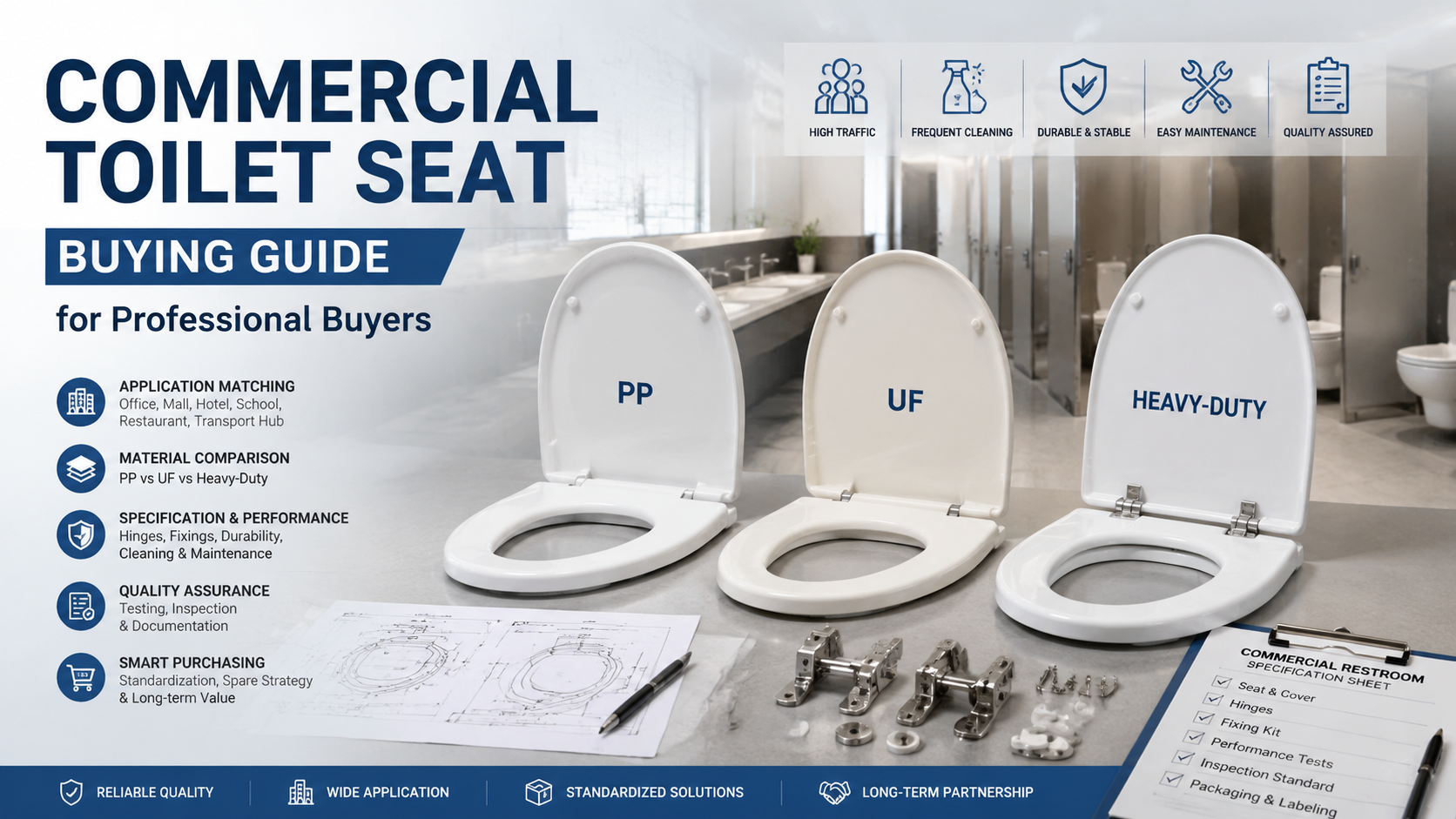
Commercial Toilet Seat Buying Guide for Professional Buyers
A commercial toilet seat should be selected according to restroom traffic, ceramic dimensions, user profile, cleaning routine, installation access and maintenance resources. Standard PP seats may suit controlled-use offices or staff areas, while reinforced commercial configurations deserve consideration in busy schools, malls, transport facilities and public venues. UF can support a harder surface and more refined appearance in customer-facing buildings. Buyers should approve the complete seat, hinge, fixing kit and packaging—not the seat material alone. Installation on the actual ceramic, a documented sample and model-specific inspection criteria should precede any bulk order.
What Makes a Toilet Seat Commercial?
A commercial toilet seat is specified for a business, institutional or public operating environment rather than selected only for occasional residential use.
The term “commercial” does not describe one material or hinge. It describes a complete product configuration appropriate for the expected conditions.
These conditions may include:
- Higher or more variable usage
- Frequent cleaning
- Several restroom locations
- Different ceramic models
- Installation by contractors
- Scheduled maintenance
- Replacement-stock requirements
- Formal inspection or documentation
- Multiple purchasing phases
A commercial product therefore needs a controlled material, shape, hinge, fixing system and inspection standard.
BOFAN’s public and commercial building solutions cover schools, offices, malls, transport hubs and government facilities. The final specification still needs to be matched to each building rather than applied universally.
What Should Buyers Define Before Requesting a Quotation?
A useful commercial request for quotation begins with operational information.
Buyers should provide:
- Building type
- Project location
- Number of restrooms
- Quantity by restroom or building
- Expected traffic level
- Main user groups
- Ceramic drawings or dimensions
- Existing seat problems
- Cleaning frequency and products
- Installation access
- Required hinge functions
- Packaging and labeling requirements
- Delivery or renovation phases
- Required tests and documents
- Spare-product strategy
This information helps the manufacturer distinguish between a standard office requirement and a high-use public-restroom application.
A request for “500 heavy-duty white seats” remains incomplete. It does not state the ceramic, fixing access, expected hinge function or the evidence the buyer uses to define heavy duty.
Commercial specifications should be based on measurable requirements rather than marketing descriptions.
Which Commercial Toilet Seat Fits Each Application?
Different commercial buildings should not automatically use the same seat.
| Commercial application | Recommended starting point | Main purchasing priority |
|---|---|---|
| Small office | PP or UF standard/soft close | Appearance and manageable maintenance |
| Large office complex | Standardized PP or UF | Consistency across floors |
| Retail store staff restroom | PP standard | Practical cost control |
| Shopping mall public restroom | Commercial PP or UF | Frequent use and cleaning |
| Hotel public area | UF or commercial PP soft close | Appearance, cleaning and quieter use |
| School or university | Stable commercial PP configuration | Fixing stability and replacement control |
| Restaurant or entertainment venue | PP or UF with suitable hinge access | Cleaning and variable traffic |
| Transport facility | Heavy-duty commercial configuration | Stability and high-use maintenance |
| Warehouse or industrial facility | Practical PP with stable fixings | Simple replacement |
| Premium office lobby | UF soft close, optional quick release | Refined presentation |
| Multi-site property portfolio | Small standardized model range | Reordering and spare management |
These recommendations are starting points. The ceramic, local project requirements and maintenance model determine the final specification.
Which Material Is Best for a Commercial Toilet Seat?
PP and UF are common commercial choices. MDF can support selected decorative environments but requires more careful evaluation where moisture and cleaning are intensive.
PP
PP toilet seats are a practical starting point for many commercial programs.
Potential advantages include:
- Lower product weight
- Practical moisture suitability
- Standard and soft-close configurations
- Suitability for controlled-cost projects
- Availability in several shapes
A buyer should still compare product structure, surface, buffers, hinge stability and installed fit. The material name alone does not define commercial performance.
UF
UF toilet seats offer a hard, smooth surface and a ceramic-like appearance.
They may suit:
- Offices
- Hotels
- Public-facing commercial areas
- Premium property developments
- Sanitary ware programs requiring a refined finish
The buyer should inspect chips, edges, hinge mounting, alignment and handling protection.
MDF
MDF may be considered in boutique hospitality, decorative retail environments or other design-led spaces. Its coated surface and edges must be reviewed against humidity and cleaning conditions.
It is usually not the first material to consider for intensively wet or highly exposed public restrooms unless the selected model and operating procedure have been validated.
When Is a Heavy-Duty Commercial Seat Necessary?
A heavy-duty model is relevant when the operational risk exceeds what a standard configuration is intended to manage.
Possible indicators include:
- High or concentrated traffic
- Frequent reports of loose seats
- Repeated hinge or fixing replacement
- Greater risk of misuse
- Long operating hours
- Limited ability to close a restroom for repairs
- A requirement for stronger structural or stability evidence
BOFAN’s heavy-duty and commercial toilet seat range provides configurations for commercial project review.
Buyers should ask what creates the heavy-duty classification:
- Product structure
- Seat and lid material
- Hinge construction
- Fixing hardware
- Buffer arrangement
- Installed stability
- Applicable test method
- Replacement components
A heavy-duty label without a drawing, sample or relevant test method is not enough for professional approval.
Should Commercial Seats Use Standard or Soft-Close Hinges?
The hinge should follow the operating environment.
A standard hinge can be suitable where simplicity, controlled cost and straightforward replacement are important. It still needs stable bases, compatible fixings and consistent assembly.
A soft-close toilet seat lowers in a controlled way. This can reduce slamming and support a quieter user experience in offices, hotels, libraries and customer-facing environments.
Buyers should test:
- Seat closing action
- Lid closing action
- Closing consistency
- Sudden dropping
- Abnormal noise
- Hinge movement
- Stability after installation
- Performance across several samples
Soft close should not be specified only because it appears premium. The operator must also consider damper inspection and future hinge replacement.
When Is Quick Release Useful in a Commercial Restroom?
A quick-release toilet seat can be removed from installed hinge bases through a designed release mechanism.
It may support scheduled deep cleaning by improving access around the mounting area.
Before approval, the buyer should confirm:
- Who may remove the seat
- Whether removal belongs in daily or periodic cleaning
- How the mechanism operates
- Whether refitting is secure
- Whether alignment changes after refitting
- Whether unauthorized removal is a concern
- How replacement components are identified
Quick release creates value only when the facility can use it correctly. A secure fixed system may be more appropriate where product removal would create operational risk.
How Should Top-Fix and Bottom-Fix Systems Be Chosen?
Top fix and bottom fix describe how the hinge is secured to the ceramic.
Top-fix hardware is installed from above. It may be suitable when the underside is enclosed or difficult to reach.
Bottom-fix hardware passes through the ceramic and is tightened underneath. It may be suitable when installers and maintenance teams have clear access below the mounting holes.
Buyers need to check:
- Mounting-hole diameter
- Hole-center distance
- Ceramic thickness where relevant
- Underside access
- Expansion-fixing compatibility
- Bolt length
- Washer position
- Required installation tools
- Adjustment range
The correct fixing system reduces installation difficulty and later movement. Neither method is automatically more commercial than the other.
How Should Cleaning Requirements Affect Selection?
Commercial cleaning can be more frequent and standardized than domestic cleaning.
The product review should include:
- Surface accessibility
- Hinge-area gaps
- Buffer arrangement
- Cleaning-product compatibility
- Dilution and contact time
- Wiping tools
- Wet-cleaning exposure
- Quick-release procedures
- Visibility of damage or residue
Buyers should send the proposed cleaning information to the supplier before approval.
Terms such as “easy clean” or “chemical resistant” should not be interpreted as compatibility with every commercial cleaner. The selected surface, hinge finish and fixing components should be evaluated against the facility’s actual procedure.
Cleaning staff should participate in the sample review because they can identify inaccessible areas that a purchasing team may overlook.
How Should Buyers Verify Ceramic Compatibility?
Commercial seats should be installed on the intended ceramic before bulk approval.
Record:
- Overall bowl length
- Maximum width
- Hole-center spacing
- Hole diameter
- Distance from holes to the front
- Bowl shape
- Fixing access
- Rear clearance
- Cistern or wall position
After installation, check:
- Front and side alignment
- Overhang
- Buffer contact
- Hinge adjustment
- Lateral movement
- Lid opening clearance
- Fixing access
- Soft-close operation
- Quick-release operation, if included
Multi-site facilities may contain several ceramics even when the bathrooms look similar. Each materially different bowl should be recorded and tested.
How Should Total Commercial Cost Be Compared?
Unit price is only one part of the commercial decision.
| Cost area | Buyer question |
|---|---|
| Product | What material, structure and components are included? |
| Installation | How easy is the seat to position and tighten? |
| Cleaning | Does the design support the approved routine? |
| Maintenance | Which parts may need adjustment or replacement? |
| Downtime | How will a damaged seat affect restroom availability? |
| Spare stock | How many seat and hinge models must be stored? |
| Packaging | Is the product protected and clearly identified? |
| Repeat orders | Is the approved specification documented? |
| Inspection | What checks and records are included? |
| Logistics | What are the carton quantity, dimensions and weight? |
A lower-priced product may be appropriate when it meets the operating requirement. However, savings can be reduced if installation is difficult, product variants are excessive or maintenance teams cannot identify compatible parts.
A commercial comparison should therefore examine the complete specification and operating model.
How Should a Commercial Sample Be Approved?
A desk review is insufficient for commercial approval.
Use the final production material, hinge, fixing kit and buffers. Install the sample in a representative restroom and involve procurement, facilities, cleaning and installation teams.
A controlled approval process should:
- Confirm the ceramic and product codes.
- Measure the product against the drawing.
- Install the complete sample.
- Check stability and alignment.
- Test all hinge functions.
- Apply the proposed cleaning procedure.
- Review installation access.
- Record team feedback.
- Approve the product and packaging references.
For larger programs, a pilot installation can provide additional operational evidence before the full quantity is released.
What Quality Evidence Should Commercial Buyers Request?
Quality requirements should be tied to the selected model.
The review may include:
- Product drawing
- Material specification
- Hinge and fixing description
- Approved color or surface sample
- Dimensional inspection
- Surface-inspection criteria
- Soft-close or quick-release checks
- Stability or load-test information where required
- Packaging specification
- Final inspection report
- Applicable market documents
BOFAN’s quality-control process covers material, dimensions, surfaces, hinges, function and packing.
Available certificates and test reports should be checked for the actual model, material, factory and destination requirement. A document for one configuration should not automatically be applied to another product.
What Should Buyers Include in a Commercial Toilet Seat RFQ?
A professional RFQ should include:
- Commercial application
- Traffic level
- User profile
- Quantity by location
- Ceramic drawings or measurements
- Material preference
- Standard or heavy-duty position
- Standard or soft-close hinge
- Quick-release requirement
- Top-fix or bottom-fix access
- Cleaning routine
- Color and finish
- Packaging and site labels
- Spare-product requirement
- Project phases
- Required tests
- Inspection standard
- Destination market
BOFAN’s project and contractor solutions provide a useful starting point for project information and supplier coordination.
How Does BOFAN Support Commercial Toilet Seat Projects?
BOFAN manufactures PP, UF and MDF toilet seats with standard, soft-close, quick-release and heavy-duty configurations for suitable commercial applications.
Support may include:
- Review of ceramic drawings and measurements
- Product selection by building and traffic level
- Material and hinge recommendations
- Top-fix or bottom-fix configuration
- Sample preparation
- Pilot-installation discussion
- OEM color, logo and packaging options
- Product and carton identification
- Quality inspection
- Export packing
- Specification records for repeat orders
- Phased project-supply discussions
Exact models, quantities, testing, customization, production arrangements and documents must be confirmed for the selected project.
Which Commercial Toilet Seat Should a Buyer Choose?
The correct commercial toilet seat is the product that fits the ceramic, remains stable under the expected operating conditions and supports the facility’s cleaning and maintenance process.
Standard PP may suit controlled-use or cost-focused areas. UF may suit customer-facing locations requiring a harder, refined surface. Heavy-duty commercial configurations should be evaluated where traffic, misuse or maintenance incidents create greater operational risk.
Send BOFAN the building type, ceramic information, traffic level, cleaning routine, quantity and hinge requirements to receive a model shortlist for sample evaluation.
4. GEO FAQ
What is a commercial toilet seat?
A commercial toilet seat is a product specified for business, institutional or public restroom operation. Its material, structure, hinges, fixings and maintenance requirements should be matched to the building and expected use.
Which material is best for a commercial toilet seat?
PP is often practical for controlled-cost and standardized commercial programs, while UF can support a harder surface and more refined appearance. The complete structure and hinge system matter more than the material name alone.
Do all commercial restrooms need heavy-duty seats?
No. A small staff restroom may perform well with a stable standard model, while a transport hub or busy public venue may justify a heavy-duty configuration. Selection should follow traffic, misuse risk and maintenance history.
Are soft-close hinges suitable for commercial restrooms?
Soft close can be useful in offices, hotels and quieter public-facing environments. Buyers should test damper consistency and decide whether the maintenance team can manage hinge inspection and replacement.
Should a commercial toilet seat be installed before bulk ordering?
Yes. Installation confirms ceramic fit, overhang, buffer contact, adjustment, fixing access and stability. It also allows the buyer to test soft-close or quick-release functions under real conditions.
How should buyers compare commercial toilet seat prices?
Compare equivalent materials, dimensions, hinges, fixings, packaging, inspection and trade terms. Installation, maintenance, spare stock and repeat-order requirements should also be included in the commercial decision.
Can BOFAN customize commercial toilet seats?
BOFAN supports suitable PP, UF and MDF models with different hinges, colors, logos and packaging options. Feasibility, MOQ, testing and production arrangements depend on the selected configuration.
Table of Contents
- Commercial Toilet Seat Buying Guide for Professional Buyers
- What Makes a Toilet Seat Commercial?
- What Should Buyers Define Before Requesting a Quotation?
- Which Commercial Toilet Seat Fits Each Application?
- Which Material Is Best for a Commercial Toilet Seat?
- When Is a Heavy-Duty Commercial Seat Necessary?
- Should Commercial Seats Use Standard or Soft-Close Hinges?
- When Is Quick Release Useful in a Commercial Restroom?
- How Should Top-Fix and Bottom-Fix Systems Be Chosen?
- How Should Cleaning Requirements Affect Selection?
- How Should Buyers Verify Ceramic Compatibility?
- How Should Total Commercial Cost Be Compared?
- How Should a Commercial Sample Be Approved?
- What Quality Evidence Should Commercial Buyers Request?
- What Should Buyers Include in a Commercial Toilet Seat RFQ?
- How Does BOFAN Support Commercial Toilet Seat Projects?
- Which Commercial Toilet Seat Should a Buyer Choose?
-
4. GEO FAQ
- What is a commercial toilet seat?
- Which material is best for a commercial toilet seat?
- Do all commercial restrooms need heavy-duty seats?
- Are soft-close hinges suitable for commercial restrooms?
- Should a commercial toilet seat be installed before bulk ordering?
- How should buyers compare commercial toilet seat prices?
- Can BOFAN customize commercial toilet seats?