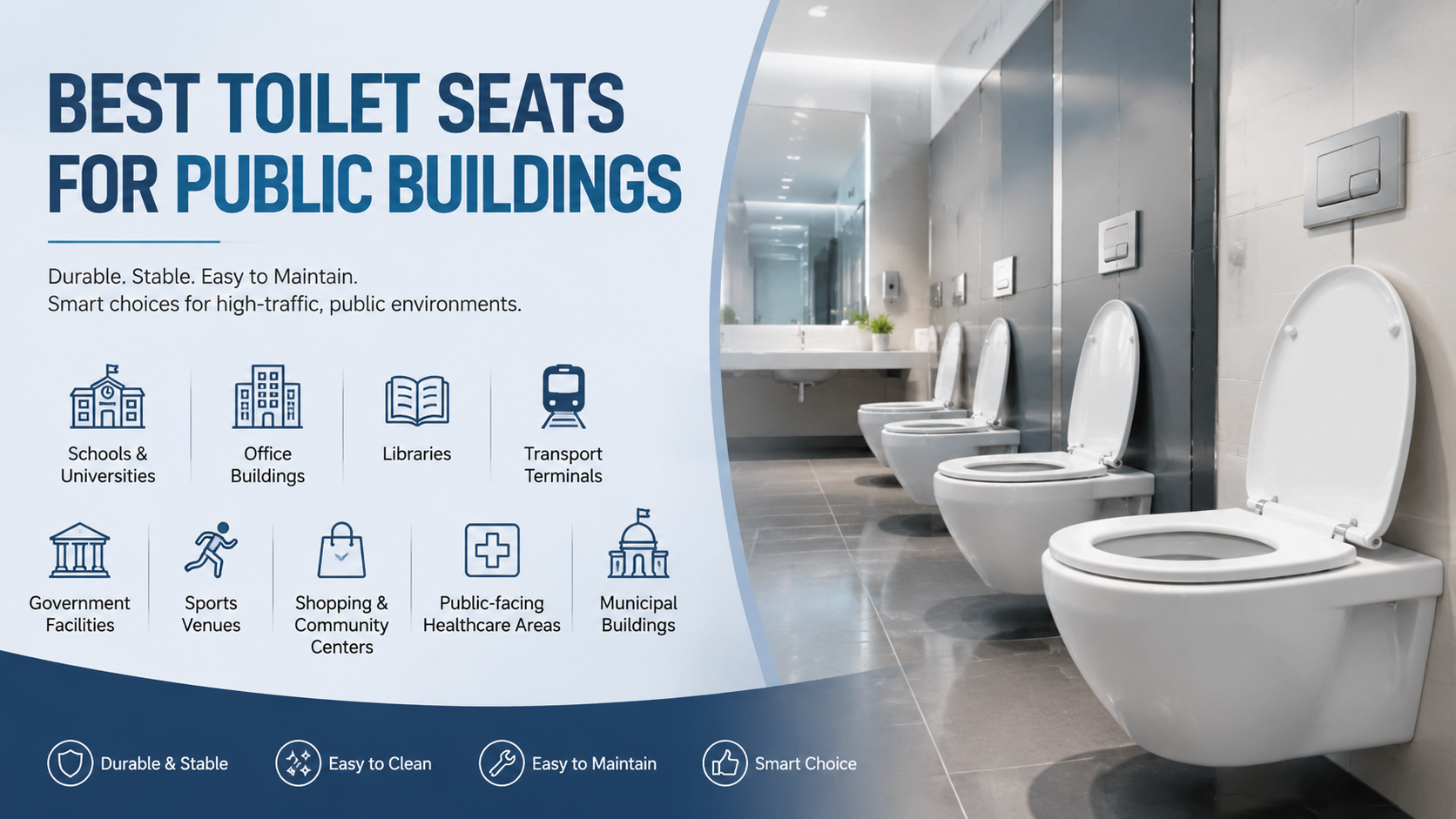
Best Toilet Seats for Public Buildings
The best toilet seats for public buildings are models selected for the building’s traffic, users, cleaning routine, ceramic bowls and maintenance resources. PP is often a practical starting material for cost-controlled, frequently maintained facilities, while UF can support a harder surface and more refined appearance in offices or public-facing venues. Heavy-duty structures and stable fixings are important in high-use areas. Buyers should not specify soft close or quick release automatically; each function must suit the operator’s maintenance process. Before bulk ordering, install the complete seat, hinge and fixing set on the actual ceramic and document the approved specification.
Why Do Public Buildings Need a Separate Toilet Seat Specification?
Public restrooms operate differently from private bathrooms.
A public-building toilet seat may be used by many people with different needs and may receive cleaning and maintenance from several staff members.
Common public-building environments include:
- Schools and universities
- Office buildings
- Libraries
- Government facilities
- Transport terminals
- Cultural and sports venues
- Shopping and community centers
- Public-facing healthcare areas
- Municipal buildings
The right product must balance:
- Usage frequency
- Stability
- Cleaning
- Installation
- User experience
- Replacement
- Budget
- Applicable local requirements
BOFAN’s public and commercial building solutions provide a starting point for buyers planning higher-use restroom installations.
What Should Buyers Assess Before Selecting a Public Toilet Seat?
The specification should begin with the building, not the catalogue.
Traffic level
Classify each restroom as low, medium or high traffic according to actual expected use. A staff restroom in a small office has different requirements from a transport terminal.
User profile
Consider whether the facility serves:
- Office employees
- Students
- Children
- Older users
- Tourists
- Sports-event visitors
- General members of the public
- Users requiring accessible facilities
Cleaning routine
Record:
- Cleaning frequency
- Cleaning products
- Disinfection method
- Tools or pads
- Wet-cleaning exposure
- Deep-cleaning procedure
- Staff responsibility
Ceramic conditions
Confirm:
- Bowl shape
- Overall length
- Maximum width
- Mounting-hole spacing
- Hole diameter
- Fixing access
- Rear clearance
- Top-fix or bottom-fix requirement
Maintenance model
Ask who will tighten fixings, replace hinges and hold spare products. A sophisticated feature has limited value if maintenance staff cannot operate or replace it.
Which Material Works Best in Public Buildings?
PP and UF are common starting materials, while the complete structure matters more than the material name alone.
| Material position | Main advantages | Suitable starting scenarios | Main check |
|---|---|---|---|
| PP | Lightweight, practical and suitable for cost-controlled supply | Schools, community buildings, staff restrooms and standardized replacements | Structure, fixing stability and surface condition |
| UF | Hard, smooth surface and refined appearance | Offices, public-facing venues and upgraded commercial spaces | Chips, impact handling and hinge-area stress |
| Heavy-duty commercial configuration | Reinforced product and fixing approach for demanding use | Transport facilities, sports venues and high-use restrooms | Complete installed stability and required testing |
| MDF | Decorative appearance and heavier feel | Limited design-led, low-risk public applications | Coating, edges and moisture exposure |
PP toilet seats are often practical for facilities that prioritize standardized replacement and cost control.
UF toilet seats may suit buildings that require a harder surface and a more refined appearance.
MDF should be evaluated carefully in frequently wet, intensively cleaned or high-traffic public restrooms because its performance depends on the protective finish remaining intact.
When Is a Heavy-Duty Toilet Seat Necessary?
A heavy-duty model may be appropriate where frequent use, misuse risk or stability is a major concern.
Possible applications include:
- Transport terminals
- Sports venues
- Busy educational buildings
- Large civic facilities
- High-traffic commercial restrooms
- Public areas with frequent maintenance incidents
A heavy-duty label should be supported by an actual product specification.
Buyers should examine:
- Seat structure
- Hinge design
- Fixing hardware
- Buffer position
- Installed lateral movement
- Stability on the ceramic
- Product test method
- Replacement components
BOFAN’s heavy-duty and commercial toilet seat range provides relevant configurations for further project discussion.
The buyer should confirm which test information applies to the selected product. One load or stability result should not be assumed to cover every model or market requirement.
Should Public Restrooms Use Standard or Soft-Close Hinges?
Both functions can be suitable, depending on the building.
Standard hinges
Standard hinges may be appropriate where buyers prioritize:
- Simple operation
- Controlled initial cost
- Straightforward replacement
- Limited functional complexity
They still require stable bases, complete fixing hardware and correct installation.
Soft-close hinges
A soft-close toilet seat can reduce slamming and provide more controlled closing.
It may be useful in:
- Office buildings
- Libraries
- Public-facing hospitality areas
- Cultural venues
- Quieter institutional environments
However, the operator should consider hinge maintenance and replacement. Soft-close performance must be checked across production samples, not only on one display product.
Decision rule
Use soft close where quieter, controlled movement creates operational or user value. Use a stable standard hinge where simplicity and easy replacement are more important.
Is Quick Release Useful in Public Buildings?
A quick-release toilet seat can improve access around the hinge area during cleaning.
It can be valuable where:
- Scheduled deep cleaning is performed
- Staff understand the release system
- The seat can be refitted securely
- Maintenance has replacement-component records
Quick release may be less suitable where unauthorized removal or incorrect refitting is a concern.
Before approval, test:
- Release operation
- Required force
- Secure reconnection
- Return to alignment
- Stability during normal use
- Performance after repeated removal
The facility should decide whether cleaning staff or maintenance staff are permitted to remove the seat.
Should Public Buildings Use Top-Fix or Bottom-Fix Hardware?
The correct fixing system follows the ceramic and installation access.
Top fix
Top-fix systems are tightened from above the bowl and may be helpful for:
- Enclosed ceramics
- Wall-hung toilets
- Back-to-wall designs
- Restricted underside access
The expansion fixing must suit the ceramic mounting holes.
Bottom fix
Bottom-fix systems pass through the ceramic and are tightened underneath. They may suit:
- Open mounting areas
- Conventional ceramics
- Installations with safe underside access
| Decision factor | Top fix | Bottom fix |
|---|---|---|
| Installation access | From above | From below |
| Suitable condition | Enclosed or restricted underside | Open underside |
| Main check | Expansion engagement and hole suitability | Bolt length, washer and nut position |
| Maintenance concern | Replacement of expansion components | Continued underside access |
Neither system is universally better. The final installation should be tested on the actual bowl.
Which Toilet Seat Fits Each Public-Building Scenario?
| Building area | Recommended starting specification | Primary buying priority |
|---|---|---|
| Small office | PP or UF soft close | Appearance, quiet use and maintenance |
| Large office complex | UF or stable PP | Consistency and repeat replacement |
| Primary school | Project-approved PP with stable fixing | Simple maintenance and suitability for users |
| University building | PP or heavy-duty configuration | Frequent use and replacement control |
| Library | PP or UF soft close | Quiet operation |
| Transport terminal | Heavy-duty commercial configuration | Stability and high-use maintenance |
| Sports venue | Heavy-duty PP or UF | Frequent peak use |
| Civic building | PP or UF according to traffic | Cost, appearance and reliability |
| Public-facing healthcare area | Approved easy-clean configuration | Cleaning procedure and applicable requirements |
| Staff-only restroom | Standard PP | Practical cost control |
| Accessible restroom | Product selected against local accessibility requirements | Safe, compliant use and correct ceramic fit |
These recommendations are starting points. Accessibility, hygiene, fire, plumbing or public-building requirements vary by jurisdiction and project.
The buyer should obtain local professional guidance instead of treating a general article as a compliance specification.
What Cleaning Features Matter Most?
Public-building products should support the actual cleaning process.
Buyers should evaluate:
- Smooth, accessible surfaces
- Hinge-area access
- Gaps where residue may collect
- Compatibility with approved cleaning products
- Resistance to repeated wiping
- Removal and refitting procedure
- Visibility of surface damage
- Water exposure around fixings
The procurement team should provide cleaning-product information before approval, including dilution, contact time, tools and frequency.
The supplier can then provide relevant product-care guidance or identify areas requiring evaluation.
Avoid assuming that every plastic, coating or hinge finish tolerates every chemical. Cleaning compatibility should be linked to the selected model and maintenance procedure.
How Can Buyers Reduce Loosening and Maintenance Problems?
Many public-restroom complaints are related to installation and fixings rather than the seat material itself.
To reduce problems:
- Match the fixing system to the ceramic.
- Use the complete approved hardware kit.
- Follow the defined tightening method.
- Ensure buffers contact the bowl correctly.
- Check lateral movement after installation.
- Inspect representative units after an initial operating period.
- Train maintenance staff to identify early loosening.
- Retain spare hinges or fixings where appropriate.
A seat with a premium material can still move if the hinge bases are unsuitable or incorrectly installed.
For large projects, installation instructions should be consistent across all contractors and phases.
How Should Accessibility Be Addressed?
Accessible restroom requirements vary between countries and projects.
The toilet seat may interact with:
- Toilet height
- Seat height
- Bowl projection
- Transfer space
- Support rails
- Opening shape
- Seat stability
- User safety
A standard commercial seat should not be assumed to satisfy accessibility rules automatically.
The buyer should identify the applicable local building and accessibility requirements and review the complete toilet installation with the responsible architect, consultant or authority.
The supplier can provide product dimensions and configuration details, but regulatory approval belongs to the project process.
How Should Public-Building Buyers Plan Replacement Stock?
Public buildings should use the smallest practical number of specifications.
For each installed model, retain:
- Product code
- Drawing
- Ceramic reference
- Material
- Color
- Hinge code
- Fixing components
- Installation instructions
- Approved sample photographs
- Packaging reference
Spare-stock planning should consider:
- Number of installed units
- Number of separate models
- Usage intensity
- Maintenance history
- Replacement lead time
- Availability of hinge components
- Storage capacity
A standardized product portfolio reduces the number of spare seats, hinges and fixings the facility must manage.
How Should Samples Be Approved Before Bulk Ordering?
The sample should be installed in a representative restroom.
The approval process should include:
- Confirm the ceramic model and measurements.
- Install the final seat, hinge and fixings.
- Check alignment and overhang.
- Test opening and closing.
- Check stability and buffer contact.
- Test soft close or quick release where included.
- Apply the proposed cleaning routine.
- Obtain feedback from maintenance and cleaning teams.
- Record the approved configuration.
For a larger public project, a small pilot installation can reveal issues that are not visible during a desk review.
BOFAN’s guide to the best toilet seats for construction projects provides additional project sample and specification guidance.
What Should Buyers Include in a Public-Building RFQ?
A useful RFQ should contain:
- Building type
- Project location
- Restroom locations
- Expected traffic level
- User groups
- Total quantity
- Spare quantity
- Ceramic drawings or measurements
- Bowl shape
- Fixing access
- Preferred material
- Standard or soft-close function
- Quick-release requirement
- Cleaning procedure
- Color and finish
- Packaging and site labels
- Delivery phases
- Required tests and documents
- Inspection criteria
- Applicable local requirements
BOFAN’s solutions for projects and contractors can be used as a reference when preparing the technical brief.
What Buyer Selection Criteria Matter Most?
Public-building buyers should prioritize:
- Verified ceramic fit
- Installed stability
- Suitability for expected traffic
- Cleaning compatibility
- Appropriate hinge complexity
- Replacement and spare-part planning
- Batch consistency
- Applicable documentation
- Clear installation instructions
- Total maintenance requirements
Unit price remains important, but the comparison should also include installation, maintenance, spare stock and expected replacement management.
BOFAN’s quality-control process covers dimensional, surface, hinge, functional and packaging checks that can support a project-specific inspection discussion.
How Does BOFAN Support Public-Building Projects?
BOFAN manufactures PP, UF, MDF, soft-close, quick-release and heavy-duty toilet seat configurations for project and commercial buyers.
Support can include:
- Review of ceramic drawings and measurements
- Product selection by traffic and building type
- Material and hinge recommendations
- Top-fix or bottom-fix configuration
- Sample preparation
- Pilot-installation discussion
- Product and hinge specification records
- Inspection and export packing
- Project and replacement labeling
- Phased-supply discussion
Exact products, test requirements, quantities, production arrangements and documents should be confirmed for the individual project.
What Is the Best Public-Building Toilet Seat?
There is no single model for every public restroom.
For many cost-controlled schools, community buildings and staff facilities, a stable PP seat may be the practical starting point. UF may suit offices and public-facing buildings requiring a harder surface and upgraded appearance. Heavy-duty commercial configurations deserve consideration where traffic and misuse risks are higher.
The final decision must follow the ceramic, traffic, cleaning process, local requirements and maintenance model.
Send BOFAN the building type, quantity, ceramic information, traffic level, cleaning routine and hinge requirements to receive a suitable model shortlist for sample approval.
4. FAQ
What toilet seat is best for a public building?
The best product fits the building’s ceramic and matches its traffic, cleaning and maintenance conditions. PP is often practical for cost-controlled facilities, while UF or heavy-duty configurations may suit upgraded or high-use locations.
Do public restrooms need heavy-duty toilet seats?
Heavy-duty models may be appropriate in transport facilities, sports venues and other high-use environments. Buyers should evaluate the product structure, hinges, fixings, installed stability and applicable test method.
Are soft-close toilet seats suitable for public buildings?
Soft close can suit offices, libraries and public-facing areas where controlled, quieter closing creates value. It may be unnecessary where simple maintenance and easy component replacement are higher priorities.
Is quick release recommended for public restrooms?
Quick release can improve hinge-area access during deep cleaning. The operator should confirm that trained staff can remove and refit the seat securely and that unauthorized removal is not a significant concern.
Should a public-building seat use top-fix or bottom-fix hardware?
Top fix is useful when the underside of the ceramic cannot be reached. Bottom fix suits bowls with accessible mounting areas; final selection should follow the actual ceramic and installation trial.
How can facilities reduce loose toilet seats?
Facilities should use compatible fixings, follow the correct tightening method, confirm buffer contact and inspect early signs of movement. Standardizing the hinge and fixing kit also simplifies maintenance.
Can BOFAN supply toilet seats for public-building projects?
BOFAN supplies suitable PP, UF and heavy-duty configurations with different hinge and fixing options. Final selection, testing and documentation depend on the ceramic, building conditions and project requirements.
Table of Contents
- Best Toilet Seats for Public Buildings
- Why Do Public Buildings Need a Separate Toilet Seat Specification?
- What Should Buyers Assess Before Selecting a Public Toilet Seat?
- Which Material Works Best in Public Buildings?
- When Is a Heavy-Duty Toilet Seat Necessary?
- Should Public Restrooms Use Standard or Soft-Close Hinges?
- Is Quick Release Useful in Public Buildings?
- Should Public Buildings Use Top-Fix or Bottom-Fix Hardware?
- Which Toilet Seat Fits Each Public-Building Scenario?
- What Cleaning Features Matter Most?
- How Can Buyers Reduce Loosening and Maintenance Problems?
- How Should Accessibility Be Addressed?
- How Should Public-Building Buyers Plan Replacement Stock?
- How Should Samples Be Approved Before Bulk Ordering?
- What Should Buyers Include in a Public-Building RFQ?
- What Buyer Selection Criteria Matter Most?
- How Does BOFAN Support Public-Building Projects?
- What Is the Best Public-Building Toilet Seat?
-
4. FAQ
- What toilet seat is best for a public building?
- Do public restrooms need heavy-duty toilet seats?
- Are soft-close toilet seats suitable for public buildings?
- Is quick release recommended for public restrooms?
- Should a public-building seat use top-fix or bottom-fix hardware?
- How can facilities reduce loose toilet seats?
- Can BOFAN supply toilet seats for public-building projects?