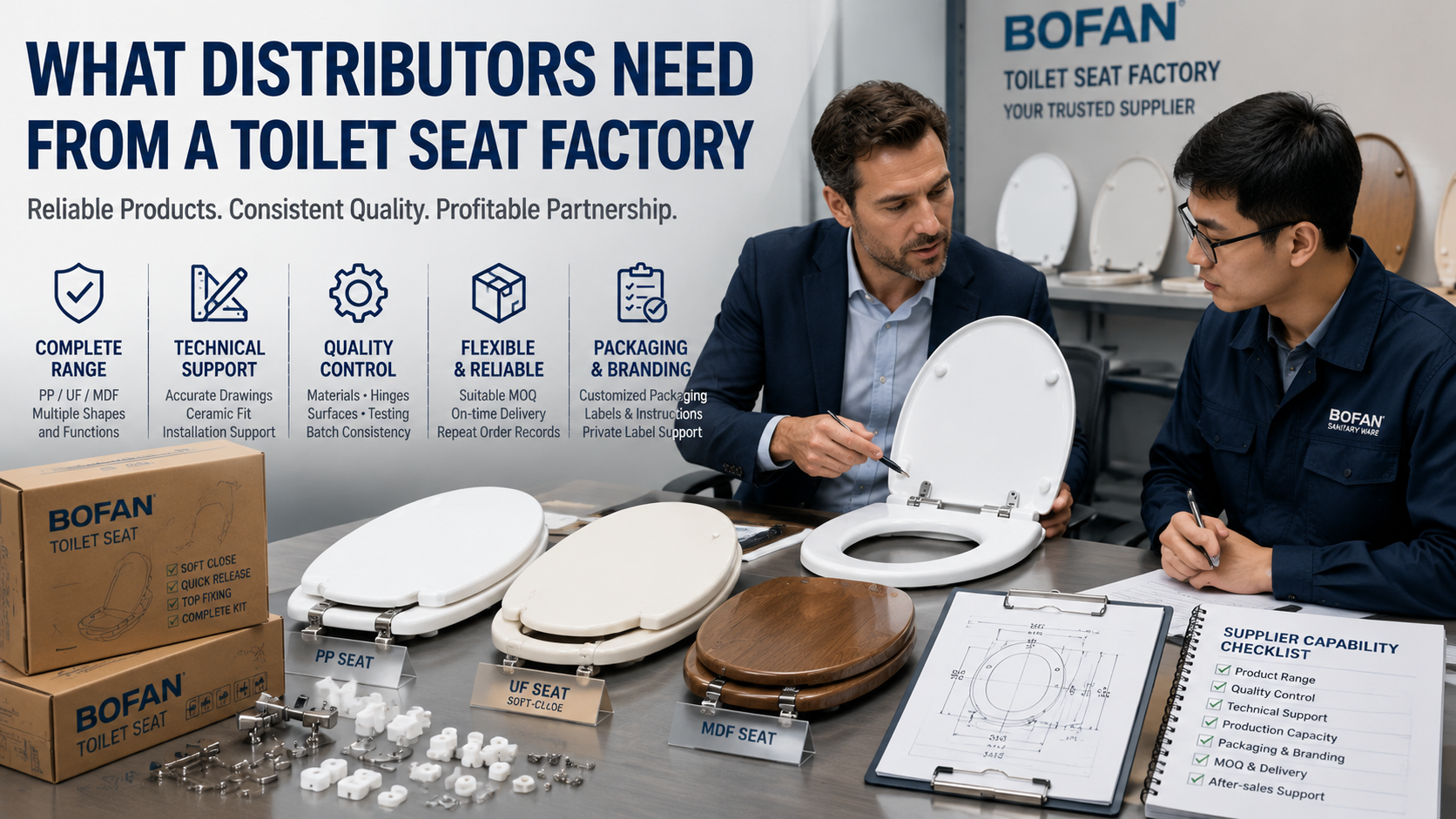
What Distributors Need from a Toilet Seat Factory
A toilet seat factory for distributors should provide more than competitive unit prices. Distributors need a commercially useful product range, accurate drawings, ceramic-fit support, equivalent samples, controlled production, clear MOQ rules, suitable packaging and reliable repeat-order records. The factory should explain which products are established, which components can be customized and which documents apply to each model. It must also control hinges, fixings, surfaces and batch consistency according to an approved specification. The strongest factory relationship helps a distributor build, stock and replenish a profitable range without creating unnecessary SKUs, compatibility problems or undocumented product changes.
Why Do Distributors Need More Than a Product Catalogue?
A one-time buyer may select one model for a single order. A distributor needs a range that can be sold and replenished over several buying cycles.
This changes the supplier relationship.
The factory must support decisions involving:
- Entry, mainstream and premium products
- Several customer channels
- Local ceramic compatibility
- Stock and replenishment
- MOQ per SKU
- Mixed-model shipments
- Private-label packaging
- Quality consistency
- Claims and replacements
- Product changes over time
A large catalogue does not automatically provide these capabilities. A factory may show hundreds of products but have regular production experience in only part of the range.
Distributors should therefore assess both product breadth and production depth.
BOFAN’s solution for toilet seat distributors and importers organizes product selection around market level, channel and purchasing requirements.
What Product Range Should a Factory Be Able to Offer?
The factory should cover the material, shape and function combinations required by the distributor’s customers.
A relevant range may include:
- PP toilet seats
- UF or duroplast seats
- MDF or molded-wood seats
- Round models
- Elongated models
- D-shaped or special shapes
- Standard hinges
- Soft-close hinges
- Quick-release systems
- Top-fix and bottom-fix hardware
- Retail, project and replacement configurations
The distributor should then examine the depth behind each category.
Useful questions include:
- Which models use existing molds?
- Which products are in regular production?
- Which hinge options fit each model?
- Which models have repeat-order records?
- Which products are suitable for the distributor’s target country?
- Which items can share packaging or components?
- Which models require separate MOQ?
BOFAN’s complete toilet seat range provides an initial reference for comparing common materials, shapes and functions.
A good factory should help the distributor reduce the shortlist, not simply send a larger catalogue.
How Should a Factory Support Product-Range Planning?
Distributors need products with clear commercial roles.
A practical range can be structured as:
| Range position | Product starting point | Main customer need |
|---|---|---|
| Entry | Standard PP seat | Practical function and controlled cost |
| Mainstream | PP or UF soft-close seat | Comfort and broad market appeal |
| Premium | UF quick-release or upgraded hinge model | Finish, function and perceived value |
| Decorative | Selected MDF model | Color, print or traditional styling |
| Project | Standardized PP or UF model | Installation and repeatability |
| Replacement | Adjustable model with clear dimensions | Compatibility across known ceramics |
The factory should explain why each proposed model belongs in the range.
If two models have similar dimensions, materials, functions and price positions, one may be unnecessary. Every additional SKU creates separate purchasing, labeling, stock and replacement requirements.
The BOFAN guide to building a toilet seat product range for distribution provides a useful framework for organizing these tiers.
What Technical Support Should a Distributor Expect?
The factory should provide accurate information before it recommends a model.
Important technical information includes:
- Overall product length and width
- Inner opening dimensions
- Hinge-center spacing
- Hinge adjustment range
- Mounting-hole requirements
- Product material
- Seat and lid structure
- Hinge material and function
- Top-fix or bottom-fix hardware
- Included components
- Product and carton weight
- Installation instructions
For sanitary ware distributors, the factory should review ceramic drawings, measurements or samples. The proposed seat should then be installed on the intended bowl.
For replacement-seat distributors, the factory should state compatibility as a defined dimensional range. The term “universal” should not replace actual measurements.
A technically responsible factory should raise fit risks before production instead of assuming that an adjustable hinge fits every ceramic.
Why Do Distributors Need Comparable Production Samples?
A sample should represent the quoted production specification.
Distributors should confirm that the sample uses:
- The quoted material
- The proposed product structure
- The final hinge
- The final fixing kit
- The approved color
- The intended surface finish
- The proposed logo
- The selected packaging
Samples should be compared under consistent conditions.
The review should cover:
- Dimensions
- Ceramic fit
- Surface appearance
- Seat and lid alignment
- Buffer contact
- Hinge movement
- Fixing stability
- Soft-close performance
- Quick-release operation
- Packaging protection
A presentation sample with an upgraded hinge should not be used to approve a quotation based on a simpler component.
Once approved, the physical sample and written specification should become the production reference.
What Production Information Should a Factory Provide?
Distributors need realistic production information for the actual product mix.
The factory should explain:
- Which facility will make the product
- Main manufacturing stages
- Which processes are completed internally
- Which components come from external suppliers
- Whether the model is in regular production
- What must be approved before production
- How model and packaging variations affect scheduling
- How production batches are identified
- How schedule risks are communicated
A general capacity figure provides context but does not confirm availability for a specific order.
A PP injection-molded model, a coated MDF seat and a UF soft-close product use different processes. A mixed order may therefore require coordination across separate production stages.
BOFAN’s About BOFAN page provides company and manufacturing-background information for distributor evaluation.
What Quality-Control Capability Should Distributors Require?
A factory’s quality claim should be converted into observable control points.
The distributor should ask how the factory checks:
- Incoming materials
- Product dimensions
- Color and surface
- Chips, cracks and scratches
- Seat and lid alignment
- Hinges and fixings
- Soft-close operation
- Quick-release operation
- Product stability
- Logo and labels
- Packaging
- Carton quantity
BOFAN’s published quality-control process covers material, dimensional, surface, hinge, functional and packaging inspection.
For distributor orders, the quality process should refer to the approved model and components. A factory-level procedure alone does not define whether a particular scratch, dimension or closing behavior is acceptable.
The buyer and factory should agree on:
- Approved drawing
- Golden sample
- Inspection stages
- Sampling method
- Defect categories
- Acceptance limits
- Required records
- Reinspection process
Which Documents Should a Factory Provide?
Document requirements depend on the product and destination market.
A distributor may need:
- Product drawing
- Material information
- Hinge specification
- Installation instructions
- Packaging specification
- Inspection report
- Functional-test information
- Quality-management documentation
- Applicable product reports
- Packing list
- Country-of-origin information where required
The factory should state which document applies to which model, material and production location.
A report for one UF model should not automatically be used for a PP or MDF seat. A report for one hinge should not automatically cover a different damper system.
BOFAN publishes available certificates and test reports. Distributors should verify applicability against their selected configuration and market requirements.
How Should a Factory Explain MOQ and Mixed Orders?
MOQ should be transparent at SKU level.
It may vary according to:
- Existing or custom model
- Material
- Color
- Hinge
- Printed design
- Logo method
- Individual packaging
- Carton artwork
- Production location
A total order quantity does not automatically satisfy the production requirement for every variation.
For example, 1,000 seats divided among several shapes, colors and branded boxes create multiple production requirements.
The distributor should request:
- MOQ for the complete order
- MOQ per model
- MOQ per color or print
- MOQ per hinge configuration
- MOQ for customized packaging
If models can be combined in one shipment, the factory should also confirm carton quantities, SKU labels and loading arrangements.
What Should a Transparent Factory Quotation Include?
A useful quotation should identify:
- Factory model
- Material and structure
- Dimensions
- Hinge and fixing system
- Included hardware
- Color and finish
- Logo work
- Individual packaging
- Master-carton quantity
- Carton dimensions and weight
- MOQ per SKU
- Unit price
- Trade term
- Sample arrangement
- Inspection assumptions
- Required documentation
- Quotation validity where applicable
The BOFAN guide on how to compare toilet seat suppliers explains why prices should be normalized before suppliers are scored.
A factory should identify exclusions and assumptions instead of giving a low headline price for an undefined product.
What Packaging Support Do Distributors Need?
Packaging must support the product’s route to market.
Wholesale distribution
Trade or project buyers may prioritize:
- Product protection
- Clear SKU identification
- Complete hardware
- Practical carton quantity
- Warehouse handling
Retail distribution
Retail channels may require:
- Color boxes
- Product features
- Fit information
- Installation instructions
- Barcodes
- Multilingual text
- Private-label branding
E-commerce distribution
Parcel delivery may require stronger individual protection and better control of loose metal components.
The factory should prepare a packed sample, artwork proof and master-carton specification before production.
Similar-looking products must have distinct SKU labels, particularly when they use different dimensions or hinges.
How Important Are Communication and Change Control?
Communication is part of supply quality.
A factory should:
- Ask for missing technical information
- Use consistent model numbers
- Record specification changes
- Distinguish confirmed details from estimates
- Identify compatibility risks
- Explain schedule dependencies
- Maintain one current document revision
- Notify the distributor before changing components
Uncontrolled substitutions can affect fit, closing behavior, appearance or packaging.
A change to a hinge, fixing kit, material, color or production location should be assessed before implementation. If the change affects the approved result, the distributor may require a new sample.
What Repeat-Order Support Should a Distributor Expect?
A distributor needs specification continuity.
For every approved product, the factory should retain or reference:
- Model code
- Drawing revision
- Material
- Color
- Hinge code
- Fixing kit
- Logo
- Packaging
- Approved sample
- Inspection requirements
- Authorized changes
Before a repeat order, the parties should confirm that the same configuration remains available.
No factory should promise indefinite availability without a defined agreement. However, documented specifications make replenishment and replacement discussions much more reliable.
Claims should also follow a structured process. Useful evidence includes product and carton codes, quantities, photographs and a description of the problem.
How Can Distributors Score a Toilet Seat Factory?
A weighted scorecard helps reduce subjective decisions.
| Evaluation area | Suggested weight |
|---|---|
| Product range and market suitability | 20% |
| Sample quality and ceramic fit | 20% |
| Quality-control capability | 15% |
| Commercial terms and MOQ | 15% |
| Production and repeat-order support | 10% |
| Packaging and private-label capability | 10% |
| Documentation | 5% |
| Communication and change control | 5% |
The weights can change according to the distributor’s model.
A sanitary ware distributor may give more weight to ceramic fit. A retail importer may prioritize packaging, pricing and replenishment. A project distributor may give more weight to installation and batch consistency.
How Does BOFAN Support Distributor Programs?
BOFAN manufactures PP, UF and MDF toilet seats with standard, soft-close and quick-release options.
Support for distributors can include:
- Product-range planning
- Material and hinge selection
- Ceramic and dimensional review
- Sample preparation
- Color, logo and packaging coordination
- Product drawings and specification confirmation
- Production inspection
- Export packing
- Mixed-model discussions
- Repeat-order specification records
BOFAN’s existing toilet seat supplier guide for wholesale buyers provides additional supplier-selection context.
Exact models, MOQ, pricing, production arrangements, customization and documentation must be confirmed for the proposed product range.
What Should Distributors Send for a Factory Evaluation?
Send the factory:
- Target country
- Customer types
- Sales channels
- Required price tiers
- Preferred materials
- Common shapes and ceramics
- Hinge functions
- Quantity per model
- Branding and packaging requirements
- Inspection expectations
- Required documents
- Trade term
- Replenishment expectations
BOFAN can use this information to propose a more focused model shortlist and clarify which factory capabilities apply to the program.
The right toilet seat factory is not simply the one with the largest catalogue or lowest first quotation. It is the factory that can repeatedly deliver the approved products, components and packaging that the distributor can sell successfully.
4. FAQ
What should distributors expect from a toilet seat factory?
Distributors should expect a commercially relevant product range, accurate technical information, representative samples, controlled production, clear MOQ rules and suitable packaging. The factory should also retain specifications for repeat orders.
How can a distributor verify a toilet seat factory?
The distributor can review factory information, production processes, product samples, quality-control records and applicable documents. A factory visit, live production review or third-party inspection can provide additional evidence when appropriate.
Why is ceramic-fit support important for distributors?
Poor fit can create installation problems, returns and customer complaints. The factory should provide dimensions and hinge ranges and should test samples on the intended ceramic when a specific bowl is involved.
Should a toilet seat factory provide a golden sample?
Yes. The approved physical sample should represent the production material, hinge, fixing kit, color, finish and packaging. It gives both parties a stronger reference than photographs alone.
Can distributors combine several models in one order?
Mixed-model supply may be possible when production, MOQ, packaging and loading conditions allow. The factory should confirm the minimum quantity and carton identification for each SKU.
How should a factory manage repeat orders?
The factory should retain controlled references for the model, drawing, material, color, hinge, fixings and packaging. Any proposed change should be communicated before repeat production.
Can BOFAN support branded distributor ranges?
BOFAN supports suitable PP, UF and MDF models with hinge, color, logo and packaging options. Final feasibility, MOQ and production arrangements depend on the selected range and customization.
Table of Contents
- What Distributors Need from a Toilet Seat Factory
- Why Do Distributors Need More Than a Product Catalogue?
- What Product Range Should a Factory Be Able to Offer?
- How Should a Factory Support Product-Range Planning?
- What Technical Support Should a Distributor Expect?
- Why Do Distributors Need Comparable Production Samples?
- What Production Information Should a Factory Provide?
- What Quality-Control Capability Should Distributors Require?
- Which Documents Should a Factory Provide?
- How Should a Factory Explain MOQ and Mixed Orders?
- What Should a Transparent Factory Quotation Include?
- What Packaging Support Do Distributors Need?
- How Important Are Communication and Change Control?
- What Repeat-Order Support Should a Distributor Expect?
- How Can Distributors Score a Toilet Seat Factory?
- How Does BOFAN Support Distributor Programs?
- What Should Distributors Send for a Factory Evaluation?
-
4. FAQ
- What should distributors expect from a toilet seat factory?
- How can a distributor verify a toilet seat factory?
- Why is ceramic-fit support important for distributors?
- Should a toilet seat factory provide a golden sample?
- Can distributors combine several models in one order?
- How should a factory manage repeat orders?
- Can BOFAN support branded distributor ranges?