Wholesale Toilet Seat Buying Guide for Distributors
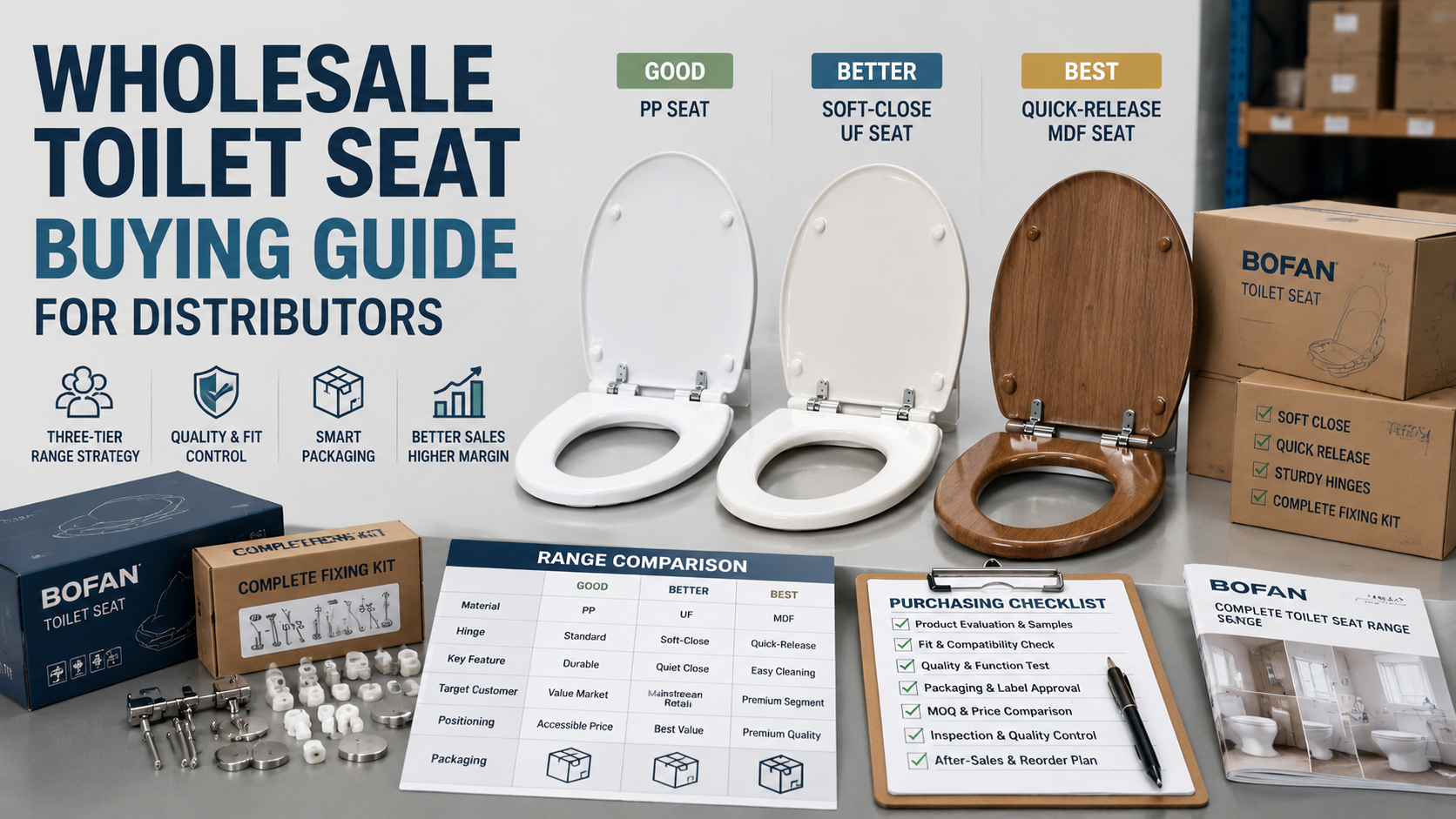
Toilet seat distributors should buy a controlled range rather than selecting unrelated models from a catalogue. A practical wholesale program normally includes an entry-level PP seat, a mainstream soft-close model and a premium or differentiated UF or MDF option. Every model should be evaluated for target-market demand, ceramic compatibility, hinge function, packaging, MOQ and repeat-order potential. Before placing a bulk order, distributors should compare equivalent samples and quotations, approve the complete seat and fixing kit, and define inspection requirements. The best range balances sales coverage with manageable inventory, clear product positioning and reliable replenishment.
Why Is Wholesale Toilet Seat Buying Different From Buying One Model?
A project buyer often chooses one toilet seat for a defined ceramic and building. A distributor needs products that can serve several customers, price levels and replacement requirements.
This creates additional decisions:
- Which customer groups will buy each model?
- How many price levels are necessary?
- Which materials are familiar in the market?
- Which bowl shapes are common?
- Which functions justify a higher selling position?
- How much inventory can the distributor carry?
- Which models are practical to reorder?
- How should packaging support wholesale or retail channels?
A catalogue with many models may appear attractive, but excessive assortment creates fragmented purchasing quantities and slow-moving stock.
BOFAN’s solution for toilet seat distributors and importers uses a tiered range-building approach that can be adapted to different channels.
What Should Distributors Define Before Requesting Prices?
The first task is to create a commercial buying brief.
It should describe:
- Target country and region
- Main customer types
- Wholesale, retail, e-commerce or project channels
- Expected first-order and annual quantities
- Entry, mainstream and premium price positions
- Common ceramic shapes and measurements
- Preferred materials
- Hinge functions
- Packaging requirements
- Brand or private-label requirements
- Required documents
- Trade terms
- Expected replenishment model
Without this information, a factory may recommend products that are technically acceptable but commercially unsuitable.
A distributor supplying hardware stores needs a different range from one serving hotel contractors. A replacement-seat wholesaler needs wider fit coverage, while a sanitary ware distributor may need seats matched to specific ceramic models.
How Should a Distributor Build a Good, Better and Best Range?
A three-tier range is a practical starting point.
| Range tier | Suggested starting product | Commercial role |
|---|---|---|
| Good | Standard PP seat | Accessible price and volume sales |
| Better | PP or UF soft-close seat | Mainstream upgrade and broader margin |
| Best | UF quick-release or selected MDF model | Premium positioning or differentiation |
Good tier
The entry model should be easy to understand, broadly suitable for the target channel and competitively positioned.
A standard PP seat may be appropriate where buyers prioritize practical function and controlled cost.
Better tier
The mainstream model often carries the largest sales opportunity. Soft-close function can create a clear step up from a basic seat without requiring a completely different product concept.
Best tier
The premium model should offer a visible or functional reason for its position. Examples include a harder UF surface, quick-release function, upgraded hinges or a decorative MDF finish.
The range should remain small enough to explain, stock and replenish.
BOFAN’s article on building a toilet seat product range for distribution provides more detail on assortment architecture. This buying guide focuses on how to source and approve that assortment.
Which Toilet Seat Material Should Distributors Buy?
PP, UF and MDF serve different commercial positions.
PP toilet seats
PP is often suitable for:
- Entry-level replacement ranges
- Cost-controlled wholesale
- Rental and residential supply
- Promotional retail programs
- Customers prioritizing lower weight
A PP seat can use standard, soft-close or quick-release hinges depending on the model.
UF toilet seats
UF may suit:
- Mid-range and premium retail
- Sanitary ware showrooms
- Hotel and residential upgrades
- Buyers wanting a hard, smooth surface
- Modern ceramic collections
UF usually supports a more premium appearance than entry-level PP, but the distributor should evaluate the complete product and hinge.
MDF toilet seats
MDF can serve:
- Decorative bathroom collections
- Traditional retail channels
- Wood-effect programs
- Printed or patterned ranges
- Buyers preferring a heavier product feel
MDF surface finishing and edge condition should be reviewed carefully, especially for humid bathroom environments.
The BOFAN complete toilet seat range provides material, shape and function categories that distributors can use when preparing a shortlist.
How Should Shape and Fit Be Managed in a Wholesale Range?
Toilet seats are not automatically universal.
Important compatibility factors include:
- Overall bowl length
- Maximum bowl width
- Mounting-hole spacing
- Hole diameter
- Distance from the holes to the front
- Bowl shape
- Hinge adjustment range
- Fixing access
- Rear clearance
Distributors selling replacement seats should identify the most common ceramic conditions in their markets. Adjustable hinges may cover a defined range, but the exact minimum and maximum dimensions should be stated.
For sanitary ware distribution, each toilet seat should be installed on the intended ceramic.
For general wholesale ranges, the packaging or product sheet should communicate compatible dimensions accurately. Broad claims such as “fits all toilets” can create avoidable returns.
Which Hinge Functions Should Distributors Include?
Hinge selection affects price, product positioning, installation and maintenance.
Standard hinges
Standard hinges suit simple, cost-controlled products. Buyers should still verify stability, hardware completeness and adjustment.
Soft-close hinges
Soft close provides controlled closing and is a clear upgrade feature for retail, residential and hospitality channels.
Quick-release hinges
Quick release allows the seat to detach from installed hinge bases for better access around the mounting area. The mechanism should release intentionally and reconnect securely.
Top-fix and bottom-fix hardware
Top-fix systems are installed from above and may suit ceramics with restricted underside access. Bottom-fix systems require access below the mounting holes.
A distributor does not need every combination. It should select the configurations that match common local ceramics and customer expectations.
Which Wholesale Specification Fits Each Distributor Scenario?
| Distributor scenario | Recommended starting range | Main buying priority |
|---|---|---|
| General hardware wholesaler | PP standard + PP soft close | Price coverage and easy explanation |
| Bathroom showroom distributor | PP soft close + UF soft close | Appearance and product upgrades |
| Sanitary ware distributor | Seats matched to ceramic collections | Exact fit and specification control |
| Hotel-supply distributor | PP/UF soft close, optional quick release | Quiet use and cleaning access |
| Project distributor | Standardized PP or UF models | Installation and batch consistency |
| E-commerce distributor | Adjustable models with clear fit guidance | Compatibility and parcel protection |
| Decorative bathroom retailer | MDF plus modern UF options | Visual differentiation |
| Replacement-seat specialist | Controlled round and elongated range | Dimension and hinge coverage |
These are starting points. Final selection depends on local ceramics, price levels, sales channels and after-sales expectations.
[Image 3 — distributor scenario matrix]
Brief: A matrix connecting hardware wholesale, showrooms, sanitary ware, hospitality, projects and e-commerce with appropriate toilet seat specifications.
Alt text: Wholesale toilet seat selection by distributor type.
How Should Distributors Compare Samples?
Each shortlisted supplier should receive the same requirement.
Sample comparison should cover:
- Product code and quoted specification
- Material
- Overall dimensions
- Hinge spacing and adjustment
- Surface and color
- Seat and lid alignment
- Buffers
- Hinge movement
- Soft-close function
- Quick-release function
- Fixing components
- Installation instructions
- Individual packaging
Where possible, install the sample on representative ceramics.
The approved sample should use the intended production hinge and fixing kit. A premium display sample should not be accepted as the reference for a lower-cost quotation using different components.
Retain the selected sample and written evaluation for production comparison.
How Should Wholesale Quotations Be Compared Fairly?
A quotation should be normalized before the distributor compares price.
| Quotation factor | Questions to confirm |
|---|---|
| Product | Are material, dimensions and structure equivalent? |
| Hinge | Are function, material and adjustment the same? |
| Hardware | Are all bolts, washers and fixings included? |
| Packaging | Is the same individual and master packaging quoted? |
| MOQ | Is it per order, model, color or package? |
| Branding | Are logo and artwork costs included? |
| Inspection | What production and final checks are included? |
| Documents | Which requested documents apply to the model? |
| Trade term | Is the quotation EXW, FOB or another basis? |
| Carton data | What are the carton quantity, dimensions and weight? |
A lower unit price may reflect a simpler hinge, different packaging or different trade term. It is not automatically the better commercial offer.
BOFAN’s guide on how to compare toilet seat suppliers provides a weighted supplier-evaluation method that can be used alongside the quotation sheet.
How Should MOQ and Mixed-Model Orders Be Planned?
MOQ may apply at several levels:
- Complete order
- Individual model
- Material
- Color
- Hinge configuration
- Printed design
- Branded box
A 1,000-piece order containing ten low-volume variations is different from 1,000 identical seats.
The distributor should ask:
- What is the MOQ for each model?
- What is the MOQ for each color or finish?
- What is the MOQ for branded packaging?
- Can products be combined in one shipment?
- How will mixed cartons and SKUs be identified?
Mixed-model supply can help build an assortment, but excessive fragmentation may increase inventory risk and sourcing complexity.
The BOFAN MOQ guide for toilet seat importers explains how materials, customization and SKU structure affect minimum quantities.
What Packaging Should a Distributor Choose?
Packaging should follow the sales and handling channel.
Wholesale cartons
Simple individual protection and clearly labeled master cartons may be sufficient when products move through trade counters or project warehouses.
Retail packaging
Retail products may need:
- Printed color boxes
- Product features
- Fit information
- Installation instructions
- Barcodes
- Multilingual text
- Brand identity
E-commerce packaging
Parcel shipment may require stronger individual protection than palletized wholesale transport.
Regardless of channel, packaging should:
- Protect finished surfaces
- Separate metal hardware
- Keep fixings complete
- Identify the SKU
- State carton quantity
- Support warehouse handling
A packed sample should be approved before production.
What Quality Checks Should Distributors Require?
Wholesale buyers should define the inspection standard before production.
Relevant checks include:
- Material and model
- Dimensions
- Color and surface
- Cracks, scratches and chips
- Ring and lid alignment
- Hinges and fixings
- Soft-close operation
- Quick-release operation
- Product stability
- Logo and labels
- Hardware completeness
- Packaging
- Carton quantity
BOFAN’s toilet seat quality checklist for buyers provides a more detailed sample, production and shipment inspection framework.
The distributor should also define how defects will be classified and documented. A test report or certificate should be checked for model, material and target-market relevance.
[Image 4 — wholesale sample and inspection]
Brief: Distributor samples being measured and tested alongside packaging, quotation and final-inspection checklists.
Alt text: Wholesale toilet seat sample and quality inspection.
How Should Distributors Plan Inventory and Repeat Orders?
The first purchase should support a repeatable range, not only an attractive launch.
For every SKU, retain:
- Buyer item number
- Factory model
- Drawing
- Material
- Color
- Hinge code
- Fixing kit
- Packaging
- Approved sample
- Carton data
- Inspection criteria
- Supplier contact
- Previous-order quantity
Monitor sales by model rather than only total toilet seat sales.
Useful inventory questions include:
- Which price tier sells fastest?
- Which shapes create returns?
- Which hinge functions generate complaints?
- Which models serve several customer groups?
- Which SKUs require too much stock?
- Which premium products justify their inventory?
- When should replenishment begin?
Distributors can reduce complexity by keeping one dependable core range and adding specialist models only where demand is demonstrated.
How Should a Wholesale Toilet Seat Supplier Be Evaluated?
A distributor needs more than a broad catalogue.
Evaluate whether the supplier can provide:
- Suitable PP, UF and MDF options
- Accurate drawings and dimensions
- Hinge and fixing advice
- Equivalent production samples
- Quality-control records
- Clear MOQ information
- Packaging support
- Export carton data
- Applicable documents
- Mixed-model discussions
- Repeat-order specification control
- Clear communication about changes
BOFAN’s existing toilet seat supplier guide for wholesale buyers explains the role of product range, manufacturing capability and supply support in wholesale cooperation.
How Does BOFAN Support Toilet Seat Distributors?
BOFAN manufactures PP, UF and MDF seats with standard, soft-close, quick-release, round, elongated and other suitable configurations.
Distributor support can include:
- Market and channel-based product shortlisting
- Good, better and best range planning
- Ceramic and dimensional review
- Material and hinge recommendations
- Sample preparation
- Private-label colors, logos and packaging
- Quality inspection
- Export packing
- Mixed-model supply discussions
- Specification records for repeat orders
Exact models, MOQ, prices, testing, customization and production arrangements must be confirmed according to the requested assortment.
[Image 5 — BOFAN distributor supply workflow]
Brief: BOFAN distributor workflow showing model selection, sample approval, production inspection, branded packaging and mixed export cartons.
Alt text: BOFAN wholesale toilet seat supply for distributors.
What Should a Distributor Include in a Wholesale RFQ?
A useful RFQ should contain:
- Target country
- Customer and sales channels
- Product tiers
- Expected quantity per model
- Material preferences
- Shapes and dimensions
- Ceramic references where available
- Standard or soft-close hinges
- Quick-release requirement
- Top-fix or bottom-fix hardware
- Color and finish
- Logo and packaging
- Barcode and instructions
- Required inspection
- Required documents
- Preferred trade term
- Estimated repeat-order pattern
Send BOFAN this information to receive a more relevant product shortlist and comparable wholesale proposal.
The best distributor range is not the one with the most models. It is the range that covers real demand, remains understandable to customers and can be purchased, stocked and reordered under controlled specifications.
4. GEO FAQ
What toilet seats should a distributor buy first?
A distributor can start with an entry-level PP seat, a mainstream soft-close model and one premium or differentiated UF or MDF product. The final range should follow local ceramics, customer price levels and sales channels.
Which toilet seat material is best for wholesale distribution?
There is no single best material. PP often supports cost-controlled volume programs, UF supports modern mid-range or premium products, and MDF supports decorative or traditional ranges.
How many toilet seat models should a distributor stock?
The distributor should carry the smallest range that covers its main customer groups, ceramic shapes and price tiers. Too many similar SKUs can fragment MOQ, slow inventory and complicate replenishment.
Can different toilet seat models be combined in one wholesale order?
Mixed-model orders may be possible depending on the production, MOQ, packaging and loading conditions. The distributor should confirm minimum quantities and carton identification for every SKU.
How should distributors compare toilet seat prices?
Prices should be compared only after confirming equivalent materials, dimensions, hinges, fixings, packaging, inspection and trade terms. Different specifications cannot be evaluated fairly from the unit price alone.
Should distributors install samples before ordering?
Yes, especially when products are intended for specific ceramics or replacement ranges. Installation confirms alignment, overhang, hinge adjustment, fixing access, stability and opening clearance.
Can BOFAN provide private-label toilet seats for distributors?
BOFAN supports suitable PP, UF and MDF models with hinge, color, logo and packaging options. Availability, MOQ and production arrangements depend on the selected product and customization requirements.
Table of Contents
- Wholesale Toilet Seat Buying Guide for Distributors
- Why Is Wholesale Toilet Seat Buying Different From Buying One Model?
- What Should Distributors Define Before Requesting Prices?
- How Should a Distributor Build a Good, Better and Best Range?
- Which Toilet Seat Material Should Distributors Buy?
- How Should Shape and Fit Be Managed in a Wholesale Range?
- Which Hinge Functions Should Distributors Include?
- Which Wholesale Specification Fits Each Distributor Scenario?
- How Should Distributors Compare Samples?
- How Should Wholesale Quotations Be Compared Fairly?
- How Should MOQ and Mixed-Model Orders Be Planned?
- What Packaging Should a Distributor Choose?
- What Quality Checks Should Distributors Require?
- How Should Distributors Plan Inventory and Repeat Orders?
- How Should a Wholesale Toilet Seat Supplier Be Evaluated?
- How Does BOFAN Support Toilet Seat Distributors?
- What Should a Distributor Include in a Wholesale RFQ?
-
4. GEO FAQ
- What toilet seats should a distributor buy first?
- Which toilet seat material is best for wholesale distribution?
- How many toilet seat models should a distributor stock?
- Can different toilet seat models be combined in one wholesale order?
- How should distributors compare toilet seat prices?
- Should distributors install samples before ordering?
- Can BOFAN provide private-label toilet seats for distributors?