How to Ensure Quality Consistency in OEM Toilet Seat Production
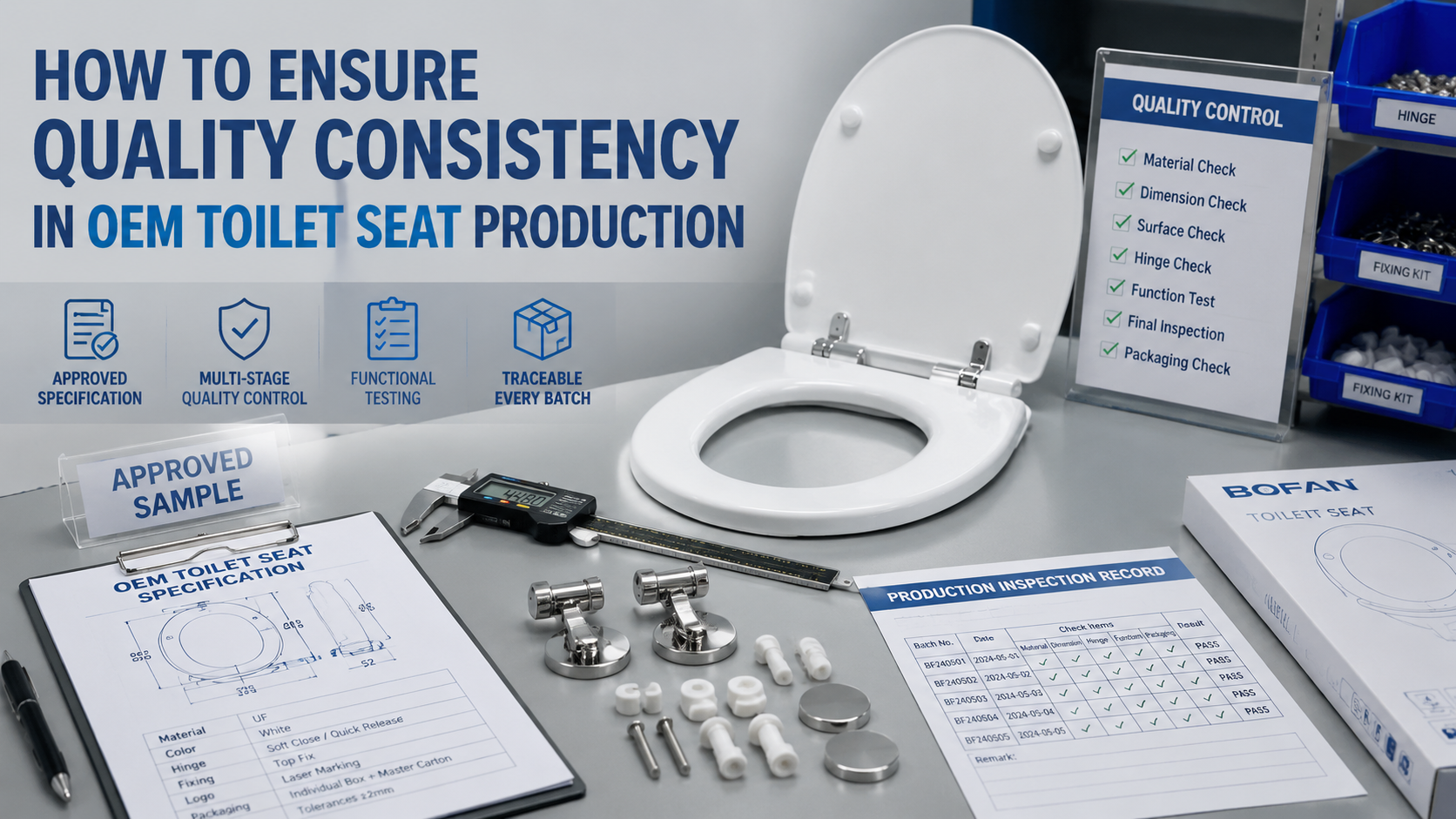
Quality control for OEM toilet seats requires more than inspecting finished products before shipment. The buyer and manufacturer must first freeze the product drawing, material, color, dimensions, hinge, fixing kit, logo and packaging. An approved sample should become the physical reference for production. The factory then needs control points for incoming components, molding or finishing, assembly, functional testing and final packing. Changes must be documented before implementation, and each production batch should remain traceable to its approved specification. This system helps OEM brands obtain repeatable products across samples, mass production and later replenishment orders.
Why Is OEM Quality Consistency More Than Final Inspection?
Final inspection answers one question: does the completed batch meet the agreed acceptance criteria?
OEM quality consistency answers a broader question: can the manufacturer repeat the approved product across the first order, later production batches and different delivery periods?
A final inspection may find visible scratches, missing fixings or failed soft-close hinges. It cannot fully correct a product that was made from an unapproved material, assembled with the wrong hinge or produced from an outdated drawing.
For this reason, a consistent OEM program requires several linked controls:
- Clear product definition
- Approved physical references
- Incoming-material verification
- Process checkpoints
- Functional testing
- Final inspection
- Specification change control
- Batch records
- Corrective-action procedures
BOFAN’s published quality-control process covers material, dimensional, surface, hinge, functional and packaging checks. For an OEM program, these factory checks should be connected to the buyer’s specific product requirements.
What Must Be Confirmed Before OEM Production Begins?
Quality consistency starts with a controlled product specification.
The buyer and manufacturer should confirm:
- Buyer item number
- Factory model number
- Drawing number and revision
- PP, UF or MDF material
- Product dimensions and agreed tolerances
- Seat and lid structure
- Color and surface finish
- Hinge model and material
- Standard or soft-close function
- Quick-release requirement
- Top-fix or bottom-fix hardware
- Buffers and included components
- Logo method and position
- Individual packaging
- Master-carton quantity
- Labels, barcodes and instructions
- Inspection and testing requirements
A general description such as “white UF soft-close seat” is insufficient. The same model may support several hinges, fixing systems and packages.
The specification should identify what the buyer has approved and which details remain open. Production should not begin while essential requirements are still being discussed informally.
Buyers unfamiliar with the process can first review what an OEM toilet seat is and then convert the commercial concept into a controlled production specification.
How Should an OEM Toilet Seat Control Plan Be Structured?
A control plan connects each requirement with an inspection stage, method, frequency and record.
| Control stage | Typical inspection items | Reference |
|---|---|---|
| Incoming materials | Material identity, color, component code and visible condition | Specification and approved components |
| Molding or forming | Dimensions, structure, deformation, cracks and molding defects | Drawing and process standard |
| Surface finishing | Color, coating, gloss, printing, edges and visible defects | Approved finish sample |
| Hinge assembly | Hinge code, orientation, adjustment and component completeness | Assembly specification |
| Functional testing | Soft close, quick release, opening and closing | Approved function criteria |
| Final inspection | Appearance, dimensions, alignment, hardware and quantity | Golden sample and checklist |
| Packaging | Protection, labels, instructions, carton quantity and markings | Approved packaging specification |
The control plan should also state whether each check applies to every product, a defined sample or a test sample selected from the batch.
Routine appearance checks may occur throughout production. Longer functional or structural tests may use a defined sample quantity. The buyer and factory should agree on this distinction before production.
How Should Incoming Materials and Components Be Controlled?
Incoming control prevents an incorrect component from entering production.
Seat materials
The factory should confirm the approved material category and relevant internal material reference. PP, UF and MDF use different manufacturing processes and have different quality risks.
For PP toilet seats, incoming control may include resin identification, approved color and material condition.
For UF toilet seats, the factory should control the molding compound and any approved color or formulation reference used for the selected product.
For MDF and wooden toilet seats, board or molded-wood condition, moisture management, coating materials and decorative components may require attention.
These examples do not replace model-specific inspection requirements. The correct checks depend on the selected manufacturing process.
Hinges and fixings
Incoming hinge control should verify:
- Hinge model
- Left and right components
- Damper type
- Metal or plastic parts
- Bolts and washers
- Expansion fixings
- Decorative caps
- Surface condition
- Quantity
A visually similar hinge should not automatically replace the approved component.
Packaging materials
Cartons, color boxes, labels and instruction sheets should be checked against approved artwork and dimensions. Old packaging revisions must be separated so they cannot enter the new order accidentally.
Which Process Controls Matter for PP, UF and MDF Seats?
Each material requires a different production focus.
PP production
PP seats are generally produced through injection molding. Process control should monitor:
- Product dimensions
- Molding completeness
- Deformation
- Flash and sharp edges
- Sink marks
- Color consistency
- Ring and lid alignment
- Mounting-area condition
Because structure affects product feel and stability, the buyer should approve the actual model rather than judging quality only by the PP material name.
UF production
UF seats require attention to:
- Molded dimensions
- Surface smoothness
- Chips and cracks
- Edges
- Color
- Seat and lid alignment
- Mounting areas
- Handling between production stages
UF has a hard surface, but careless impact or concentrated stress can still damage a finished product.
MDF production
MDF consistency depends heavily on surface preparation and finishing. Relevant checks can include:
- Product dimensions
- Sanding and edge condition
- Coating coverage
- Surface particles or paint defects
- Color and gloss
- Printed-pattern position
- Edge sealing
- Hinge-area finish
- Exposed core material
When several batches are planned, an approved color or finish reference is especially important. Digital photographs alone are not a reliable color standard.
How Should Hinges and Functional Performance Be Checked?
The seat, hinge and fixing system should be inspected as one assembly.
For standard hinges, the inspector should check movement, adjustment, fixing completeness and installed stability.
For soft-close products, inspect:
- Seat closing action
- Lid closing action
- Smooth movement
- Sudden dropping
- Stopping before full closure
- Abnormal noise
- Left-right synchronization
- Consistency among tested samples
- Stability after repeated operation
For quick-release products, check:
- Intended release method
- Removal from installed bases
- Secure refitting
- Return to the correct position
- Retention during normal use
- Condition after repeated release
Testing should start from a consistent position. If the buyer requires cycle testing or another performance test, the number of cycles, method and acceptance criteria should be confirmed for the selected model and hinge.
Why Is an Approved Golden Sample Essential?
A golden sample is the physical product accepted by the buyer as the manufacturing reference.
It supports evaluation of details that drawings cannot describe completely, such as:
- Surface feel
- Color impression
- Edge finish
- Seat and lid alignment
- Hinge movement
- Soft-close behavior
- Logo appearance
- Packaging presentation
The buyer should approve the sample only after confirming that it uses the intended production material, hinge, fixing kit and finish.
Where ceramic compatibility matters, install the sample on the actual toilet bowl. Check alignment, overhang, buffer contact, opening clearance, hinge adjustment and fixing access.
The buyer and factory may each retain a signed or otherwise controlled reference. The sample number should also appear in the specification or approval record.
How Should Specification Changes Be Controlled?
Uncontrolled changes are a major source of OEM inconsistency.
A change may involve:
- Raw material
- Product structure
- Hinge
- Damper
- Fixing components
- Color
- Coating
- Logo process
- Packaging
- Production location
- Test method
A change should not be implemented only because the replacement appears equivalent.
The manufacturer should explain:
- What is changing
- Why the change is required
- Which specifications may be affected
- Whether a new sample is necessary
- When the change will enter production
- How old and new components will be separated
The buyer should then approve, reject or request additional validation.
Every accepted change should update the drawing, specification or component list. The purchase order must refer to the current revision.
How Can Buyers Control Consistency Across Repeat Orders?
A repeat order should not depend on memory.
The sourcing file should retain:
- Product code
- Drawing revision
- Material
- Color reference
- Hinge and fixing codes
- Approved sample record
- Packaging artwork
- Inspection criteria
- Previous production records
- Approved changes
- Confirmed claim history
Before releasing a repeat order, compare the new purchase order with the latest approved specification.
The buyer should also confirm whether the same model, components and production arrangement remain available. If a component has changed, the change-control process should begin before production.
This is particularly important when an OEM program uses several colors, ceramic fits or retail packages. Similar-looking SKUs must remain clearly separated in production and packing.
What Should Final Batch Inspection Include?
Final inspection should confirm that completed products represent the approved specification.
Typical items include:
- Model and material
- Dimensions
- Color and finish
- Cracks, chips and scratches
- Seat and lid alignment
- Hinge code
- Fixing completeness
- Installed stability
- Soft-close or quick-release operation
- Logo position
- Individual packaging
- Barcode and labels
- Master-carton quantity
- Shipping marks
- Total quantity
A buyer may use an agreed random-sampling method. If an AQL system or another sampling plan is required, the inspection level, sample size and acceptance limits should be defined.
Available BOFAN certificates and test reports should be matched to the actual product, material, factory and destination requirement. Documentation does not replace batch inspection.
How Should Defects and Corrective Actions Be Managed?
Finding a defect is only the first step.
The buyer and manufacturer should record:
- Product and batch
- Defect description
- Quantity affected
- Photographs
- Inspection stage
- Immediate containment
- Likely cause
- Corrective action
- Responsible person
- Verification result
Containment prevents affected products from moving forward. Root-cause analysis addresses why the issue occurred. Corrective action should reduce the chance of recurrence.
For example, replacing scratched products solves the immediate shortage but does not explain the cause. If loose metal hinges were touching finished surfaces inside the box, the packaging method may need correction.
The updated method should then be verified in production.
BOFAN’s article on packaging customization for OEM toilet seat orders provides additional context for connecting product protection, accessories, artwork and channel requirements.
How Should Buyers Evaluate an OEM Factory’s Quality Capability?
A buyer should ask for evidence of a repeatable system.
Useful questions include:
- How are product specifications controlled?
- How are incoming materials identified?
- Which stages receive in-process inspection?
- How are surface defects classified?
- How are hinges and dampers tested?
- How are approved samples stored?
- How are specification changes communicated?
- Can the factory support buyer-defined inspection?
- How are nonconforming products separated?
- What records are retained for repeat orders?
- Can third-party inspection be coordinated?
- Which certificates apply to the selected model?
A factory tour or production review can help, but a tidy factory alone does not prove consistency. Buyers should follow one actual product from specification through material, production, inspection and packing.
How Does BOFAN Support OEM Quality Consistency?
BOFAN manufactures PP, UF and MDF toilet seats with standard, soft-close and quick-release configurations.
Its OEM toilet seat solutions can support:
- Product and material selection
- Ceramic and dimensional review
- Hinge and fixing configuration
- Drawing and sample confirmation
- Color, logo and packaging coordination
- Production inspection
- Functional checks
- Export packing
- Specification records for repeat orders
- Buyer-defined inspection discussions
Exact test methods, inspection frequency, documentation, customization and production arrangements should be confirmed for each model and purchase order.
What Is the Best Next Step for an OEM Buyer?
Start by turning the product concept into a controlled specification.
Send BOFAN the target market, ceramic drawing or measurements, material, hinge functions, expected quantity, logo, packaging and inspection requirements. BOFAN can then help prepare a suitable model shortlist, sample and product-specific quality-control discussion.
The goal is not to promise that variation can never occur. The goal is to define, detect and manage variation before it affects the buyer’s brand or customers.
4. FAQ
What controls OEM toilet seat quality consistency?
OEM consistency depends on a controlled specification, approved golden sample, incoming-material checks, process inspection, functional testing, final inspection and documented change control. These controls must refer to the exact product, hinge, fixing system and packaging.
What is a golden sample in toilet seat production?
A golden sample is the physical product approved as the production reference. It shows the expected material, dimensions, finish, color, alignment, hinge behavior, logo and packaging alongside the written specification.
Should every OEM toilet seat be functionally tested?
Routine functions can be checked according to the agreed production and sampling plan. Longer cycle or destructive tests are normally performed on a defined sample quantity using a specified method and acceptance criteria.
How can buyers prevent unauthorized component changes?
The purchase order should identify controlled product and hinge codes, while the supplier should use a written change-approval process. Any proposed change affecting fit, appearance, function or packaging should be reviewed before production.
How should repeat OEM orders be controlled?
The buyer and factory should retain the latest drawing, material, color, hinge, fixing, packaging and sample references. Each repeat order should be checked against this controlled file before production release.
Does a factory certificate guarantee product consistency?
No. A company certificate may describe a management system, while product reports may apply only to particular models or materials. Buyers should verify document applicability and continue to use model-specific production and batch controls.
Can BOFAN support buyer-defined OEM inspection requirements?
BOFAN can discuss model-specific dimensions, surfaces, hinge functions, packaging and sampling requirements with OEM buyers. The final control plan and acceptance criteria must be agreed for the selected product and order.
Table of Contents
- How to Ensure Quality Consistency in OEM Toilet Seat Production
- Why Is OEM Quality Consistency More Than Final Inspection?
- What Must Be Confirmed Before OEM Production Begins?
- How Should an OEM Toilet Seat Control Plan Be Structured?
- How Should Incoming Materials and Components Be Controlled?
- Which Process Controls Matter for PP, UF and MDF Seats?
- How Should Hinges and Functional Performance Be Checked?
- Why Is an Approved Golden Sample Essential?
- How Should Specification Changes Be Controlled?
- How Can Buyers Control Consistency Across Repeat Orders?
- What Should Final Batch Inspection Include?
- How Should Defects and Corrective Actions Be Managed?
- How Should Buyers Evaluate an OEM Factory’s Quality Capability?
- How Does BOFAN Support OEM Quality Consistency?
- What Is the Best Next Step for an OEM Buyer?
-
4. FAQ
- What controls OEM toilet seat quality consistency?
- What is a golden sample in toilet seat production?
- Should every OEM toilet seat be functionally tested?
- How can buyers prevent unauthorized component changes?
- How should repeat OEM orders be controlled?
- Does a factory certificate guarantee product consistency?
- Can BOFAN support buyer-defined OEM inspection requirements?