12 Common Mistakes When Sourcing Toilet Seats
The most common mistakes when sourcing toilet seats are requesting prices without a complete specification, assuming a seat will fit every ceramic bowl, choosing material by price alone, overlooking hinge quality, approving uninstalled samples and comparing non-equivalent quotations. Buyers also create risk when they misunderstand MOQ, accept documents without checking model applicability, postpone inspection until production is finished or leave packaging and replacement requirements undefined. A safer process uses one controlled specification, actual ceramic measurements, installed sample approval, documented quality criteria and clear commercial terms before bulk production begins.
Why Do Toilet Seat Sourcing Mistakes Become Expensive?
A toilet seat is a relatively compact product, but a complete sourcing specification includes numerous connected decisions:
- Material
- Shape
- Dimensions
- Ceramic compatibility
- Hinge function
- Fixing method
- Surface finish
- Color
- Packaging
- Labels
- Inspection
- Export requirements
If one decision is incorrect, the problem may spread across a complete order.
An incompatible hinge can delay installation. A poorly protected MDF surface can be damaged during transport. An undefined color standard can create differences between batches. Incorrect carton labels can send similar-looking models to the wrong project area.
These risks grow with order volume. A sourcing mistake affecting one consumer purchase is inconvenient; the same mistake repeated across a wholesale or project order can affect inventory, customer claims and future supply.
Buyers should therefore manage toilet seats as controlled technical products rather than selecting them from photographs alone.
Mistake 1: Requesting a Price Without a Complete Specification
A request such as “Please quote 1,000 white soft-close toilet seats” is not detailed enough for a reliable comparison.
The supplier still needs to know:
- PP, UF or MDF material
- Round, elongated or special shape
- Overall dimensions
- Product structure
- Hinge type
- Top-fix or bottom-fix installation
- Quick-release requirement
- Color and surface finish
- Product and carton packaging
- Logo requirements
- Destination market
- Inspection expectations
- Trade term
Without these details, different suppliers will make different assumptions. Their prices may all be correct for the products they selected, but the quotations will not represent the same product.
A professional RFQ should either identify one exact model or define the intended product tier and application. Buyers who need several price levels can request separate good, better and best options.
BOFAN’s solution for toilet seat distributors and importers organizes PP, UF and MDF ranges around different channels and commercial positions.
How to prevent this mistake
Create a one-page product brief before requesting prices. Give every shortlisted supplier the same document and require each deviation to be stated clearly.
Mistake 2: Assuming a Toilet Seat Has Universal Fit
“Universal” is one of the most dangerous undefined terms in replacement-seat sourcing.
Toilet bowls vary by:
- Overall length
- Maximum width
- Shape
- Mounting-hole spacing
- Hole diameter
- Hinge adjustment area
- Front profile
- Rear clearance
- Fixing access
An adjustable hinge may support several ceramics, but it still has a minimum and maximum range. A seat can fit the mounting holes while remaining visually or structurally unsuitable for the bowl.
Buyers should obtain:
- Bowl length from the mounting-hole centers to the front
- Maximum bowl width
- Mounting-hole center distance
- Hole diameter
- Top and underside photographs
- Confirmation of top-fix or bottom-fix access
The proposed seat should then be installed on the actual ceramic.
How to prevent this mistake
Replace “universal fit” in the specification with measured compatibility limits. For an OEM or project order, record the approved ceramic model alongside the toilet seat and hinge codes.
Mistake 3: Selecting Material by Price Alone
PP, UF and MDF do not serve identical applications.
| Material | Common sourcing advantage | Main point to verify |
|---|---|---|
| PP | Lightweight, practical and suitable for many cost-controlled ranges | Product structure, molding and hinge stability |
| UF | Hard, smooth surface and refined modern appearance | Chips, impact handling and hinge-area stress |
| MDF | Heavier feel and decorative surface options | Coating, edges and moisture protection |
The cheapest material is not necessarily the most cost-effective for the buyer’s channel.
A hotel may value a smooth UF surface and soft-close hinge. A rental program may prioritize a practical PP model with stable fixings. A decorative retail collection may use MDF because color, printing or wood-effect styling is central to the offer.
Material names are also incomplete quality descriptions. Two PP seats can have different structures, weights and hinges. Two MDF seats can use different finishing and edge-protection processes.
How to prevent this mistake
Select material according to the target user, bathroom environment, sales position, cleaning method and replacement plan. Compare complete samples rather than general material categories.
Buyers can review BOFAN’s PP toilet seats, UF toilet seats and MDF and wooden toilet seats when building a shortlist.
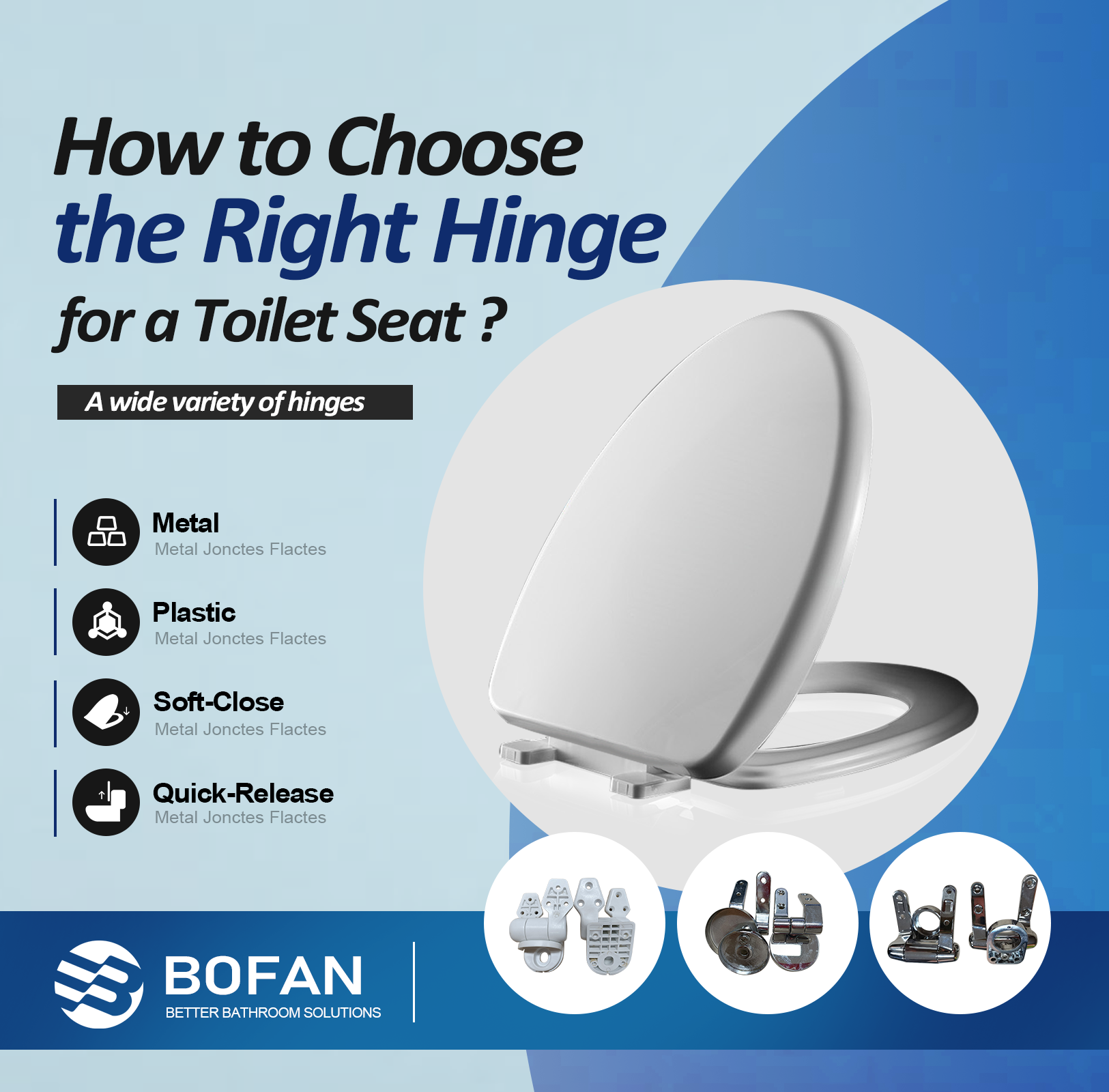
Mistake 4: Treating the Hinge as a Minor Accessory
The hinge determines how the seat is installed, adjusted, opened, closed and removed.
Common hinge-related sourcing failures include:
- Wrong fixing method
- Insufficient adjustment range
- Missing bolts or washers
- Unstable hinge bases
- Inconsistent soft-close dampers
- Quick-release mechanisms that are difficult to refit
- Hardware unsuitable for the seat structure
- No hinge code in the purchase order
A “soft-close toilet seat” quotation should identify the exact hinge configuration. The seat and lid should close smoothly, and the installed product should remain stable after adjustment.
A quick-release toilet seat should detach intentionally and reconnect securely. A soft-close toilet seat should be inspected for both seat and lid movement.
How to prevent this mistake
Approve the hinge and fixing kit as part of the complete product. Include the hinge code, material, function, adjustment range and included hardware in the specification.
Mistake 5: Approving a Sample Without Installing It
A sample examined on a desk can demonstrate surface quality and basic function, but it cannot confirm:
- Bowl alignment
- Front and side overhang
- Buffer contact
- Hinge adjustment
- Fixing access
- Installed stability
- Opening clearance
- Lid position
- Soft-close behavior at the installed angle
This is particularly important for projects, sanitary ware brands and replacement programs.
A sample can be dimensionally close to the requirement and still look incorrect on the ceramic. The rear of the lid may also contact a cistern or wall before it opens fully.
How to prevent this mistake
Install the sample with final production hinges and fixings. Take top, side and rear photographs and record the ceramic model, measurements and installation result.
For a larger project, use a small pilot installation before authorizing the complete production quantity.
Mistake 6: Changing the Product After Sample Approval
Buyers sometimes approve one sample and then change the hinge, color, weight, packaging or fixing components during price negotiation.
The final product may no longer match the approved reference.
Even apparently small changes can affect performance:
- A different hinge can change alignment.
- A lighter structure can change soft-close behavior.
- A new fixing kit can affect installation.
- A different coating can alter color or cleaning performance.
- Revised packaging can reduce surface protection.
How to prevent this mistake
Every approved change should create a new specification revision. If the change affects fit, appearance or function, request a revised sample or component confirmation before production.
The purchase order should identify the current drawing and specification revision.
Mistake 7: Comparing Quotations That Are Not Equivalent
A low price can result from a genuinely efficient supply proposal, but it can also reflect a different specification.
Before comparing prices, check:
| Quotation factor | Questions to ask |
|---|---|
| Product | Are the material, dimensions and structure equivalent? |
| Hinge | Are the functions, materials and fixings the same? |
| Packaging | Is individual and master-carton packaging included? |
| OEM | Are logo, color and artwork costs included? |
| MOQ | Is the MOQ per order or per SKU? |
| Inspection | What inspection is included? |
| Trade term | Is the price EXW, FOB or another term? |
| Components | Are all installation parts included? |
| Documentation | Are required reports or documents included? |
| Production | Is the quotation based on an existing or customized model? |
A FOB quotation and an EXW quotation do not have the same cost boundary. Likewise, a neutral bulk carton and a printed retail box are not commercially equivalent.
How to prevent this mistake
Build one comparison sheet and normalize every quotation. List any missing item as an additional cost or unresolved risk.
Mistake 8: Misunderstanding MOQ and Mixed-Model Orders
MOQ is not always one number for the complete purchase order.
Manufacturers may need separate minimum quantities for:
- Each model
- Each material
- Each color
- Each hinge
- Each printed design
- Each branded box
- Each production location
An order of 1,000 seats divided among ten low-volume variations creates a different production arrangement from 1,000 identical seats.
Mixed-model loading may be possible, but it does not automatically remove the production requirement for each SKU.
How to prevent this mistake
Ask four separate questions:
- What is the total-order MOQ?
- What is the MOQ per model?
- What is the MOQ per color or design?
- What is the MOQ for customized packaging?
Also confirm whether different products can be combined in one shipment and how cartons will be identified.
The existing BOFAN MOQ guide for toilet seat importers explains how materials, models and customization affect minimum quantities.
Mistake 9: Assuming One Certificate Covers Every Product
Buyers may receive a folder containing company certificates and product test reports and assume that every document covers every proposed model.
This is not always correct.
A document should be checked for:
- Certificate holder
- Factory
- Material
- Product or model
- Hinge configuration
- Test standard
- Issue date
- Validity
- Destination-market relevance
A quality-management certificate describes a management system. It does not replace model-specific fit, function or performance inspection.
A test report for one UF model should not automatically be applied to a different PP or MDF product.
How to prevent this mistake
Create a document matrix that connects each requirement to the exact supporting document. BOFAN’s available certificates and test reports should be checked for applicability to the selected model and market.
Avoid requesting “all certificates” without first defining what the destination or customer requires.
Mistake 10: Waiting Until Final Inspection to Check Quality
Final inspection is important, but it is too late to introduce the quality standard.
Quality control should begin during:
- Sample approval
- Pre-production confirmation
- Incoming-material checking
- In-process production
- Assembly and functional inspection
- Final random inspection
- Packing and shipment release
If the factory receives appearance or hinge requirements only after production is complete, correction may be difficult.
The buyer should define:
- Dimensions and tolerances
- Surface standard
- Color reference
- Hinge function
- Fixing completeness
- Soft-close criteria
- Quick-release criteria
- Defect classifications
- Sampling plan
- Packaging requirements
BOFAN’s toilet seat quality-control process covers material, surface, dimensional, hinge, functional and packing checks.
How to prevent this mistake
Agree on the inspection checklist before production. Use an approved drawing and golden sample and define how critical, major and minor defects will be handled.
Mistake 11: Under-Specifying Packaging and Carton Labels
A technically acceptable seat can still arrive damaged or become difficult to distribute if packaging is not controlled.
Packaging risks include:
- Hinges scratching the finished surface
- Missing hardware
- Insufficient edge protection
- Incorrect quantity per carton
- Cartons exceeding handling limits
- Similar SKUs using identical labels
- Incorrect barcodes
- Mixed colors inside one carton
- Instructions missing or using the wrong language
- Inaccurate carton dimensions
Retail, e-commerce and project orders require different packaging.
Retail products may need a printed box and product information. E-commerce products may require individual parcel protection. Construction projects may prioritize simple protective packaging and clear building or SKU identification.
How to prevent this mistake
Approve the individual package, hardware position, instructions, carton quantity, dimensions, gross weight and shipping marks. Conduct a packed-sample review rather than approving only the unboxed product.
Mistake 12: Ignoring Claims and Repeat-Order Planning
Many buyers focus on the first shipment and leave future replacement questions unanswered.
A long-term supply program needs records for:
- Product code
- Drawing revision
- Material
- Color
- Hinge code
- Fixing components
- Packaging
- Approved sample
- Inspection criteria
- Claim evidence
- Replacement components
If the product changes or a claim occurs, both parties need a common reference.
The buyer should also understand how confirmed defects will be documented. Useful evidence may include carton labels, production codes, photographs, quantities and a description of the failure.
No supplier should promise indefinite availability without an agreed arrangement. However, the parties can retain technical records and discuss repeat-order requirements before the first order.
How to prevent this mistake
Create a sourcing file for each approved SKU. Keep the purchase order, drawings, samples, inspection reports, packaging details and communication about approved changes together.
Which Mistakes Matter Most for Different Buyers?
| Buyer type | Highest sourcing risks | Recommended control |
|---|---|---|
| Distributor or importer | Wrong product mix, fragmented MOQ and excessive inventory | Start with a controlled good/better/best range |
| Sanitary ware brand | Poor ceramic fit and inconsistent OEM execution | Approve every seat on the brand’s ceramics |
| Retail chain | Packaging, barcode, shelf presentation and replenishment | Test final retail packaging and repeat-order workflow |
| E-commerce seller | Fit claims, parcel damage and customer instructions | Define compatibility and parcel-ready packaging |
| Construction project | Installation delay, mixed models and site allocation | Standardize SKUs and run a pilot installation |
| Hotel buyer | Cleaning, hinge stability and replacement management | Include housekeeping and engineering in approval |
| Wholesale buyer | Non-equivalent prices and uncertain batch consistency | Normalize quotations and use a golden sample |
The correct sourcing process changes with the business model. A retail product should not be approved only as if it were a project product, and a hotel seat should not be evaluated only by its retail appearance.
What Is a Safer Toilet Seat Sourcing Workflow?
A controlled sourcing process can follow ten steps:
- Define the target market and application.
- Create the product and packaging specification.
- Provide ceramic measurements where fit is relevant.
- Request comparable models and quotations.
- Review supplier manufacturing and quality capabilities.
- Install and approve the complete sample.
- Freeze the product, hinge, color and packaging.
- Agree on inspection and document requirements.
- Inspect production and packed goods.
- Retain records for claims and repeat orders.
For project buyers, BOFAN’s project toilet seat buying checklist provides an additional pre-order reference.
How Does BOFAN Help Buyers Reduce Sourcing Risk?
BOFAN manufactures PP, UF and MDF toilet seats with standard, soft-close, quick-release, round, elongated and project-oriented configurations.
BOFAN support may include:
- Product selection by market and channel
- Ceramic drawing and dimension review
- Material and hinge recommendations
- Sample preparation
- Installed-sample confirmation support
- OEM color, logo and packaging options
- Specification and drawing coordination
- Production inspection
- Export packing
- Mixed-model supply discussions
- Repeat-order specification records
BOFAN’s OEM toilet seat solutions are intended for sanitary ware companies and brands requiring controlled product development and private-label execution.
Exact models, MOQ, pricing, production timing, test documents and customization feasibility must be confirmed according to the final specification.
Conclusion
Most sourcing problems do not begin on the production line. They begin when the buyer and supplier work from different assumptions.
The highest-risk mistakes are:
- An incomplete RFQ
- Unverified ceramic compatibility
- Material selection based only on price
- Undefined hinges and fixings
- Uninstalled sample approval
- Uncontrolled specification changes
- Non-equivalent quotation comparisons
- Late quality requirements
- Incomplete packaging instructions
- Missing repeat-order records
A reliable sourcing process makes every important assumption visible before production.
Send BOFAN your target market, ceramic drawings or measurements, preferred material, hinge functions, quantity, packaging and inspection requirements to receive a model-specific sourcing proposal and sample recommendation.
4. FAQ
What information is needed when sourcing toilet seats?
Buyers should provide the target market, application, material, dimensions, ceramic measurements, hinge functions, fixing method, quantity, packaging and required documents. A complete specification allows suppliers to prepare comparable models and quotations.
What is the biggest mistake when buying toilet seats wholesale?
The biggest mistake is comparing prices before confirming that products have equivalent materials, dimensions, hinges, hardware and packaging. A low quotation cannot be evaluated accurately when the underlying specification is different.
Should a toilet seat sample be installed before bulk ordering?
Yes. Installation on the intended ceramic confirms alignment, overhang, buffer contact, hinge adjustment, fixing access and opening clearance. A desk review cannot verify these conditions.
Does a universal toilet seat fit every toilet bowl?
No. Adjustable seats and hinges still have defined dimensional and mounting ranges. Buyers should measure the bowl and test the proposed model on the actual ceramic.
How should buyers verify toilet seat quality?
Use an approved drawing and golden sample, inspect materials and dimensions during production, test hinges and functions, and conduct a final random inspection. Packaging and hardware completeness should also be checked before shipment.
Why does toilet seat packaging need approval?
Packaging protects surfaces, separates metal hardware and ensures the correct components reach the buyer. Approved carton quantities, weights, labels and barcodes also reduce warehouse and project-distribution errors.
Can BOFAN support customized wholesale toilet seat orders?
BOFAN supports suitable PP, UF and MDF models with hinge, color, logo and packaging options. Final customization, MOQ, production and document arrangements depend on the selected product and market requirements.
Table of Contents
- 12 Common Mistakes When Sourcing Toilet Seats
- Why Do Toilet Seat Sourcing Mistakes Become Expensive?
- Mistake 1: Requesting a Price Without a Complete Specification
- Mistake 2: Assuming a Toilet Seat Has Universal Fit
- Mistake 3: Selecting Material by Price Alone
- Mistake 4: Treating the Hinge as a Minor Accessory
- Mistake 5: Approving a Sample Without Installing It
- Mistake 6: Changing the Product After Sample Approval
- Mistake 7: Comparing Quotations That Are Not Equivalent
- Mistake 8: Misunderstanding MOQ and Mixed-Model Orders
- Mistake 9: Assuming One Certificate Covers Every Product
- Mistake 10: Waiting Until Final Inspection to Check Quality
- Mistake 11: Under-Specifying Packaging and Carton Labels
- Mistake 12: Ignoring Claims and Repeat-Order Planning
- Which Mistakes Matter Most for Different Buyers?
- What Is a Safer Toilet Seat Sourcing Workflow?
- How Does BOFAN Help Buyers Reduce Sourcing Risk?
- Conclusion
-
4. FAQ
- What information is needed when sourcing toilet seats?
- What is the biggest mistake when buying toilet seats wholesale?
- Should a toilet seat sample be installed before bulk ordering?
- Does a universal toilet seat fit every toilet bowl?
- How should buyers verify toilet seat quality?
- Why does toilet seat packaging need approval?
- Can BOFAN support customized wholesale toilet seat orders?