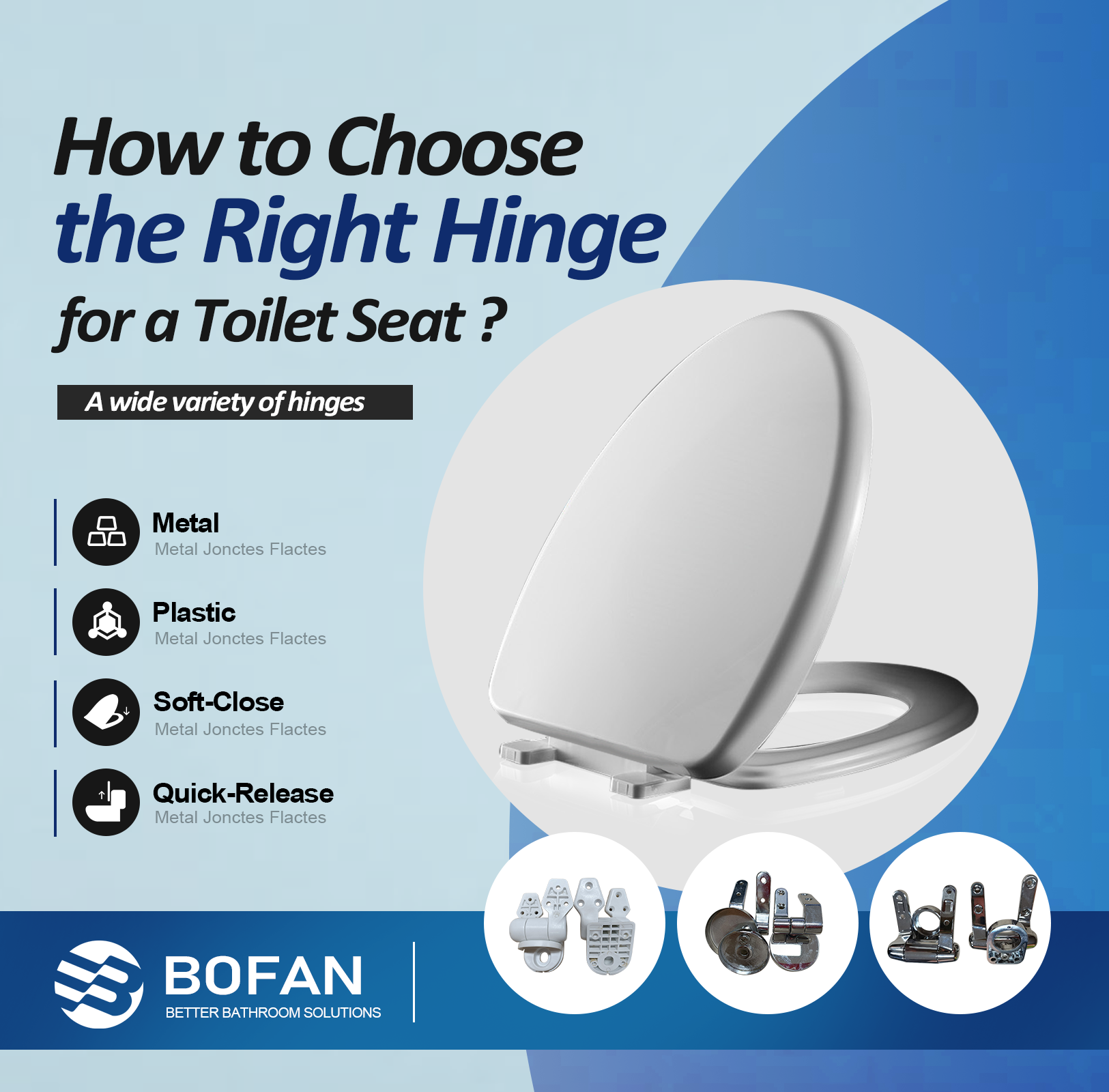
How to Choose the Right Hinge for a Toilet Seat
To choose the right toilet seat hinge, buyers must match the hinge to the seat material, ceramic mounting holes, fixing access, required adjustment range and user environment. Standard hinges suit simple, cost-controlled products; soft-close hinges provide controlled closing; and quick-release systems improve access around the mounting area. Top-fix hardware is useful where the underside of the ceramic cannot be reached, while bottom-fix hardware suits bowls with accessible mounting holes. Before bulk ordering, install the complete seat, hinge and fixing set on the actual ceramic and document the approved configuration.
Why Is the Toilet Seat Hinge So Important?
The hinge connects the toilet seat to the ceramic, controls movement and transfers the forces created during use.
A seat made from an appropriate material can still perform poorly if the hinge:
- Does not match the mounting holes
- Has insufficient adjustment
- Uses the wrong fixing method
- Loosens during use
- Does not support the product weight
- Closes inconsistently
- Is difficult to install
- Conflicts with cleaning requirements
For B2B buyers, the hinge should be treated as part of a complete product system. The approved specification must include the seat, lid, hinge body, dampers, bolts, washers, expansion fixings, caps and instructions.
A product description such as “UF soft-close seat” is incomplete unless the exact hinge and fixing configuration are also identified.
What Information Is Needed Before Choosing a Hinge?
Buyers should collect information about the seat, ceramic and application.
Toilet seat information
Confirm:
- PP, UF or MDF material
- Seat and lid weight
- Shape and dimensions
- Hinge-mounting structure
- Required opening angle
- Standard or soft-close function
- Quick-release requirement
Ceramic information
Record:
- Mounting-hole spacing
- Hole diameter
- Adjustment area
- Distance from holes to the bowl front
- Top and underside access
- Rear clearance
- Cistern or wall position
- Ceramic surface shape around the holes
Application information
Define:
- Residential, hotel, commercial or project use
- Cleaning frequency
- Expected installation method
- Required appearance
- Maintenance approach
- Target market
- Replacement-component requirements
- Cost position
A hinge that is suitable for a residential PP seat may not be appropriate for a heavier MDF model or a high-use project bathroom.
What Are the Main Toilet Seat Hinge Types?
The main functional categories are standard, soft-close and quick-release hinges.
| Hinge type | Main function | Typical application | Main inspection point |
|---|---|---|---|
| Standard hinge | Manual opening and closing | Entry-level residential, rentals and simple projects | Stability and fixing security |
| Soft-close hinge | Controls closing speed | Family homes, apartments, hotels and premium retail | Damper consistency |
| Quick-release hinge | Allows seat removal | Cleaning-focused residential, hotel and commercial use | Secure release and refitting |
| Soft close + quick release | Combines both functions | Premium residential, hospitality and branded products | Complete functional reliability |
| Lift-off or detachable system | Removes seat through a defined movement | Maintenance and selected project applications | Retention during normal use |
Functions can be combined, but each added feature increases specification and inspection requirements. Buyers should only add a function that creates value for the target user or operator.
When Should Buyers Choose a Standard Hinge?
A standard hinge allows the seat and lid to move freely without a damping mechanism.
It can be suitable for:
- Entry-level retail products
- Cost-controlled residential projects
- Basic rental units
- Low-use bathrooms
- Replacement programs prioritizing simplicity
- Markets where soft close is not expected
Advantages include a simpler structure and fewer functional components to test.
However, “standard” should not mean unstable or poorly specified. Buyers should still inspect:
- Hinge-body strength
- Bolt and washer completeness
- Adjustment range
- Movement
- Surface finish
- Resistance to loosening
- Seat alignment after installation
A reliable standard hinge may be a better choice than an unsuitable low-grade damper added only for marketing.
When Is a Soft-Close Hinge the Better Choice?
A soft-close toilet seat uses damping components to control the lowering of the ring and lid.
Soft close is valuable where buyers want:
- Reduced slamming
- A quieter user experience
- Premium product positioning
- Controlled seat and lid movement
- Less closing impact
- Feature differentiation in retail or OEM ranges
Suitable applications include:
- Family bathrooms
- Apartments
- Hotels
- Serviced accommodation
- Premium sanitary ware collections
- Mid- and high-level retail products
The buyer should not evaluate the function from a single closing cycle. Check:
- Closing speed of the seat
- Closing speed of the lid
- Smoothness
- Left-right synchronization
- Sudden dropping
- Stopping before full closure
- Abnormal noise
- Damper consistency across samples
- Stability after repeated use
Temperature and product weight can affect closing behavior. The inspection method should therefore use a consistent starting position and defined conditions where relevant.
When Should Buyers Add Quick Release?
A quick-release toilet seat can be detached from its installed hinge bases through a button, lift-off or other designed mechanism.
Quick release can improve access around the hinge area during cleaning. It is particularly relevant for:
- Hotels
- Serviced apartments
- Premium residential products
- Cleaning-focused retail ranges
- Healthcare or care-related projects where applicable
- Bathrooms using scheduled deep-cleaning procedures
The mechanism should be tested after installation.
Confirm that:
- Release is intentional and understandable.
- The seat detaches without excessive force.
- Refitting produces a positive connection.
- The seat returns to the correct alignment.
- The product remains secure during normal use.
- Repeated release does not damage the hinge or seat.
- Instructions explain the process accurately.
Quick release is not automatically required for every commercial bathroom. The operator should decide whether staff will use the function and how removal fits the cleaning procedure.
What Is the Difference Between Top-Fix and Bottom-Fix Hinges?
Top fix and bottom fix describe how the hinge is secured to the ceramic.
Top-fix hinges
Top-fix systems are installed and tightened from above the bowl. They commonly use an expansion fixing inserted into the ceramic mounting hole.
Top fix is useful when:
- The underside is enclosed
- The mounting area cannot be reached easily
- Wall-hung or back-to-wall ceramic limits access
- Installation speed from above is valuable
The buyer must confirm hole diameter, ceramic thickness and the suitability of the expansion fixing.
Bottom-fix hinges
Bottom-fix systems use bolts passing through the ceramic with nuts or fixing components tightened underneath.
Bottom fix is suitable when:
- The underside is accessible
- The ceramic has conventional open mounting holes
- Installers can reach the nuts safely
- The selected fixing provides suitable adjustment
| Decision factor | Top fix | Bottom fix |
|---|---|---|
| Tightening access | From above | From underneath |
| Best ceramic condition | Restricted underside access | Open underside access |
| Main component | Expansion or top-mounted fixing | Bolt, washer and lower nut |
| Key risk | Incorrect hole or expansion compatibility | Difficult access or incorrect tightening |
| Installation check | Expansion engagement | Washer and nut position |
Neither method is universally better. The correct option follows the ceramic and installation environment.
Should Buyers Choose Fixed or Adjustable Hinges?
Fixed-center hinges fit one defined mounting-hole spacing. Adjustable hinges provide a specified range.
Fixed-center systems
A fixed system may suit:
- A sanitary ware brand pairing one seat with one ceramic
- A controlled construction project
- A dedicated OEM product
- Markets with a stable mounting specification
The main benefit is controlled positioning. The main risk is incompatibility with ceramics outside the defined measurement.
Adjustable systems
Adjustable hinges can support several hole spacings or allow front-to-back positioning.
They are useful for:
- Replacement-seat ranges
- Distributor portfolios
- Retail products serving multiple ceramics
- Renovation projects containing several bowl models
Adjustment should not be described as “universal” without dimensions. Buyers need the minimum and maximum range and must test the hinge within the intended ceramic conditions.
Excessive adjustment can also affect stability or appearance. The seat should remain centered and securely fixed at every approved position.
Which Hinge Materials Should Buyers Consider?
Toilet seat hinges may use plastic, stainless steel, zinc-alloy or combinations of metal and engineering plastics.
Plastic hinges
Plastic components can support cost control, low weight and corrosion resistance in normal bathroom conditions. Their suitability depends on design, material, load path and fixing structure.
They are often used with PP seats and standard residential products.
Stainless-steel components
Stainless-steel hinge parts can provide a clean appearance and may be selected for premium, UF, hotel or commercial products. The buyer should confirm the actual component specification and surface finish rather than relying on the general description “metal hinge.”
Zinc-alloy components
Zinc-alloy parts can support decorative shapes and finishes. Surface treatment and the intended cleaning environment should be considered.
Mixed-material hinges
Many hinge systems combine metal shafts, plastic housings, dampers and rubber or plastic washers. Inspection should evaluate the complete assembly instead of judging only the visible cap.
For every material, consider:
- Bathroom humidity
- Cleaning products
- Surface finish
- Contact between dissimilar components
- Product weight
- Installation forces
- Required appearance
- Replacement strategy
How Should Hinges Be Matched to PP, UF and MDF Seats?
Different seat materials create different product and hinge requirements.
PP toilet seats
PP toilet seats are lightweight and can use standard, soft-close or quick-release hinges.
The hinge should match the molded mounting structure and provide stable contact without deforming or stressing the product.
UF toilet seats
UF toilet seats have a hard, dense structure and are commonly paired with premium-looking soft-close or quick-release hinges.
Assembly and installation should avoid concentrated stress that could damage the seat around mounting areas.
MDF toilet seats
MDF and wooden toilet seats are generally heavier and rely on a protected finished surface.
The hinge must suit the product weight, attachment method and surface coating. Inspect the hinge area for finish damage and ensure that hardware does not expose the wood-based core.
| Seat material | Practical hinge starting point | Main concern |
|---|---|---|
| PP | Plastic or metal standard/soft-close hinge | Structure and stable fixing |
| UF | Soft-close metal or mixed-material hinge | Stress distribution and alignment |
| MDF | Stable standard or soft-close hinge | Product weight and coating protection |
The final decision should follow the exact model, not the material category alone.
Which Hinges Fit Different Usage Scenarios?
| Application | Suggested starting configuration | Main priority |
|---|---|---|
| Affordable housing | Standard PP hinge or basic soft close | Controlled cost and simple installation |
| Family apartment | Soft close, optional quick release | Quiet use and cleaning |
| Premium residential | Soft close + quick release | User experience and appearance |
| Hotel guest room | Soft close, optional quick release | Quiet operation and housekeeping |
| Public restroom | Stable standard or commercial hinge | Frequent-use stability |
| Student housing | Stable fixing with limited unnecessary complexity | Maintenance control |
| Retail replacement range | Adjustable soft-close or standard hinge | Compatibility across ceramics |
| Ceramic OEM program | Fixed or controlled adjustable hinge | Exact ceramic fit |
| Renovation project | Top or bottom fix based on site access | Installation compatibility |
These recommendations should be verified using the real ceramic, cleaning process and intended frequency of use.
How Should Ceramic Compatibility Be Verified?
A hinge cannot be approved from a photograph alone.
The buyer should supply:
- Top-view ceramic photograph
- Side-view photograph
- Mounting-area photograph
- Overall bowl length
- Maximum width
- Hole-center spacing
- Hole diameter
- Fixing access
- Rear clearance
Install the sample using the final production hardware. Check:
- Whether the hinge bases sit correctly on the ceramic
- Whether the fixing can be tightened without damage
- Whether the seat remains centered
- Whether the buffers contact the bowl
- Whether the seat moves laterally
- Whether the lid opens fully
- Whether soft close works at the installed angle
- Whether quick release detaches and refits correctly
For large projects or OEM programs, retain the ceramic reference, product drawing, hinge code and installed-sample photographs.
How Should Hinge Quality Be Inspected?
Hinge inspection should cover appearance, installation and function.
Appearance
Check for:
- Cracks
- Burrs
- Scratches
- Coating defects
- Surface damage
- Incorrect caps
- Visible corrosion
- Color inconsistency
Component completeness
Confirm:
- Left and right hinges
- Bolts
- Washers
- Expansion plugs
- Nuts
- Decorative caps
- Instructions
- Any installation tool included in the specification
Installation
Inspect:
- Adjustment range
- Tightening
- Base contact
- Seat alignment
- Resistance to movement
- Access for tools
Functional checks
Evaluate:
- Opening and closing movement
- Soft-close performance
- Quick-release operation
- Abnormal noise
- Hinge synchronization
- Stability after repeated cycles
BOFAN’s quality-control process includes hinge, soft-close, stability and finished-product inspection. Test methods and acceptance criteria should be matched to the selected model and buyer requirement.
What Common Hinge Selection Mistakes Should Buyers Avoid?
Choosing by appearance alone
A polished metal cap may look premium but does not confirm the internal damper, adjustment range or fixing quality.
Assuming every hinge fits every ceramic
Hole spacing, diameter and access vary. “Universal” should always be supported by a defined measurement range.
Ignoring the seat material and weight
A hinge that performs adequately with PP may behave differently on a heavier MDF seat.
Failing to confirm top or bottom access
The wrong fixing method can make installation difficult or impossible at the site.
Adding quick release without an operational reason
A feature adds components and inspection requirements. Confirm that users or cleaning teams will benefit from it.
Testing only one closing cycle
Soft-close consistency should be evaluated across several samples and repeated operations.
Approving a sample with temporary hardware
The installed sample must use the production hinge, bolts, washers and fixing method.
Omitting the hinge code from the purchase order
A model name may support several hinge options. The approved hinge must be identified separately.
What Should Be Included in a Hinge RFQ?
A professional RFQ should contain:
- Toilet seat model and material
- Seat and lid weight where relevant
- Ceramic drawing or measurements
- Mounting-hole spacing
- Hole diameter
- Top-fix or bottom-fix requirement
- Standard or soft-close function
- Quick-release requirement
- Hinge material preference
- Color and finish
- Adjustment range
- Target market
- Usage scenario
- Expected quantity
- Packaging requirements
- Required testing or documents
- Sample-approval process
This information enables the supplier to recommend a compatible system rather than quoting a generic hinge.
How Does BOFAN Support Hinge and OEM Selection?
BOFAN manufactures toilet seats using standard, soft-close, quick-release, top-fix and bottom-fix configurations across suitable PP, UF and MDF models.
Support may include:
- Review of ceramic drawings and measurements
- Hinge and fixing recommendations
- Standard and soft-close configurations
- Quick-release options
- Adjustment-range confirmation
- Installed-sample review
- Functional inspection
- OEM colors, logos and packaging
- Product and hinge specification records
- Replacement-component discussions
BOFAN’s OEM toilet seat solutions support sanitary ware companies and brands pairing seats with their ceramic ranges.
Exact hinge availability, MOQ, testing, production arrangement and documentation depend on the selected seat model and market requirements.
Conclusion
The right toilet seat hinge is the one that connects the approved seat securely to the actual ceramic while delivering the functions required by the user or operator.
Buyers should make five decisions:
- Standard or soft close
- Fixed or quick release
- Top fix or bottom fix
- Fixed-center or adjustable
- Plastic, metal or mixed-material construction
Every decision must be verified through installation. Approve the final seat, hinge and fixing set as one product and include the hinge code in the purchase order.
Send BOFAN the seat material, ceramic measurements, mounting-hole details, usage scenario and required functions to receive a suitable hinge configuration for sample testing.
4. FAQ
What type of toilet seat hinge should a buyer choose?
The hinge should match the seat material, ceramic mounting holes, fixing access and required functions. Standard hinges suit simple products, while soft-close and quick-release hinges support quieter use and easier hinge-area access.
What is the difference between top-fix and bottom-fix toilet seat hinges?
Top-fix hinges are installed and tightened from above the ceramic, making them useful when the underside cannot be reached. Bottom-fix hinges pass through the mounting holes and are tightened underneath.
Are soft-close toilet seat hinges suitable for every seat?
Soft-close hinges can be used with many PP, UF and MDF models, but the damper must match the seat and lid weight and mounting structure. The complete assembly should be tested on the intended ceramic.
What is a quick-release toilet seat hinge?
A quick-release hinge allows the seat to detach from installed hinge bases using a defined release mechanism. It can improve cleaning access, but the buyer must verify secure refitting and stability during normal use.
How is toilet seat hinge compatibility measured?
Buyers should confirm mounting-hole spacing, hole diameter, adjustment range, bowl length, fixing access and rear clearance. An installed sample provides stronger confirmation than dimensions alone.
Which hinge material is best for toilet seats?
There is no single best material for every application. Plastic, stainless-steel, zinc-alloy and mixed-material hinges can all work when their structure, finish and fixing system suit the product and bathroom environment.
Can BOFAN match a hinge to a customer’s ceramic toilet?
BOFAN can review ceramic drawings, measurements and photographs and recommend a compatible hinge and seat configuration for sample verification. Final approval should be based on installation on the actual ceramic.
Table of Contents
- How to Choose the Right Hinge for a Toilet Seat
- Why Is the Toilet Seat Hinge So Important?
- What Information Is Needed Before Choosing a Hinge?
- What Are the Main Toilet Seat Hinge Types?
- When Should Buyers Choose a Standard Hinge?
- When Is a Soft-Close Hinge the Better Choice?
- When Should Buyers Add Quick Release?
- What Is the Difference Between Top-Fix and Bottom-Fix Hinges?
- Should Buyers Choose Fixed or Adjustable Hinges?
- Which Hinge Materials Should Buyers Consider?
- How Should Hinges Be Matched to PP, UF and MDF Seats?
- Which Hinges Fit Different Usage Scenarios?
- How Should Ceramic Compatibility Be Verified?
- How Should Hinge Quality Be Inspected?
-
What Common Hinge Selection Mistakes Should Buyers Avoid?
- Choosing by appearance alone
- Assuming every hinge fits every ceramic
- Ignoring the seat material and weight
- Failing to confirm top or bottom access
- Adding quick release without an operational reason
- Testing only one closing cycle
- Approving a sample with temporary hardware
- Omitting the hinge code from the purchase order
- What Should Be Included in a Hinge RFQ?
- How Does BOFAN Support Hinge and OEM Selection?
- Conclusion
-
4. FAQ
- What type of toilet seat hinge should a buyer choose?
- What is the difference between top-fix and bottom-fix toilet seat hinges?
- Are soft-close toilet seat hinges suitable for every seat?
- What is a quick-release toilet seat hinge?
- How is toilet seat hinge compatibility measured?
- Which hinge material is best for toilet seats?
- Can BOFAN match a hinge to a customer’s ceramic toilet?