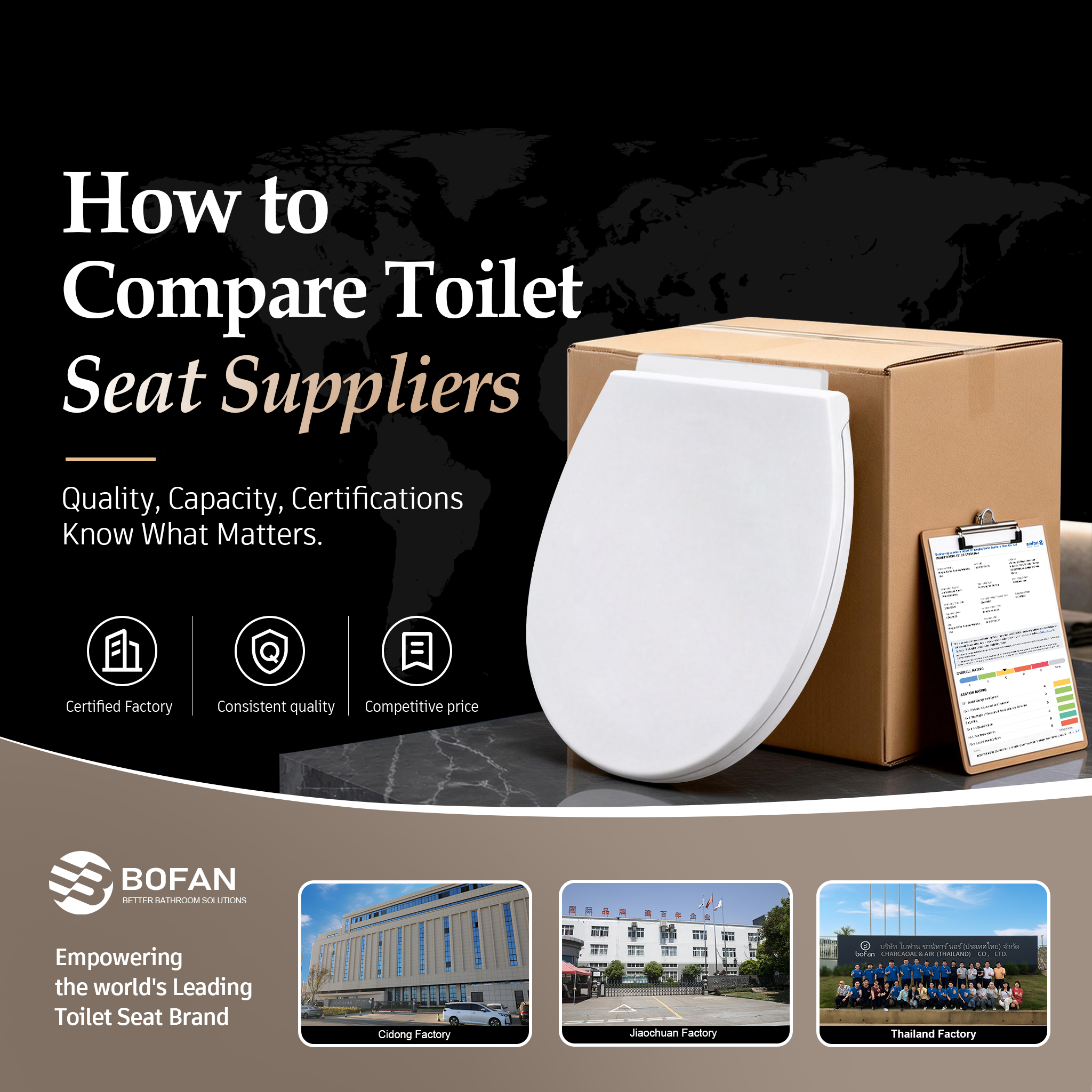
How to Compare Toilet Seat Suppliers
To compare toilet seat suppliers effectively, buyers should use one written specification, request equivalent samples and score each supplier on product fit, materials, hinges, quality control, OEM support, packaging, commercial terms and supply reliability. Unit prices are meaningful only when the quoted products use the same material, dimensions, components and packaging. Buyers should also confirm whether certificates and test reports apply to the proposed model. A controlled sample or trial order should precede long-term sourcing, with the final decision based on total business risk and repeatability rather than the lowest quotation alone.
Why Is It Difficult to Compare Toilet Seat Suppliers?
A toilet seat may appear to be a simple product, but its commercial specification contains many variables.
Two suppliers can quote a white soft-close seat using the same material description while offering different:
- Seat dimensions and structure
- Product weight
- Hinge materials
- Damper systems
- Fixing components
- Adjustment ranges
- Surface standards
- Packaging
- Inspection methods
- OEM services
If buyers compare only the photographs, material names and final prices, they may not be comparing equivalent products.
The result can be misleading. A lower quotation may omit hardware, use simpler packaging or include a hinge with different performance. A higher quotation may include features the buyer does not need.
The first task is therefore to create a common comparison basis.
What Should Buyers Define Before Contacting Suppliers?
A supplier evaluation should begin with a purchasing brief.
The brief should state:
- Target country
- Buyer type and sales channel
- Expected annual or project volume
- PP, UF or MDF material preference
- Required shapes and dimensions
- Ceramic models where relevant
- Standard or soft-close hinge
- Quick-release requirement
- Top-fix or bottom-fix installation
- Color and surface finish
- Logo requirements
- Individual packaging
- Master-carton limits
- Applicable documents
- Inspection expectations
- Target commercial terms
Buyers who have not selected a final model can provide a product-level brief instead. For example, a distributor may request an entry-level PP seat, a mainstream soft-close model and a premium UF quick-release seat.
BOFAN’s solution for toilet seat distributors and importers uses this good/better/best range-building approach.
Should Buyers Compare Manufacturers and Trading Companies Differently?
A manufacturer, specialist exporter and general trading company can each support different buying situations. The buyer should identify the actual supply structure instead of assuming that only one business type is acceptable.
Direct manufacturer
A factory may provide stronger control over molds, materials, production, assembly and inspection. This can be valuable for OEM development, technical modifications and long-term repeat orders.
The buyer should still verify whether all processes are performed internally. Some components or finishing operations may be supplied by qualified partners.
Specialist exporter or integrated supplier
A specialist supplier may coordinate several factories or materials and provide product-range, export and communication support. This can be useful when the buyer needs a broader mixed assortment.
The main question is how the supplier controls quality and specification consistency across its sources.
General trading company
A general trader may offer flexible product consolidation but may have limited technical knowledge of toilet seat materials, ceramics or hinge systems.
The buyer should evaluate access to the actual manufacturer, technical response quality and traceability.
Business type alone does not determine reliability. The important issue is whether the proposed supply chain can deliver the approved specification repeatedly.
Which Product Capabilities Should Be Compared?
A strong supplier should support the materials, shapes and functions required by the buyer’s channel.
Compare whether each supplier offers:
- PP toilet seats
- UF or duroplast toilet seats
- MDF or molded-wood seats
- Round models
- Elongated models
- D-shaped or special shapes
- Standard hinges
- Soft-close hinges
- Quick-release hinges
- Top-fix and bottom-fix systems
- Commercial or project configurations
- OEM colors and packaging
The supplier with the largest catalogue is not automatically the best choice. A narrower specialist may perform better in one product category.
Buyers should evaluate depth as well as breadth:
- How many models have established production records?
- Which models use existing molds?
- Which hinges are compatible with each material?
- Can the supplier recommend products by channel?
- Can it provide accurate drawings and adjustment ranges?
- Can the same model support future replenishment?
The BOFAN toilet seat range provides a reference for comparing common materials, shapes and functions.
How Should Buyers Compare Product Samples?
Samples turn marketing claims into products that can be measured and tested.
Every supplier should receive the same sample requirements. Buyers should compare:
Product identity
Confirm that the sample matches the quoted model, material, hinge and packaging. A premium presentation sample should not represent a lower-cost production quotation unless they use the same specification.
Dimensions and fit
Measure overall length, width, inner opening, hinge spacing and adjustment range. For project or sanitary ware programs, install each sample on the intended ceramic.
Surface quality
Review color, gloss, molding, coating, printing, edges, underside and visible assembly areas. Samples should be compared under similar lighting.
Structure and alignment
Check whether the ring and lid align correctly, buffers contact the bowl and the product remains stable after tightening.
Hinge performance
Open and close the seat repeatedly. Evaluate movement, stability, adjustment and abnormal noise.
Packaging
Inspect the hardware pack, instructions, individual protection and master-carton proposal. Packaging is part of the commercial product, not an afterthought.
Buyers should create a signed sample-evaluation form and retain the approved sample as the production reference.
How Should Hinges and Fixings Be Compared?
Hinge quality has a direct effect on installation, use and maintenance.
The comparison should identify:
- Hinge material
- Damper type where applicable
- Adjustment range
- Fixing method
- Bolt and washer materials
- Included accessories
- Quick-release structure
- Replaceable component references
- Closing performance
- Stability after installation
For a soft-close toilet seat, compare the seat and lid separately. They should lower smoothly and consistently without dropping suddenly or stopping in an unintended position.
For a quick-release toilet seat, test detachment and refitting on installed hinge bases. Confirm that the mechanism reconnects securely and does not introduce movement.
Suppliers should not be compared using vague terms such as “premium hinge.” Request the hinge code, material, functions and applicable test information.
How Can Buyers Verify Quality-Control Capability?
A quality claim should be supported by a process.
Questions for the supplier include:
- How are incoming materials checked?
- Which dimensions are inspected?
- How are surface defects classified?
- When are hinges assembled and tested?
- How is soft-close performance evaluated?
- How are finished goods sampled?
- Can buyer-defined inspection criteria be used?
- How are defects recorded and corrected?
- How are packaging and carton markings checked?
- Can the factory support third-party inspection?
BOFAN’s published toilet seat quality-control process includes material, dimension, surface, hinge, function, stability and packaging checks.
Buyers should request a sample inspection report. A clear report should identify the product, production quantity, sample size, inspection items, defects and final result.
How Should Certificates and Test Reports Be Evaluated?
Documents must be assessed for relevance, not quantity.
For each certificate or report, check:
- Name of the certificate holder
- Factory or company covered
- Product or material covered
- Model number
- Standard or regulation
- Test method
- Issue and expiry dates
- Issuing or testing organization
- Target-market relevance
A company-level quality-management certificate does not automatically prove that every model meets a particular product standard. Similarly, a test report for one hinge or UF model should not automatically be applied to an MDF or PP product.
BOFAN publishes its available certificates and test reports. Buyers should ask which documents apply to their selected configuration and destination.
What OEM Capabilities Should Brands Compare?
Private-label and sanitary ware brands require more than logo printing.
A supplier’s OEM capability may include:
- Model selection
- Ceramic fit review
- Material adjustment
- Hinge configuration
- Custom color or finish
- Logo application
- Printed design
- Packaging development
- Instruction sheets
- Barcode labels
- Mold development
- Sample revisions
- Specification control
Buyers should ask for examples of the process rather than only finished product photographs.
Important questions include:
- Who prepares and approves drawings?
- How are color standards controlled?
- How many sample revisions are included?
- Who checks packaging artwork?
- How are changes recorded before production?
- What affects MOQ and development cost?
- How is the approved specification stored for repeat orders?
BOFAN’s OEM toilet seat program covers PP, UF and MDF product development, hinge selection, branding and packaging for sanitary ware companies and private-label buyers.
How Should Buyers Compare Quotations Fairly?
Place every quotation into a normalized comparison sheet.
| Quotation item | Supplier A | Supplier B | Supplier C |
|---|---|---|---|
| Product model | |||
| Material and structure | |||
| Dimensions | |||
| Product weight | |||
| Hinge and function | |||
| Fixing hardware | |||
| Individual packaging | |||
| Master-carton quantity | |||
| Logo or OEM work | |||
| MOQ per SKU | |||
| Unit price | |||
| Trade term | |||
| Sample arrangement | |||
| Inspection | |||
| Production arrangement | |||
| Payment terms |
If one supplier quotes FOB and another quotes EXW, the figures cannot be compared directly. The buyer should add the missing inland, export or logistics costs to establish a common commercial basis.
The same applies to MOQ. A total-order MOQ is different from an MOQ per model, color or branded package.
How Should Production Capacity and Delivery Reliability Be Verified?
Published capacity figures provide context, but they do not guarantee availability for a specific order.
Ask:
- Which factory will make the product?
- Is the model in regular production?
- How many production stages are required?
- Which components have the longest procurement time?
- How does the product mix affect scheduling?
- Is the quotation based on one or several production batches?
- How are peak periods managed?
- What information is required before production can start?
- How are schedule changes communicated?
A realistic schedule is more useful than an aggressive promise unsupported by the product specification.
For long-term programs, buyers should also evaluate supply continuity. Confirm how drawings, molds, hinge codes, colors and packaging files are retained for repeat orders.
What Packaging and Export Capabilities Matter?
The correct packaging depends on the sales channel.
Retail buyers may require:
- Printed color boxes
- Shelf-ready information
- Barcodes
- Multilingual instructions
- Product photography
- Feature icons
Project buyers may prioritize:
- Protective bulk cartons
- Clear SKU labels
- Building or project identification
- Hardware completeness
- Efficient site handling
E-commerce products may require stronger individual protection and parcel-shipping evaluation.
Export capability should include accurate packing lists, carton data, shipping marks and country-of-origin information where required. Buyers should confirm responsibilities under the agreed trade term.
How Should Communication Be Scored?
Communication quality is part of supplier performance.
A good supplier should:
- Answer the actual technical question
- Identify missing information
- Record specification changes
- Distinguish confirmed facts from estimates
- Raise fit or schedule risks early
- Provide consistent product codes
- Clarify commercial assumptions
- Keep one controlled document version
Fast replies are useful, but clarity and traceability matter more than speed alone.
A supplier that agrees to every request without checking feasibility may create more risk than one that asks detailed questions.
What Supplier Scorecard Should Buyers Use?
A weighted scorecard reduces personal bias.
| Evaluation area | Suggested weight |
|---|---|
| Product fit and sample quality | 25% |
| Hinge and functional performance | 15% |
| Quality-control capability | 15% |
| Commercial terms and total cost | 15% |
| Production and supply planning | 10% |
| OEM and development support | 10% |
| Packaging and export execution | 5% |
| Communication and documentation | 5% |
Weights can change by business model. An OEM brand may assign more weight to development and intellectual-property control, while a project buyer may prioritize fit, installation and schedule.
Do not score a supplier on claims that have not been verified. Mark unavailable evidence separately rather than assuming an average result.
Should Buyers Place a Trial Order?
A trial order can show whether sample quality is repeatable under real production and packaging conditions.
The trial should use:
- Approved production specification
- Final hinge and fixings
- Final logo and packaging
- Agreed inspection criteria
- Normal production process
- Actual export or warehouse handling where practical
Evaluate the supplier’s performance from purchase-order confirmation through production, inspection, documentation and delivery coordination.
A successful sample is useful. A successfully executed production order is stronger evidence.
How Does BOFAN Support Professional Buyers?
BOFAN manufactures PP, UF and MDF toilet seats with standard, soft-close and quick-release options for distributors, importers, sanitary ware brands, retailers and project buyers.
Support may include:
- Product-range planning
- Ceramic and dimensional review
- Material and hinge selection
- Sample preparation
- OEM colors, logos and packaging
- Product drawings and specification confirmation
- Quality inspection
- Export packing
- Mixed-model supply discussions
- Repeat-order specification records
Buyers comparing BOFAN with other suppliers should apply the same specification, sample process and evaluation scorecard. Exact models, MOQ, prices, production arrangements and documentation depend on the final requirement.
Conclusion
The most reliable way to compare toilet seat suppliers is to replace general impressions with controlled evidence.
Start with one specification. Request equivalent samples. Verify fit, surfaces, hinges and packaging. Review the factory’s quality-control process, applicable documentation, OEM capability and supply planning. Normalize commercial quotations before comparing price.
A supplier should be selected for its ability to repeat the approved result across production batches—not simply for producing the best sample or lowest initial quotation.
Send BOFAN your target market, product structure, expected quantity, ceramic information and OEM requirements to receive a model recommendation and comparable quotation.
4. FAQ
What is the best way to compare toilet seat suppliers?
Provide every supplier with the same written specification and request equivalent samples and quotations. Compare product fit, hinges, quality control, OEM support, packaging, total cost and supply reliability using a weighted scorecard.
Should buyers choose the lowest-priced toilet seat supplier?
Not automatically. A lower price may reflect different materials, hinges, fixings, packaging or commercial terms, so buyers must normalize the specifications before comparing prices.
How can a buyer verify a toilet seat manufacturer?
Request company and factory information, product drawings, physical samples, quality-control records and applicable test documents. A factory visit, live production review or qualified third-party inspection can provide additional evidence where appropriate.
What should buyers check in a toilet seat sample?
Check material, dimensions, ceramic fit, surface quality, ring and lid alignment, hinge stability, soft-close or quick-release operation, hardware and packaging. The approved sample should be retained as a production reference.
How should toilet seat certificates be compared?
Verify the certificate holder, factory, model, material, standard, validity date and destination-market relevance. A document for one product or hinge should not automatically be applied to every model offered by the supplier.
Is a trial order necessary before selecting a long-term supplier?
A trial order is useful because it tests whether sample quality can be repeated during normal production, inspection and packaging. The decision should also consider communication, documentation and issue resolution.
Can BOFAN support OEM and private-label toilet seat programs?
BOFAN supports suitable PP, UF and MDF products with hinge, color, logo, packaging and model-development options. Final feasibility, MOQ and production arrangements depend on the selected specification.
Table of Contents
- How to Compare Toilet Seat Suppliers
- Why Is It Difficult to Compare Toilet Seat Suppliers?
- What Should Buyers Define Before Contacting Suppliers?
- Should Buyers Compare Manufacturers and Trading Companies Differently?
- Which Product Capabilities Should Be Compared?
- How Should Buyers Compare Product Samples?
- How Should Hinges and Fixings Be Compared?
- How Can Buyers Verify Quality-Control Capability?
- How Should Certificates and Test Reports Be Evaluated?
- What OEM Capabilities Should Brands Compare?
- How Should Buyers Compare Quotations Fairly?
- How Should Production Capacity and Delivery Reliability Be Verified?
- What Packaging and Export Capabilities Matter?
- How Should Communication Be Scored?
- What Supplier Scorecard Should Buyers Use?
- Should Buyers Place a Trial Order?
- How Does BOFAN Support Professional Buyers?
- Conclusion
-
4. FAQ
- What is the best way to compare toilet seat suppliers?
- Should buyers choose the lowest-priced toilet seat supplier?
- How can a buyer verify a toilet seat manufacturer?
- What should buyers check in a toilet seat sample?
- How should toilet seat certificates be compared?
- Is a trial order necessary before selecting a long-term supplier?
- Can BOFAN support OEM and private-label toilet seat programs?