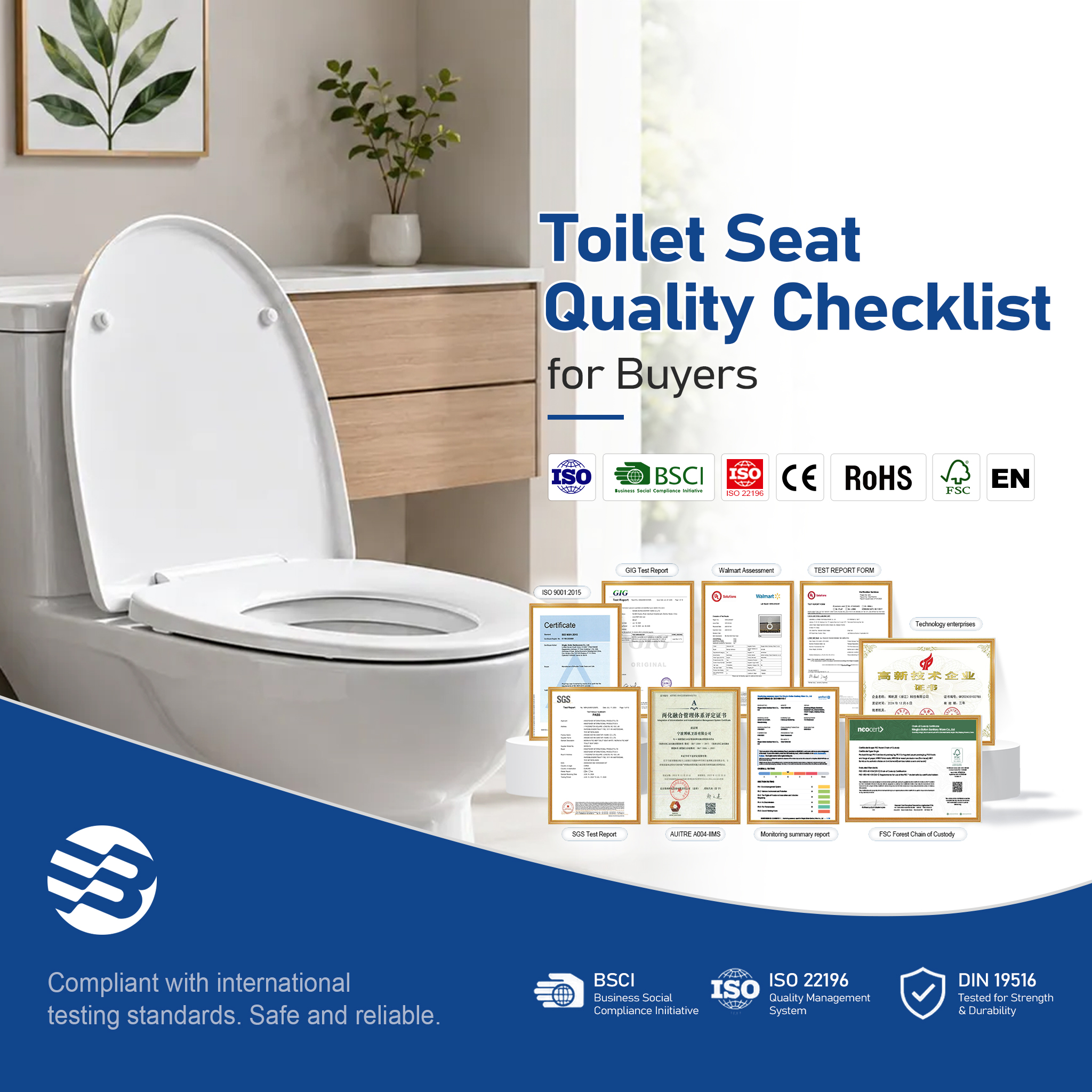
Toilet Seat Quality Checklist for Professional Buyers
A professional toilet seat quality checklist should verify the approved specification, material, dimensions, surface, seat-to-lid alignment, hinges, fixings, functional performance, packaging and batch consistency. Inspection should not begin only when production is finished. Buyers need control points at sample approval, pre-production confirmation, manufacturing, final inspection and shipment release. Every requirement should refer to an approved drawing or sample and use an agreed inspection method. Soft-close, quick-release and customized products require additional functional checks. Any certificate or test report must also be matched to the actual model, material and destination market.
Why Do Buyers Need a Written Toilet Seat Quality Checklist?
A product image and model name do not create a complete quality standard.
Two toilet seats can look similar but differ in material, dimensions, weight, hinge structure, fixing components, surface finish and closing performance. If these details are not documented, the buyer and factory may evaluate the same batch against different expectations.
A written checklist provides three benefits:
- It converts general expectations into inspection points.
- It creates one reference for the buyer, supplier and inspector.
- It helps distinguish acceptable variation from a real defect.
This is particularly important for bulk orders. A small dimensional or hinge problem repeated across a full production batch can affect installation, customer complaints and replacement costs.
BOFAN’s quality-control process covers incoming materials, production checks, functional testing, appearance inspection and packing control.
At Which Stages Should Toilet Seats Be Inspected?
Quality control should be divided across the order rather than concentrated at the end.
| Inspection stage | Main purpose | Required reference |
|---|---|---|
| Sample approval | Confirm the proposed product and fit | Drawing, ceramic and approved sample |
| Pre-production confirmation | Freeze materials, components, color and packaging | Signed specification or order sheet |
| In-process inspection | Identify variation before the full batch is completed | Production standard and control sample |
| Final random inspection | Evaluate completed, packed goods | Inspection checklist and sampling plan |
| Shipment release | Confirm quantity, markings and shipping condition | Purchase order and packing list |
Sample approval
The buyer should inspect the sample on the intended ceramic wherever possible. A loose sample reviewed on a desk cannot verify alignment, opening clearance or fixing stability.
Pre-production confirmation
Before production, confirm that the factory is using the approved material, hinge, color, fixings, logo and packaging. Changes should be documented rather than accepted through informal messages.
In-process inspection
Production checks can identify surface, dimensional, assembly or color issues while correction is still practical.
Final inspection
The final inspection should evaluate randomly selected units from completed goods. Products prepared only for inspection should not replace random selection from the actual batch.
Shipment release
Carton quantity, labels, shipping marks and packing-list information should be reconciled before loading.
What Should Be Included in the Master Product Specification?
The checklist should begin with product identity.
Buyers should confirm:
- Buyer item number
- Factory model number
- Product drawing and revision
- PP, UF or MDF material
- Seat and lid dimensions
- Product color
- Surface finish
- Hinge code and material
- Standard or soft-close function
- Quick-release function
- Top-fix or bottom-fix hardware
- Buffers and included accessories
- Logo position and method
- Individual packaging
- Master-carton quantity
- Instruction sheet or labels
BOFAN’s complete toilet seat range includes different materials, shapes and hinge configurations. Each selected configuration should have its own controlled specification.
How Should Buyers Verify Toilet Seat Materials?
Material identification matters because PP, UF and MDF have different manufacturing processes, surfaces and inspection risks.
PP inspection points
For PP products, check:
- Approved product structure
- Color consistency
- Molding marks
- Flash or sharp edges
- Sink marks or deformation
- Surface contamination
- Seat and lid alignment
- Consistency with the approved sample
PP can flex differently according to the product design and material distribution. Buyers should not judge the entire specification from material name alone.
UF inspection points
For UF seats, inspect:
- Surface smoothness
- Chips or cracks
- Edge condition
- Color consistency
- Molding defects
- Seat and lid alignment
- Hinge stress areas
- Handling damage
UF has a hard, dense surface but should still be protected from severe impact during production, packing and transport.
MDF inspection points
For MDF products, review:
- Coating coverage
- Edge sealing
- Surface gloss or approved finish
- Chips, scratches or dents
- Paint runs or particles
- Printed-design alignment
- Hinge-area finish
- Signs of exposed core material
The approved cleaning instructions and intended bathroom environment should also be considered when evaluating MDF.
Which Dimensions Should Be Checked?
Dimensional inspection should follow the signed drawing, not a general description such as “round” or “elongated.”
Important dimensions include:
- Overall length
- Maximum width
- Inner opening length and width
- Seat and lid thickness
- Hinge-center spacing
- Hinge adjustment range
- Distance from hinge centers to the front edge
- Fixing-bolt diameter
- Buffer position
- Required clearance around the cistern or wall
The buyer and supplier should agree on measurement points and tolerances. Measuring two different edges or reference points can produce different results even when both inspectors use accurate tools.
For project orders, install a sample on the actual ceramic. Confirm:
- Centering on the bowl
- Front overhang
- Side overhang
- Contact between buffers and ceramic
- Opening angle
- Lid clearance
- Hinge adjustment
- Fixing access
A dimensionally correct seat can still be unsuitable if the bowl profile or fixing environment is different.
What Surface Defects Should Inspectors Look For?
Surface expectations should be defined separately for the top, underside, visible edge and hidden assembly areas.
Common appearance checkpoints include:
- Cracks
- Chips
- Scratches
- Dents
- Stains
- Black spots
- Color variation
- Uneven gloss
- Paint defects
- Printing misalignment
- Molding flash
- Exposed or sharp edges
- Adhesive residue
- Fingerprints or packing contamination
- Incorrect logo position
Inspectors should use agreed lighting and viewing distance. A defect visible only under extreme magnification should not automatically receive the same classification as a scratch visible in normal bathroom use.
An approved physical sample or color reference is more reliable than comparing production only with digital photographs.
How Should Seat Structure and Stability Be Checked?
A toilet seat must remain stable as a complete assembly.
The inspection should examine:
- Seat and lid alignment
- Hinge mounting
- Buffer contact
- Lateral movement
- Rocking after installation
- Visible deformation
- Cracks around stressed areas
- Separation of assembled parts
- Opening and closing movement
Where the buyer specifies structural or load testing, the test method, load, application position, duration and pass criteria should be agreed before production. A result from one test method should not be presented as equivalent to every market requirement.
Destructive or long-cycle tests may be performed on a defined sample quantity rather than every production unit. The inspection plan should state which checks are routine and which require laboratory or fixture testing.
What Should Buyers Inspect on Hinges and Fixings?
Hinges are one of the most important sources of performance differences.
Check that:
- The hinge matches the approved code.
- Left and right components are correctly assembled.
- Metal surfaces are free from visible corrosion or damage.
- Plastic hinge parts are free from cracks.
- Fixing bolts, washers and expansion components are complete.
- Adjustment operates within the stated range.
- The seat remains stable after tightening.
- The hinge does not produce abnormal friction or noise.
- Decorative caps are secure and correctly aligned.
- Installation instructions match the supplied hardware.
For top-fix systems, the expansion fixing should engage correctly with the ceramic mounting hole. For bottom-fix systems, the buyer should confirm that the bolt length and washers suit the intended bowl.
A hinge should be evaluated after installation because a loose desk test cannot reproduce the loading and alignment of the complete product.
How Should Soft-Close Performance Be Inspected?
A soft-close toilet seat needs functional checks beyond ordinary hinge inspection.
The checklist should cover:
- Seat closing action
- Lid closing action
- Closing-time consistency
- Smooth movement
- Sudden drops
- Stopping before full closure
- Abnormal noise
- Left-right synchronization
- Damper fit
- Hinge stability after repeated operation
The agreed test should begin from a consistent opening angle and at a defined temperature range where relevant. Closing behavior can be affected by temperature, product weight and hinge adjustment, so vague requirements such as “closes slowly” are difficult to inspect objectively.
For cycle testing, the buyer should specify the number of cycles and pass criteria required for the product or market. The report should identify the tested model and hinge rather than referring only to a general soft-close series.
How Should Quick-Release Functions Be Checked?
A quick-release toilet seat should detach and refit without damage or unintended movement.
Inspectors should confirm:
- Release buttons or mechanisms operate correctly.
- The seat can be removed using the intended method.
- Refitting produces a positive connection.
- The seat returns to the correct position.
- The mechanism does not release during normal use.
- Repeated operation does not damage visible surfaces.
- Instructions explain removal and installation clearly.
The release mechanism should be tested on the installed hinge bases. Testing only the unmounted parts may not reveal alignment problems.
How Can Buyers Check Batch Consistency?
An approved sample demonstrates that the supplier can make one acceptable product. Batch inspection determines whether the factory can repeat it.
Consistency checks should compare:
- Dimensions
- Color
- Surface finish
- Product weight where specified
- Hinge function
- Closing behavior
- Logo position
- Fixing components
- Packaging
- Carton markings
A formal sampling plan may use an agreed AQL or another buyer-defined inspection system. The parties should confirm the lot size, inspection level, sample size and acceptance limits before inspection.
The checklist should not simply say “AQL inspection” without defining which defects are critical, major or minor.
How Should Defects Be Classified?
A practical inspection plan normally separates defects by their effect.
| Defect class | General meaning | Possible toilet-seat examples |
|---|---|---|
| Critical | Creates an unacceptable safety or regulatory risk | Sharp exposed edge or wrong regulated material where applicable |
| Major | Affects fit, function, saleability or intended use | Crack, wrong dimensions, failed hinge, missing fixing or severe color difference |
| Minor | Does not prevent use but falls below the agreed appearance standard | Small cosmetic mark within defined limits |
The final classification must follow the buyer’s product, destination and agreed inspection standard. The examples above are a framework, not an automatic rule for every order.
Photographic defect references can improve consistency between factory inspectors, third-party inspectors and buyers.
What Packaging Checks Are Required?
Product quality can be lost after inspection if packaging is unsuitable.
Check:
- Correct individual bag or box
- Protective material around vulnerable surfaces
- Separation of metal components from finished surfaces
- Complete hardware pack
- Correct instructions
- Barcode and label accuracy
- Model and color identification
- Quantity per master carton
- Carton dimensions and weight
- Shipping marks
- Carton strength and closure
- Pallet requirements where applicable
- Packing-list consistency
For mixed-model orders, each carton should identify the exact SKU. Similar-looking round, elongated or differently hinged seats should not share ambiguous labels.
Which Documents Should Buyers Review?
Documents support inspection, but they do not replace product verification.
A buyer may require:
- Approved product drawing
- Bill of materials or controlled specification
- Color standard
- Sample-approval record
- In-process inspection record
- Final inspection report
- Functional-test report
- Packaging specification
- Material information
- Quality-management documentation
- Applicable compliance certificates
- Packing list
- Corrective-action report where needed
BOFAN publishes available certificates and test reports. Buyers should verify the document’s model, material, factory, standard, issue date and target-market relevance.
A report for one material, hinge or product family should not automatically be applied to a different configuration.
How Should Buyers Create an Inspection Record?
The inspection record should be detailed enough for another person to understand the decision later.
Include:
- Purchase-order number
- Product and factory model numbers
- Production quantity and completed quantity
- Inspection date and location
- Drawing revision
- Approved-sample reference
- Sampling method
- Inspection results by item
- Defect quantities and photographs
- Functional-test results
- Packaging and quantity checks
- Final pass, fail or pending decision
- Corrective action, if required
- Reinspection result
The approved “golden sample” should be identified and stored carefully. If the buyer and supplier each retain a signed sample, both sides have a stronger reference for future production.
How Does BOFAN Manage Toilet Seat Quality Control?
BOFAN manufactures PP, UF and MDF toilet seats with standard, soft-close and quick-release options.
Its published quality-control workflow includes checks related to:
- Incoming materials
- Dimensions
- Surface appearance
- Seat and lid alignment
- Hinge assembly
- Soft-close function
- Product stability
- Packaging
- Batch inspection
BOFAN’s About BOFAN page provides additional factory and manufacturing information. For project buyers, the existing project toilet seat buying checklist can be used alongside this product-focused inspection checklist.
Buyer support may include drawing confirmation, sample approval, inspection requirements, OEM specifications, packaging coordination and applicable document review. The final inspection method and acceptance criteria should be agreed for each product and purchase order.
Conclusion
A reliable toilet seat quality checklist follows the product from sample approval to shipment release.
Professional buyers should verify five areas:
- Specification and material
- Dimensions and ceramic fit
- Surface and structural condition
- Hinges and functional performance
- Batch consistency and packaging
The checklist should use an approved drawing, physical sample, defined inspection method and agreed defect classification. Any test report or certificate must be matched to the selected product rather than accepted as a general factory claim.
Send BOFAN the product drawing, required material, hinge function, target market, packaging and inspection requirements to build a model-specific quality-control plan.
4.FAQ
What should be included in a toilet seat quality checklist?
The checklist should cover material, dimensions, surface finish, alignment, hinges, fixings, soft-close or quick-release functions, packaging and labeling. Every item should refer to an approved drawing, sample or written acceptance criterion.
When should a buyer inspect a toilet seat order?
Inspection should occur during sample approval, pre-production confirmation, manufacturing and final packing. Using several control points makes it easier to identify problems before the entire batch is completed.
How should toilet seat dimensions be inspected?
Dimensions should be measured from the reference points shown on the approved drawing. Buyers should also install a sample on the intended ceramic to verify alignment, overhang, hinge adjustment and fixing access.
How is a soft-close toilet seat inspected?
Inspectors should check the seat and lid closing actions, closing consistency, smooth movement, noise and hinge stability. Any cycle requirement should identify the tested model, hinge, number of cycles and pass criteria.
What is an approved or golden sample?
A golden sample is the physical product accepted by the buyer as the manufacturing reference. It records expected material, finish, dimensions, hinge feel, appearance and packaging alongside the written specification.
Does one toilet seat certificate cover every model?
Not necessarily. The buyer should verify the product, material, factory, test method and market covered by each certificate or report. Documents for one configuration should not automatically be applied to another model.
Can BOFAN support third-party or buyer-defined inspection?
BOFAN can coordinate model-specific inspection requirements and provide available production and test information. The sampling plan, acceptance criteria, inspection timing and required documents should be confirmed before production.
Table of Contents
- Toilet Seat Quality Checklist for Professional Buyers
- Why Do Buyers Need a Written Toilet Seat Quality Checklist?
- At Which Stages Should Toilet Seats Be Inspected?
- What Should Be Included in the Master Product Specification?
- How Should Buyers Verify Toilet Seat Materials?
- Which Dimensions Should Be Checked?
- What Surface Defects Should Inspectors Look For?
- How Should Seat Structure and Stability Be Checked?
- What Should Buyers Inspect on Hinges and Fixings?
- How Should Soft-Close Performance Be Inspected?
- How Should Quick-Release Functions Be Checked?
- How Can Buyers Check Batch Consistency?
- How Should Defects Be Classified?
- What Packaging Checks Are Required?
- Which Documents Should Buyers Review?
- How Should Buyers Create an Inspection Record?
- How Does BOFAN Manage Toilet Seat Quality Control?
- Conclusion
-
4.FAQ
- What should be included in a toilet seat quality checklist?
- When should a buyer inspect a toilet seat order?
- How should toilet seat dimensions be inspected?
- How is a soft-close toilet seat inspected?
- What is an approved or golden sample?
- Does one toilet seat certificate cover every model?
- Can BOFAN support third-party or buyer-defined inspection?