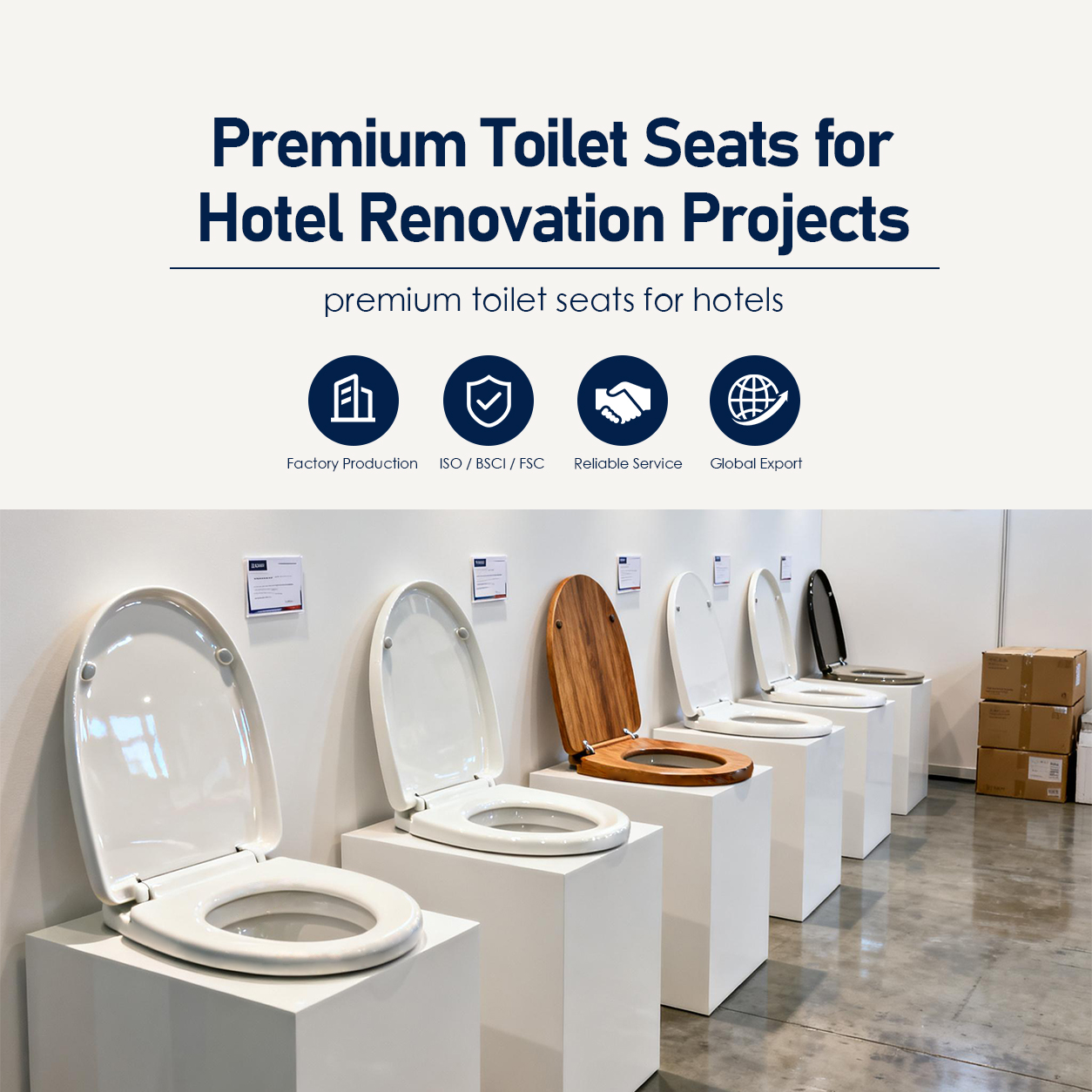
Premium Toilet Seats for Hotel Renovation Projects
Premium toilet seats for hotels should combine a refined appearance with verified ceramic compatibility, stable hinges, practical cleaning and repeatable replacement specifications. UF soft-close seats are often the strongest starting point for modern guest rooms because they provide a hard, smooth surface and a contemporary appearance. Selected MDF seats can suit boutique, heritage or design-led properties requiring decorative finishes. Before bulk ordering, hotels should audit the existing bowls, install samples in representative rooms, involve housekeeping and engineering teams, and document the approved seat, hinge, fixing, finish and packaging for each renovation phase.
Why Does the Toilet Seat Matter in a Hotel Renovation?
The toilet seat is a relatively small part of a hotel bathroom budget, but it is one of the fixtures that every guest sees and uses.
A worn, unstable or poorly matched seat can weaken the impression created by new tiles, sanitary ware, lighting and bathroom furniture. A compatible premium seat, by contrast, can make an existing toilet look cleaner and more current without requiring the entire ceramic unit to be replaced.
Hotel renovation teams also face operational requirements that are less important in a private residence:
- Rooms may be renovated in separate phases.
- Existing buildings may contain several ceramic models.
- Housekeeping teams clean the product frequently.
- Engineering teams need manageable replacement parts.
- Guest rooms must maintain a consistent appearance.
- Work may need to continue while part of the hotel remains open.
- Approved products may need to be reordered for later floors or buildings.
BOFAN’s hotel toilet seat solutions cover hospitality applications ranging from value properties to business hotels, resorts and premium guest rooms.
What Makes a Hotel Toilet Seat “Premium”?
A premium toilet seat should not be defined by weight, price or material alone. It is a complete specification that supports the intended guest experience and hotel operating model.
For a renovation project, premium quality normally includes:
- Accurate fit on the approved ceramic
- A surface appropriate for frequent cleaning
- Consistent color and finish
- Stable hinges and fixings
- Controlled soft-close operation
- Suitable opening angle and lid position
- Clean alignment with the bowl
- Accessible hinge areas
- Documented replacement components
- Consistency across the renovation batch
A heavy seat with an attractive finish is not premium if it moves on the bowl or conflicts with the hotel’s cleaning process. Similarly, a feature-rich seat is not a good upgrade when the ceramic cannot support its hinge configuration.
The hotel should therefore define premium performance in measurable terms before comparing quotations.
What Should Hotels Audit Before Selecting a Replacement Seat?
A renovation project begins with the existing bathroom, not the product catalogue.
Ceramic models
The project team should identify every toilet bowl model used in the rooms being renovated. Different construction phases may have introduced ceramics from different suppliers, even when the bathrooms look similar.
For each bowl, record:
- Overall bowl length
- Maximum bowl width
- Mounting-hole spacing
- Distance from the mounting holes to the front edge
- Bowl shape
- Fixing access
- Available hinge-adjustment area
- Any cistern or wall clearance affecting the lid
Photographs should include top, side and mounting-area views. A drawing or ceramic model number is helpful, but physical measurements remain important for older bathrooms.
Existing seat problems
Engineering and housekeeping teams should document why the current seats are being replaced. Typical reasons include:
- Loose fixings
- Worn hinges
- Inconsistent closing
- Surface scratches or discoloration
- Damaged MDF edges
- Difficult hinge-area cleaning
- Poor alignment
- Unavailable spare components
- Mixed seat designs across rooms
This review helps the buyer specify an improvement instead of replacing the old seat with another product that has the same weaknesses.
Which Material Is Best for a Premium Hotel Renovation?
UF, MDF and upgraded PP can all be used in hotel projects, but they serve different renovation goals.
| Material | Main renovation advantage | Suitable hotel application | Key evaluation point |
|---|---|---|---|
| UF | Hard, smooth surface and modern appearance | Business hotels, resorts, upscale chains and premium rooms | Confirm impact handling, hinge design and ceramic fit |
| MDF | Heavy feel and decorative finish options | Boutique, heritage and design-led hotels | Inspect coating, edges and cleaning compatibility |
| PP | Practical moisture performance and flexible specifications | Value hotels, staff rooms and cost-controlled renovations | Compare structure, weight, finish and hinge quality |
When should a hotel choose UF?
UF toilet seats are a practical premium starting point for contemporary hotel renovations.
UF has a dense, smooth surface and a ceramic-like appearance. It is suitable for frequent routine cleaning and coordinates naturally with modern white sanitary ware. It can also be paired with stainless-steel hinge components, soft-close dampers and quick-release systems, depending on the selected model.
UF is particularly relevant when the renovation objective is to modernize the bathroom and create consistent presentation across many rooms.
When can MDF be the stronger choice?
MDF and wooden toilet seats can support painted, printed, decorative or wood-effect designs. Their heavier feel may suit a classic or residential-style bathroom.
MDF may be appropriate for:
- Boutique properties
- Heritage hotels
- Country-style resorts
- Themed guest rooms
- Decorative suites
- Renovations retaining traditional sanitary ware
The protective surface and edges must remain intact. The hotel should approve the cleaning method and consider humidity, wet-cleaning frequency and spare-unit requirements before using MDF throughout a property.
Can premium PP be used?
Yes. PP should not automatically be treated as an entry-level material. Product structure, finish, hinge selection and fit can position a PP seat for mid-range hotel applications.
Upgraded PP may be useful where the hotel needs lower weight, practical moisture performance or a controlled renovation budget. However, the approved sample should confirm that its appearance supports the intended room category.
Should Renovated Hotel Rooms Use Soft-Close Hinges?
A soft-close toilet seat is usually appropriate for guest rooms, suites and serviced apartments.
The controlled closing action reduces slamming and supports a quieter bathroom experience. This is valuable where bathrooms are close to beds or share walls with neighboring rooms.
| Hinge option | Hotel benefit | Best use | What to inspect |
|---|---|---|---|
| Standard hinge | Simple configuration | Highly cost-controlled rooms or selected public areas | Stability, corrosion suitability and tightening |
| Soft close | Controlled, quieter closing | Guest rooms, suites and serviced apartments | Closing speed, consistency and damper performance |
| Soft close + quick release | Comfort plus better hinge-area access | Premium rooms and cleaning-focused operations | Release operation, refitting accuracy and staff training |
| Top-fix system | Installation from above | Ceramics with restricted underside access | Expansion fixing and resistance to movement |
| Bottom-fix system | Conventional underside tightening | Ceramics with accessible mounting areas | Access, washer position and tightening method |
The hotel should test the complete seat and hinge assembly. A premium material cannot compensate for unstable fixings or inconsistent dampers.
Is Quick Release Valuable in Hotel Bathrooms?
A quick-release toilet seat can be detached from its hinge connection so that housekeeping or engineering staff can access the mounting area more easily.
This may support periodic deep cleaning, particularly where dirt and cleaning residue collect around the hinge bases.
Quick release should still be evaluated operationally. Hotels need to confirm:
- Who is permitted to remove the seat
- Whether removal is part of daily or scheduled cleaning
- How the mechanism is released
- Whether the seat returns to the same position
- How staff will avoid incorrect refitting
- Whether replacement hinge components are documented
A function only adds value when the hotel team can use it consistently.
Which Specification Fits Each Area of a Hotel?
One material does not need to serve every bathroom. The hotel can establish a controlled specification by room category or operating area.
| Hotel area | Recommended starting point | Main priority |
|---|---|---|
| Standard guest room | UF or upgraded PP soft close | Consistent appearance and quiet operation |
| Premium room or suite | UF soft close with optional quick release | Refined surface and guest experience |
| Boutique suite | Selected MDF or UF soft close | Coordination with the interior concept |
| Accessible guest room | Compatible seat selected with accessibility requirements | Correct height, fit and safe use |
| Lobby restroom | UF or durable PP with stable fixing | Cleaning and frequent use |
| Restaurant or conference area | UF or PP quick release | Maintenance access |
| Staff bathroom | PP standard or soft close | Practical operation and cost control |
| Humid resort bathroom | UF or PP | Moisture suitability |
| Heritage property | Coated MDF or suitable UF design | Traditional appearance with controlled maintenance |
These are starting recommendations. The ceramic model, local project requirements and hotel brand standards must determine the final choice.
How Should a Hotel Approve the Sample Room?
The sample-room process should be treated as a technical approval, not merely an interior-design review.
Step 1: Select representative bathrooms
Choose rooms containing each ceramic model and each relevant renovation condition. Include at least one standard room and any materially different suite or accessible-room configuration.
Step 2: Install the complete product
Use the proposed production hinge, fixings and buffers. A temporary hinge or visually similar sample cannot verify the final installation.
Step 3: Check fit and movement
Inspect:
- Front and side alignment
- Overhang
- Contact with the ceramic
- Hinge-adjustment range
- Seat stability
- Opening clearance
- Lid resting position
- Soft-close speed
- Quick-release operation
Step 4: Test housekeeping procedures
Clean the seat with the hotel’s proposed products, dilution and tools. Confirm that staff can access critical areas without damaging the surface or mechanism.
Step 5: Collect cross-functional approval
Procurement, design, engineering, housekeeping and hotel operations should participate. Each team sees a different risk that may be missed by purchasing alone.
Step 6: Create an approved reference
The final record should include the product code, drawing, material, color, hinge code, fixing components, ceramic reference, photographs and packaging details.
The approved reference protects consistency during later production and replacement orders.
How Can Hotels Manage a Phased Renovation?
Hotel renovations are often completed floor by floor, building by building or during low-occupancy periods. Toilet seat procurement should follow the same phase structure.
The purchasing plan should identify:
- Quantity by room category
- Quantity by ceramic model
- Spare quantity policy
- Sample-approval date
- Production-release date
- Shipment or delivery phases
- Storage capacity
- Room installation sequence
- Carton identification
- Responsibility for receiving and inspection
Products for separate areas should have clear SKU and carton labels. Similar-looking seats with different dimensions should never depend on visual recognition alone.
The hotel should also distinguish between one production batch dispatched in phases and multiple production batches made at different times. If color and finish consistency are critical, this distinction should be discussed before ordering.
What Should Housekeeping and Engineering Teams Evaluate?
Housekeeping should evaluate:
- Surface-cleaning efficiency
- Hinge-area access
- Cleaning-product compatibility
- Visible water or residue marks
- Quick-release practicality
- Ease of identifying surface damage
Engineering should evaluate:
- Installation access
- Fixing stability
- Hinge adjustment
- Damper consistency
- Availability of component references
- Time required for seat replacement
- Number of spare SKUs
A product that saves a small amount at purchase but increases maintenance visits across hundreds of rooms may not be the better renovation choice.
What Quality Evidence Should a Hotel Buyer Request?
Quality requirements should be linked to the selected model and destination market.
The buyer may request:
- Product drawing and dimensions
- Material specification
- Approved color or finish sample
- Hinge specification
- Soft-close test method
- Stability or load-test information
- Surface-inspection criteria
- Packaging specification
- Batch-inspection report
- Applicable compliance documents
- Replacement-component references
BOFAN’s quality-control process covers material, surface, dimensional, hinge, functional and packaging inspection. Available certificates and test reports should be reviewed for applicability to the selected model and target market; a company-level document should not be assumed to certify every product configuration.
How Does BOFAN Support Hotel Renovation Projects?
BOFAN manufactures PP, UF and MDF toilet seats with standard, soft-close and quick-release configurations for hospitality, project and OEM buyers.
Renovation support can include:
- Review of ceramic measurements and photographs
- Shortlisting by hotel category
- UF, MDF and PP material options
- Hinge and fixing selection
- Sample-room preparation
- Color and finish coordination
- OEM logo and packaging options
- Product and carton identification
- Inspection and export packing
- Phased-supply discussion
- Approved specification records for repeat orders
BOFAN’s OEM toilet seat solutions may also support hotel-supply companies and sanitary ware brands requiring customized specifications.
Exact models, customization, quantities, production arrangements and documents must be confirmed for the individual project.
Conclusion
The right premium toilet seat can update a hotel bathroom, improve daily operation and create a more consistent guest experience without replacing every ceramic fixture.
UF soft-close seats are often the strongest modern-hotel starting point. MDF can provide greater decorative flexibility for boutique and heritage properties, while upgraded PP may suit controlled-budget renovation programs.
The final selection should be based on actual ceramic measurements, housekeeping procedures, hinge performance, room category and replacement planning.
Send BOFAN the hotel category, ceramic drawings or measurements, room quantities, cleaning requirements and renovation phases to receive a suitable model shortlist and sample recommendation.
4. FAQ
What toilet seat material is best for a premium hotel renovation?
UF is often the strongest starting point because it provides a hard, smooth surface and modern appearance suitable for frequent hotel cleaning. MDF may be preferred in boutique or heritage properties requiring decorative or traditional finishes.
Do premium hotel toilet seats need soft-close hinges?
Soft-close hinges are generally valuable in guest rooms because they reduce slamming and provide a more controlled user experience. Buyers should test closing speed, hinge stability and repeated operation on the approved sample.
Can a hotel replace toilet seats without replacing the ceramic toilets?
Yes, provided a compatible seat can be identified for the existing bowl. The hotel should measure the bowl, mounting-hole spacing and fixing access and then test the proposed seat on each ceramic model.
Is quick release useful during a hotel renovation?
Quick release can improve access around the hinge area for deep cleaning and maintenance. The hotel should define who will remove the seat and train staff to release and refit it correctly.
How should hotels approve toilet seat samples?
The sample should be installed in a representative guest room using the final hinge and fixings. Procurement, design, housekeeping and engineering teams should review fit, appearance, cleaning and function before bulk approval.
How can hotels keep replacement seats consistent?
Hotels should retain the approved product code, drawing, ceramic reference, hinge code, finish, packaging details and photographs. This documentation gives later renovation phases and replacement orders a clear reference.
Can BOFAN customize premium toilet seats for hotel projects?
BOFAN supports suitable UF, MDF and PP models with different hinges, colors, logos and packaging options. Availability, MOQ and production arrangements depend on the chosen model and customization requirements.
Table of Contents
- Premium Toilet Seats for Hotel Renovation Projects
- Why Does the Toilet Seat Matter in a Hotel Renovation?
- What Makes a Hotel Toilet Seat “Premium”?
- What Should Hotels Audit Before Selecting a Replacement Seat?
- Which Material Is Best for a Premium Hotel Renovation?
- Should Renovated Hotel Rooms Use Soft-Close Hinges?
- Is Quick Release Valuable in Hotel Bathrooms?
- Which Specification Fits Each Area of a Hotel?
- How Should a Hotel Approve the Sample Room?
- How Can Hotels Manage a Phased Renovation?
- What Should Housekeeping and Engineering Teams Evaluate?
- What Quality Evidence Should a Hotel Buyer Request?
- How Does BOFAN Support Hotel Renovation Projects?
- Conclusion
-
4. FAQ
- What toilet seat material is best for a premium hotel renovation?
- Do premium hotel toilet seats need soft-close hinges?
- Can a hotel replace toilet seats without replacing the ceramic toilets?
- Is quick release useful during a hotel renovation?
- How should hotels approve toilet seat samples?
- How can hotels keep replacement seats consistent?
- Can BOFAN customize premium toilet seats for hotel projects?