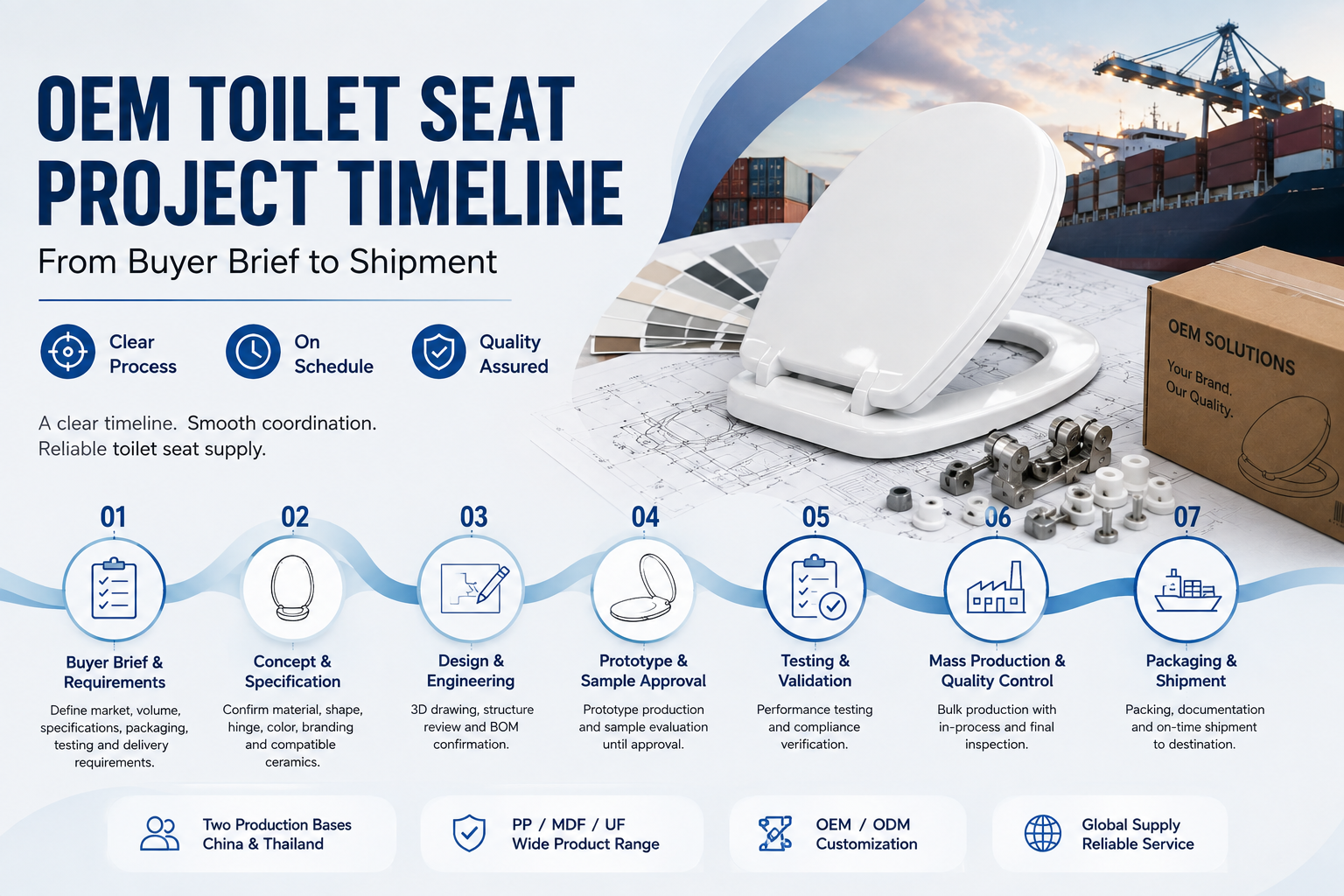
OEM Toilet Seat Project Timeline: From Buyer Brief to Shipment
An OEM toilet seat project does not begin when mass production starts. It begins when the buyer defines the product, target toilet ceramics, commercial requirements, packaging format, testing standards, and approval process.
If these inputs arrive at different times, the project may appear active while critical decisions remain unresolved. Samples may need to be remade, packaging artwork may be based on an outdated specification, or production may wait for approval of a small but essential component.
For distributors, sanitary ware brands, retail suppliers, and project buyers, a practical OEM toilet seat project timeline should identify:
- Which decisions must be completed first
- Which activities can run in parallel
- Who has approval authority
- What evidence is required at each stage
- Which changes would affect cost, tooling, testing, or delivery
The following framework helps procurement teams plan an OEM toilet seat program from the first inquiry to final shipment.
1. Select the Correct Development Route
The development route has the greatest influence on the project schedule.
Existing-model route
The buyer selects a toilet seat from the manufacturer’s existing range and mainly customizes elements such as color, logo, packaging, fixing set, or instruction sheet.
This is normally the most straightforward route because the basic seat geometry and production process already exist. However, the model must still be checked against the buyer’s toilet ceramics and market requirements.
Buyers can begin by reviewing BOFAN’s existing ranges:
- PP toilet seats
- UF/Duroplast toilet seats
- MDF and wooden toilet seats
- Soft-close toilet seats
- Quick-release toilet seats
Modified-model route
An existing platform is used, but the buyer requests changes to components, finish, hinge configuration, fixing system, branding, or packaging.
The effect on the timeline depends on whether the requested changes require new tooling, new suppliers, additional testing, or validation on different ceramics.
New-mold route
A new seat and lid geometry is developed for a specific ceramic range or brand program. This route requires more engineering input, design review, prototype evaluation, tooling, trial production, and final approval.
Buyers considering this route should review how custom mold development works for toilet seats.
The route should be agreed before the buyer requests a final project schedule. Otherwise, the quoted timeline may be based on assumptions that later prove incorrect.
2. Complete the Commercial and Technical Brief
The first project phase is not simply asking for a quotation. It is creating a usable sourcing brief.
The buyer should define:
- Target market and sales channel
- Estimated annual volume
- Initial order quantity
- Required material
- Seat shape and dimensions
- Compatible ceramic models
- Hinge and fixing preferences
- Soft-close and quick-release requirements
- Color and surface finish
- Logo and branding method
- Retail, e-commerce, project, or bulk packaging
- Required test reports or certifications
- Target shipment window
- Incoterm and destination
- Sample and artwork approval contacts
A complete brief allows the manufacturer to identify technical gaps before sampling begins. BOFAN’s guide to the information an OEM toilet seat factory needs from a buyer can be used as a pre-inquiry checklist.
Procurement teams should also separate essential requirements from preferences. This makes it easier to evaluate alternatives if a preferred component creates a tooling, cost, or delivery constraint.
3. Confirm Ceramic Compatibility
A toilet seat can look suitable in a catalog and still perform poorly on the target ceramic.
The manufacturer may need:
- Ceramic top-view drawing
- Side-view drawing
- Overall pan length and width
- Hinge-hole spacing
- Distance from hinge holes to the front edge
- Photographs with a ruler or measurement reference
- Ceramic model number
- A physical ceramic sample when drawings are insufficient
The review should cover more than whether the seat fits between the edges of the bowl. It should also evaluate overhang, underhang, centering, hinge adjustment, mounting access, stability, and the visual relationship between the lid, seat ring, and ceramic.
For a range containing several ceramic models, each intended combination should be listed in a compatibility matrix. A single approval should not automatically be applied to every ceramic in the range.
4. Confirm the Product Specification
Once the development route and ceramic information are clear, both parties should establish a controlled specification.
The specification should cover:
- Seat and lid material
- Product dimensions
- Weight or agreed weight tolerance where relevant
- Color reference
- Surface finish
- Hinge material and finish
- Damper configuration
- Quick-release mechanism
- Fixing components
- Buffers and accessory parts
- Logo position and method
- Packaging contents
- Labeling requirements
- Inspection criteria
- Required testing
Every component that affects fit, function, appearance, installation, or compliance should be identifiable.
The buyer should also establish a revision number and date for the specification. This helps prevent an old drawing, packing list, or artwork file from being used after a change has been approved.
5. Produce and Evaluate Samples
Sampling should answer specific questions. A sample is not only a visual sales item.
The buyer should evaluate:
Fit
Does the seat align correctly with the target ceramic? Is the hinge adjustment range sufficient? Is the installation stable?
Function
Does the soft-close system operate correctly? Can the quick-release mechanism be removed and reinstalled as intended? Are the fixings suitable for the installation environment?
Appearance
Are the color, gloss, logo, parting lines, hinge finish, and visible surfaces acceptable?
Packaging
Are the product and accessories protected? Can the carton accommodate the instruction sheet, label, barcode, and required retail information?
User installation
Can the product be installed using the supplied components and instructions? Are any steps likely to cause customer confusion?
Feedback should be consolidated into one controlled document. Separate comments from purchasing, product, packaging, and sales teams can otherwise result in conflicting instructions.
After corrections, the approved unit should become a clearly identified reference sample. The approval record should state exactly which attributes it controls.
6. Plan Testing and Compliance Activities
Testing should be considered before the product and packaging are frozen—not added after production has been scheduled.
Depending on the market and buyer program, the validation plan may include:
- Load and strength checks
- Soft-close cycle testing
- Hinge and fixing durability
- Quick-release operation
- Dimensional verification
- Color and appearance review
- Material-related testing
- Packaging transport evaluation
- Retailer-specific protocols
- Market-specific documentation
Buyers should confirm that any certificate or test report applies to the actual product, material, component configuration, and market involved. A report for a similar item should not be assumed to cover a newly modified model.
Available factory documentation can be reviewed through BOFAN’s Certificates & Test Reports and Download Center.
7. Develop Packaging and Artwork in Parallel
Packaging is frequently treated as a final activity, but it often becomes part of the project’s critical path.
While product samples are being evaluated, the buyer and manufacturer can begin confirming:
- Packaging structure
- Carton dimensions
- Protective inserts
- Accessory bag contents
- Instruction sheet
- Barcode format
- Product labels
- Country-of-origin marking
- Shipping marks
- Master-carton quantity
- Pallet requirements
- E-commerce protection where applicable
Artwork should only be released for production after the product name, model number, specifications, claims, barcode, and regulatory information have been checked.
If packaging text makes claims about material, function, compatibility, or certification, those claims should match the approved product and supporting evidence.
8. Freeze the Specification Before Mass Production
A formal specification freeze is one of the most important project milestones.
Before issuing the production order, the buyer should confirm:
- Approved product sample
- Approved drawings and dimensions
- Final bill of materials
- Approved color and finish
- Approved hinge and fixing set
- Approved logo
- Approved packaging artwork
- Final carton contents
- Inspection standard
- Test and documentation requirements
- Quantity by SKU
- Shipping marks and logistics instructions
Changes requested after this point should go through a documented review. The supplier should confirm whether the change affects tooling, material procurement, testing, price, packaging, or delivery.
Without change control, the factory may receive an updated artwork file while the packing department continues using an earlier component list.
9. Use a Trial Order to Validate the System
A trial order can test more than the product. It can validate the entire order process:
- Purchase-order interpretation
- Material control
- Production consistency
- Assembly
- Packaging
- Label accuracy
- Inspection
- Export documents
- Transit performance
- Installation feedback
- Claims handling
The trial quantity should be commercially useful while remaining manageable if adjustments are needed. It should also represent the intended production configuration rather than a temporary sample-only setup.
See BOFAN’s guide on structuring a trial order before scaling an OEM toilet seat program.
10. Plan Production, Inspection, and Shipment Release
After the specification is frozen and the order is confirmed, the manufacturer can schedule materials, components, production, assembly, packing, and inspection.
Procurement teams should request milestone visibility instead of relying only on a final delivery date. Useful milestones include:
- Material and component readiness
- Production start
- Assembly completion
- Packing completion
- Inspection window
- Corrective-action window if required
- Shipment release
- Documentation completion
Quality requirements should be defined before inspection. The inspection plan should identify the approved sample, specification revision, sampling method, defect categories, functional checks, packaging checks, and release authority.
BOFAN describes its manufacturing controls on the Quality Control page and explains program-level controls in How to Ensure Quality Consistency in OEM Toilet Seat Production.
The final shipment should not be released solely because the planned shipping date has arrived. It should be released after the agreed product, packaging, inspection, and documentation requirements have been satisfied.
11. Identify the Critical Path
Not every project task must be completed sequentially.
For example, these activities may run in parallel when properly controlled:
- Ceramic review and initial quotation
- Product sampling and packaging structure planning
- Testing preparation and artwork development
- Production planning and logistics preparation
- Inspection booking and document-template review
However, some dependencies cannot safely be skipped:
- Ceramic data before final fit approval
- Final components before functional approval
- Approved specification before production
- Approved artwork before packaging printing
- Completed inspection before shipment release
A good timeline shows these dependencies instead of presenting one unsupported completion date.
Common Causes of OEM Project Delays
Typical delays include:
- Incomplete ceramic drawings
- Unclear ownership of sample approval
- Repeated small specification changes
- Late packaging artwork
- Barcode or label corrections
- Certification requirements identified too late
- Unapproved substitute components
- Conflicting feedback from different departments
- New test requirements after production planning
- Shipping instructions received after packing
Most of these are coordination problems rather than manufacturing problems. A shared milestone tracker, controlled files, named approvers, and written change records can substantially improve project discipline.
Final Procurement Checklist
Before approving the project schedule, confirm:
- The development route is defined.
- The target ceramics have been identified.
- The commercial and technical brief is complete.
- The specification has an owner and revision number.
- Sample acceptance criteria are documented.
- Testing requirements are confirmed.
- Packaging development is included.
- A specification-freeze milestone exists.
- Trial-order objectives are defined.
- Inspection requirements are agreed.
- Export documentation has been reviewed.
- Change-control responsibilities are clear.
- Schedule assumptions and dependencies are visible.
For shipment documentation planning, use the Toilet Seat Export Documentation Checklist for Importers.
Conclusion
An effective OEM toilet seat timeline is not simply a production lead-time estimate. It is a decision map connecting ceramic compatibility, product engineering, sampling, testing, packaging, approvals, production, inspection, and logistics.
Buyers who complete these decisions in the correct order can reduce avoidable revisions and establish a more dependable path from product brief to repeat orders.
BOFAN supports OEM brands and sanitary ware companies with model selection, customization, sampling, production, quality control, packaging, and export coordination. Learn more about BOFAN’s OEM manufacturing support.
CTA
Planning a new toilet seat range? Send BOFAN your ceramic information, target market, estimated quantities, functional requirements, and preferred packaging. The team can help identify the appropriate development route and prepare a milestone-based project plan.
Request an OEM Project Timeline
FAQ
How long does an OEM toilet seat project take?
The timeline depends on whether the buyer selects an existing model, modifies an existing platform, or develops new tooling. Ceramic data, sample revisions, testing, packaging artwork, and approval speed can also affect the schedule.
What information is required before requesting a project timeline?
The supplier should receive the target ceramic dimensions, product material, required functions, estimated quantity, target market, packaging requirements, testing expectations, and desired shipment window.
Can packaging development begin before the seat sample is approved?
Packaging structure and artwork preparation can often begin in parallel. Final dimensions, product claims, model numbers, accessories, and technical details should not be released for printing until the product configuration is confirmed.
Is a physical ceramic sample always necessary?
Not always. Accurate drawings and measurements may be sufficient for an existing model. A physical ceramic may be required when the geometry is complex, drawings are incomplete, or a new mold is being developed.
Should buyers approve a sample before placing a trial order?
Yes. The approved sample should be supported by a controlled specification defining the product, components, finish, function, branding, and packaging.
What changes can delay mass production?
Changes to seat geometry, color, hinges, fixings, packaging, labeling, testing, or order quantities can affect materials, tooling, approvals, and production planning.
Why use a milestone-based schedule?
Milestones show which decisions and approvals control the delivery date. They also allow the buyer and manufacturer to identify delays early and assign responsibility for the next action.
Table of Contents
- OEM Toilet Seat Project Timeline: From Buyer Brief to Shipment
- 1. Select the Correct Development Route
- 2. Complete the Commercial and Technical Brief
- 3. Confirm Ceramic Compatibility
- 4. Confirm the Product Specification
- 5. Produce and Evaluate Samples
- 6. Plan Testing and Compliance Activities
- 7. Develop Packaging and Artwork in Parallel
- 8. Freeze the Specification Before Mass Production
- 9. Use a Trial Order to Validate the System
- 10. Plan Production, Inspection, and Shipment Release
- 11. Identify the Critical Path
- Common Causes of OEM Project Delays
- Final Procurement Checklist
- Conclusion
-
FAQ
- How long does an OEM toilet seat project take?
- What information is required before requesting a project timeline?
- Can packaging development begin before the seat sample is approved?
- Is a physical ceramic sample always necessary?
- Should buyers approve a sample before placing a trial order?
- What changes can delay mass production?
- Why use a milestone-based schedule?