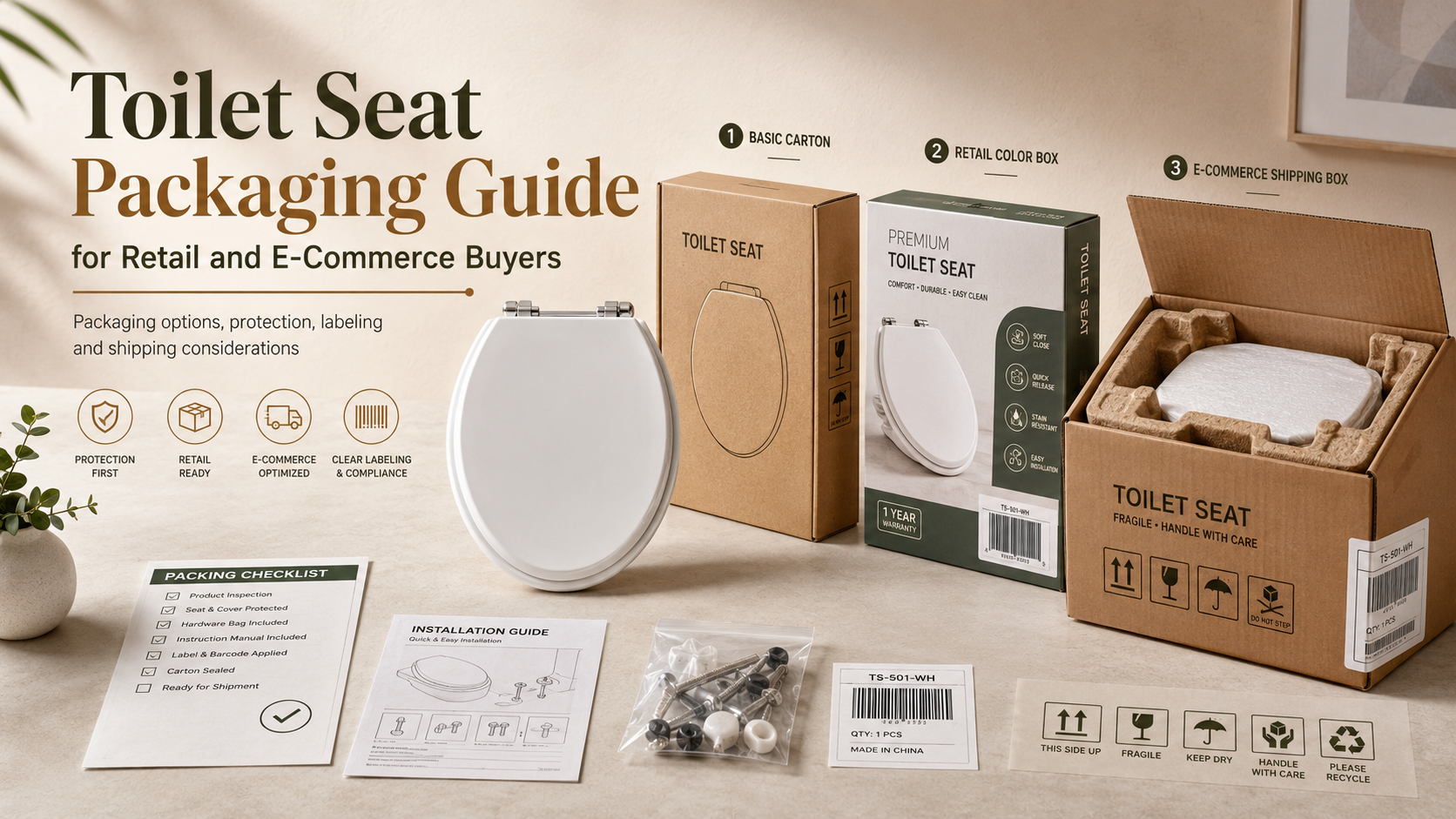
Toilet Seat Packaging Guide for Retail and E-Commerce Buyers
A toilet seat may pass product inspection and still create customer complaints if its packaging is poorly designed.
For retail and e-commerce programs, packaging has several jobs at once: it must protect the product, carry the correct product information, support the brand image, make installation easier and survive transport through the chosen distribution channel.
A simple brown box may be sufficient for a bulk wholesaler. A private-label retailer may require a printed box, barcode, installation instructions and stronger internal protection. An e-commerce seller may need additional protection against parcel-shipping damage.
The right packaging should be decided together with the product specification—not after production has already started.
Start With the Sales Channel
Packaging requirements should reflect how the product will be sold and transported.
| Sales channel | Main packaging priority |
|---|---|
| Wholesale distributor | Product protection, clear carton labels and efficient container loading |
| Retail store | Shelf appearance, feature communication, barcode and installation information |
| E-commerce | Stronger protection, lower damage risk and clear customer instructions |
| Project supply | Product identification, installation hardware and site-delivery efficiency |
| Private-label brand | Brand consistency, product photography, compliant labels and repeat-order control |
A retail box designed for a home-improvement store may focus on clear feature icons and shelf appeal. A box designed for parcel delivery should focus more heavily on impact protection and hardware retention.
Before quotation, buyers should explain where the toilet seat will be sold, whether it will be shipped individually and whether the outer carton will be handled by courier networks.
Choose the Right Packaging Level
Common toilet seat packaging options include:
- Neutral brown carton
- White box with label
- Printed retail box
- Printed sleeve over a plain carton
- Inner protective bag
- Foam, molded pulp or cardboard inserts
- Reinforced outer carton
- Master carton for bulk shipment
- Palletized shipment packaging
The most suitable option depends on the product material, hinge type, channel and budget.
For example, a molded wood toilet seat with a decorative finish may require more surface protection than a basic PP replacement seat. A soft-close hinge may also need protected positioning to avoid scratches or impact damage during transport.
Protect the Product, Not Only the Box
The packaging should protect the seat, lid, hinge area, fixing kit and visible surface.
Check:
- Seat and lid are secured against movement
- Hinge area is protected from impact
- Hardware bag cannot scratch the product
- Surface is protected from abrasion
- Buffers are not compressed or damaged
- Printed or coated finishes are protected
- The product cannot move freely inside the box
- The box can withstand expected transport handling
For online orders, the product may be handled multiple times by warehouses, courier companies and end customers. The package should be tested based on realistic handling conditions rather than only container shipment.
Include Clear Product Information
Packaging is also part of the customer experience. It should help customers understand what they are buying before opening the box.
Useful retail-box information may include:
- Product name
- Material
- Product shape
- Round, elongated or D-shape compatibility
- Soft-close feature
- Quick-release feature
- Top-fix or bottom-fix installation
- Color and finish
- Product dimensions
- Included hardware
- Brand name and logo
- Barcode
- Country-of-origin marking where required
- Basic installation guidance
Do not use feature claims that do not exactly match the approved product. For example, a box should not say “quick release” if the supplied seat uses a fixed hinge.
Make Installation Easier for the End Customer
A customer’s first impression often comes during installation.
The package should include the correct fixing kit and instructions for the specific model. This is especially important when a product is sold as a replacement toilet seat.
Confirm:
- Hardware bag contains the correct bolts, nuts, washers and plugs
- Components are clearly separated
- Instructions match the selected fixing method
- Product dimensions are correctly shown
- Compatibility guidance is clear
- Tools required for installation are stated
- Customer-service or warranty contact details are included if needed
A strong product can still receive poor reviews if customers cannot identify the correct hardware or do not understand whether the seat fits their toilet bowl.
Control Barcodes, Labels and Artwork
For private-label and retail programs, packaging data should be controlled before bulk production.
The buyer should provide:
- Final logo files
- Packaging artwork file
- Product name
- Buyer SKU
- UPC, EAN or required barcode
- Product feature wording
- Required warning labels
- Country-specific language requirements
- Carton marking details
- Artwork version number
Every packaging version should have a controlled approval record. If a buyer changes the product color, hinge or artwork, the related package image, barcode and SKU may also need to change.
Manage Carton Size and Weight
Master-carton dimensions affect shipping cost, warehouse handling and container loading.
Buyers should confirm:
- Quantity per master carton
- Individual-box dimensions
- Master-carton dimensions
- Gross and net carton weight
- Maximum carton weight for the retailer
- Pallet requirements
- Carton stacking requirement
- Shipping mark position
- Whether cartons will be floor-loaded or palletized
A carton that is too heavy may create warehouse-handling problems. A carton that is too weak may collapse during stacking. The goal is not simply to fit the highest number of units into a container; it is to balance loading efficiency with safe delivery.
Approve a Packed Sample Before Bulk Production
The buyer should inspect a packed sample, not only the toilet seat itself.
Check:
- Correct model, color and hinge
- Surface condition after unpacking
- Hardware completeness
- Box artwork
- Barcode readability
- Instruction accuracy
- Internal protection
- Carton labels
- Master-carton quantity
- Shipping marks
- Product condition after a basic transport simulation
For repeat orders, retain the approved packaging file, box sample, hardware-bag specification and carton-label reference. This creates a practical standard for future production.
Toilet Seat Packaging Checklist
Before releasing packaging for production, confirm:
- Sales channel and transport method
- Product model, material and hinge configuration
- Individual packaging type
- Internal product protection
- Fixing-kit arrangement
- Installation instructions
- Product claims and feature icons
- Barcode and buyer SKU
- Brand artwork and packaging version
- Carton quantity, dimensions and weight
- Pallet and shipping-mark requirements
- Approved packed sample
How BOFAN Supports Packaging Development
BOFAN can help buyers match toilet seat packaging to their product configuration and sales channel, including neutral cartons, private-label boxes, barcode labels, installation instructions and shipping-carton requirements.
For a packaging proposal, send your selected seat model, target market, sales channel, artwork brief, expected quantity and delivery destination.
FAQ
What packaging is best for toilet seats sold online?
E-commerce toilet seats usually need stronger internal protection than products shipped only by container to a distributor. The hinge, surface and hardware bag should be secured to reduce damage during parcel handling.
Can I use private-label packaging for toilet seats?
Yes. Private-label packaging can include your logo, artwork, barcode, product information, installation instructions and retailer-specific labels.
Should the hardware bag be placed inside the toilet seat box?
Yes, but it should be positioned so that metal components cannot scratch the seat surface or damage the hinge during transport.
What should be checked on a packed sample?
Check the product, hinge, hardware, artwork, barcode, instructions, internal protection, carton label and product condition after unpacking.
Why do carton dimensions matter?
They affect freight cost, container loading, warehouse handling, palletization and the risk of transport damage.
Table of Contents
- Toilet Seat Packaging Guide for Retail and E-Commerce Buyers
- Start With the Sales Channel
- Choose the Right Packaging Level
- Protect the Product, Not Only the Box
- Include Clear Product Information
- Make Installation Easier for the End Customer
- Control Barcodes, Labels and Artwork
- Manage Carton Size and Weight
- Approve a Packed Sample Before Bulk Production
- Toilet Seat Packaging Checklist
- How BOFAN Supports Packaging Development
- FAQ