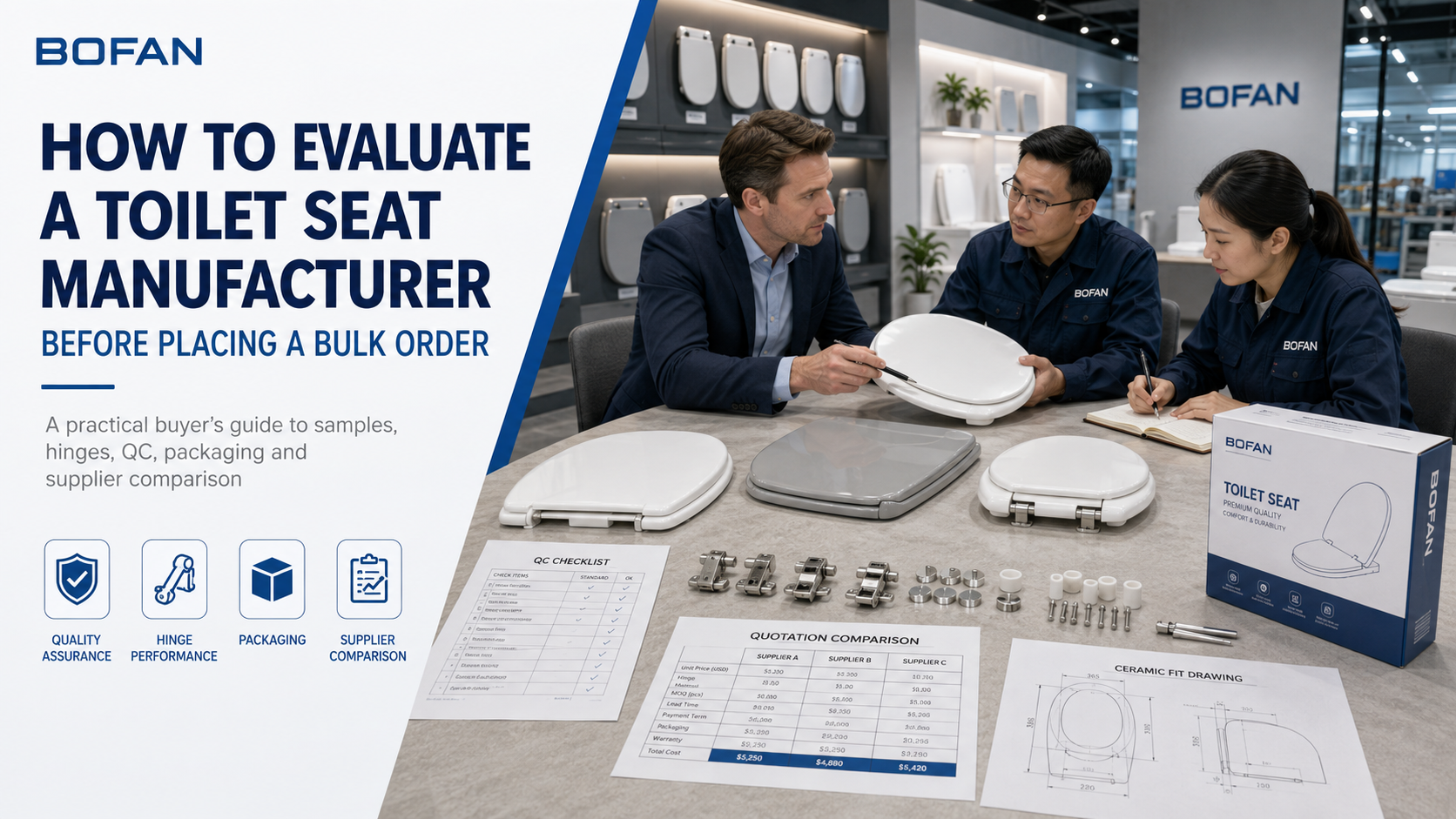
How to Evaluate a Toilet Seat Manufacturer Before Placing a Bulk Order
Choosing a toilet seat supplier based only on a catalog photo or the lowest quotation can create avoidable problems later.
Two factories may quote a toilet seat that looks similar in photographs while using different materials, seat weights, hinges, fixing kits, quality-control processes and packaging levels. The lowest price may therefore not represent the same product.
A better approach is to evaluate the manufacturer’s ability to deliver the approved product consistently—from sample stage through repeat orders.
Start With Your Own Product Requirement
A supplier cannot give a reliable proposal if the buyer’s requirement is unclear.
Before comparing manufacturers, define:
- Target market
- Sales channel
- Product material
- Required shape
- Target toilet-bowl compatibility
- Hinge and fixing method
- Soft-close or quick-release requirement
- Target price level
- Packaging requirement
- Quantity by SKU
- Required delivery date
- Trade term and destination port
A clear RFQ helps every supplier quote on the same basis. It also makes it easier for the buyer to identify whether a supplier has understood the product correctly.
Check Whether the Factory Makes Your Required Product Type
A supplier may be experienced in one material but less suitable for another.
For example, PP, UF and molded wood toilet seats have different production processes, appearance expectations and quality-control points.
Ask the manufacturer about:
- Product categories currently produced
- Available seat shapes
- Existing model range
- Material options
- Hinge options
- Surface finishes
- Customization capability
- New-mold development process
- Sample lead time
- Bulk-production lead time
A factory with relevant experience can usually ask more specific questions about ceramic fit, hinge selection, packaging and expected product positioning.
BOFAN provides PP, UF and MDF/wooden toilet seat options for different market and channel requirements.
Evaluate Product Fit, Not Just Product Appearance
A toilet seat needs to work with the intended ceramic.
Ask whether the manufacturer can review:
- Bowl length and width
- Mounting-hole spacing
- Hole diameter
- Rear ceramic platform
- Top-fix or bottom-fix access
- Hinge adjustment range
- Seat overhang
- Buffer contact
- Installed stability
A “universal” toilet seat should still be evaluated against the target toilet shape or stated measurement range.
The best evidence is an installed sample on the buyer’s intended ceramic or a controlled drawing with complete dimensions.
Review the Hinge and Fixing System Carefully
The hinge is a key part of product performance.
Ask the supplier to clarify:
- Standard-close or soft-close function
- Fixed or quick-release design
- Hinge material
- Hinge finish
- Damper system
- Top-fix or bottom-fix method
- Adjustment range
- Fixing-kit contents
- Replacement-hardware availability
- Functional testing method
A basic plastic fixed hinge should not be compared directly with a metal soft-close quick-release hinge simply because both products are described as “toilet seats.”
The selected hinge code should be written into the product specification and included in the approved sample record.
Ask How Quality Is Controlled
“High quality” is not enough. A reliable manufacturer should be able to explain what it checks and when.
A quality-control process may include:
| Inspection stage | Typical checks |
|---|---|
| Incoming materials | Material condition, color, components and hinge parts |
| Production process | Shape, dimensions, surface, assembly and alignment |
| Functional testing | Opening, closing, soft-close, quick release and stability |
| Final inspection | Appearance, hardware completeness, packaging and labels |
| Pre-shipment review | Carton condition, quantity, shipping marks and loading readiness |
For the specific order, buyers should agree measurable inspection points such as dimensions, color reference, surface condition, hinge function, packaging accuracy and fixing-kit completeness.
BOFAN’s quality-control process can be used as a starting point for discussing project-specific inspection requirements.
Verify Sample Quality Before Approving Bulk Production
A sample should represent the actual bulk-order configuration as closely as possible.
Check:
- Material and product weight
- Seat shape and dimensions
- Surface finish
- Color
- Seat and lid alignment
- Hinge operation
- Soft-close performance
- Quick-release function
- Fixing kit
- Installation stability
- Product logo
- Packaging
- Barcode and instructions
If the bulk product will use printed packaging or a customized hinge, the sample should include those elements wherever practical.
Do not approve production based only on a product photograph or an early development prototype with different parts.
Understand Customization and Change Control
Private-label programs often include multiple variables: logo, packaging, color, hinge, fixing kit and product model.
The buyer should ask:
- Which changes require a new sample?
- Which changes affect MOQ?
- Which changes affect lead time?
- Who controls artwork versions?
- How are product codes managed?
- Can the factory reuse approved packaging files?
- How are repeat-order changes documented?
- What happens if a component must be substituted?
A supplier should not change the hinge, packaging material or product specification without written approval simply because a similar component is available.
Compare Quotations Properly
The correct comparison is not price versus price. It is specification versus specification.
Compare each supplier on:
- Product model
- Material
- Shape and dimensions
- Product weight where relevant
- Hinge and fixing kit
- Color and finish
- Product logo
- Packaging level
- Barcode and instructions
- MOQ by SKU and variation
- Inspection scope
- Certificate or document requirements
- Trade term
- Lead time
- Payment terms
A lower quotation can be valid, but only after confirming that it covers the same product and commercial basis.
Check Production Capacity and Delivery Communication
Capacity is not only about the number of units a factory claims to make each year. Buyers should also assess whether the supplier can manage the requested schedule and provide clear production updates.
Ask:
- What is the normal lead time?
- What affects lead time?
- How long does custom packaging take?
- How long does a new mold take?
- When are samples approved?
- When is artwork frozen?
- When is final inspection arranged?
- What shipment documents can be provided?
- Who is responsible for project communication?
A factory should give a realistic schedule based on the approved product configuration, not an optimistic date based on an incomplete requirement.
Review Packaging and Shipping Readiness
The manufacturer should understand that packaging, carton limits and shipment preparation can affect the final customer experience.
Confirm:
- Individual packaging type
- Product protection
- Hardware-bag position
- Retail-box content
- Carton quantity
- Carton weight
- Pallet requirement
- Shipping marks
- Barcode labels
- Container loading arrangement
- Required export documentation
For retail and e-commerce orders, packaging should be part of sample approval and final inspection.
Use a Trial Order Before Scaling
For a new supplier relationship, a controlled trial order can reduce commercial risk.
A trial order helps verify:
- Product consistency
- Ceramic compatibility
- Hinge function
- Packaging execution
- Communication quality
- Inspection process
- Shipping documentation
- Delivery timing
- Market feedback
- Repeat-order potential
The first order does not need to include every possible SKU. A focused selection of core products is usually easier to evaluate and improve.
For a practical framework, see BOFAN’s guide on how to structure an OEM toilet seat trial order.
Toilet Seat Manufacturer Evaluation Checklist
Before placing a bulk order, confirm:
- The factory produces the required material and product type
- The proposed seat fits the intended ceramic
- The hinge and fixing system are clearly identified
- The factory can explain its quality-control process
- A production-representative sample is approved
- Packaging, barcode and instructions are confirmed
- MOQ is clear by model, color and packaging version
- Quotations are compared on the same specification basis
- Lead time and shipment requirements are realistic
- Repeat-order change-control process is understood
How BOFAN Supports Buyer Evaluation
BOFAN can provide product information, material options, hinge configurations, ceramic-fit review, packaging proposals and project-specific quality checkpoints for toilet seat programs.
To begin an evaluation, send your target market, required seat type, toilet-bowl information, target quantity, packaging brief and delivery destination.
FAQ
What should I ask a toilet seat manufacturer before ordering?
Ask about product material, seat shape, ceramic compatibility, hinge type, fixing kit, quality checks, packaging, MOQ, lead time, certificates and trade terms.
Why do toilet seat prices vary between suppliers?
The price can vary because of different materials, product weights, hinges, fixings, finishes, packaging, inspection standards, quantities and trade terms.
Should I approve a sample before placing a bulk order?
Yes. Ideally, approve a production-representative sample that includes the intended hinge, fixing kit, color, logo and packaging.
Can one toilet seat fit every toilet bowl?
No. Some models have broad adjustment ranges, but compatibility should still be checked against the intended ceramic or measurement range.
What is the most important component to compare?
The complete approved configuration matters most. However, the hinge, fixing system, ceramic fit and packaging are especially important because they strongly affect user experience and customer complaints.
Table of Contents
- How to Evaluate a Toilet Seat Manufacturer Before Placing a Bulk Order
- Start With Your Own Product Requirement
- Check Whether the Factory Makes Your Required Product Type
- Evaluate Product Fit, Not Just Product Appearance
- Review the Hinge and Fixing System Carefully
- Ask How Quality Is Controlled
- Verify Sample Quality Before Approving Bulk Production
- Understand Customization and Change Control
- Compare Quotations Properly
- Check Production Capacity and Delivery Communication
- Review Packaging and Shipping Readiness
- Use a Trial Order Before Scaling
- Toilet Seat Manufacturer Evaluation Checklist
- How BOFAN Supports Buyer Evaluation
- FAQ