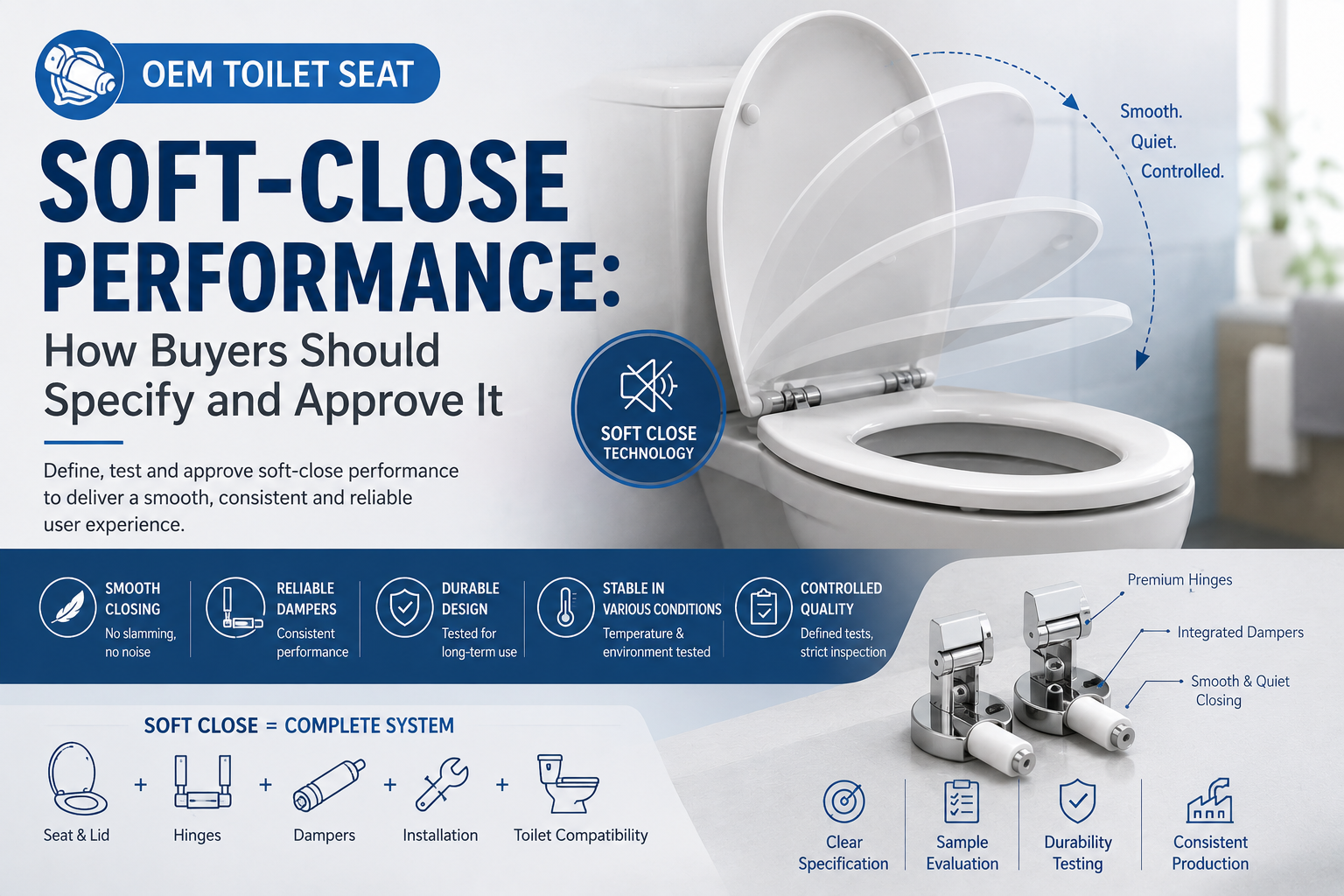
OEM Toilet Seat Soft-Close Performance: How Buyers Should Specify and Approve It
“Soft close” is often written as one line in a toilet seat quotation. In practice, it describes a complete functional system involving the seat, lid, hinges, dampers, product weight, opening angle, installation and operating conditions.
Two products may both be described as soft-close toilet seats while delivering noticeably different user experiences. One may close both the seat and lid smoothly. Another may damp only the lid. Closing speed may also vary between samples, after repeated use or under different temperatures.
For OEM brands, sanitary ware companies, distributors and retailers, soft-close performance should therefore be defined before quotation and verified before mass production.
A useful specification should answer:
- Which moving parts are damped?
- How should the closing motion begin?
- What closing behavior is acceptable?
- Which seat, lid and hinge configuration is covered?
- How will samples be evaluated?
- What routine production checks are required?
- What longer-term durability testing is needed?
- How will complaints be investigated?
The objective is not to create one universal closing speed. It is to establish an agreed, repeatable performance range for the selected product.
Treat Soft Close as a Complete Assembly
The damper does not operate independently.
Soft-close behavior can be influenced by:
- Seat material
- Lid and ring weight
- Product dimensions
- Center of gravity
- Hinge position
- Damper specification
- Left and right damper configuration
- Opening angle
- Friction inside the hinge
- Quick-release structure
- Installation alignment
- Temperature
- Component tolerances
- Product age and cycle history
A damper suitable for a lightweight PP lid may not perform identically with a heavier molded-wood or UF assembly.
For this reason, buyers should not approve a hinge by reviewing the loose component alone. The complete seat, lid, hinge, fixing kit and intended ceramic should be evaluated together.
BOFAN’s guide to choosing the right toilet seat hinge explains how product weight, ceramic dimensions, fixing access and hinge functions should be considered as one system.
Define Which Parts Are Soft Closing
The specification should state whether the function applies to:
- Lid only
- Seat ring only
- Both lid and seat ring
- Lid and seat moving together
- Lid and seat moving independently
Packaging, product listings and instructions must use the same description.
A carton stating “soft-close seat and lid” is inaccurate if only one component is damped. Likewise, product photography or video should not demonstrate a different closing sequence from the supplied product.
The buyer should also confirm whether the product uses:
- One damper controlling the lid and another controlling the seat
- Separate left and right hinge functions
- Integrated or removable dampers
- Fixed or quick-release hinges
- Product-specific damper orientation
These details should be included in the controlled product specification.
Establish an Approved Closing Reference
Terms such as “slow,” “smooth,” “premium” or “not too fast” are subjective.
A better approval process uses:
- A production-representative sample
- An agreed starting position
- A defined test environment
- A documented observation or timing method
- An acceptable performance range
- A video or physical reference where useful
The buyer should observe:
- Whether closing begins consistently
- Whether movement is smooth
- Whether the seat or lid pauses unexpectedly
- Whether one side moves differently from the other
- Whether the component reaches the ceramic gently
- Whether it stops before fully closing
- Whether abnormal noise is present
- Whether the product rebounds
- Whether the two parts interfere with each other
The approved sample should represent the actual seat material, product weight, hinges and fixing configuration intended for production.
Avoid One Unsupported Universal Closing-Time Requirement
Some buyers try to define quality using one exact closing time.
Closing time can be useful as an inspection reference, but it should be applied carefully. Natural variation may occur because of:
- Product weight tolerance
- Damper tolerance
- Starting angle
- Temperature
- Measurement method
- Installation alignment
- Friction in the hinge system
Instead of selecting an arbitrary number from another product, buyers should establish an acceptable range through sample evaluation and relevant testing.
The specification should clarify:
- Which component is timed
- Starting angle
- Ending point
- Number of preliminary operations
- Number of measured operations
- Test temperature
- Whether the product is installed
- Acceptable range
- Treatment of results outside the range
Any published performance claim should match the actual approved method.
Check Performance at the Sample Stage
A soft-close sample review should cover more than one closing operation.
Check:
Product identity
- Correct seat model
- Correct material
- Correct product weight where specified
- Correct hinge and damper codes
- Correct fixing kit
- Correct production-intended components
Appearance
- Hinge finish
- Seat and lid alignment
- Gap consistency
- Visible hinge position
- Surface condition
- Covers and release buttons
Function
- Seat closing
- Lid closing
- Repeated operation
- Opening resistance
- Full opening position
- Smooth movement
- Final contact
- Quick-release operation where applicable
- Stability after installation
Installation
- Ceramic compatibility
- Hinge adjustment
- Fixing access
- Buffer contact
- Seat centering
- Rear clearance
The sample should be installed on the intended ceramic or an accurately controlled representative bowl before final approval.
Condition the Product Before Testing
A product that has just arrived from a cold or hot transport environment may not immediately behave like a product stored under normal indoor conditions.
The test plan should therefore state:
- Storage conditions before evaluation
- Conditioning period
- Test temperature
- Whether packaging has been removed
- Number of initial opening and closing operations
- Time between repeated measurements
If the buyer needs performance across a specified temperature range, that requirement should be agreed before testing.
Do not reject or approve a program based on uncontrolled comparisons between samples tested under different conditions.
Define Routine Functional Inspection
Long durability tests cannot be performed on every finished unit, but routine functional checks can be built into production and final inspection.
Possible checks include:
- Correct hinge assembly
- Correct left and right components
- Smooth opening
- Controlled closing
- Complete final closure
- No abnormal noise
- No interference
- Quick-release engagement
- Hinge-cover fit
- Fixing-kit completeness
The buyer and manufacturer should agree:
| Control item | Required decision |
|---|---|
| Inspection stage | Assembly, in-process, final or packed-product inspection |
| Frequency | Every unit or agreed sampling plan |
| Test method | Defined opening and closing sequence |
| Acceptance range | Approved sample or measurable criterion |
| Record | Checklist, inspection report, video or production record |
| Authority | Person responsible for release |
BOFAN’s article on quality consistency in OEM toilet seat production explains how functional requirements should connect to an approved sample and production control plan.
Plan Soft-Close Cycle Testing
Cycle testing is used to evaluate how the mechanism performs after repeated operation.
Before testing, define:
- Exact product model
- Seat and lid material
- Hinge and damper codes
- Fixing arrangement
- Test fixture or ceramic
- Opening and closing angle
- Cycle speed
- Number of cycles
- Inspection intervals
- Test environment
- Failure criteria
- Final evaluation
- Sample quantity
Possible failure criteria may include:
- Loss of damping
- Excessively fast closing
- Failure to close completely
- Damper leakage
- Hinge damage
- Abnormal looseness
- Noise
- Component separation
- Quick-release failure
- Visible deformation
A cycle result for one hinge configuration should not automatically be applied to every toilet seat using a visually similar hinge.
Buyers should confirm which exact product and component arrangement each report covers through BOFAN’s Certificates & Test Reports page and project-specific confirmation.
Distinguish Cycle Testing From Routine Inspection
Cycle testing and production inspection serve different purposes.
| Test type | Main purpose |
|---|---|
| Sample functional check | Approve user experience and initial behavior |
| Routine production check | Identify incorrect assembly or obvious functional defects |
| Durability cycle test | Evaluate repeated-use performance |
| Batch confirmation test | Check production-representative samples |
| Complaint investigation | Compare reported products with approved performance |
A supplier may perform routine closing checks on production while using a smaller number of samples for longer durability evaluation.
The buyer should not assume that “100% soft-close tested” means every unit completed the full durability-cycle test.
The inspection plan should explain exactly what was checked.
Test Both the Seat and Lid
The seat ring and lid may have different weights and use different damping behavior.
Evaluate each part separately where appropriate:
- Closing from the approved starting angle
- Movement through the full closing path
- Final contact
- Interaction when both are raised
- Interference between components
- Consistency after repeated operations
A product may pass a lid-only test while the seat ring closes too quickly or stops before reaching the bowl.
The packaging claim should reflect the functions actually tested and approved.
Check Left-to-Right Consistency
Uneven hinge operation can create twisting, hesitation or abnormal movement.
Review:
- Left and right hinge installation
- Damper orientation
- Component engagement
- Hinge-axis alignment
- Seat and lid symmetry
- Uneven friction
- Fixing-base alignment
If the seat appears to descend unevenly, determine whether the cause is:
- Damper variation
- Incorrect assembly
- Hinge misalignment
- Product deformation
- Ceramic installation
- Uneven tightening
Replacing a damper will not solve a ceramic or installation-alignment problem.
Evaluate Quick Release Together With Soft Close
When a product combines quick release and soft close, both functions should be tested as a system.
Check:
- Product is securely locked during normal use.
- Release buttons or mechanisms operate correctly.
- Seat can be removed without forcing the hinges.
- Hinge bases remain stable.
- Product can be reinstalled in the correct position.
- Locking engagement is confirmed.
- Soft-close behavior remains consistent after reinstallation.
The instruction sheet should explain the correct removal and refitting sequence.
BOFAN’s quick-release toilet seat range can be reviewed alongside its soft-close toilet seat range when buyers require both functions.
Control Component Substitutions
A damper or hinge substitution may change:
- Closing speed
- Opening resistance
- Noise
- Product alignment
- Adjustment range
- Quick-release behavior
- Hinge appearance
- Product cost
- Spare-parts compatibility
- Test-report applicability
The supplier should not substitute a critical hinge or damper based only on a claim that it is “equivalent.”
A change-control record should show:
- Current component
- Proposed component
- Reason for change
- Affected SKUs
- Dimensional comparison
- Functional comparison
- Required samples
- Required cycle test
- Buyer approval
- Effective production batch
- Spare-parts effect
The approved hinge and damper codes should be listed in the purchase order or controlled product specification.
Inspect Packed Products
Packaging can affect the hinge system during shipment.
Check that:
- Hinges are protected from impact
- The product cannot move excessively inside the box
- Metal components cannot scratch the seat
- Hardware bags are secured
- The seat is not stored under damaging pressure
- Release buttons are protected
- The packed sample remains functional after handling
After packaging validation, unpack the sample and repeat the functional test.
BOFAN’s Toilet Seat Packaging Guide for Retail and E-Commerce Buyers provides broader packaging controls for different distribution channels.
Investigate Soft-Close Complaints Systematically
When a complaint is received, collect:
- Buyer SKU
- Factory model
- Production batch
- Photographs
- Video of the complete closing movement
- Seat and lid starting position
- Ceramic model
- Installation photographs
- Hinge and fixing details
- Temperature where relevant
- Quantity affected
- Number of products checked
- Length of use
- Whether the product was removed or reinstalled
Classify the complaint accurately:
- Closes too quickly
- Closes too slowly
- Does not close completely
- One side descends unevenly
- Soft close stopped working
- Abnormal noise
- Quick-release problem
- Loose installation mistaken for damper failure
- Product damaged during transport
- Performance differs from customer expectation but matches specification
BOFAN’s guide to warranty and claims terms for OEM toilet seat programs explains why claim decisions need agreed evidence and performance references.
Soft-Close Approval Checklist
Before mass production, confirm:
- Seat and lid functions are clearly defined.
- Exact hinge and damper codes are recorded.
- The complete product configuration is frozen.
- A production-representative sample is approved.
- The intended ceramic has been used for fit validation.
- Closing behavior has an agreed reference.
- Test conditions and starting angles are defined.
- Seat and lid are evaluated separately where required.
- Left-to-right consistency is checked.
- Quick release is tested with the soft-close system.
- Routine inspection requirements are documented.
- Durability-cycle test requirements are defined.
- Packaging claims match the approved function.
- Instructions explain correct use.
- Component substitutions require approval.
- Complaint evidence requirements are established.
How BOFAN Supports Soft-Close OEM Programs
BOFAN can coordinate suitable soft-close hinge configurations across approved PP, UF and MDF toilet seat programs.
Depending on the selected product, support may include:
- Product and hinge matching
- Ceramic-information review
- Standard and quick-release options
- Production-representative samples
- Functional inspection discussions
- Packaging coordination
- Product and hinge specification records
- Repeat-order change control
- Claim-evidence review
Test methods, cycle requirements, acceptance ranges and report applicability must be confirmed for the exact model and buyer program.
BOFAN supports OEM brands and sanitary ware companies as well as distributors and importers.
CTA
Need to define soft-close performance for an OEM toilet seat? Send BOFAN your selected seat model, ceramic information, expected product position, hinge functions and test requirements. The team can help prepare a configuration for sample and performance review.
Request a Soft-Close Performance Review
FAQ
What does soft close mean on an OEM toilet seat?
It means an approved hinge and damper system controls the closing movement of the seat, lid or both. The exact function must be defined for the selected model.
Should every soft-close toilet seat have the same closing time?
No. Performance can vary by product weight, damper design, starting angle, temperature and test method. Buyers should approve a suitable range for the specific product.
How should a soft-close sample be approved?
Install the production-representative seat, hinges and fixings on the intended ceramic. Check the seat and lid repeatedly for smooth movement, complete closure, noise, alignment and stability.
What is a toilet seat soft-close cycle test?
It is a repeated opening-and-closing test used to evaluate whether the hinge and damper continue operating within the agreed criteria after a defined number of cycles.
Can one hinge cycle report cover every toilet seat?
Not automatically. Buyers should verify the tested product, weight, hinge, damper, fixing configuration, method and report date.
Does temperature affect soft-close performance?
It can affect the behavior of some damping systems. If temperature performance matters, conditioning and test conditions should be included in the agreement.
Can a loose toilet seat be mistaken for a soft-close defect?
Yes. Incorrect fixing, poor alignment or unsuitable ceramic compatibility can affect movement and should be checked before diagnosing damper failure.
Can BOFAN supply soft-close and quick-release toilet seats?
BOFAN supports suitable models with soft-close, quick-release and combined configurations. Availability and testing depend on the selected seat and hinge system.
Table of Contents
- OEM Toilet Seat Soft-Close Performance: How Buyers Should Specify and Approve It
- Treat Soft Close as a Complete Assembly
- Define Which Parts Are Soft Closing
- Establish an Approved Closing Reference
- Avoid One Unsupported Universal Closing-Time Requirement
- Check Performance at the Sample Stage
- Condition the Product Before Testing
- Define Routine Functional Inspection
- Plan Soft-Close Cycle Testing
- Distinguish Cycle Testing From Routine Inspection
- Test Both the Seat and Lid
- Check Left-to-Right Consistency
- Evaluate Quick Release Together With Soft Close
- Control Component Substitutions
- Inspect Packed Products
- Investigate Soft-Close Complaints Systematically
- Soft-Close Approval Checklist
- How BOFAN Supports Soft-Close OEM Programs
-
FAQ
- What does soft close mean on an OEM toilet seat?
- Should every soft-close toilet seat have the same closing time?
- How should a soft-close sample be approved?
- What is a toilet seat soft-close cycle test?
- Can one hinge cycle report cover every toilet seat?
- Does temperature affect soft-close performance?
- Can a loose toilet seat be mistaken for a soft-close defect?
- Can BOFAN supply soft-close and quick-release toilet seats?