Toilet Seat Batch Traceability: A Practical Guide for OEM Buyers
When an importer receives a complaint about a toilet seat, one of the first questions should be: which product, component configuration and production batch was involved?
Without reliable traceability, the buyer may know the product model but not which hinge was installed, which fixing kit was packed, which artwork revision was used or which inspection record applies. The result is often a broad investigation covering more products than necessary.
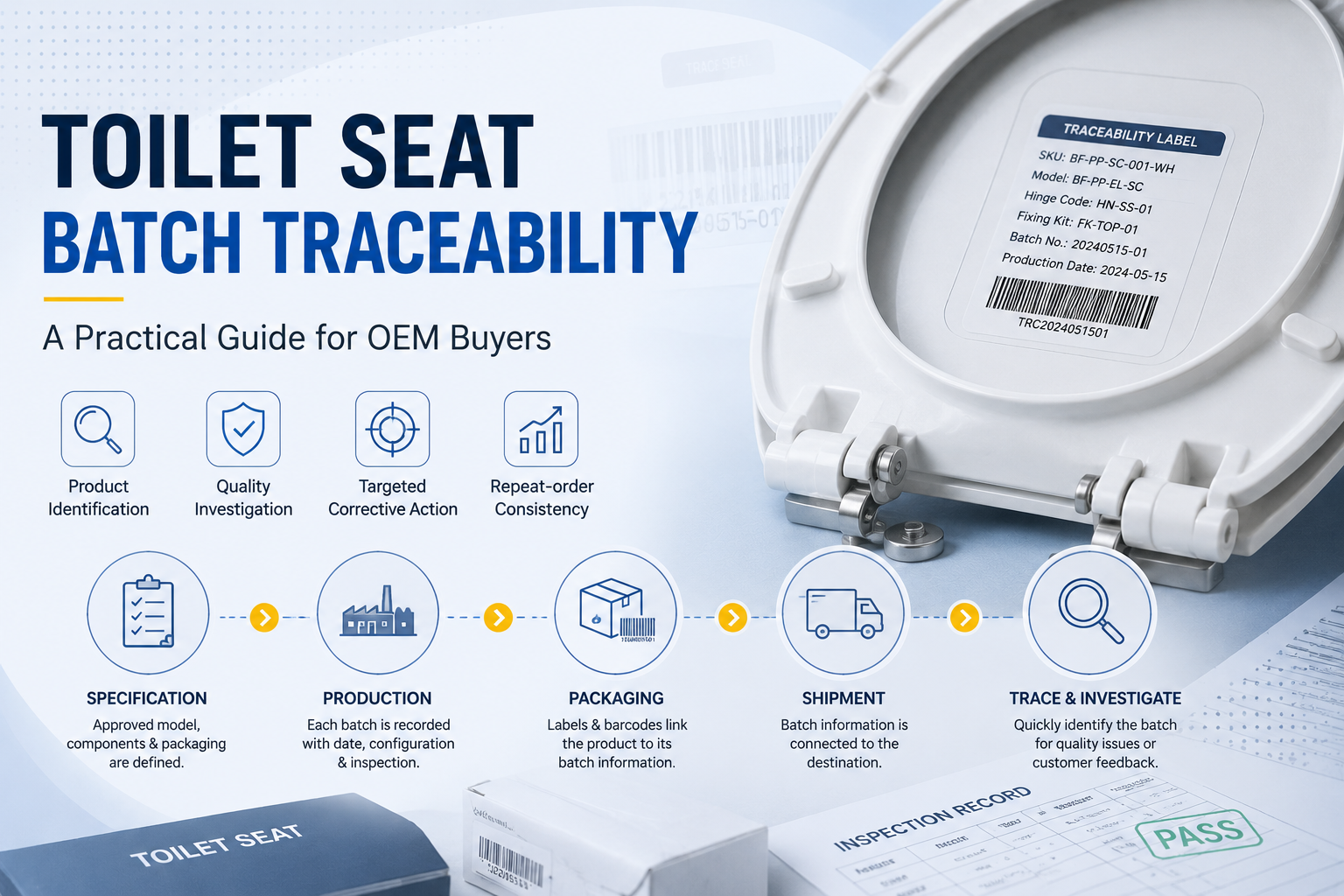
A practical toilet seat batch-traceability system connects the finished product with its approved specification, critical components, packaging version, production period, inspection evidence and shipment destination.
For distributors, private-label brands, sanitary ware companies, retailers and project buyers, traceability supports four important activities:
- Product identification
- Quality investigation
- Targeted corrective action
- Repeat-order consistency
Traceability does not require every low-risk component to carry a unique serial number. It requires enough controlled information to identify what was produced, when it was produced, which approved configuration was used and where the goods were shipped.
Why Toilet Seat Traceability Matters
A toilet seat is an assembly rather than a single material.
Depending on the model, it may contain:
- Seat and lid
- Standard or soft-close hinges
- Dampers
- Quick-release components
- Hinge bases and covers
- Fixing bolts
- Nuts and washers
- Expansion plugs
- Buffers
- Installation tools
- Hardware bags
- Instructions
- Product labels
- Retail packaging
Two products may have the same external shape and color while using different hinges or fixing systems. If both versions are described only as “white soft-close toilet seat,” a complaint investigation becomes difficult.
A controlled traceability system helps the buyer distinguish between:
- A model-wide design issue
- A component-specific issue
- A limited production-batch issue
- A packaging or assembly error
- An installation problem
- A ceramic-compatibility problem
- Damage occurring during transport or handling
- A complaint unrelated to manufacturing conformity
This distinction matters because each cause requires a different response.
Define the Traceability Level Before Production
Not every toilet seat program requires the same level of control.
The traceability plan should reflect:
- Product value
- Sales channel
- Annual volume
- Number of SKUs
- Number of hinge and fixing configurations
- Buyer warranty policy
- Retailer requirements
- Project installation scale
- Destination-market requirements
- Likely cost of a broad recall or replacement
- Availability of replacement parts
A basic wholesale product may require a production-date or lot code connected to an inspection record.
A private-label retail program may additionally need the buyer SKU, packaging revision, barcode, factory model and component configuration.
A large hotel or residential project may need building, phase or delivery-batch identification so replacement products remain compatible with earlier installations.
The buyer and manufacturer should agree on the required level before packaging artwork and production documents are finalized.
Build a Product Identity Record
Every approved product should have one controlled identity record.
Useful fields include:
| Control field | Information to record |
|---|---|
| Buyer SKU | Buyer’s commercial product code |
| Factory model | Manufacturer’s internal product model |
| Material | PP, UF, MDF or other approved material |
| Shape | Round, elongated, D-shape or model-specific |
| Dimensions | Approved product dimensions and tolerances |
| Color | Approved color name and reference |
| Surface finish | Gloss, matte, printed or other finish |
| Hinge code | Exact approved hinge configuration |
| Closing function | Standard close or soft close |
| Release function | Fixed or quick release |
| Fixing method | Top fix or bottom fix |
| Fixing-kit code | Approved hardware set |
| Packaging revision | Retail box, instruction and label version |
| Approved sample | Reference-sample number and date |
| Specification revision | Current controlled product revision |
The goal is to prevent one SKU from silently changing over time.
If a hinge, fixing kit, damper, color, product weight or packaging format changes, the record should show whether the change is:
- A direct replacement with written approval
- A new product revision
- A temporary authorized deviation
- A separate SKU
BOFAN’s guide to quality consistency in OEM toilet seat production explains why the approved product, components and packaging must be frozen before repeatable production can be expected.
Identify Critical Components
A traceability system should focus particularly on components that affect fit, function, installation, appearance or customer service.
For toilet seats, these may include:
Hinges and dampers
Record the hinge code, hinge material, finish, adjustment range, soft-close configuration and quick-release structure.
A product using a plastic fixed hinge should not share an uncontrolled identity with a visually similar product using a metal quick-release hinge.
Fixing hardware
Record whether the product uses top or bottom fixing and identify the bolts, washers, plugs, nuts and caps included in the kit.
Missing or incorrect fixings may appear to be product failures when the actual issue is a packing or installation mismatch.
Buffers
The number, position, material and height of the buffers can affect stability and contact with the ceramic bowl.
Seat and lid construction
Where relevant, record material, product weight, thickness, reinforcement or other approved structural information.
Packaging and instructions
The correct product can still create complaints if it is packed with an instruction sheet for another hinge or a box showing inaccurate dimensions and features.
BOFAN’s toilet seat spare-parts planning guide provides a related framework for connecting each product SKU to its approved hinges, fixing kits and service components.
Create a Practical Batch Code
A batch code should be understandable to the organizations that need to use it while avoiding unnecessary complexity.
Depending on the program, the code may identify:
- Manufacturing site
- Production date or period
- Production line
- Product model
- Assembly lot
- Component lot
- Packing date
- Shift
- Inspection lot
- Revision
One possible internal structure could combine:
Factory – Product – Production Date – Lot
The exact format should be agreed by the buyer and supplier. A buyer does not necessarily need every internal factory field printed on the retail product, but the visible code must connect reliably to the underlying production record.
Avoid codes that:
- Are reused across unrelated production
- Disappear when the outer carton is discarded
- Cannot be read after installation
- Depend entirely on one employee’s memory
- Are printed only on a temporary warehouse label
- Cannot be connected to inspection and shipment records
- Change format without documented notice
Where the product itself cannot carry the full code, the system may combine product, unit-box, master-carton and shipment identifiers.
Decide Where the Code Should Appear
Possible locations include:
- Underside of the lid
- Underside of the seat ring
- Hinge-area label
- Hardware bag
- Individual product box
- Retail label
- Master carton
- Pallet label
- Inspection report
- Packing list
- Internal production traveler
The appropriate location depends on product design, surface, cleaning requirements, packaging format and buyer service process.
A distributor handling after-sales requests should be able to tell the customer where to find the relevant code without removing or damaging the product.
If the code appears only on the master carton, it may be lost after warehouse distribution. If it appears only on the installed seat, warehouse teams may be unable to separate batches before sale.
For higher-control programs, use more than one linked location.
Connect Production Records to the Batch
A printed code has little value unless it leads to usable records.
The factory record may include:
- Purchase order
- Buyer SKU
- Factory product model
- Approved specification revision
- Production quantity
- Production dates
- Material or molding records
- Hinge and fixing-kit codes
- Component receiving information
- Color or surface reference
- Assembly records
- Packaging version
- In-process inspection
- Final inspection
- Rework or corrective-action records
- Released quantity
- Carton range
- Shipment reference
The buyer does not need to receive every internal document automatically. However, both parties should agree on which records will be retained, for how long and how they can be retrieved if a quality investigation begins.
BOFAN’s quality-control process can be used as a starting point when defining which production and inspection stages should support the traceability plan.
Control Packaging and Artwork Revisions
Packaging is part of the traceable product configuration.
Record:
- Retail-box revision
- Barcode
- Buyer SKU
- Product title
- Product photograph
- Listed dimensions
- Material description
- Hinge and fixing claims
- Installation instructions
- Language version
- Country-of-origin marking where required
- Master-carton label
- Pallet label
- Packing quantity
A product packed in an old box may display an incorrect hinge, installation method or compatibility claim even if the physical seat meets the latest specification.
The packaging revision should therefore be linked to the production batch. Obsolete artwork and instructions should be separated from approved files.
For broader packaging controls, see BOFAN’s Toilet Seat Packaging Guide for Retail and E-Commerce Buyers.
Link Inspection Evidence to the Batch
An inspection report should identify the actual goods inspected.
Include:
- Purchase-order number
- Product SKU
- Factory model
- Batch or lot code
- Quantity produced
- Quantity presented for inspection
- Sample size
- Specification revision
- Approved sample reference
- Inspection date
- Product and packaging checks
- Findings
- Corrective actions
- Final result
- Shipment-release authority
Photographs should show identifiable products or cartons where practical. Generic factory photographs should not be treated as evidence for a specific batch.
If rework is required, record:
- Affected quantity
- Defect category
- Corrective action
- Reinspection quantity
- Reinspection result
- Final released quantity
This creates a usable chain from the original finding to the released shipment.
Maintain Shipment-Level Traceability
Production data should connect to the actual shipment.
Useful shipping records include:
- Commercial invoice
- Packing list
- Container or transport reference
- Container number where applicable
- Seal number where applicable
- Quantity by SKU
- Carton range
- Pallet identification
- Loading photographs
- Shipment date
- Destination
- Buyer warehouse or project phase
BOFAN’s Toilet Seat Export Documentation Checklist for Importers explains how commercial, packing, product and quality documents should be coordinated before shipment.
If several batches are loaded together, the packing record should identify which quantities belong to each batch.
Use Traceability During Claims Investigation
When a complaint is received, collect:
- Buyer SKU
- Batch code
- Purchase date or shipment reference
- Photographs
- Video where function is involved
- Ceramic model and dimensions
- Installation method
- Hinge and fixing configuration
- Cleaning and use conditions where relevant
- Quantity affected
- Number of units checked
- Description of the failure
- Whether replacement components solved the issue
The investigation can then compare the complaint with:
- Approved specification
- Golden or reference sample
- Component records
- Production records
- Inspection report
- Other complaints from the same batch
- Complaints from other batches
- Installation evidence
One reported problem should not automatically be treated as evidence that every product in the shipment is defective. Equally, repeated reports from the same batch should not be dismissed as unrelated incidents.
Traceability allows the response to be based on evidence.
Protect Traceability Across Repeat Orders
Repeat orders are a common point of failure because the commercial SKU remains unchanged while components or packaging gradually change.
Before every repeat order, confirm:
- Current product revision
- Current hinge code
- Current fixing kit
- Current color and finish
- Current packaging artwork
- Current barcode
- Current instruction sheet
- Approved substitutions
- Required tests or documents
- Current reference sample
If the original component is discontinued, the proposed replacement should be evaluated for fit, function, appearance, installation and service compatibility before approval.
The change record should identify:
- Reason for the change
- Old and new components
- Affected SKUs
- Sample or testing requirement
- Buyer approval
- Effective production batch
- Effect on spare parts
- Effect on packaging or instructions
Toilet Seat Traceability Checklist
Before mass production, confirm:
- Every product has a buyer SKU and factory model.
- The approved specification has a revision number.
- Critical hinges and fixings have controlled codes.
- The approved sample can be identified.
- The batch-code format is documented.
- The code appears in usable locations.
- Production records connect to the batch code.
- Packaging and instruction revisions are recorded.
- Inspection reports identify the inspected batch.
- Cartons and pallets can be connected to the shipment.
- Mixed batches can be separated by quantity.
- Claims teams know which evidence to collect.
- Repeat-order changes require written approval.
- Record-retention responsibilities are defined.
- The buyer has tested whether a code can actually be traced.
How BOFAN Supports Traceable OEM Programs
BOFAN can coordinate product, hinge, fixing, packaging and inspection information for approved toilet seat programs.
Depending on the model and order, support may include:
- Buyer SKU and factory-model mapping
- Product-specification records
- Hinge and fixing-kit identification
- Packaging-revision control
- Approved-sample records
- Quality and inspection coordination
- Carton and shipment information
- Repeat-order change control
- Spare-parts configuration review
The appropriate traceability arrangement should be confirmed for the selected product, market, packaging format and buyer process.
BOFAN supports both OEM brands and sanitary ware companies and distributors and importers with specification-based product development and repeat supply.
CTA
Need better control over product batches and repeat orders? Send BOFAN your product range, buyer SKUs, hinge configurations, packaging requirements and current traceability concerns. The team can help review a practical identification and record-control structure.
FAQ
What is toilet seat batch traceability?
It is a system connecting a finished toilet seat or shipment with its product specification, production period, critical components, packaging revision, inspection evidence and shipment record.
Does every toilet seat need an individual serial number?
Not necessarily. Many programs can use batch or lot identification. The required level depends on the product, sales channel, volume, risk and buyer requirements.
Where should a toilet seat batch code be placed?
Possible locations include the underside of the product, individual box, master carton, pallet label and production documents. The final arrangement should allow both warehouse and after-sales teams to retrieve the information.
Should hinges and fixing kits be traceable?
Critical hinge and fixing configurations should be identifiable because they affect function, installation, compatibility and spare-parts support.
How does traceability help with warranty claims?
It allows the buyer and supplier to compare the reported product with the approved specification, component configuration, production records and inspection evidence.
What happens when a component changes in a repeat order?
The new component should be reviewed and approved. The change record should identify the affected product, effective batch, validation completed and any effect on packaging, instructions or spare parts.
Can several production batches be shipped in one container?
Yes, but the quantity and carton or pallet identification for each batch should be recorded so the goods remain distinguishable.
Table of Contents
- Toilet Seat Batch Traceability: A Practical Guide for OEM Buyers
- Why Toilet Seat Traceability Matters
- Define the Traceability Level Before Production
- Build a Product Identity Record
- Identify Critical Components
- Create a Practical Batch Code
- Decide Where the Code Should Appear
- Connect Production Records to the Batch
- Control Packaging and Artwork Revisions
- Link Inspection Evidence to the Batch
- Maintain Shipment-Level Traceability
- Use Traceability During Claims Investigation
- Protect Traceability Across Repeat Orders
- Toilet Seat Traceability Checklist
- How BOFAN Supports Traceable OEM Programs
-
FAQ
- What is toilet seat batch traceability?
- Does every toilet seat need an individual serial number?
- Where should a toilet seat batch code be placed?
- Should hinges and fixing kits be traceable?
- How does traceability help with warranty claims?
- What happens when a component changes in a repeat order?
- Can several production batches be shipped in one container?