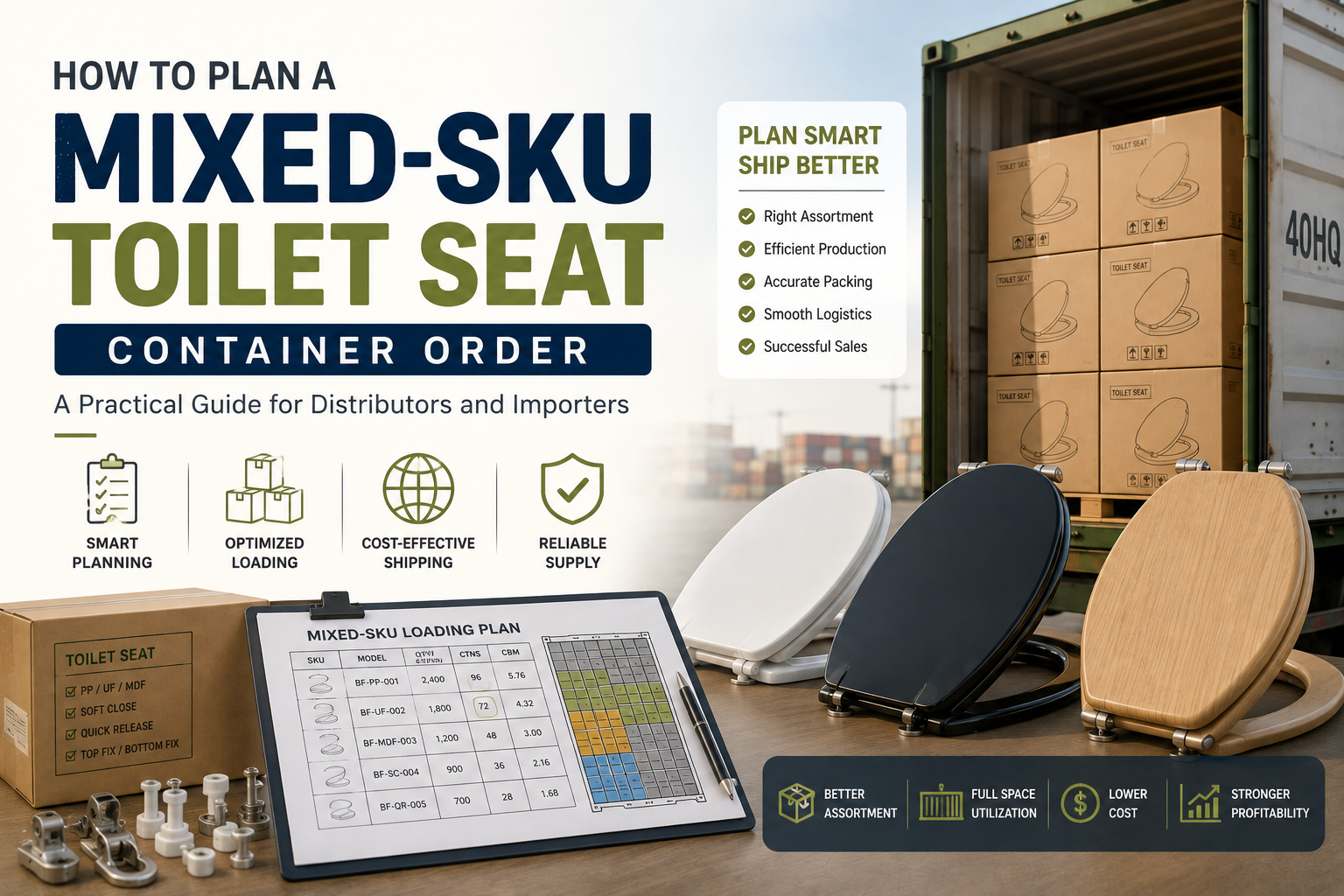
How to Plan a Mixed-SKU Toilet Seat Container Order
A mixed-SKU toilet seat container can help a distributor launch a broader range, replenish several product levels and use shipping space more efficiently.
It can also create unnecessary complexity when too many models, colors, hinges and packaging versions are combined without a controlled plan.
A successful mixed container begins with the commercial role of every SKU. The buyer should know which products are core volume items, which are premium upgrades, which serve specific ceramic shapes and which are being tested in limited quantities.
The order must then coordinate:
- MOQ
- Material and component purchasing
- Production scheduling
- Packaging
- Carton dimensions
- Loading sequence
- Inspection
- Shipping documents
- Warehouse receiving
- Repeat-order planning
For distributors and importers, the goal is not to load the largest possible number of unrelated products. It is to create a commercially useful assortment that can be produced, identified, shipped and replenished reliably.
Why Buyers Use Mixed-SKU Containers
A distributor may need several toilet seat types because the local market contains different ceramics, price levels and sales channels.
A mixed order may include:
- Round and elongated seats
- D-shaped seats
- PP, UF and molded-wood products
- Standard-close and soft-close models
- Fixed and quick-release hinges
- Top-fix and bottom-fix configurations
- Entry, mainstream and premium price tiers
- Retail and wholesale packaging
- White and selected decorative colors
- Initial spare products and component kits
Combining products can support:
- A new range launch
- Inventory replenishment
- Regional distributor demand
- Retail-chain assortment
- Project and wholesale supply in one shipment
- Testing of a limited number of new SKUs
- Consolidation of several repeat orders
However, every additional configuration creates another unit that must be quoted, sampled, produced, inspected, labeled and stocked correctly.
Start With a Commercial Assortment Plan
Before requesting loading calculations, classify each proposed SKU.
| SKU role | Purpose | Typical buying approach |
|---|---|---|
| Core volume | Main repeat seller | Highest quantity and strongest stock coverage |
| Value option | Entry price point | Controlled specification and efficient packaging |
| Feature upgrade | Soft close or quick release | Moderate quantity based on channel demand |
| Premium option | Higher material or finish level | Selective quantity and stronger presentation |
| Shape-specific | Covers defined ceramic types | Quantity based on local installed base |
| Test SKU | Measures demand for a new option | Limited, clearly defined evaluation quantity |
| Project SKU | Supports a confirmed contract | Quantity tied to project phase |
| Service stock | Replacement units or components | Planned separately from saleable stock |
This classification prevents the container from becoming an assortment of attractive samples without sufficient stock depth.
BOFAN’s guide on how to build a toilet seat product range for distribution can help buyers define the role of each product before calculating quantities.
Limit Unnecessary Configuration Proliferation
One seat model can become many production configurations.
For example, the same product body may be divided by:
- Two colors
- Two hinge systems
- Two fixing kits
- Three packaging languages
- Retail and wholesale cartons
That combination can produce 24 separate SKUs even before material or shape changes are added.
Ask whether every variation is commercially necessary.
Where practical, standardize:
- Hinge families
- Fixing kits
- White color reference
- Accessory contents
- Instruction format
- Master-carton quantity
- Barcode position
- Shipping-mark structure
- Spare-parts range
Standardization can make ordering, inspection, customer service and replenishment easier. It must still respect differences in product weight, material, ceramic fit and target market.
Confirm MOQ at Configuration Level
A total container quantity does not automatically satisfy the MOQ for every SKU.
MOQ may apply separately to:
- Seat model
- Material
- Color
- Hinge
- Fixing set
- Surface decoration
- Logo application
- Retail box
- Printed instruction
- Language version
- Master-carton print
- Spare-part pack
Suppose a buyer orders 6,000 toilet seats divided among 20 configurations. The overall volume may appear substantial, while several individual variants remain below practical production or packaging quantities.
Before finalizing the order, request an MOQ table showing:
| Item | Required information |
|---|---|
| Product MOQ | Minimum per factory model |
| Color MOQ | Minimum per custom color |
| Hinge MOQ | Minimum for non-standard hardware |
| Packaging MOQ | Minimum printed quantity |
| Artwork MOQ | Minimum by design or language |
| Order MOQ | Minimum total commercial quantity |
| Repeat MOQ | Minimum quantity for replenishment |
| Spare-part MOQ | Minimum by component kit |
If a planned quantity is below MOQ, possible alternatives may include:
- Selecting an existing factory model
- Using a standard color
- Standardizing the hinge
- Using neutral packaging with controlled labels
- Combining languages in one approved instruction
- Reducing the number of test SKUs
- Increasing the quantity of a stronger core product
All alternatives should be approved against the intended market and product position.
Freeze Every SKU Before Loading Calculations
Container planning should use the final product and packaging configuration.
For each SKU, confirm:
- Product model
- Material
- Shape
- Dimensions
- Product weight
- Color
- Surface finish
- Hinge
- Fixing kit
- Soft-close function
- Quick-release function
- Individual packaging
- Accessories
- Instruction sheet
- Barcode
- Individual-box dimensions
- Master-carton quantity
- Master-carton dimensions
- Gross and net weight
- Pallet requirement
Estimated carton dimensions based on a different hinge or packaging structure can produce an inaccurate loading plan.
A thicker molded-wood product, larger retail box or different carton pack quantity may materially change the number of units that fit.
For product-level preparation, buyers can review BOFAN’s wholesale toilet seat buying guide.
Decide Between Floor Loading and Pallet Loading
The buyer, supplier and logistics provider should confirm how the goods will be loaded.
Floor-loaded cartons
Potential advantages include:
- Higher use of container volume
- No pallet cost
- No pallet weight
- Potentially more units per container
Operational considerations include:
- More manual handling
- Longer unloading time
- Greater need for carton strength
- More difficult batch separation
- Receiving requirements at the destination warehouse
Palletized loading
Potential advantages include:
- Faster mechanical handling
- Easier warehouse receiving
- Better separation by SKU or batch
- More structured project or retailer delivery
Operational considerations include:
- Reduced usable volume
- Pallet cost and weight
- Pallet dimensions and height limits
- Stacking restrictions
- Destination pallet requirements
- Wood-packaging documentation where applicable
The choice should reflect destination handling, warehouse capability, product weight, carton strength and commercial requirements—not loading quantity alone.
Calculate by Carton, Not Only by Unit
A loading plan should be based on confirmed master cartons.
For every SKU, record:
- Units per master carton
- Master-carton dimensions
- Carton volume
- Gross weight
- Number of cartons
- Total units
- Total volume
- Total gross weight
- Pallet quantity where applicable
Container capacity should be checked against both volume and weight constraints. Practical loading may also be affected by carton orientation, stacking strength, irregular spaces and the need to separate products.
Do not assume that theoretical cubic capacity equals the safely usable loading capacity.
The freight forwarder and loading team should review the proposed arrangement for the actual shipment.
Use a Loading Priority System
When the first calculation does not fit the target container, adjust quantities according to commercial priority.
A practical order of protection may be:
- Confirmed project quantities
- Core repeat-selling SKUs
- Committed retailer quantities
- Essential shape coverage
- Main feature upgrades
- Premium options
- Test colors or low-volume variants
This prevents a container adjustment from accidentally reducing the products most important to sales continuity.
Avoid making last-minute quantity changes without reviewing:
- MOQ
- Packaging print quantities
- Production balance
- Carton labels
- Invoice and packing list
- Inspection sample
- Warehouse order plan
Plan the Container Loading Sequence
Loading order affects unloading and receiving.
The plan should consider:
- Which SKUs the warehouse needs first
- Whether goods will be delivered to several locations
- Whether a project phase must be separated
- Whether pallets are used
- Whether similar cartons could be confused
- Whether heavy cartons may damage lighter cartons
- Whether mixed batches require separation
- Whether inspection or customs access may be needed
Possible controls include:
- Loading map
- Carton number ranges
- Pallet numbers
- Color-coded warehouse labels
- SKU labels on multiple carton faces
- Separate loading zones
- Photographs during loading
- Final container diagram
If several buyers or project destinations are being consolidated, the separation method should be particularly clear.
Make Carton Identification Unambiguous
Every carton should help the warehouse answer:
- What is inside?
- How many units are inside?
- Which SKU is it?
- Which batch is it?
- Where should it go?
Useful carton fields include:
- Buyer name or code
- Buyer SKU
- Factory model
- Product description
- Material
- Color
- Hinge or feature code where necessary
- Quantity
- Carton number
- Batch code
- Gross and net weight
- Carton dimensions
- Destination or warehouse code
- Purchase-order reference
- Country-of-origin marking where required
- Barcode or logistics label where required
Avoid relying only on a product photograph. Several white toilet seats can look nearly identical from the outside while requiring different installation hardware.
Align Barcodes, SKUs and Documents
The same product identity should appear consistently across:
- Purchase order
- Product specification
- Retail box
- Barcode label
- Master carton
- Packing list
- Commercial invoice
- Inspection report
- Warehouse receiving file
Common mixed-order errors include:
- Correct product in the wrong retail box
- Correct box with the wrong barcode
- Incorrect hinge listed on the instruction sheet
- Two products using similar internal codes
- Carton quantities not matching the packing list
- Last-minute quantity changes omitted from documents
- Mixed colors recorded as one generic SKU
A final cross-document review should be completed before shipment release.
Inspect by SKU, Not Only by Total Order
A mixed container should not be treated as one homogeneous inspection lot when the products have different materials, hinges, colors or packaging.
The inspection plan should identify:
- SKU
- Quantity
- Production batch
- Sample size
- Product specification
- Approved sample
- Hinge and fixing configuration
- Functional checks
- Packaging checks
- Barcode and label checks
- Carton quantity
- Result
Higher-risk or newly introduced SKUs may require more attention than stable repeat products.
Typical checks include:
Product identity
- Correct model
- Correct material
- Correct color
- Correct hinge
- Correct fixing kit
Appearance and function
- Surface condition
- Seat and lid alignment
- Hinge movement
- Soft-close operation
- Quick-release operation
- Buffer position
- Installation stability
Packaging
- Correct retail box
- Correct barcode
- Correct instruction
- Complete accessories
- Correct carton quantity
- Correct shipping marks
BOFAN’s quality-control information provides a useful starting point for defining inspection stages for the selected order.
Prepare an Accurate Packing List
The packing list should show the final loaded quantities.
For a mixed shipment, include:
- SKU
- Product description
- Quantity per carton
- Number of cartons
- Total quantity
- Net weight
- Gross weight
- Carton dimensions
- Total volume
- Pallet number where applicable
- Batch information where required
- Shipping marks
If quantities change during loading, update the final packing list and commercial documents.
BOFAN’s export documentation checklist explains how packing, transport, product and shipment records should be coordinated.
Plan Destination Warehouse Receiving
The order is not complete when the container doors close.
Before shipment, confirm that the destination warehouse has:
- Final packing list
- SKU master file
- Barcode records
- Carton-label examples
- Loading map
- Pallet list where applicable
- Batch information
- Product photographs
- Receiving instructions
- Exception-reporting process
Warehouse teams should know how to handle:
- Damaged cartons
- Unreadable labels
- Quantity discrepancies
- Mixed products
- Missing accessories
- Products placed on the wrong pallet
- Goods received under an unfamiliar revision
Good receiving data makes it easier to identify whether a discrepancy began during packing, loading, transport or warehouse handling.
Protect Repeat-Order Feasibility
A mixed container should produce useful sales information for the next purchasing cycle.
After the shipment, track:
- Sales by SKU
- Stock on hand
- Weeks of cover
- Return rate
- Complaint category
- Installation issues
- Damaged units
- Margin by SKU
- Reorder quantity
- Reorder lead time
- MOQ constraint
- Discontinued or revised components
The next order should not simply repeat the original proportions.
Increase quantities for products with proven demand and reduce variants that create slow inventory without improving range coverage.
For new programs, BOFAN’s guide to structuring a trial order before scaling explains how initial assortment decisions can be linked to measurable reorder criteria.
Common Mixed-Container Mistakes
Watch for:
- Too many low-volume SKUs
- MOQ checked only at total-order level
- Custom packaging below print MOQ
- Carton sizes estimated before sample approval
- Similar products using unclear codes
- Inconsistent hinge and fixing descriptions
- No loading-priority system
- Last-minute quantity changes
- Incorrect barcode-to-product mapping
- One inspection result applied to all configurations
- Packing-list quantities not matching loaded goods
- No warehouse receiving map
- No spare-parts identification
- No plan for replenishment
- Test SKUs taking space from core inventory
Mixed-SKU Container Checklist
Before confirming the order, check:
- Every SKU has a clear commercial role.
- Unnecessary variants have been removed.
- MOQ has been confirmed by model, color, hinge and package.
- Every product configuration is frozen.
- Samples represent the intended production configuration.
- Individual and master-carton dimensions are confirmed.
- Units and cartons have both been calculated.
- Floor or pallet loading has been agreed.
- Core-SKU loading priorities are documented.
- Carton labels clearly distinguish similar products.
- Barcodes match the correct SKUs.
- Inspection is planned by SKU and batch.
- Final documents reflect actual loaded quantities.
- The destination warehouse has a receiving plan.
- Repeat-order data will be reviewed after delivery.
How BOFAN Supports Mixed-SKU Orders
BOFAN can review mixed toilet seat requirements for suitable distributor, retail, OEM and project programs.
Depending on the selected products and quantities, support may include:
- PP, UF and MDF or molded-wood model selection
- Shape and ceramic-fit review
- Hinge and fixing-kit configuration
- Quantity and MOQ review
- Packaging coordination
- Carton-data preparation
- Mixed-model production planning
- Inspection coordination
- Shipping-document information
- Repeat-order specification control
Mixed-order feasibility depends on the exact models, colors, hinges, packaging, quantities and delivery requirements.
Buyers can review BOFAN’s product ranges:
- PP Toilet Seats
- UF/Duroplast Toilet Seats
- MDF and Wooden Toilet Seats
- Soft-Close Toilet Seats
- Quick-Release Toilet Seats
CTA
Planning a mixed toilet seat container? Send BOFAN your target market, required models, quantities by SKU, hinge options, packaging formats and destination port. The team can review the assortment and prepare a more practical mixed-order proposal.
Request a Mixed-Container Proposal
FAQ
Can different toilet seat models be loaded in one container?
Different models may be combined when their production, MOQ, packaging, inspection and loading requirements are compatible. Feasibility should be confirmed from the complete SKU list.
How many SKUs should a mixed container contain?
There is no universal number. Use the fewest SKUs needed to cover the intended shapes, price levels and customer groups while maintaining practical stock depth.
Does the total order quantity satisfy every MOQ?
Not necessarily. MOQ may apply separately to the product model, color, hinge, packaging design, language and logo process.
Can PP, UF and MDF toilet seats be shipped together?
They may be combined when production and loading conditions allow. Their different weights, packaging needs and inspection points must be reflected in the plan.
Is floor loading better than pallet loading?
Neither method is always better. Floor loading may use more container volume, while pallets can simplify handling and SKU separation. The buyer should consider warehouse capability, carton strength and destination requirements.
How should similar toilet seat models be identified?
Use a controlled buyer SKU, factory model, product description, barcode, batch code and clear carton label. Do not rely only on appearance or photographs.
Should every SKU be inspected separately?
Inspection should recognize differences in product, components and packaging. Sample sizes and checkpoints should be defined for the relevant SKUs or inspection lots.
What information does BOFAN need to prepare a mixed-order proposal?
Provide the target market, product models, material, shape, hinge and fixing requirements, quantity per configuration, packaging, destination and desired shipment timing.
Table of Contents
- How to Plan a Mixed-SKU Toilet Seat Container Order
- Why Buyers Use Mixed-SKU Containers
- Start With a Commercial Assortment Plan
- Limit Unnecessary Configuration Proliferation
- Confirm MOQ at Configuration Level
- Freeze Every SKU Before Loading Calculations
- Decide Between Floor Loading and Pallet Loading
- Calculate by Carton, Not Only by Unit
- Use a Loading Priority System
- Plan the Container Loading Sequence
- Make Carton Identification Unambiguous
- Align Barcodes, SKUs and Documents
- Inspect by SKU, Not Only by Total Order
- Prepare an Accurate Packing List
- Plan Destination Warehouse Receiving
- Protect Repeat-Order Feasibility
- Common Mixed-Container Mistakes
- Mixed-SKU Container Checklist
- How BOFAN Supports Mixed-SKU Orders
-
FAQ
- Can different toilet seat models be loaded in one container?
- How many SKUs should a mixed container contain?
- Does the total order quantity satisfy every MOQ?
- Can PP, UF and MDF toilet seats be shipped together?
- Is floor loading better than pallet loading?
- How should similar toilet seat models be identified?
- Should every SKU be inspected separately?
- What information does BOFAN need to prepare a mixed-order proposal?