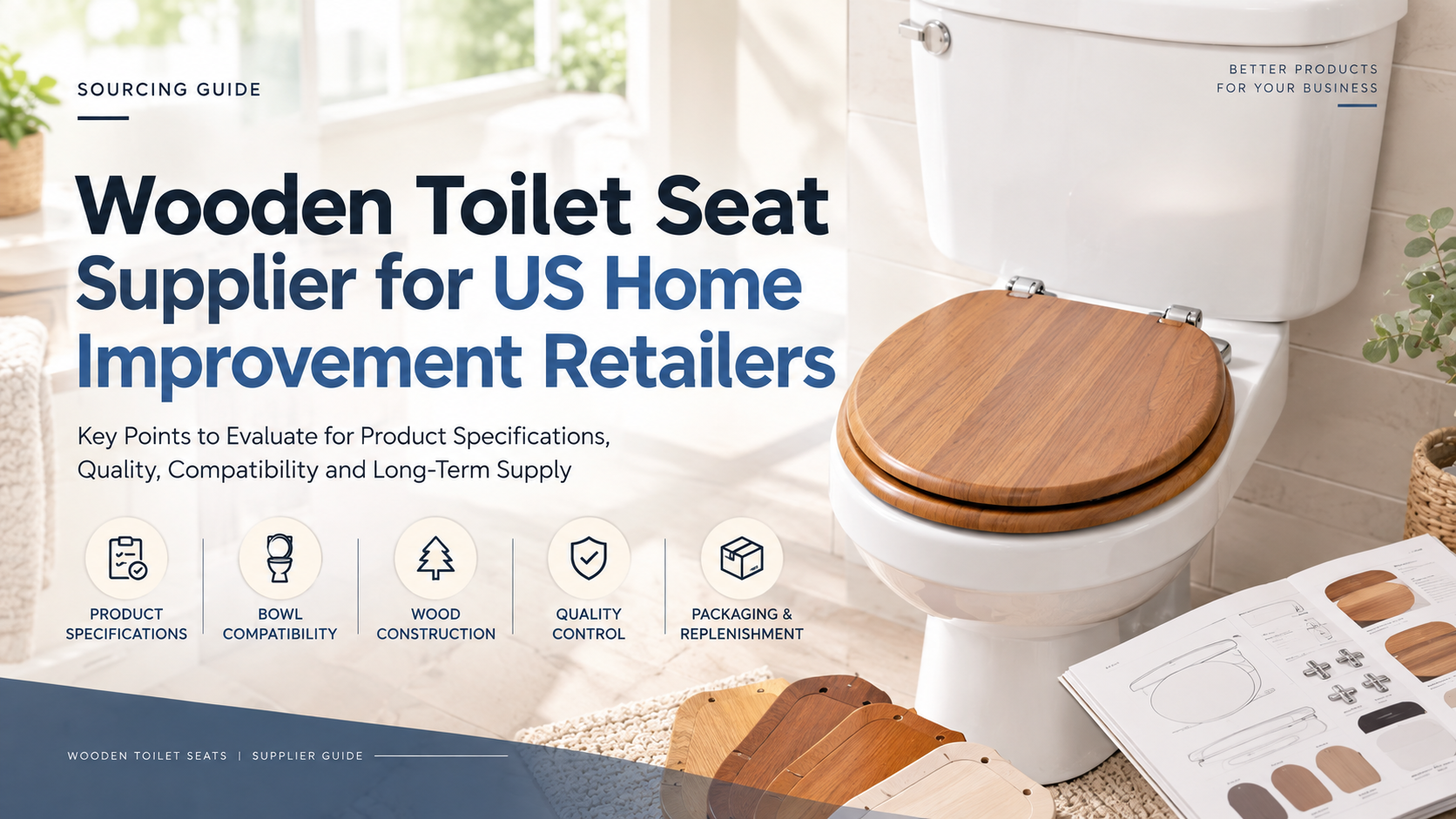
Wooden Toilet Seat Supplier for US Home Improvement Retailers
For US home improvement retailers, choosing a wooden toilet seat supplier is not only about finding a competitive unit price. The supplier also needs to support the product specifications, bowl compatibility, packaging, quality requirements and replenishment expectations of a retail program.
Wooden toilet seats can serve different retail positions, from traditional replacement products to more decorative bathroom programs. Before adding a supplier to a sourcing list, buyers should evaluate the actual product configuration and the supplier's ability to maintain consistent specifications across repeat orders.
This guide explains the key points US home improvement retailers should review when evaluating a wooden toilet seat supplier.
1. Define the Wooden Toilet Seat Program
Start by defining exactly what the retail program needs.
A wooden toilet seat program may include:
Standard or elongated bowl applications
Different finishes or colors
Different hinge configurations
Standard or upgraded hardware
Retail-ready packaging
Multiple SKUs for different price points
Private label or retailer-specific packaging
The supplier should be able to map these requirements to specific SKUs rather than providing only a general product catalog.
A clear SKU list makes later quotation, sampling, purchasing and quality inspection much easier.
2. Confirm Bowl Compatibility
Bowl compatibility is one of the first technical points a retailer should confirm.
Before selecting a wooden toilet seat, verify:
Bowl shape
Seat length
Seat width
Hinge position
Mounting-hole spacing
Fixing method
Overall seat geometry
Do not rely only on descriptions such as "fits most toilets." For a retail program, the final compatibility should be confirmed against the target toilet models or dimensional requirements.
A supplier should be able to provide the dimensions needed for the buyer's internal product review.
3. Review the Wood Seat Construction
Wooden toilet seats can differ significantly in construction, even when they have a similar appearance.
The buyer should understand:
Core or substrate construction
Surface finish
Paint or coating system
Edge treatment
Hardware configuration
Hinge attachment
Surface appearance requirements
These details should be documented by SKU.
For a home improvement retailer, consistency is particularly important because customers expect the product shown on the packaging or online listing to match the product received.
4. Evaluate Finish and Color Consistency
Appearance is an important part of a wooden toilet seat program.
When evaluating a supplier, review:
Color consistency
Surface smoothness
Gloss or matte appearance
Edge finishing
Coating uniformity
Visible defects
Scratch or surface-damage controls
For private-label or retailer-specific programs, an approved reference sample can help establish the expected appearance.
The supplier should use the approved specification or sample as the reference for production rather than relying on informal descriptions.
5. Check Hinge and Hardware Options
The hinge system affects installation, appearance and the customer's overall experience.
Depending on the retail program, buyers may need to evaluate:
Hinge material
Hinge finish
Standard or soft-close configuration
Fixing hardware
Adjustment range
Installation method
Replacement hardware availability
The important point is to connect the hinge configuration to the exact SKU.
If a retailer approves one hinge configuration during sampling, later production should not change to another configuration without review and approval.
6. Ask About Quality Control
A wooden toilet seat supplier should have a practical quality-control process covering both incoming materials and finished products.
Retail buyers can ask how the supplier checks:
Dimensions
Surface appearance
Finish quality
Hinge installation
Hardware completeness
Product function
Packaging condition
Final quantity
The supplier should also be able to explain how defects are identified and handled before shipment.
A documented inspection process provides a stronger basis for repeat purchasing than relying only on a final visual check.
7. Review Samples Before the First Purchase Order
Samples allow the retailer to evaluate the actual product before committing to a larger order.
A useful sample review should cover:
Overall appearance
Bowl fit
Mounting dimensions
Hinge operation
Hardware
Finish
Packaging
Installation instructions
For a multi-SKU retail program, samples should be clearly identified by SKU.
The approved sample can then become a reference for future production and quality discussions.
8. Confirm MOQ and Retail Pricing Structure
A wooden toilet seat supplier should provide clear commercial terms.
Important items include:
MOQ per SKU
Sample cost
Production pricing
Packaging cost
Private-label charges, if applicable
Tooling or development charges, if applicable
Payment terms
Lead time
The lowest unit price is not necessarily the lowest total sourcing cost.
A retailer should evaluate pricing together with MOQ, packaging, freight requirements, quality controls and expected replenishment frequency.
9. Review Retail Packaging Requirements
Home improvement retailers often have specific packaging requirements.
Before placing an order, confirm:
Individual packaging format
Carton dimensions
Product protection
Barcode requirements
Product labels
Installation instructions
Master-carton quantity
Shipping marks
Packaging should protect the wooden surface and hardware during handling and transportation.
If the retailer has a packaging specification, the supplier should review it before production rather than after the goods are completed.
10. Confirm Lead Time and Replenishment Capability
A retail program needs more than an initial shipment.
The buyer should discuss:
Sample lead time
Initial production lead time
Repeat-order lead time
Peak-season capacity
Raw-material planning
Production scheduling
Shipping preparation
Lead time should be confirmed for the actual SKU and order quantity.
For an established retail program, repeat-order reliability can be more important than the initial order lead time.
11. Build a Change-Control Process
Product changes can create problems for retail programs if they are made without approval.
Changes that may require review include:
Material
Finish
Color
Hinge
Hardware
Dimensions
Packaging
Labeling
Manufacturing process that affects product performance
A supplier should communicate material or configuration changes before implementing them on a production order.
This helps protect the consistency of the retailer's SKU and customer-facing product information.
12. Evaluate the Supplier as a Long-Term Partner
The final evaluation should go beyond the sample.
A useful supplier scorecard can include:
| Evaluation Area | What to Confirm |
|---|---|
| Product fit | Bowl shape and dimensional compatibility |
| Construction | Wood structure, finish and hardware |
| Quality | Inspection and functional controls |
| Sampling | Sample accuracy and approval process |
| MOQ | Quantity requirements by SKU |
| Pricing | Product and packaging costs |
| Packaging | Retail and shipping requirements |
| Lead time | Initial and repeat production |
| Documentation | Specifications and supporting documents |
| Communication | Response and change-control process |
This gives the retailer a more complete picture of supplier suitability.
How BOFAN Supports Wooden Toilet Seat Programs
BOFAN can support buyers evaluating wooden toilet seat programs by working from defined product specifications, dimensional requirements, functional requirements and packaging needs.
For a US home improvement retail program, the sourcing process can be organized around the actual SKU requirements rather than treating every wooden toilet seat as the same product.
The final product configuration, quotation, MOQ, lead time, packaging and supporting documents should be confirmed for the selected program before purchase.
Request a Wood Seat Program
If you are sourcing wooden toilet seats for a US home improvement retail program, prepare your target bowl type, dimensions, finish, hinge requirements, packaging needs and estimated quantity.
Request a Wood Seat Program to discuss the appropriate product configuration and commercial requirements.
FAQ
What should I look for in a wooden toilet seat supplier?
Look at product compatibility, construction, finish consistency, hinge options, quality control, packaging, MOQ, pricing, lead time and repeat-order capability.
Can a wooden toilet seat supplier support private-label retail programs?
Some suppliers can support private-label requirements. Confirm packaging, labeling, SKU specifications, MOQ and production requirements before placing an order.
How do I confirm whether a wooden toilet seat fits a US toilet?
Confirm the bowl shape, seat dimensions, mounting-hole spacing, hinge position and other relevant dimensions against the target toilet configuration.
What MOQ should I expect for wooden toilet seats?
MOQ varies by supplier, product configuration and packaging requirements. Always request the MOQ for the specific SKU rather than relying on a general catalog quantity.
Should I request samples before a retail order?
Yes. Samples allow the buyer to verify appearance, dimensions, fit, hinge operation, hardware and packaging before approving production.
How can I compare two wooden toilet seat suppliers?
Use the same scorecard for both suppliers and compare product specifications, quality controls, MOQ, total pricing, packaging, lead time, documentation and communication.
Table of Contents
- Wooden Toilet Seat Supplier for US Home Improvement Retailers
- 1. Define the Wooden Toilet Seat Program
- 2. Confirm Bowl Compatibility
- 3. Review the Wood Seat Construction
- 4. Evaluate Finish and Color Consistency
- 5. Check Hinge and Hardware Options
- 6. Ask About Quality Control
- 7. Review Samples Before the First Purchase Order
- 8. Confirm MOQ and Retail Pricing Structure
- 9. Review Retail Packaging Requirements
- 10. Confirm Lead Time and Replenishment Capability
- 11. Build a Change-Control Process
- 12. Evaluate the Supplier as a Long-Term Partner
- How BOFAN Supports Wooden Toilet Seat Programs
- Request a Wood Seat Program
-
FAQ
- What should I look for in a wooden toilet seat supplier?
- Can a wooden toilet seat supplier support private-label retail programs?
- How do I confirm whether a wooden toilet seat fits a US toilet?
- What MOQ should I expect for wooden toilet seats?
- Should I request samples before a retail order?
- How can I compare two wooden toilet seat suppliers?