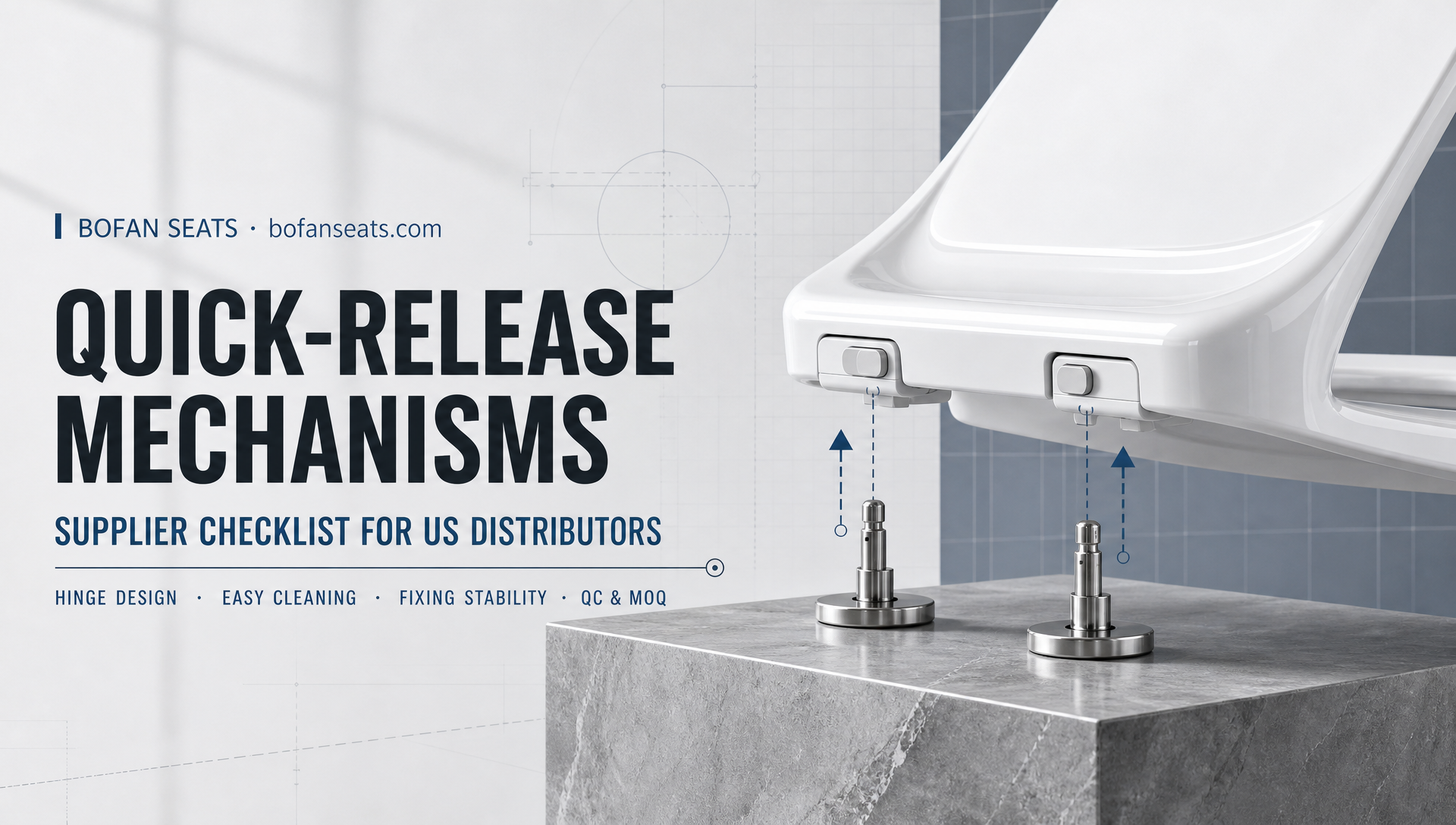
Quick Release Toilet Seat Supplier for US Distributors: What to Check
Quick-release toilet seats can be useful for distributors serving residential, commercial and home-improvement customers who want easier toilet cleaning and seat removal.
But "quick release" does not describe one universal mechanism.
Different suppliers may use different hinge structures, release methods, fixing systems and product configurations.
For a US distributor, the supplier should therefore be evaluated on more than the presence of a quick-release function.
The key questions are product compatibility, release mechanism, hinge durability, installation method, packaging, MOQ and repeat-order control.
1. What Type of Quick-Release Mechanism Is Used?
Start by identifying exactly how the seat is removed.
Ask whether the product uses:
Button release
Push release
Slide release
Lift-off mechanism
Hinge-based release
Other proprietary configuration
Also confirm whether the mechanism releases:
The complete seat and lid
The seat only
The lid only
Both components together
The mechanism should be identified in the product specification and sample approval record.
2. Can the Quick-Release Seat Match the Target Toilet Bowl?
Quick-release functionality does not replace bowl-fit requirements.
Confirm:
Round or elongated shape
Seat dimensions
Mounting-hole spacing
Mounting-hole diameter
Rear-platform shape
Fixing access
Hinge adjustment range
Top-fix or bottom-fix installation
If the distributor has a specific ceramic model, provide the bowl dimensions or drawing to the supplier.
For a new SKU, an installed sample can provide a more reliable fit reference than a catalog description alone.
3. How Is the Seat Fixed During Normal Use?
A quick-release seat needs to remain stable during normal use while still allowing the user to remove it when required.
Ask the supplier to explain:
Fixing method
Hinge locking method
Adjustment mechanism
Anti-movement design
Fixing-kit configuration
Installation procedure
Check whether the release function affects the stability of the installed seat.
The approved sample should demonstrate both normal-use stability and the intended release operation.
4. How Does the Release Mechanism Work?
Ask for clear instructions on:
How the user releases the seat.
What component is pressed, pulled or moved.
Whether tools are required.
How the seat is reinstalled.
How the mechanism locks after reinstallation.
Whether the installation position can be adjusted.
For distributor programs, simple installation and removal instructions can reduce customer-service questions.
Include the approved release method in the product documentation.
5. What Hinge Configuration Is Used?
Do not evaluate the product only by the phrase "quick release."
Confirm:
Hinge material
Hinge finish
Hinge code
Release mechanism
Soft-close function, if applicable
Lid and seat damper configuration
Fixing-kit code
Adjustment range
Replacement-part availability
If the quick-release function is combined with soft close, both functions should be reviewed as one approved hinge configuration.
6. How Is Quick-Release Durability Tested?
Ask how the manufacturer evaluates repeated release and reinstallation.
Relevant information may include:
Number of release cycles
Installation and removal procedure
Test method
Test equipment
Inspection intervals
Pass/fail criteria
Final locking performance
The buyer should understand what the supplier's durability result actually represents.
A general statement such as "tested for durability" is less useful than a documented test method connected to the exact hinge configuration.
7. What Quality Checks Are Performed During Production?
Ask the supplier to identify the production checks for the quick-release mechanism.
These may include:
Hinge installation
Release-button operation
Locking function
Seat alignment
Hinge stability
Soft-close function, where applicable
Fixing-kit completeness
Surface finish
Product dimensions
For a private label or distributor program, define any special inspection requirements before bulk production.
8. What MOQ Applies to the Quick-Release Model?
MOQ can vary depending on the selected configuration.
Ask whether the minimum quantity changes for:
Standard quick-release hinge
Special hinge finish
Soft-close quick-release hinge
Custom color
Custom logo
Custom packaging
Special fixing kit
Also confirm whether several quick-release SKUs can be combined in one order.
A supplier's standard MOQ may not apply to every customized configuration.
9. Can the Supplier Provide Distributor-Friendly Packaging?
Packaging should make the product easy to store, transport and sell.
Confirm:
Individual box or bulk packaging
Hinge protection
Fixing-kit packaging
Installation instructions
Quick-release instructions
Buyer SKU
Barcode
Carton quantity
Carton dimensions
Gross weight
CBM
Outer-carton marking
Pallet requirements
For a distributor, clear installation and release instructions can be especially useful because the product may be resold through several channels.
10. What Samples and Documents Are Available?
Before approving the supplier, request a sample of the exact quick-release configuration.
Review:
Bowl fit
Seat alignment
Release operation
Reinstallation
Locking stability
Hinge movement
Soft-close performance, if included
Fixing hardware
Packaging
Depending on the program, also ask for:
Product specification
Installation instructions
Available test evidence
Material information
Packaging specification
Product drawings
Buyer-required declarations
The documents should correspond to the actual product model.
11. How Will Repeat Orders Be Controlled?
Quick-release hardware should be controlled as part of the SKU specification.
Keep records for:
Buyer SKU
Factory model
Seat material
Shape
Hinge code
Release mechanism
Fixing-kit code
Color
Approved sample
Packaging artwork
Barcode
Inspection requirements
Approved changes
This helps prevent a different quick-release hinge from being substituted during later production.
12. Can the Supplier Support Long-Term Wholesale Supply?
Before choosing a supplier, discuss the complete commercial program.
Confirm:
| Commercial Item | What to Confirm |
|---|---|
| Product | Exact quick-release model |
| Material | PP, UF, molded wood or other approved material |
| Shape | Round, elongated or D-shape |
| Hinge | Quick-release configuration and code |
| MOQ | Standard and customized quantity |
| Packaging | Individual or bulk format |
| Sample | Approval status |
| Lead Time | Production and shipment schedule |
| Documents | Available technical evidence |
| Spare Parts | Hinge and fixing-kit availability |
| Pricing | Unit price and applicable conditions |
| Repeat Orders | Specification and change-control process |
The goal is to evaluate the supplier as a long-term product partner rather than simply selecting the lowest initial quotation.
How BOFAN Supports Quick-Release Toilet Seat Programs
BOFAN works with distributors, importers and bathroom-product buyers on toilet seat programs across PP, UF and molded-wood ranges, including quick-release configurations.
Support can include product selection, ceramic-fit review, quick-release hinge configuration, fixing-system selection, sample preparation, packaging coordination, technical specification and repeat-order control.
Final product compatibility, hinge configuration, MOQ, pricing, lead time, packaging and available documentation should be confirmed for each selected quick-release SKU.
CTA: Request Quick-Release Quote
Looking for a quick release toilet seat supplier for a US distribution program?
Send BOFAN your target seat shape, material preference, estimated quantity, quick-release requirements and packaging needs. Our team can help review the product requirements and prepare a quotation for the selected program.
FAQ
What should a US distributor ask a quick release toilet seat supplier?
Ask about the release mechanism, bowl compatibility, hinge configuration, fixing method, durability testing, MOQ, packaging, lead time, spare parts and repeat-order controls.
Are all quick-release toilet seat mechanisms the same?
No. Suppliers may use different release structures, fixing systems and hinge configurations. The exact mechanism should be confirmed through the product specification and sample.
Can quick-release and soft-close functions be combined?
Yes, depending on the product and hinge configuration. The buyer should evaluate both functions together when they are included in the same SKU.
Should I test the quick-release function before placing a wholesale order?
Yes. A sample allows the buyer to review release, reinstallation, locking stability, bowl fit and overall product operation before bulk production.
What information should I include when requesting a quick-release toilet seat quote?
Provide the target shape, material, estimated quantity, toilet bowl information, preferred hinge configuration, packaging requirements and any buyer-specific product or inspection requirements.
Table of Contents
- Quick Release Toilet Seat Supplier for US Distributors: What to Check
- 1. What Type of Quick-Release Mechanism Is Used?
- 2. Can the Quick-Release Seat Match the Target Toilet Bowl?
- 3. How Is the Seat Fixed During Normal Use?
- 4. How Does the Release Mechanism Work?
- 5. What Hinge Configuration Is Used?
- 6. How Is Quick-Release Durability Tested?
- 7. What Quality Checks Are Performed During Production?
- 8. What MOQ Applies to the Quick-Release Model?
- 9. Can the Supplier Provide Distributor-Friendly Packaging?
- 10. What Samples and Documents Are Available?
- 11. How Will Repeat Orders Be Controlled?
- 12. Can the Supplier Support Long-Term Wholesale Supply?
- How BOFAN Supports Quick-Release Toilet Seat Programs
-
FAQ
- What should a US distributor ask a quick release toilet seat supplier?
- Are all quick-release toilet seat mechanisms the same?
- Can quick-release and soft-close functions be combined?
- Should I test the quick-release function before placing a wholesale order?
- What information should I include when requesting a quick-release toilet seat quote?