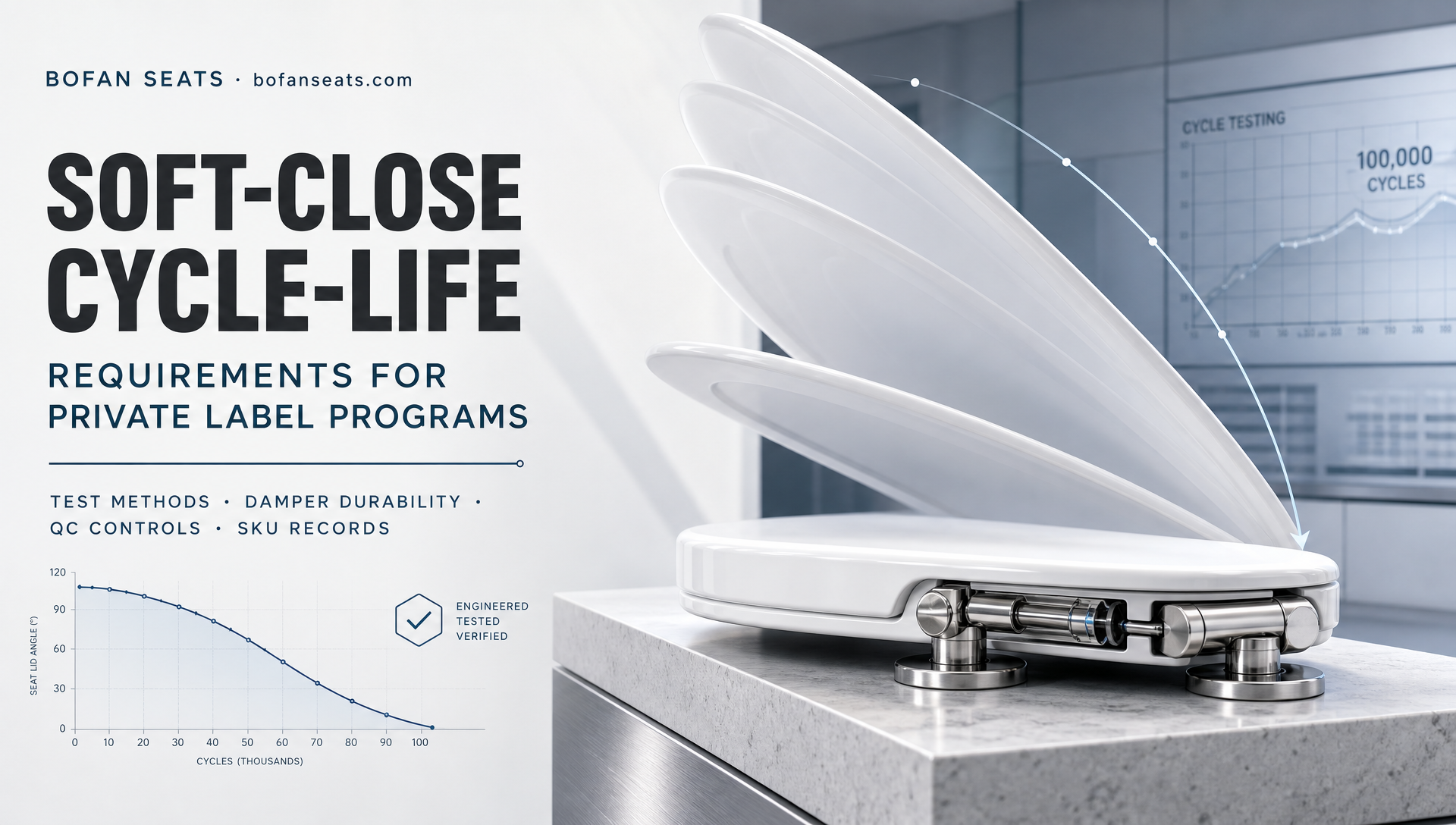
Soft-Close Mechanism Cycle-Life Requirements for Private Label Toilet Seat Programs
For a private label toilet seat program, soft-close performance should be evaluated beyond the first few sample cycles.
A toilet seat may operate correctly during a product demonstration but still require a more structured durability review before a distributor or retailer approves the product for repeated orders.
The key is to define what the buyer expects from the soft-close mechanism and how the supplier will verify it.
Instead of asking only whether a toilet seat is "soft close," buyers should confirm the hinge configuration, test method, cycle requirement, sample status and production quality controls.
1. Define What Soft-Close Performance Means for the Product
Start by defining the exact function being purchased.
Confirm whether soft-close applies to:
Lid only
Seat only
Both lid and seat
A specific hinge configuration
A particular product SKU
Also confirm the expected closing behavior.
The buyer may want:
Controlled closing speed
Smooth movement
No sudden slamming
Stable hinge movement
Consistent performance during repeated use
The approved product specification should describe the selected configuration clearly.
2. Identify the Exact Hinge Configuration
A soft-close toilet seat should not be specified only by the words "soft close."
Ask for:
Factory hinge code
Hinge material
Hinge finish
Damper configuration
Lid damper
Seat damper
Fixing method
Adjustment range
Quick-release function, if included
The hinge configuration should be linked to the toilet seat SKU.
This helps prevent a different hinge or damper arrangement from being used on a repeat order without approval.
3. Ask How Cycle Life Is Tested
The buyer should ask the supplier to explain how the soft-close mechanism is tested.
Relevant information includes:
Number of opening and closing cycles
Test equipment
Test speed
Opening angle
Closing conditions
Load conditions, where applicable
Test temperature or environment, if relevant
Inspection intervals
Pass/fail criteria
A cycle number without a defined test method is difficult to compare between suppliers.
The buyer should therefore request the actual test conditions used for the quoted product.
4. Confirm the Required Cycle-Life Target
Different private label programs may have different durability requirements.
Before supplier approval, define:
Required cycle count
Applicable SKU
Test method
Acceptance criteria
Required test evidence
Sample quantity, if applicable
Do not assume that a cycle-life statement from one supplier can be directly compared with another supplier's result unless the test conditions are comparable.
The cycle-life target should be included in the product approval documentation when it is a formal purchasing requirement.
5. Review the Test Report Before Approving the Product
If cycle testing is used as part of supplier qualification, ask for the available test report or test evidence.
Review:
Product model
Hinge configuration
Test sample identification
Number of cycles
Test conditions
Test result
Observed failures
Final operating condition
Test date
Supplier or laboratory identification, where applicable
The report should be connected to the actual hinge and toilet seat configuration being purchased.
A test report for a different model should not automatically be treated as evidence for the selected SKU.
6. Check Soft-Close Performance Before and After Testing
Cycle life is not only about whether the hinge remains attached.
Where applicable, compare the mechanism before and after testing.
Check:
Closing speed
Closing smoothness
Hinge stability
Lid movement
Seat movement
Damper condition
Fixing stability
Unusual noise
Visible damage
If the buyer has defined a specific acceptance requirement, the inspection should follow that requirement.
The purpose is to confirm that the mechanism continues to perform the intended function after the required test period.
7. Confirm Compatibility Between the Hinge and Toilet Seat
The hinge is part of a larger product system.
Review compatibility between:
Seat material
Lid weight
Seat weight
Hinge capacity
Mounting arrangement
Buffer configuration
Bowl shape
Fixing system
A soft-close mechanism that works on one product configuration may require different validation on another.
For private label programs with several seat models, each approved configuration should be identified separately.
8. Establish Production Quality Controls for the Hinge
Ask the supplier how the approved hinge configuration is controlled during production.
Relevant checks may include:
Hinge model identification
Damper installation
Fixing-kit completeness
Hinge alignment
Opening and closing operation
Soft-close function
Surface finish
Product-to-hinge matching
If the buyer has an inspection procedure, agree on the applicable sampling and acceptance requirements before bulk production.
This makes the cycle-life requirement part of a broader quality-control system rather than a one-time laboratory exercise.
9. Approve a Reference Sample
For private label products, keep an approved physical sample or documented product reference.
The reference should identify:
Buyer SKU
Factory model
Hinge code
Product material
Color
Approved finish
Fixing kit
Packaging configuration
If the supplier changes the hinge or damper later, the buyer can compare the proposed version against the approved product.
This is particularly important for repeat orders.
10. Ask About Hinge and Damper Changes
Soft-close performance depends heavily on the hinge and damper configuration.
Ask the supplier what happens if:
The hinge supplier changes
A damper is discontinued
A component specification changes
A fixing component changes
A production process changes
The supplier should notify the buyer when a change affects the approved product.
A revised sample or test evidence may be appropriate before the changed configuration enters production.
11. Consider Cycle-Life Requirements During Commercial Evaluation
A soft-close mechanism is not simply a product feature. It can also affect the commercial structure.
Ask about:
Standard hinge option
Premium hinge option
MOQ for special hinges
Spare hinge availability
Replacement-part lead time
Cost impact
Sample availability
Test-report availability
This allows the buyer to compare suppliers based on the complete program rather than the toilet seat unit price alone.
12. Keep Cycle-Test Evidence With the SKU Record
Once the product is approved, retain the relevant evidence with the purchasing record.
Keep together:
Buyer SKU
Factory model
Hinge code
Approved sample
Cycle-life requirement
Test method
Test report
Inspection requirements
Packaging specification
Approved changes
This gives the purchasing and quality teams a common reference when the next order is placed.
How BOFAN Supports Soft-Close Toilet Seat Programs
BOFAN works with distributors, importers and private label buyers on toilet seat programs across PP, UF and molded-wood ranges, including soft-close configurations.
Support can include product selection, hinge and fixing configuration, sample preparation, product specification, testing-document coordination, packaging requirements and repeat-order specification control.
Final cycle-life requirements, test conditions, applicable evidence, hinge configuration, MOQ and lead time should be confirmed for each selected SKU.
CTA: Request Cycle Test Report
Need to evaluate the soft-close mechanism for a private label toilet seat program?
Send BOFAN the target SKU, preferred hinge configuration, expected quantity and cycle-life requirement. Our team can review the product requirements and provide the applicable cycle-test information for the selected program.
FAQ
What does soft-close toilet seat cycle life mean?
It refers to the number of opening and closing cycles used to evaluate the durability and continued operation of the soft-close mechanism under a defined test method.
Why should buyers ask for the test method?
A cycle number alone does not explain how the test was performed. Test conditions and acceptance criteria make the result more useful for supplier comparison.
Should the cycle-life requirement be included in the product specification?
If cycle life is a formal requirement of the private label program, it should be documented together with the applicable SKU and hinge configuration.
Does a test report for one toilet seat apply to every model?
Not necessarily. The buyer should confirm that the tested product, hinge configuration and relevant specifications match the product being purchased.
What should happen if the supplier changes the soft-close hinge?
The supplier should notify the buyer when the change affects the approved configuration. Depending on the change, a new sample or additional test evidence may be required before production approval.
Table of Contents
- Soft-Close Mechanism Cycle-Life Requirements for Private Label Toilet Seat Programs
- 1. Define What Soft-Close Performance Means for the Product
- 2. Identify the Exact Hinge Configuration
- 3. Ask How Cycle Life Is Tested
- 4. Confirm the Required Cycle-Life Target
- 5. Review the Test Report Before Approving the Product
- 6. Check Soft-Close Performance Before and After Testing
- 7. Confirm Compatibility Between the Hinge and Toilet Seat
- 8. Establish Production Quality Controls for the Hinge
- 9. Approve a Reference Sample
- 10. Ask About Hinge and Damper Changes
- 11. Consider Cycle-Life Requirements During Commercial Evaluation
- 12. Keep Cycle-Test Evidence With the SKU Record
- How BOFAN Supports Soft-Close Toilet Seat Programs
- FAQ