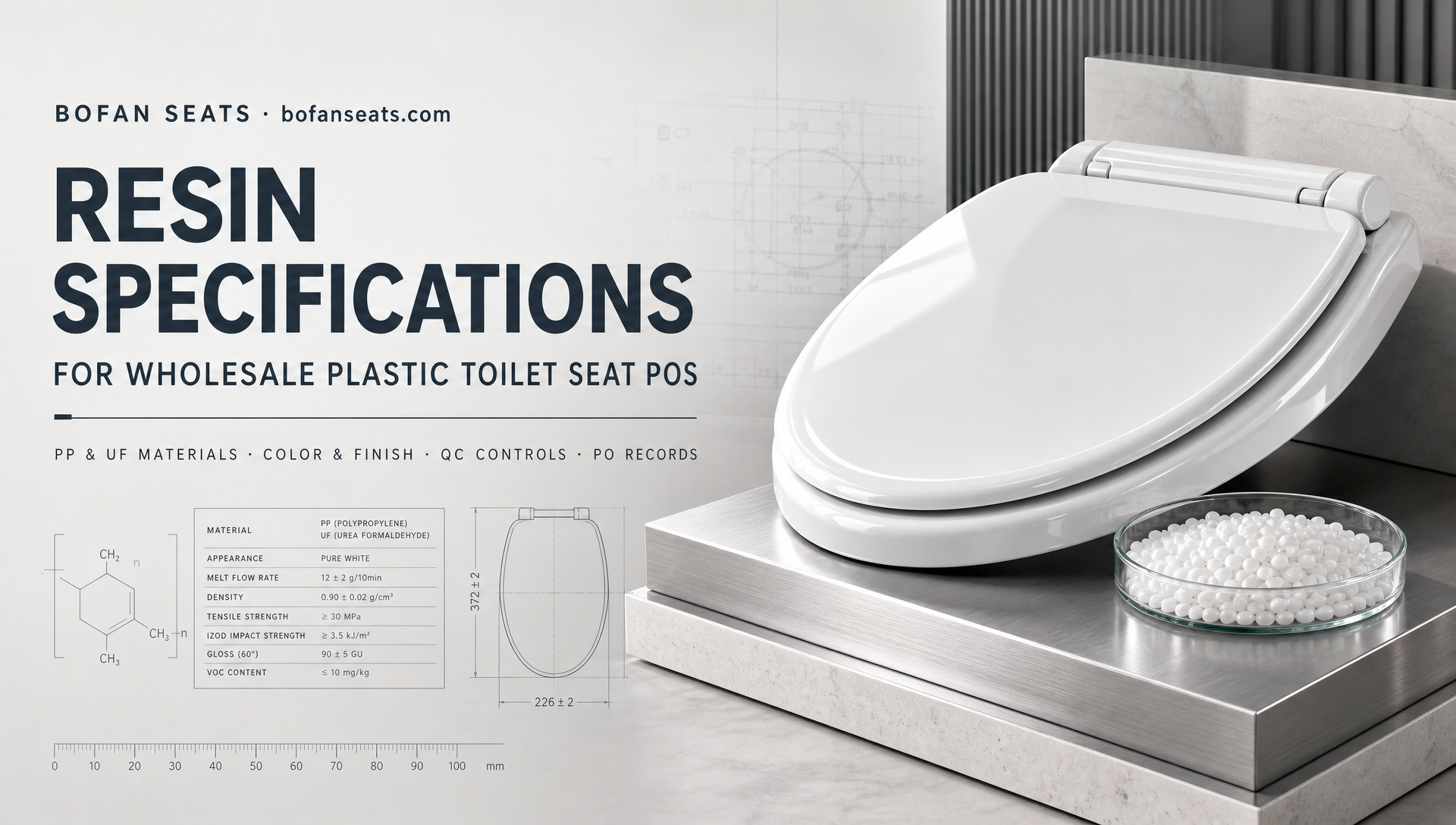
Plastic Toilet Seat Resin Specification for Wholesale Purchase Orders
For wholesale toilet seat purchasing, the material specification should be clear before the purchase order is released.
A description such as "plastic toilet seat" does not identify the exact material arrangement, color requirements, surface finish or product specification being purchased.
For distributors and importers, a controlled plastic toilet seat resin specification helps connect the purchased material and product to the approved SKU.
It also gives the buyer and supplier a reference for repeat orders, quality control and any future product changes.
1. Start With the Exact Toilet Seat Material
The first step is to identify the material used for the selected toilet seat.
Depending on the product program, buyers may be comparing:
PP toilet seats
UF toilet seats
Other plastic-based configurations
Do not use "plastic" as the complete material specification.
The purchase-order documentation should identify the approved material associated with the specific factory model.
This is especially important when a supplier offers several toilet seat materials within the same product range.
2. Confirm the Resin or Material Specification With the Supplier
Ask the supplier what material information can be provided for the selected product.
Depending on the supplier's documentation, this may include:
Material type
Resin identification
Material grade or specification
Color specification
Relevant material declaration
Product model
Manufacturing arrangement
The supplier should clarify which information is commercially available and which information is part of internal manufacturing control.
Do not assume that two products described with the same general material name have identical specifications.
3. Connect the Material Specification to the Product SKU
The resin or material requirement should be linked to the actual toilet seat SKU.
Record:
Buyer SKU
Factory model
Material
Color
Product shape
Product dimensions
Hinge configuration
Approved sample
This prevents a material specification from becoming detached from the product it is intended to control.
For repeat orders, the purchase order should reference the approved SKU and specification.
4. Confirm Color and Surface Requirements
Material and appearance should be controlled together.
Ask about:
Standard color
Custom color
Color reference
Surface finish
Gloss level
Texture
Color consistency between batches
If a custom color is required, use an approved physical sample or agreed color reference.
For a wholesale program, the buyer should specify which reference controls production.
A product photograph alone may not be sufficient to define an exact color or surface finish.
5. Ask What Material Documentation Is Available
Wholesale buyers may require material-related documentation during supplier evaluation or product approval.
Depending on the program, ask whether the supplier can provide:
Material declarations
Product specifications
Available test evidence
Product identification
Country-of-origin information
Buyer-required declarations
The supplier should confirm whether the documentation applies to the exact product model and material configuration.
Avoid using generic documentation as proof for a different product.
6. Define the Product Performance Requirements Separately
Material specification and product performance are related but should not be treated as the same requirement.
The buyer may also need to define:
Product dimensions
Seat and lid alignment
Hinge performance
Soft-close operation
Quick-release operation
Installation stability
Surface finish
Buffer placement
Fixing-kit completeness
For a wholesale purchase order, these product requirements should be recorded alongside the material specification.
This gives the supplier a clearer production reference.
7. Confirm Whether Recycled or Reprocessed Material Is Allowed
If the buyer has a specific material policy, discuss it before the purchase order is issued.
Clarify whether the program allows:
Virgin material
Recycled content
Reprocessed material
A defined percentage of recycled content
Material restrictions specified by the buyer
Do not assume that a supplier's standard material practice automatically matches the buyer's requirements.
Any special material requirement should be documented and approved before production.
8. Establish Incoming and Production Material Controls
Ask how the manufacturer controls the material during production.
Relevant controls may include:
Incoming material identification
Material supplier records
Color identification
Production-batch identification
Material mixing controls
Product identification
Final product inspection
The exact controls will depend on the manufacturer's production system.
The buyer should focus on whether the supplier can consistently connect the approved material requirement to the finished product.
9. Confirm MOQ and Material-Related Minimums
Material customization can affect the commercial order structure.
Ask whether MOQ changes when the buyer requests:
Custom colors
Special material grades
Custom resin requirements
Recycled content
Special surface finishes
Custom packaging
Also confirm whether the material requirement can be used across multiple approved SKUs.
A lower product MOQ may not apply when the material or color is customized.
10. Record the Specification in the Purchase Order
The purchase order should contain enough information to identify the approved product.
A useful purchase-order reference may include:
| Item | Information to Record |
|---|---|
| Buyer SKU | Internal buyer identification |
| Factory Model | Manufacturer product code |
| Material | Approved material/resin specification |
| Color | Color reference or approved sample |
| Shape | Round, elongated or D-shape |
| Dimensions | Approved product dimensions |
| Hinge | Approved hinge configuration |
| Fixing Kit | Approved hardware |
| Packaging | Approved packaging format |
| Sample | Reference sample/version |
| Quantity | Order quantity |
| Inspection | Applicable requirements |
The exact fields should be adjusted to the buyer's purchasing system.
The purpose is to prevent the purchase order from relying on an incomplete product description.
11. Establish Change Control for Material Changes
Material specifications can change for commercial or production reasons.
For example, a supplier may propose a different:
Resin source
Material grade
Color formulation
Additive arrangement
Recycled-content level
The supplier should notify the buyer when a change affects the approved product specification.
A practical process is:
Identify the affected SKU.
Explain the proposed material change.
Explain why the change is required.
Review product and appearance effects.
Provide documentation or a sample when needed.
Obtain buyer approval.
Record the effective production batch.
This keeps the purchase-order specification aligned with the product actually supplied.
12. Keep the Resin Specification With the Repeat-Order Record
The resin or material specification should remain part of the SKU's long-term purchasing record.
Keep together:
Buyer SKU
Factory model
Material specification
Color reference
Approved sample
Hinge configuration
Fixing-kit code
Packaging artwork
Inspection requirements
Approved changes
When the next order is placed, the purchasing team should be able to retrieve the approved specification without rebuilding the product requirements.
How BOFAN Supports Plastic Toilet Seat Material Specifications
BOFAN works with distributors, importers and bathroom-product buyers on PP, UF and molded-wood toilet seat programs.
Support can include product selection, material and finish discussion, product specification, ceramic-fit review, hinge and fixing selection, sample preparation, packaging coordination and repeat-order specification control.
Material availability, exact resin or material documentation, MOQ, product configuration and production requirements should be confirmed for each selected SKU.
CTA: Request Resin Specification
Need to confirm the material specification for a wholesale toilet seat purchase order?
Send BOFAN the target SKU, toilet seat material, expected quantity, color requirements and any buyer-specific material documentation requirements. Our team can review the product requirements and provide the applicable specification information for the selected program.
FAQ
What is a plastic toilet seat resin specification?
It is the material information used to identify and control the approved plastic or resin configuration associated with a specific toilet seat product.
Should a purchase order simply say "plastic toilet seat"?
No. A purchase order should identify the specific product, material, color, configuration and other relevant requirements needed to distinguish the approved SKU.
Can PP toilet seat material specifications vary between suppliers?
Yes. Buyers should confirm the exact material information provided for the selected product rather than assuming that a general material name describes identical specifications across suppliers.
Should material specifications be connected to the buyer SKU?
Yes. Linking the material requirement to the buyer SKU and factory model helps maintain consistency during repeat orders.
What should buyers ask about recycled material?
If recycled content or material restrictions matter to the program, clarify the requirement before production and record the approved condition in the purchasing documentation.
Can a supplier change the resin specification after approval?
Any material change that affects the approved product should be reviewed through an agreed change-control process before the changed product enters production.
Table of Contents
- Plastic Toilet Seat Resin Specification for Wholesale Purchase Orders
- 1. Start With the Exact Toilet Seat Material
- 2. Confirm the Resin or Material Specification With the Supplier
- 3. Connect the Material Specification to the Product SKU
- 4. Confirm Color and Surface Requirements
- 5. Ask What Material Documentation Is Available
- 6. Define the Product Performance Requirements Separately
- 7. Confirm Whether Recycled or Reprocessed Material Is Allowed
- 8. Establish Incoming and Production Material Controls
- 9. Confirm MOQ and Material-Related Minimums
- 10. Record the Specification in the Purchase Order
- 11. Establish Change Control for Material Changes
- 12. Keep the Resin Specification With the Repeat-Order Record
- How BOFAN Supports Plastic Toilet Seat Material Specifications
-
FAQ
- What is a plastic toilet seat resin specification?
- Should a purchase order simply say "plastic toilet seat"?
- Can PP toilet seat material specifications vary between suppliers?
- Should material specifications be connected to the buyer SKU?
- What should buyers ask about recycled material?
- Can a supplier change the resin specification after approval?