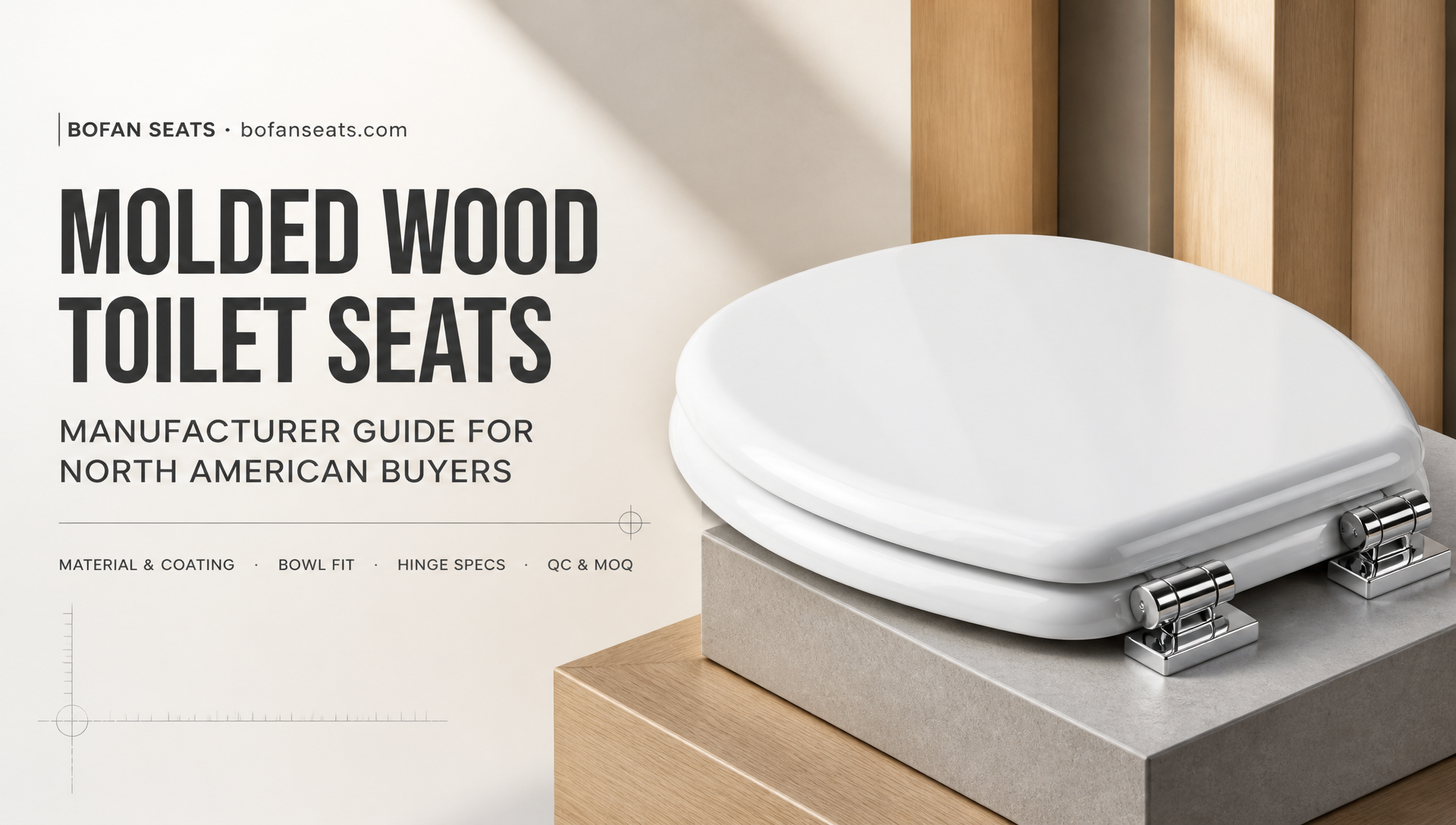
Molded Wood Toilet Seat Manufacturer for North American Buyers: What to Confirm
Choosing a molded wood toilet seat manufacturer involves more than comparing the quoted price per unit.
North American buyers may need to manage product fit, material specifications, surface finish, hinge configuration, packaging, quality control and repeat-order consistency across multiple SKUs.
Molded wood seats can also be positioned differently from PP and UF products, so buyers should confirm the actual construction and specifications before approving a supplier.
Instead of evaluating a supplier only by its catalog or quotation, ask for the specific product information needed to compare manufacturers on the same basis.
1. What Type of Molded Wood Construction Is Used?
Start by confirming exactly what the manufacturer means by molded wood.
Ask for information about:
Base material
Wood-fiber or wood-based composition
Core construction
Surface treatment
Paint or coating system
Gloss or matte finish
Color
Product weight
A product described generally as a "wood toilet seat" may have different materials and construction methods.
The material information should therefore be connected to the exact factory model being quoted.
For private label or wholesale programs, record the approved material specification as part of the SKU documentation.
2. What Toilet Bowl Shapes Can the Seat Match?
Molded wood seats are available in different shapes and dimensions.
Before ordering, confirm compatibility with the toilet bowls commonly sold in the target market.
Relevant information includes:
Round or elongated shape
Seat length
Seat width
Mounting-hole spacing
Mounting-hole diameter
Rear-platform shape
Hinge adjustment range
Top-fix or bottom-fix installation
Where the buyer has a specific ceramic model, provide drawings, measurements or a physical sample.
A general-fit claim should not replace an actual compatibility review when the product is intended for a specific toilet bowl.
3. What Surface Finish and Color Options Are Available?
Surface appearance is an important part of a molded wood toilet seat program.
Ask the manufacturer to confirm:
Standard colors
Custom colors
Gloss level
Surface texture
Coating or paint finish
Color consistency between batches
Custom color sample process
For custom colors, approve a physical sample before bulk production.
If the buyer uses a color reference such as a Pantone specification, confirm how the factory handles the reference and what sample becomes the production standard.
The final color requirement should be recorded in the approved product specification.
4. Which Hinge Configuration Is Available?
The hinge can significantly change the product specification.
Do not accept a quotation that only states "metal hinge."
Confirm:
Hinge material
Visible finish
Standard-close or soft-close function
Quick-release function
Lid and seat damping
Fixing method
Adjustment range
Fixing-kit configuration
Replacement-hardware availability
For private label products, record the factory hinge code together with the product SKU.
This helps prevent an unapproved hinge substitution during repeat orders.
5. How Is Product Quality Controlled?
Ask the molded wood toilet seat manufacturer to explain the actual quality-control process for the selected model.
Relevant checks may include:
Material confirmation
Product dimensions
Surface finish
Color consistency
Edge quality
Seat and lid alignment
Hinge operation
Soft-close movement
Quick-release operation
Fixing-kit completeness
Buffer placement
Installation stability
Packaging condition
If the buyer has its own inspection requirements, confirm the inspection method and acceptance criteria before production begins.
The important point is to define what "approved quality" means before the first bulk order.
6. What MOQ Applies to Molded Wood Seats?
MOQ can vary depending on the product and customization requirements.
Ask the manufacturer to separate:
Standard model MOQ
Custom color MOQ
Special hinge MOQ
Custom logo MOQ
Custom packaging MOQ
Special hardware MOQ
Mixed-SKU order conditions
A manufacturer may offer a reasonable MOQ for the toilet seat itself while requiring a higher quantity for custom cartons or special components.
Review the complete order structure rather than looking at the product MOQ alone.
7. Can the Manufacturer Support Wholesale Packaging?
North American wholesale buyers may need packaging that is different from standard factory packaging.
Discuss:
Individual boxes
Bulk cartons
Product protection
Hinge protection
Hardware-bag location
Installation instructions
Buyer SKU
Barcode
Country-of-origin marking
Outer-carton labels
Carton quantity
Carton dimensions
Gross weight
CBM
Pallet requirements
For distributors and home-improvement retailers, packaging should support warehouse receiving and inventory management.
For e-commerce programs, additional attention may be needed for product protection and customer instructions.
8. Can the Manufacturer Provide Samples Before Bulk Production?
A sample allows the buyer to check more than appearance.
Review:
Product dimensions
Bowl fit
Surface finish
Color
Hinge operation
Soft-close function
Fixing kit
Buffers
Packaging
For a customized molded wood seat, record the approved sample information.
If any specification changes after sample approval, the change should be documented before mass production.
This creates a clear reference between the quoted product and the product actually manufactured.
9. What Lead Time Should Buyers Expect?
Ask the manufacturer to separate the major production stages.
Confirm timing for:
Standard sample
Custom sample
Color approval
Packaging artwork
Packaging-material preparation
Component preparation
Bulk production
Inspection
Booking-ready shipment
Also ask about factors that could affect the schedule.
These may include:
Custom colors
Special hinges
Packaging MOQ
Artwork changes
Component availability
Production capacity
Changes after sample approval
A useful lead-time answer should explain what starts the production clock.
10. What Product Documents Can Be Provided?
Depending on the buyer's requirements, request relevant product documentation.
This may include:
Product specification
Material information
Product dimensions
Installation instructions
Available test evidence
Country-of-origin information
Packaging information
Product photographs
Buyer-required declarations
Ask the manufacturer to confirm whether each document applies to the exact model being quoted.
Avoid assuming that a document for one material, model or product configuration automatically applies to another SKU.
11. How Will Repeat Orders Be Controlled?
Repeat-order consistency is particularly important for distributors and retailers.
Ask the manufacturer to maintain records for:
Factory model
Buyer SKU
Material
Color
Hinge code
Fixing-kit code
Buffer configuration
Packaging artwork
Barcode
Approved sample
Inspection requirements
Approved changes
A repeat order should be based on a controlled specification rather than a product photograph or a general description.
This reduces the risk of receiving a slightly different product after the original SKU has already entered the market.
12. Can the Manufacturer Support Spare Parts?
Buyers should consider replacement components before selecting a long-term supplier.
Ask about availability for:
Hinge sets
Fixing kits
Dampers
Buffers
Quick-release components
Installation instructions
Replacement packaging
Confirm component codes, minimum quantities and lead times.
Spare-part support can be useful for distributors that need to handle customer-service requests after the original toilet seat has been sold.
How BOFAN Supports Molded Wood Toilet Seat Programs
BOFAN works with distributors, importers and bathroom-product buyers on toilet seat programs across PP, UF and molded-wood ranges.
Support can include product selection, ceramic-fit review, material and finish discussion, hinge and fixing selection, sample preparation, packaging coordination, specification control and repeat-order planning.
Final material specifications, product compatibility, MOQ, lead time, packaging and documentation should be confirmed for each selected molded wood program.
CTA: Request Molded Wood Quote
Looking for a molded wood toilet seat manufacturer for a North American wholesale or retail program?
Send BOFAN your target seat shape, material requirements, estimated quantity, preferred hinge configuration and packaging requirements. Our team can help review the product requirements and prepare a quotation for the selected program.
FAQ
What should buyers ask a molded wood toilet seat manufacturer?
Ask about the material construction, dimensions, bowl compatibility, surface finish, hinge configuration, MOQ, quality controls, packaging, lead time and repeat-order management.
Are molded wood toilet seats different from PP toilet seats?
Yes. They can differ in material construction, surface finish, weight, appearance, manufacturing process and product positioning. Buyers should compare the exact specifications rather than using material names alone.
Can molded wood toilet seats be customized?
Customization may include color, surface finish, hinge configuration, packaging and other product details, depending on the manufacturer's capabilities and MOQ.
What information should I provide when requesting a molded wood toilet seat quote?
Provide the target shape, material requirements, quantity, toilet bowl information, hinge requirements, packaging needs and any buyer-specific product or inspection requirements.
Why is the approved sample important?
The approved sample provides a physical reference for the final product. It can help control dimensions, finish, color, hinge configuration and other details during bulk production.
Table of Contents
- Molded Wood Toilet Seat Manufacturer for North American Buyers: What to Confirm
- 1. What Type of Molded Wood Construction Is Used?
- 2. What Toilet Bowl Shapes Can the Seat Match?
- 3. What Surface Finish and Color Options Are Available?
- 4. Which Hinge Configuration Is Available?
- 5. How Is Product Quality Controlled?
- 6. What MOQ Applies to Molded Wood Seats?
- 7. Can the Manufacturer Support Wholesale Packaging?
- 8. Can the Manufacturer Provide Samples Before Bulk Production?
- 9. What Lead Time Should Buyers Expect?
- 10. What Product Documents Can Be Provided?
- 11. How Will Repeat Orders Be Controlled?
- 12. Can the Manufacturer Support Spare Parts?
- How BOFAN Supports Molded Wood Toilet Seat Programs
- FAQ