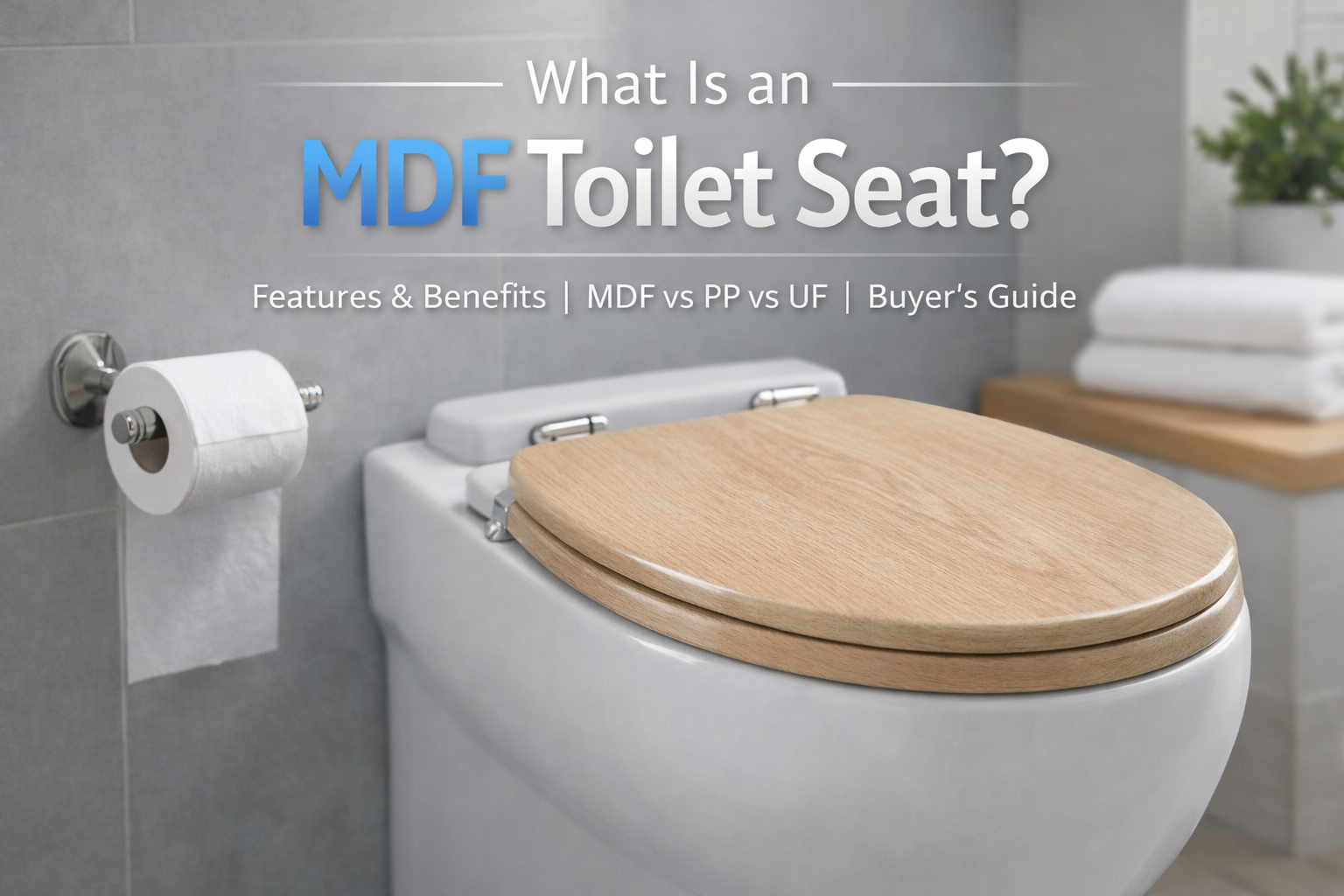
When buyers search for an MDF toilet seat, they are usually looking for a toilet seat that offers a more decorative appearance, a solid feel, and a different market position from standard plastic models.
In the toilet seat industry, MDF is often used for product lines that focus on style, home décor appeal, and mid-range retail value.
An MDF toilet seat is a toilet seat made from medium-density fiberboard, an engineered wood-based material produced from wood fibers and resin under heat and pressure.
Compared with lightweight plastic seats, MDF toilet seats are generally heavier, more substantial in feel, and better suited to decorative finishes such as wood-look patterns, printed designs, or painted surfaces.
For importers, distributors, retailers, OEM brands, and hospitality buyers, understanding MDF toilet seat material is important because it affects product appearance, positioning, cost, packaging, and long-term performance.
In this guide, we explain what an MDF toilet seat is, its main features, its advantages and disadvantages, how it compares with PP and UF, and what buyers should check before placing wholesale or OEM orders.
What Does MDF Mean in a Toilet Seat?
In the toilet seat industry, MDF stands for medium-density fiberboard. It is an engineered wood product made by compressing wood fibers with resin under controlled temperature and pressure. The result is a dense board material that can be shaped, finished, and coated for use in a variety of furniture and home-related products, including toilet seats.
MDF is used in toilet seat manufacturing because it can create a solid, heavy feel and support many different decorative surface designs. This makes it attractive for buyers who want more than a simple basic plastic seat. In many markets, MDF toilet seats are chosen because they look warmer, more decorative, or more traditional than standard PP products.
However, MDF toilet seats are not simply raw wood products. In most commercial applications, the seat surface is coated, painted, printed, or sealed to improve appearance and help protect the material from moisture and daily wear. That surface treatment is a major part of product quality.
What Are the Main Features of an MDF Toilet Seat?
An MDF toilet seat has several characteristics that make it different from both PP and UF toilet seats.
Solid and Heavier Feel
One of the most obvious features of an MDF toilet seat is its weight. Compared with PP toilet seats, MDF models usually feel heavier and more solid. In many retail markets, this gives the product a stronger sense of quality and substance.
For buyers who want a toilet seat that feels more substantial in the hand, MDF is often seen as a good option.
Decorative Appearance
MDF toilet seats are often selected because they allow more decorative finishes than many standard plastic models. Depending on the manufacturer and surface process, MDF seats may feature:
- wood-look finishes
- painted colors
- printed patterns
- glossy decorative surfaces
- classic or traditional bathroom styles
This makes MDF a popular material for product lines that want stronger visual appeal.
Smooth Finished Surface
Although MDF itself is a board material, the final toilet seat usually has a finished outer coating that gives it a smooth and attractive appearance. A well-made MDF toilet seat should look clean, even, and consistent in color and finish.
Suitable for Style-Driven Product Lines
MDF toilet seats are often used in decorative retail programs, home improvement product lines, and selected hospitality collections where the product needs to offer more than basic functionality. The material is especially useful when the buyer wants a design-focused product.
Wide Range of Surface Options
Another important feature of MDF toilet seats is that they can support different visual styles. This gives OEM buyers and private label brands more flexibility when creating collections for different markets.
Advantages of MDF Toilet Seats
For many B2B buyers, the biggest value of an MDF toilet seat is the combination of appearance, product feel, and market positioning.
1. Stronger Decorative Appeal
An MDF toilet seat often looks more decorative than a standard PP toilet seat. This can make it easier to sell in home improvement stores, retail collections, and design-oriented product lines.
2. Solid and Premium Feel
Because MDF toilet seats are usually heavier, they often feel more substantial than lightweight plastic options. Some buyers and end customers associate this extra weight with better quality.
3. Suitable for Wood-Look and Style-Focused Designs
MDF is a practical choice for buyers who want a toilet seat with a wood-inspired or classic home appearance. It works well in collections where visual style is an important selling point.
4. Good for Retail Presentation
In stores and online product catalogs, appearance matters. MDF toilet seats can look more refined or decorative than simple entry-level plastic seats, which may help improve perceived value.
5. Useful for Private Label Programs
Private label buyers often need products that stand out visually. MDF toilet seats can support that goal because they allow more creative surface designs, decorative finishes, and product differentiation.
6. Suitable for Selected Hospitality and Residential Markets
In some hotel, guest house, and residential upgrade projects, MDF toilet seats are chosen because they offer a warmer or more design-oriented look than ordinary plastic models.
Disadvantages of MDF Toilet Seats
Like any product material, MDF also has limitations. Buyers should understand these clearly before making a sourcing decision.
Heavier Than PP Toilet Seats
The heavier feel of MDF can be a selling point, but it also means higher product weight. This may affect handling, shipping, and packaging requirements in bulk orders.
Surface Quality Matters Greatly
The quality of an MDF toilet seat depends heavily on its coating and finishing process. If the surface treatment is poor, the product may not perform well in appearance or long-term use.
Moisture Resistance Depends on Coating
MDF is a wood-based engineered material, so moisture resistance depends strongly on how well the seat is sealed and finished. A poorly coated MDF seat may not perform as well as a properly finished product.
Not Always the Best Choice for Budget Programs
Compared with basic PP toilet seats, MDF toilet seats are usually positioned higher in the market. That means they may not be the best option for buyers focused only on the lowest possible price.
May Not Match UF in Surface Hardness
Although MDF can look very attractive, UF toilet seats generally offer a harder, more ceramic-like surface. Buyers focused on surface hardness and scratch resistance may prefer UF in some markets.
MDF Toilet Seat vs PP Toilet Seat
A common buyer question is whether an MDF toilet seat or a PP toilet seat is the better option. The answer depends on product positioning, target market, and price level.
ItemMDF Toilet SeatPP Toilet SeatMaterialEngineered wood fiberboardPolypropyleneAppearanceDecorative / style-focusedBasic / practicalWeightHeavierLighterProduct feelSolid and substantialLightweightPrice positionMid-rangeBudget-friendlyBest forDecorative retail linesMass-market programs
A PP toilet seat is usually the better choice when the priority is affordability, practicality, and large-volume supply. An MDF toilet seat is usually better when the buyer wants a stronger decorative appearance, heavier feel, and more differentiated product presentation.
For this reason, many distributors offer both MDF and PP ranges to cover different buyer needs.
MDF Toilet Seat vs UF Toilet Seat
Another important comparison is between MDF and UF toilet seats. While both may be positioned above basic PP in some markets, they serve different product styles.
|
Item |
MDF Toilet Seat |
UF Toilet Seat |
|
Appearance |
Decorative / warm style |
Smooth / ceramic-like |
|
Material type |
Engineered wood-based |
Thermosetting urea-formaldehyde |
|
Product feel |
Heavy and traditional |
Hard and refined |
|
Surface hardness |
Depends on finish |
Generally harder |
|
Typical market style |
Decorative / classic |
Modern / premium |
|
Best for |
Style-focused programs |
Premium functional programs |
An MDF toilet seat is often the better option for buyers who want a more decorative or home-style product. A UF toilet seat is usually the better choice for buyers who prefer a harder surface, smoother finish, and more modern premium look.
The decision depends on whether the target market values decorative style or functional premium appearance more strongly.
MDF Toilet Seat vs Wooden Toilet Seat
Many buyers also confuse MDF toilet seats with general “wooden toilet seats.” In practice, the term wooden toilet seat can be used broadly in the market and may refer to different structures, including molded wood, MDF-based products, or other wood-related constructions.
An MDF toilet seat is an engineered wood product made from compressed fibers. Other wooden toilet seat types may use different internal structures or molding processes. This is why buyers should always confirm the exact material and product construction with the supplier instead of relying only on general category names.
In many cases, MDF offers more stable shaping and smoother finishing for decorative product lines. However, exact performance still depends on the factory’s finishing process, coating quality, and hinge system.
Where Are MDF Toilet Seats Commonly Used?
An MDF toilet seat is not suitable for every market, but it is widely used in product lines where design, decoration, and perceived quality matter.
Home Improvement and Residential Retail
MDF toilet seats are often sold through home improvement channels and residential retail programs because they look more decorative than standard basic toilet seats.
Decorative Bathroom Product Lines
Retailers and brands that want to offer more stylish bathroom accessories often choose MDF because it supports printed, painted, or wood-look finishes.
Selected Hotel and Hospitality Projects
Some hospitality projects choose MDF toilet seats when visual presentation is important, especially in style-driven or themed bathroom environments.
Private Label and OEM Programs
OEM buyers who want differentiated product design often use MDF toilet seats in their private label collections. The material allows greater visual flexibility compared with many basic PP products.
Mid-Range Import and Distribution Programs
Importers targeting the mid-range home product market may choose MDF toilet seats because they sit between basic plastic utility products and more specialized premium material programs.
Who Should Choose an MDF Toilet Seat?
An MDF toilet seat is especially suitable for buyers who want style, product differentiation, and a stronger visual presentation.
Retail Chains with Decorative Product Lines
Retailers that need visually attractive toilet seat options often include MDF products in their range because they can offer more design variety.
Importers Targeting Mid-Range Home Products
Importers serving home décor or residential upgrade markets may find MDF toilet seats useful because they combine decorative value with a familiar bathroom product category.
Private Label Brands
Brands looking to create product collections with a stronger design identity may benefit from MDF toilet seats, especially when customized finishes and packaging are available.
Buyers Looking for Wood-Look or Classic Styles
If the target customer prefers warmer or more traditional bathroom aesthetics, MDF toilet seats are often a good fit.
Hospitality Buyers Seeking Decorative Options
Hotels, guest houses, or styled residential projects that value bathroom appearance may choose MDF toilet seats in selected applications.
What Should Buyers Check Before Ordering MDF Toilet Seats?
Before placing a bulk order, buyers should look beyond the general material name and review the actual product details carefully.
Surface Coating Quality
This is one of the most important points for MDF toilet seats. Buyers should confirm whether the coating is smooth, stable, and suitable for the target market. Surface finishing quality directly affects appearance, durability, and moisture resistance.
Shape and Size
As with any toilet seat order, buyers should confirm round or elongated shapes and make sure the seat dimensions match local toilet standards.
Hinge Options
Since MDF toilet seats are heavier than PP seats, hinge quality matters. Buyers should check:
- soft close or standard close
- quick release options
- hinge strength
- installation compatibility
Weight and Packaging
The heavier weight of MDF seats means packaging must be suitable for transport and protection. Buyers should confirm carton structure, inner protection, and packaging layout for bulk orders.
MOQ and Lead Time
Decorative finishes, custom packaging, and private label programs may affect minimum order quantity and lead time. These points should be discussed early in the project.
Moisture Resistance and Durability Testing
Because MDF performance depends heavily on finishing quality, buyers should ask about testing standards, coating performance, and product durability under normal bathroom conditions.
Can MDF Toilet Seats Be Customized?
Yes. MDF toilet seats are often a strong option for OEM and private label projects because they allow flexible design and surface customization.
Common customization options may include:
- custom colors
- wood-look finishes
- printed decorative surfaces
- logo printing
- custom packaging
- hinge selection
- standard or upgraded functionality
For brands and distributors, this makes MDF useful when the goal is to build a product line with stronger visual distinction rather than basic standard utility.
How to Choose a Reliable MDF Toilet Seat Manufacturer
Choosing the right supplier is essential, especially for MDF products where finishing quality has a major impact on final performance.
Look for MDF Product Experience
A supplier with real experience in MDF toilet seat production is more likely to understand coating control, product finishing, hinge matching, and export packaging.
Review Finishing and Coating Capability
Since surface treatment is critical, buyers should ask about the factory’s painting, printing, or coating process and request clear samples.
Check Hinge Quality
A well-designed MDF toilet seat needs hinges that can support the product weight and daily usage. Poor hinges can damage the overall product experience even if the seat finish looks good.
Confirm OEM and ODM Support
If the project involves custom design, packaging, or branding, the manufacturer should be able to support OEM or ODM requirements with stable communication and process control.
Evaluate Export Experience
Factories with export experience usually understand international quality expectations, packaging standards, and buyer communication needs more clearly.
Review Samples Carefully
Before confirming any order, buyers should inspect samples for appearance, finish consistency, hinge quality, weight, and packaging suitability.
FAQ About MDF Toilet Seats
What is an MDF toilet seat made of?
An MDF toilet seat is made of medium-density fiberboard, an engineered wood-based material made from wood fibers and resin.
Is an MDF toilet seat durable?
Yes, an MDF toilet seat can be durable when it has proper finishing and good hardware. However, overall quality depends heavily on coating and manufacturing standards.
Is MDF better than PP for toilet seats?
MDF is often better for decorative and style-focused product lines, while PP is usually better for budget, lightweight, and mass-market programs.
Is an MDF toilet seat waterproof?
MDF itself is wood-based, so water resistance depends on the quality of the coating and surface sealing. Buyers should confirm finishing quality with the supplier.
Are MDF toilet seats heavy?
Yes, MDF toilet seats are usually heavier than PP toilet seats and often feel more solid.
Can MDF toilet seats be customized?
Yes, many manufacturers offer OEM and private label customization for MDF toilet seats, including color, finish, packaging, and hinge options.
Are MDF toilet seats suitable for hotels?
They can be suitable for selected hotel or hospitality projects where decorative appearance matters, but buyers should choose the right finish and quality level for the environment.
What is the difference between MDF and wooden toilet seats?
MDF is an engineered wood product made from compressed fibers. “Wooden toilet seat” is a broader market term that may include different constructions such as molded wood or other wood-based materials.
Conclusion
An MDF toilet seat is a wood-based toilet seat option designed for buyers who want a more decorative look, a heavier product feel, and stronger retail presentation than standard plastic models. Made from medium-density fiberboard, it is widely used in home improvement, decorative bathroom, private label, and selected hospitality product lines.
Compared with PP, MDF offers a more design-oriented and substantial product. Compared with UF, MDF usually provides a warmer and more decorative appearance rather than a hard ceramic-like finish. For importers, retailers, distributors, and OEM brands, the right choice depends on target market positioning, finish quality, and customer expectations.
If you are looking for a reliable MDF toilet seat manufacturer for wholesale or private label business, choosing the right supplier is essential for ensuring consistent finishing quality, stable production, and suitable customization support.