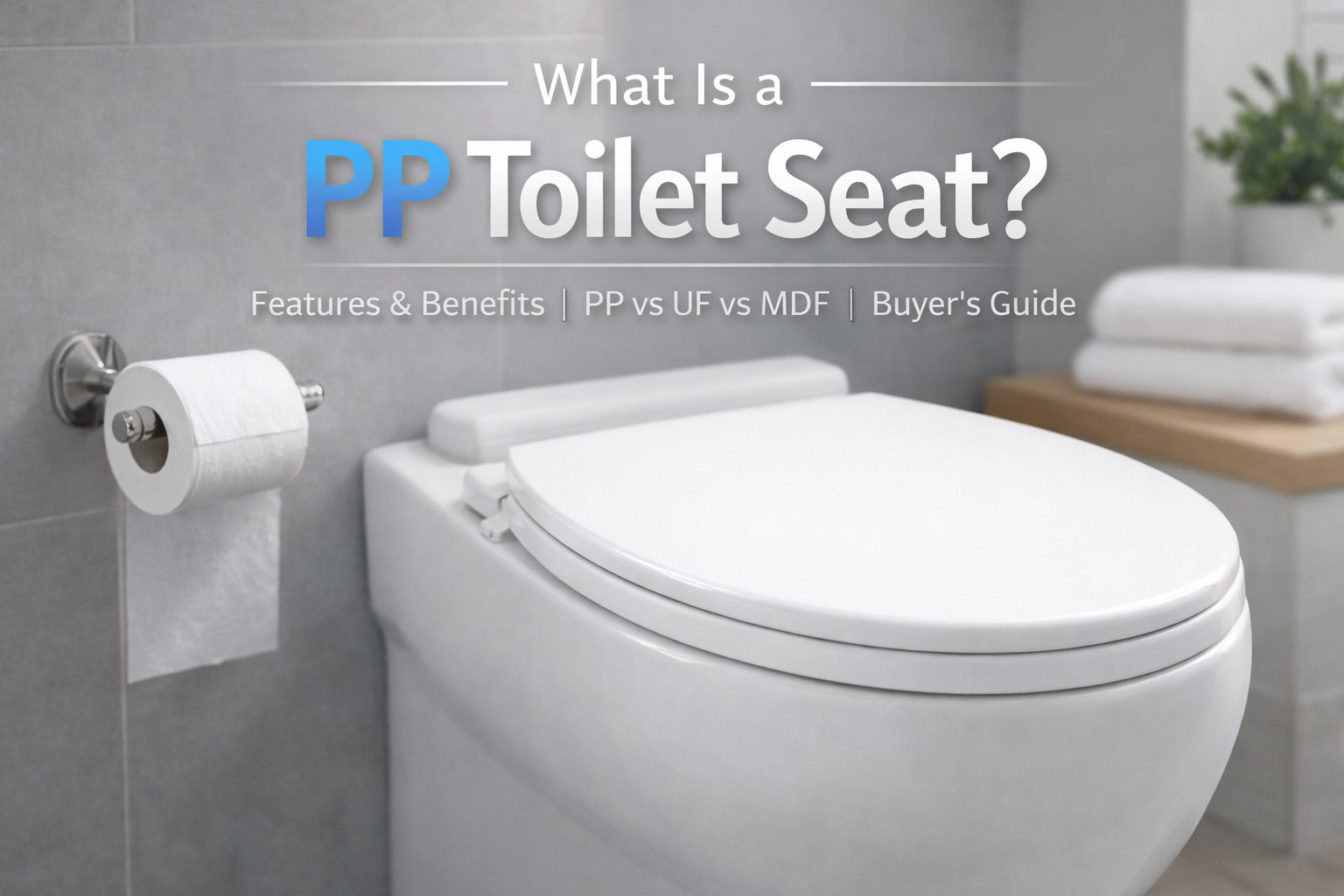
When buyers look for a PP toilet seat, they are usually searching for a practical, affordable, and widely used toilet seat option that fits mass-market demand. In the toilet seat industry, PP is one of the most common materials because it offers a good balance between cost, function, and ease of production.
A PP toilet seat is a toilet seat made from polypropylene, a thermoplastic material that is lightweight, durable enough for daily use, easy to clean, and suitable for high-volume manufacturing. Compared with more premium materials such as UF or molded wood, PP toilet seats are usually more budget-friendly and are often used in retail programs, wholesale supply, entry-level product lines, and cost-sensitive projects.
For distributors, importers, supermarket buyers, OEM brands, and e-commerce sellers, understanding the features of a PP toilet seat is important because the material directly affects price positioning, product appearance, shipping weight, and market suitability. In this guide, we explain what a PP toilet seat is, its main features, its advantages and limitations, and what buyers should consider before ordering in bulk.
What Does PP Mean in a Toilet Seat?
In the toilet seat industry, PP stands for polypropylene. It is a thermoplastic material widely used in bathroom products, household goods, packaging, and many other consumer applications. Because polypropylene is relatively lightweight, economical, and easy to process, it has become one of the most popular materials for toilet seat manufacturing.
A PP toilet seat is especially common in markets where buyers need reliable products at competitive prices. It is often selected for standard household models, promotional product lines, supermarket programs, and wholesale orders where cost control is an important factor.
Compared with more premium toilet seat materials, PP usually offers a simpler appearance and lighter feel. However, that does not mean it lacks value. For many buyers, especially those targeting budget-conscious customers, PP is a very practical material choice.
What Are the Main Features of a PP Toilet Seat?
A PP toilet seat has several characteristics that make it suitable for large-volume and cost-sensitive markets.
Lightweight Structure
One of the most noticeable features of a PP toilet seat is its light weight. Compared with UF or MDF toilet seats, PP models are generally easier to handle, easier to install, and often more convenient for shipping.
For importers and distributors, lighter products may also help improve logistics efficiency in certain order structures, especially for large-volume shipments.
Affordable Material Cost
PP is widely used because it is cost-effective. The material itself is generally more affordable than many premium alternatives, which makes it suitable for buyers looking to build an entry-level or price-competitive toilet seat line.
This is one of the main reasons PP toilet seats are popular in supermarkets, DIY chains, discount retail programs, and wholesale distribution channels.
Practical for Mass Production
Another major benefit of PP is that it works well for standardized production. Manufacturers can produce PP toilet seats efficiently for large-volume orders, making the material a good fit for buyers who need consistent supply and repeat orders.
For OEM and wholesale projects, this production efficiency can support more stable pricing and better availability.
Easy to Clean
A PP toilet seat is generally easy to clean in daily use. Its smooth plastic surface makes it a practical choice for households, rental properties, and basic commercial bathroom programs where easy maintenance matters.
Suitable for Standard Product Lines
PP toilet seats are often used in standard product ranges because they are practical, simple, and easy to position in the market. They are commonly offered in classic shapes, standard white finishes, and basic function models, including some soft close and standard hinge versions.
Advantages of PP Toilet Seats
For many B2B buyers, the real value of a PP toilet seat is not only in the material itself, but in how well it fits a mass-market product strategy.
1. Cost-Effective for Budget Markets
One of the biggest advantages of a PP toilet seat is price competitiveness. Buyers who serve cost-sensitive markets often choose PP because it allows them to offer a practical product at an accessible price point.
2. Lightweight and Easy to Handle
The lighter weight of PP toilet seats can be attractive for buyers who want easy product handling, simpler installation, and practical day-to-day use. This also makes PP a common choice for standard home replacement seats.
3. Suitable for High-Volume Orders
Because PP is efficient for mass production, it is well suited to supermarket programs, wholesale orders, and distributor product lines. For buyers who focus on repeat business and bulk purchases, this is a major advantage.
4. Good for Entry-Level Product Positioning
Not every market needs a premium ceramic-like toilet seat. In many countries and channels, customers simply want a clean, functional, affordable product. PP toilet seats fit this market need very well.
5. Easy to Include in Standard Retail Assortments
Retailers and distributors often need a basic toilet seat option that can appeal to a broad customer base. PP toilet seats are often used in these programs because they are familiar, easy to price, and simple to position.
6. Flexible for OEM and Private Label Programs
Although PP is usually associated with entry-level or mid-range products, it can still be customized for OEM and private label projects. Buyers can often adjust packaging, labeling, hinge options, and selected color details depending on the supplier’s capability.
Disadvantages of PP Toilet Seats
A good buying guide should also explain the limitations of the material. A PP toilet seat is practical, but it is not always the best choice for every market.
Less Premium Appearance
Compared with UF toilet seats, PP toilet seats usually have a more basic plastic appearance. They may not deliver the same high-end visual impression required by premium bathroom brands or luxury hospitality projects.
Softer Surface
PP generally has a softer surface than UF. This can mean lower scratch resistance in some conditions, especially when compared with harder thermosetting materials.
Lighter Product Feel
While light weight is often an advantage, some customers associate heavier products with higher quality. A PP toilet seat may feel less substantial than a UF or MDF seat, which can influence buying decisions in more premium market segments.
Not Always Ideal for High-End Programs
If the target market expects a ceramic-like finish, a solid premium hand feel, or a more decorative appearance, PP may not be the best fit. In those cases, buyers often compare PP with UF or MDF before making a final material decision.
PP Toilet Seat vs UF Toilet Seat
A common question from buyers is whether a PP toilet seat or a UF toilet seat is the better choice. The answer depends on the target market, budget, and product positioning.
|
Item |
PP Toilet Seat |
UF Toilet Seat |
|
Material |
Polypropylene |
Urea-formaldehyde |
|
Product feel |
Lightweight |
Heavier and more solid |
|
Appearance |
Basic plastic look |
More premium, ceramic-like |
|
Surface hardness |
Softer |
Harder |
|
Scratch resistance |
Lower |
Better |
|
Cost |
Lower |
Higher |
|
Best for |
Budget and mass-market programs |
Mid-range and premium programs |
PP Toilet Seat vs MDF Toilet Seat
PP and MDF toilet seats serve different product styles and market needs.
A PP toilet seat is usually lighter, simpler, and more economical. It is often used for practical household programs, standard retail lines, and budget-friendly distribution.
An MDF toilet seat is usually heavier and may offer a more decorative or traditional style, depending on the design and finish. MDF can be used in selected premium or style-driven retail programs where appearance is more important than basic cost efficiency.
In general:
- Choose PP for practical, affordable, large-volume product lines
- Choose MDF for more decorative or heavier product positioning
For many B2B buyers, the decision between PP and MDF depends on whether the market values lower cost and simplicity, or visual style and product presentation.
Where Are PP Toilet Seats Commonly Used?
A PP toilet seat is widely used because it suits many different business channels.
Retail and Supermarket Programs
Supermarkets and retail chains often carry PP toilet seats because they fit price-sensitive consumer demand. Standard white PP models are especially common in large-volume programs where broad market appeal matters more than premium product feel.
Budget Residential Projects
PP toilet seats are often used in cost-sensitive residential or housing projects where the focus is on function, standardization, and price control.
Wholesale and Distribution Programs
Distributors and importers frequently include PP toilet seats in their catalog because they are easy to sell, easy to reorder, and suitable for many different customer types.
E-Commerce and Entry-Level Product Lines
Online sellers often choose PP models for entry-level offers because the products are affordable, straightforward, and familiar to a large segment of the market.
Replacement Toilet Seat Programs
Because PP toilet seats are widely available in standard shapes and sizes, they are often used in replacement toilet seat programs for home improvement, maintenance, and basic bathroom upgrades.
Who Should Choose a PP Toilet Seat?
A PP toilet seat is especially suitable for buyers who need practical performance and competitive pricing.
Distributors and Importers
Importers serving budget-friendly or mid-volume markets often choose PP because it offers a stable, easy-to-position product line for broad customer demand.
Supermarkets and Retail Chains
Retail buyers looking for standard, affordable toilet seat models often include PP products in their assortment because the price point is attractive and the models are easy for customers to understand.
E-Commerce Sellers
Online sellers who want practical products with broad appeal may find PP toilet seats useful for building entry-level collections.
Budget Project Buyers
Projects with strict cost control requirements may prefer PP over higher-cost materials, especially when the goal is functionality rather than premium presentation.
Buyers Building Standard Product Ranges
If a buyer needs a simple, scalable, and repeatable product line, PP is often one of the easiest materials to work with.
What Should Buyers Check Before Ordering PP Toilet Seats?
Before placing a bulk order, buyers should confirm several product and supply details.
Seat Shape and Size
Buyers should confirm whether the target market requires round or elongated shapes, and whether the seat dimensions fit local toilet standards.
Hinge Type and Function
A PP toilet seat can come with different hinge options, including standard hinges, soft close hinges, or quick release systems. Buyers should confirm which function best fits their product line.
Weight and Product Positioning
Since PP is lightweight, buyers should consider whether that matches their target market. For budget and practical programs, it usually works well. For more premium buyers, they may need a heavier alternative.
Packaging Requirements
Retail and private label programs may require custom packaging, barcode labels, instruction sheets, and logo printing. These requirements should be confirmed before production starts.
MOQ and Lead Time
As with any bulk purchase, buyers should check minimum order quantity, delivery time, and whether custom packaging or branding affects production lead time.
Production Quality Consistency
Even with a cost-effective product, quality consistency is important. Buyers should review sample quality, color consistency, hinge assembly, and packaging execution before confirming a large order.
Can PP Toilet Seats Be Customized?
Yes, PP toilet seats can often be customized for wholesale and OEM programs. Depending on the manufacturer, customization options may include:
- Custom logo printing
- Private label packaging
- Retail barcode labeling
- Different hinge options
- Standard or upgraded closing systems
- Color options for selected models
- Instruction manual customization
For many buyers, this makes PP a strong material for private label projects where cost control remains a priority. A capable manufacturer can help combine standard production efficiency with selected customization needs.
How to Choose a Reliable PP Toilet Seat Manufacturer
Selecting the right supplier is just as important as selecting the right product.
Check Toilet Seat Manufacturing Experience
A professional toilet seat manufacturer usually has better control over molds, hinges, assembly, and packaging than a general plastic product supplier.
Review PP Product Range
A strong supplier should offer a clear range of PP models, including standard seats, soft close versions, and different hinge solutions for different markets.
Confirm OEM Support
If you need custom packaging, private label support, or specific product features, make sure the manufacturer can handle OEM requirements effectively.
Evaluate Sample Quality
Always ask for samples before placing a bulk order. This allows you to check surface finish, hinge quality, product feel, and overall market suitability.
Ask About Export Experience
Manufacturers with export experience are generally better prepared for communication, documentation, packaging standards, and international customer expectations.
Review Production Capacity and Delivery Stability
For distributors and supermarket buyers, stable supply is critical. A reliable supplier should be able to support repeat orders, volume planning, and consistent lead times.
FAQ About PP Toilet Seats
What is a PP toilet seat made of?
A PP toilet seat is made of polypropylene, which is a thermoplastic material commonly used in household and bathroom products.
Is a PP toilet seat durable?
Yes, a PP toilet seat is durable enough for normal daily use, especially in standard residential and budget retail markets. However, it is usually less hard and less scratch-resistant than UF.
Is PP better than UF for budget buyers?
Yes, in many cases PP is better for budget buyers because it is more affordable and well suited to mass-market programs.
Are PP toilet seats lightweight?
Yes, one of the main features of PP toilet seats is that they are lighter than many other toilet seat materials.
Are PP toilet seats easy to clean?
Yes, PP toilet seats are generally easy to clean because they have a smooth plastic surface.
Can PP toilet seats be used for wholesale orders?
Yes, PP toilet seats are widely used in wholesale supply because they are practical, cost-effective, and suitable for large-volume production.
Can PP toilet seats be customized?
Yes, many manufacturers support OEM services for PP toilet seats, including custom packaging, logo printing, and hinge options.
What is the difference between PP and MDF toilet seats?
PP toilet seats are usually lighter, more affordable, and more practical for volume supply. MDF toilet seats are usually heavier and may offer a more decorative style.
Conclusion
A PP toilet seat is one of the most practical and widely used toilet seat options in the global market. Made from polypropylene, it offers a lightweight structure, affordable cost, easy maintenance, and strong suitability for large-volume production. These advantages make it a popular choice for distributors, retailers, importers, e-commerce sellers, and buyers serving budget-conscious markets.
While it may not offer the same premium feel as UF or the decorative character of MDF, a PP toilet seat remains a highly effective choice when price, practicality, and standardization are the main priorities. For B2B buyers, the key is to work with a reliable manufacturer that can provide consistent quality, suitable packaging, and dependable supply for wholesale or OEM programs.
If you are looking for a dependable PP toilet seat manufacturer for wholesale or private label orders, choosing the right supplier is the best way to build a practical and competitive product range.