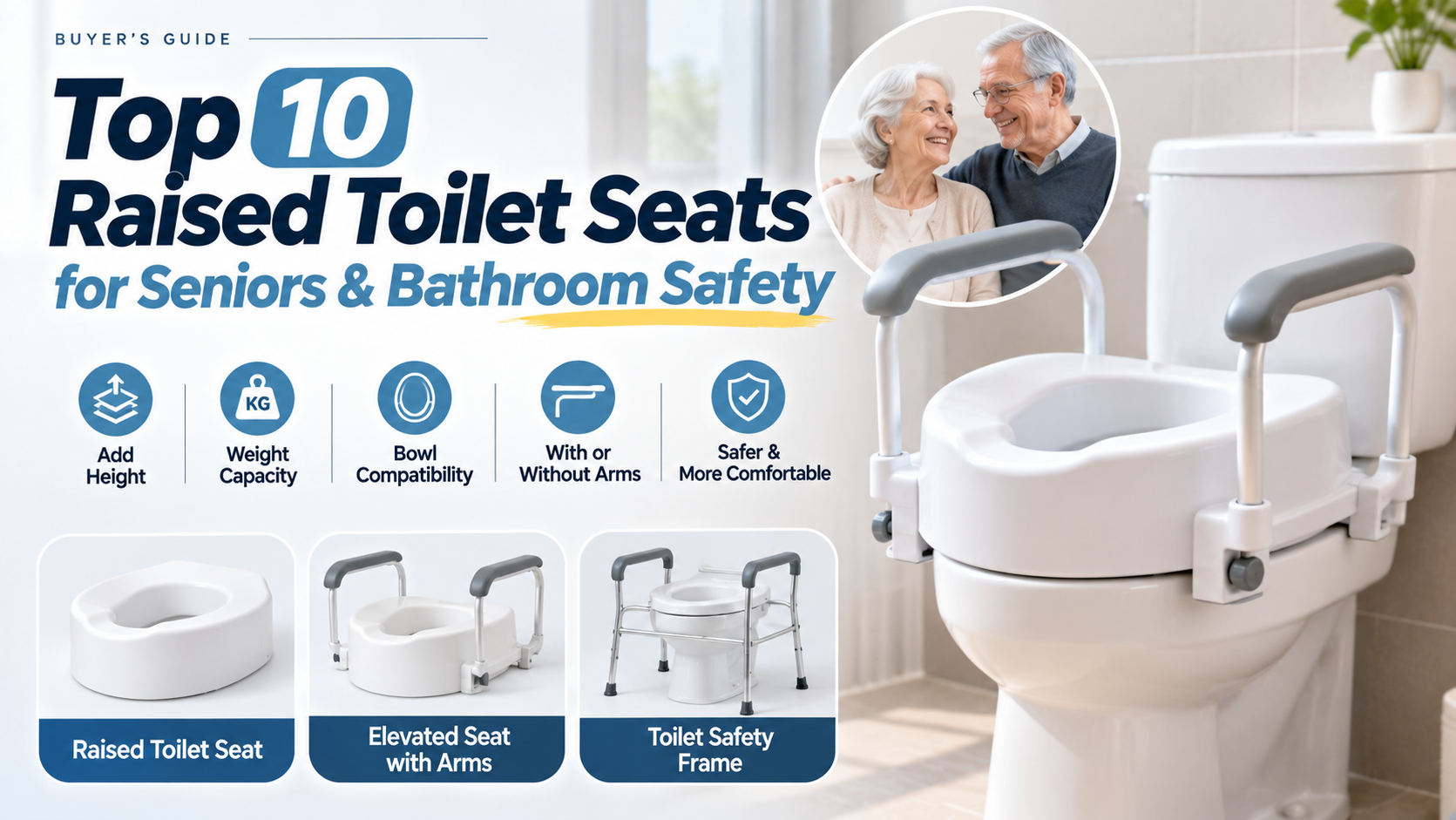
Top 10 Raised Toilet Seats for Seniors & Bathroom Safety
A raised toilet seat can increase the sitting height of an existing toilet without replacing the toilet itself. For older adults, caregivers and facilities, the right choice depends on more than the advertised height. Bowl shape, fixing method, side support, opening size, cleaning access and the published weight limit all need review.
This is a comparison shortlist, not a ranking. Product specifications can change, so confirm the current instructions, compatibility details and weight capacity with the manufacturer before purchase or installation.
Where a person has mobility limitations, transfer difficulties, balance concerns, post-operative restrictions or a history of falls, the choice and setup should also be confirmed with an appropriate care or medical professional.
Raised Toilet Seat, Toilet Riser or Safety Frame?
These terms are often used together, but they describe different product types.
| Product type | Typical function | Key buying check |
|---|---|---|
| Raised toilet seat | Adds height directly on the toilet bowl | Bowl fit and locking method |
| Elevated seat with arms | Adds height and includes side supports | Arm stability and transfer clearance |
| Toilet seat riser | Installs below or with a standard toilet seat | Mounting method and finished height |
| 3-in-1 commode | Can work bedside, over a toilet or as a raised toilet option | Frame dimensions and bathroom space |
| Toilet safety frame | Adds hand support around a toilet | Floor footprint and secure positioning |
A raised seat does not automatically provide safe hand support. A model with arms may be useful for some users, but armrests can also affect side transfers and bathroom clearance. Review the specific user’s needs before selecting a design.
10 Raised Toilet Seats to Compare
| Product | Publicly listed feature to compare | Best question before buying |
|---|---|---|
| Drive Medical AquaSense Raised Toilet Seat with Lid | 4-inch raised option, clamp attachment and standard or elongated variants | Does the selected version match the toilet bowl shape? |
| Drive Medical Raised Toilet Seat with or without Lid | 2-inch and 4-inch versions, with or without lid | Is the required height available with the preferred lid configuration? |
| Drive Medical AquaSense 3-in-1 Contoured Raised Toilet Seat | 2-inch or 4-inch elevation options with configurable arm support | Are one or two arms appropriate for the transfer method? |
| Carex Quick-Lock Raised Toilet Seat | 4-inch rise, Quick-Lock attachment and wide opening | Does the locking system fit the bowl rim correctly? |
| Carex Safe-Lock 2-Inch Raised Toilet Seat | 2-inch raised seat with locking design | Is a 2-inch increase enough for the intended user? |
| Carex Classics Raised Toilet Seat with Armrests | Raised seat format with integrated armrests | Will the arms fit the available bathroom space? |
| Carex Safe-Lock Bariatric Raised Toilet Seat | 4.25-inch raised option intended for a higher-capacity category | What current capacity and installation conditions apply? |
| Medline Elevated Open Front Toilet Seat | Open-front elevated-seat format | Is an open-front design suitable for the hygiene and care routine? |
| Medline Guardian Raised Locking Toilet Seat | 5-inch locking raised-seat format | Does the toilet geometry allow the locking mechanism to engage securely? |
| Medline AltiCare Raised Toilet Seat with Adjustable Arms | Raised seat with adjustable arm supports | Can the arm position be adjusted for the actual transfer space? |
The correct product is the one that fits the toilet, supports the intended use and can be installed according to its instructions. It is not necessarily the tallest model or the model with the most accessories.
Compare the Height Increase First
Most raised toilet seats add a defined amount of height, commonly around 2 to 5 inches. The total seated height depends on both the existing toilet and the riser.
Before buying, measure:
Existing toilet-seat height from floor to top surface
Required finished height
User’s ability to sit and stand safely
Clearance under vanity units or nearby rails
Height of nearby mobility equipment, if used
Whether the added height affects foot contact with the floor
More height is not always better. An excessively high seat can make stable positioning difficult for some users. A care professional can help determine an appropriate target height where necessary.
Check Bowl Shape and Attachment Method
Many raised seats are designed for standard round or elongated toilet bowls, but “fits most toilets” does not mean every toilet.
Confirm:
Round or elongated bowl shape
Bowl rim profile
Width at the rear mounting area
Whether the toilet has an unusual or compact shape
Clearance near the cistern, wall or bidet attachment
Whether the seat uses clamps, locking plates or permanent mounting hardware
Whether the original toilet lid can still be used
A seat that is not fully seated on the bowl or cannot be tightened correctly should not be used.
Consider Locks, Clamps and Permanent Installation
Raised toilet seats use different securing methods.
| Attachment style | Typical benefit | Important check |
|---|---|---|
| Clamp-on | Fast installation and removal | Clamp contact and tightness |
| Locking plate | More controlled connection to bowl rim | Correct engagement with bowl shape |
| Screw-secured | Can provide a firm fitted arrangement | Correct installation and hardware compatibility |
| Hinged riser | Allows access for cleaning or original-seat use | Hinge movement and mounting stability |
| Frame-supported unit | Reduces reliance on bowl attachment alone | Frame footprint and floor stability |
Follow the manufacturer’s setup instructions exactly. Recheck tightness at the recommended intervals and stop using the product if it shifts, cracks or no longer locks securely.
Do You Need Handles or Armrests?
Handles can provide a place to push from during standing or to steady the body during sitting. However, their suitability depends on the user’s movement pattern and available space.
Review:
Width between arms
Arm height
Whether arms are fixed or adjustable
Clearance for wheelchair or side transfers
Whether the arms are part of the seat or part of a separate frame
Whether the user would pull, push or lean in a way outside the product instructions
Do not assume a raised seat with armrests replaces a properly installed grab bar or professional transfer assessment.
Check Weight Capacity and Product Condition
Weight capacity must be taken from the exact current product instructions, not from a similar-looking model, an older retailer listing or a previous purchase.
Also inspect:
Cracks in molded plastic
Loose clamps or locking plates
Worn threads
Missing anti-slip pads
Damaged armrests
Deformation around the opening
Loose hardware
Replace the product or its approved components when damage is found. Do not modify a raised seat, add unapproved cushions or combine it with unrelated hardware.
Cleaning and Shared-Use Considerations
For home-care, assisted-living and facility use, cleaning access can influence product selection.
Consider:
Smooth, wipeable surfaces
Removal method for cleaning
Access around clamps and locking parts
Lid or no-lid preference
Open-front versus closed-front shape
Whether separate components can trap moisture or soil
Availability of replacement hardware
A product that is difficult to inspect and clean may be unsuitable for a shared-use environment even if it fits the toilet.
Checklist Before Ordering a Raised Toilet Seat
Confirm these points before purchase:
Current toilet height
Required finished seat height
Toilet bowl shape and dimensions
Mounting or clamp compatibility
Bathroom clearance
Need for arms, handles or a separate safety frame
Exact current published weight capacity
Cleaning requirements
User’s transfer method
Care professional guidance where mobility or falls risk applies
Return policy and replacement-parts availability
How BOFAN Supports Toilet Seat Sourcing
BOFAN develops standard toilet seat programs for distributors, private-label brands and bathroom-product buyers. Product selection can include PP, UF and molded-wood seats, soft-close hinges, quick-release functions, top-fix and bottom-fix hardware, packaging and repeat-order specification control.
Raised or care-related products should be evaluated as a separate project with clear requirements for intended use, load, installation, applicable standards and documentation.
CTA: Discuss a Toilet Seat Product Program
Planning a toilet seat range for retail, distribution or private label? Send BOFAN your target market, material preference, hinge function, toilet shape, packaging requirements and expected order quantity.
FAQ
What is the best height for a raised toilet seat?
The appropriate height depends on the user, current toilet height and transfer needs. Measure the existing seat height and confirm the target with a care or medical professional when mobility or fall risk is involved.
Are raised toilet seats safe for every toilet?
No. The seat must match the toilet bowl shape and be installed according to the manufacturer’s instructions. Check the rim profile, attachment method and stability before use.
Is a raised toilet seat with handles always better?
Not necessarily. Handles can help some users, but they also require adequate bathroom clearance and may affect certain transfer methods.
What is the difference between a raised toilet seat and a toilet safety frame?
A raised toilet seat increases the sitting height. A safety frame provides external hand support around the toilet. Some users may need one, both or a different bathroom-access solution.
Are these products ranked from best to worst?
No. This is a public-information shortlist of raised toilet seat options to compare. Suitability depends on the exact toilet, user requirements, current product specifications and installation conditions.
Table of Contents
- Top 10 Raised Toilet Seats for Seniors & Bathroom Safety
- Raised Toilet Seat, Toilet Riser or Safety Frame?
- 10 Raised Toilet Seats to Compare
- Compare the Height Increase First
- Check Bowl Shape and Attachment Method
- Consider Locks, Clamps and Permanent Installation
- Do You Need Handles or Armrests?
- Check Weight Capacity and Product Condition
- Cleaning and Shared-Use Considerations
- Checklist Before Ordering a Raised Toilet Seat
- How BOFAN Supports Toilet Seat Sourcing
- FAQ