Custom Toilet Seat Project Timeline: Design Freeze to Shipment
A custom toilet seat project can move quickly when the product specification is clear. It can also lose weeks when the buyer, factory, packaging supplier and inspection team are working from different assumptions.
For OEM brands, distributors and private-label retailers, the project timeline should cover more than manufacturing lead time. It needs to include product development, ceramic fit review, sample approval, artwork, packaging materials, production planning, inspection and shipping preparation.
The most important milestone is the design freeze: the point at which the buyer confirms the exact product configuration that will be used for bulk production.
Start With a Complete Project Brief
The timeline starts before the factory prepares a sample.
A useful brief should include:
Product shape: round, elongated, D-shape or custom fit
Ceramic drawing, measurements or physical reference
Material: PP, UF, MDF or molded wood
Color and surface finish
Hinge type and finish
Soft-close requirement
Quick-release requirement
Top-fix or bottom-fix system
Fixing-kit specification
Target quantity
Packaging format
Sales channel
Destination market
Required testing or documentation
Target launch date
If the buyer only provides a photo and a target price, the supplier may need to make assumptions. Those assumptions often create revisions later.
Typical Custom Toilet Seat Project Stages
| Project stage | Main buyer decision | Main factory action |
|---|---|---|
| Product brief | Confirm target product and sales channel | Review feasibility and recommend platform |
| Ceramic-fit review | Provide bowl information | Check shape, mounting range and buffer contact |
| Quotation | Confirm product scope and quantity | Quote material, hinge, packaging and tooling |
| Sample development | Approve technical direction | Prepare sample or modified existing model |
| Design freeze | Approve final product configuration | Lock materials, components and specifications |
| Packaging approval | Approve artwork and labels | Order packaging materials |
| Bulk production | Release purchase order | Schedule production and component supply |
| Inspection | Confirm inspection standard | Conduct in-process and final checks |
| Shipment | Approve shipping documents | Pack, load and arrange delivery |
The duration of each stage depends on whether the project uses an existing model, a modified platform or completely new tooling.
Existing Model, Modified Model or New Tooling?
The project route affects both cost and timing.
Existing Product Platform
An existing model is usually the fastest option. The buyer may select a current shape, material, hinge, fixing kit, color and packaging format.
This route can be suitable when:
The existing seat fits the intended ceramic
The product shape does not need structural changes
The buyer can use an available hinge system
Customization is limited to color, packaging, labels or branding
Modified Existing Model
A modified model may include a new color, print, hinge cover, buffer arrangement or packaging structure. This route normally requires more sample review but may avoid full mold development.
New Tooling Project
New tooling may be needed when the buyer requires a unique shape, dimensions, structural design or ceramic fit that cannot be achieved with an existing platform.
Before starting, confirm:
Tooling scope
Tooling cost
Tooling ownership
Sample timing
Revision process
Mold maintenance responsibility
Approval point before bulk production
Set the Design Freeze Before Ordering Bulk Materials
The design freeze should happen before the factory orders bulk components, packaging materials or production-specific color materials.
The approved specification should identify:
Buyer SKU
Factory model
Product drawing
Material
Color and finish
Seat and lid configuration
Hinge code
Fixing-kit code
Soft-close and quick-release functions
Buffer configuration
Product weight where relevant
Packaging artwork version
Barcode and labels
Instruction sheet
Inspection criteria
Approved sample reference
A design freeze protects both buyer and supplier. It reduces the risk of changing a hinge, carton or color during production after related materials have already been ordered.
Use Samples to Answer Specific Questions
A sample should not simply answer “Does it look good?”
It should help the buyer verify:
Ceramic fit
Mounting-hole adjustment range
Seat alignment
Buffer contact
Soft-close movement
Quick-release operation
Surface finish
Color appearance
Hinge appearance
Fixing-kit completeness
Product stability after installation
Packaging protection
For private-label programs, the final approval should include the complete sellable unit where possible: product, fixing kit, instruction sheet, retail carton and labels.
Develop Packaging in Parallel With Product Approval
Packaging should not wait until the product is already in production.
Once the product configuration is stable, begin work on:
Retail carton layout
Product image or illustration
Brand logo
Product name
Material and feature descriptions
Barcode
Country-of-origin marking
Warning labels
Installation instructions
Outer-carton shipping marks
Carton quantity
Pallet labels, if required
The packaging must fit the exact product. A molded-wood seat, a quick-release hinge or a heavier UF model may need different internal protection from a standard PP seat.
Build Time Into the Plan for Approvals
Most delays in OEM projects are caused by missing or late approvals, not by the production machine itself.
The buyer should nominate one responsible approval contact for:
Product sample
Color sample
Ceramic fit
Packaging artwork
Barcode
Instruction sheet
Test evidence
Golden sample
Inspection report
Shipping release
If several departments must approve the product, agree on the review route before sampling begins.
Plan Inspection Before Production Starts
Inspection criteria should be agreed before bulk production, not only after the goods are finished.
Typical checkpoints include:
Material confirmation
Product dimensions
Hinge and fixing-kit identity
Soft-close function
Quick-release function
Surface finish
Color consistency
Buffer placement
Product stability
Packaging completeness
Barcode and label accuracy
Carton dimensions and weight
A buyer may also request pre-production, during-production or final inspection depending on the product value, order size and quality risk.
Keep Shipping Preparation Separate From Production Completion
“Production complete” does not always mean “ready to ship.”
Before shipment, confirm:
Final inspection result
Carton quantity
Carton dimensions
Gross and net weight
Total CBM
Pallet plan, if applicable
Shipping marks
Commercial invoice details
Packing list details
Destination requirements
Freight booking cut-off
Required shipping documents
This avoids a situation where goods are completed but cannot be loaded because packaging data, labels or destination documents are still missing.
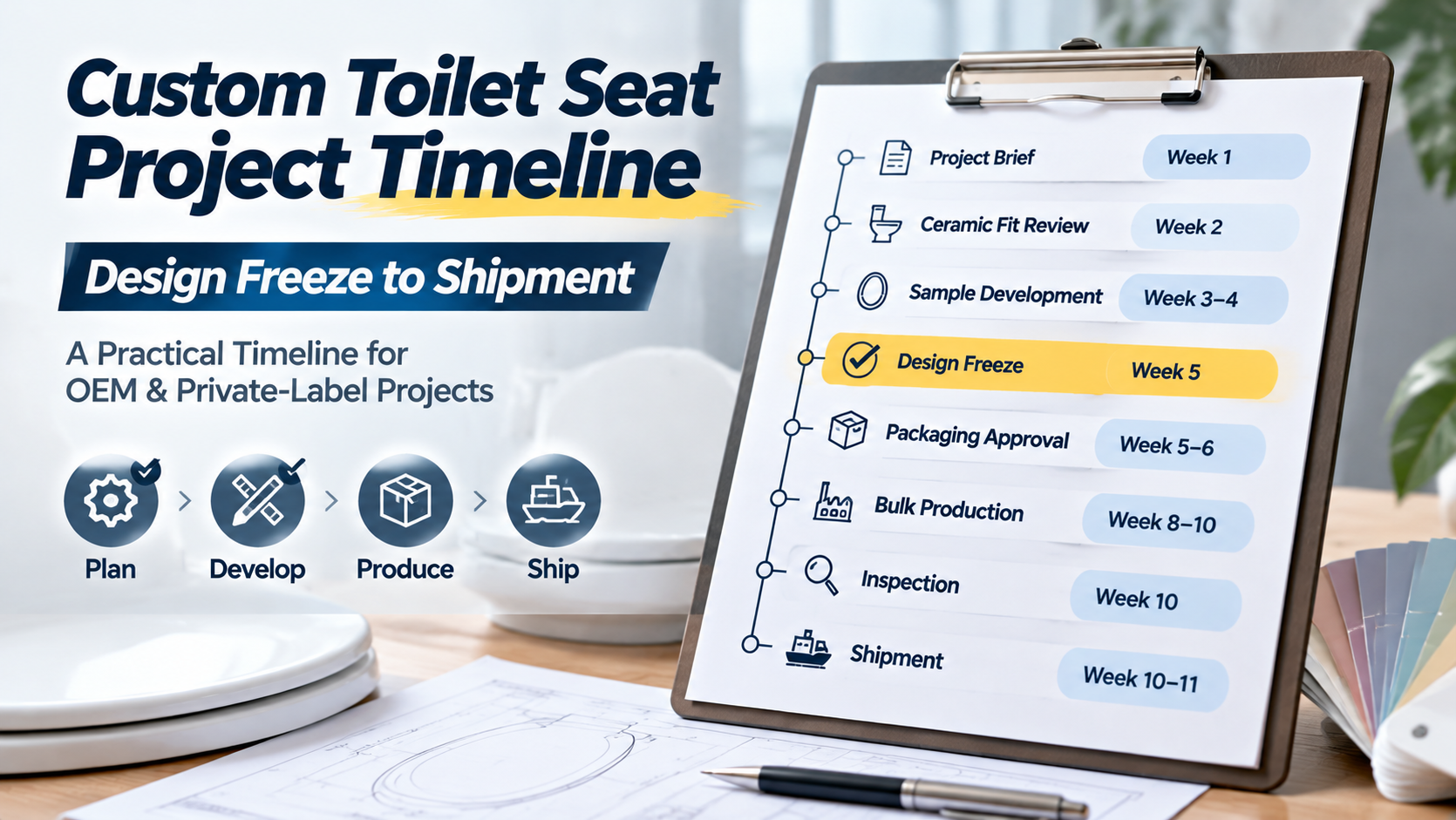
Example Project Timeline
| Week | Main activity |
|---|---|
| Week 1 | Product brief, ceramic information and quotation review |
| Week 2 | Existing-model selection or development confirmation |
| Week 3–4 | Sample preparation and technical review |
| Week 5 | Sample approval and design freeze |
| Week 5–6 | Packaging artwork and label approval |
| Week 6–7 | Bulk material and packaging preparation |
| Week 8–10 | Bulk production and in-process control |
| Week 10–11 | Final inspection, packing and shipment preparation |
This is an illustrative planning model. Actual timing depends on product complexity, tooling, material availability, order quantity, packaging and shipping schedule.
How BOFAN Supports Custom Toilet Seat Projects
BOFAN supports OEM and private-label toilet seat programs across PP, UF and molded-wood product ranges. Support may include product-platform review, ceramic compatibility discussion, hinge and fixing-kit selection, sample preparation, packaging coordination, inspection planning and repeat-order specification control.
CTA: Request a Custom Toilet Seat Project Timeline
Planning a new toilet seat program? Send BOFAN your ceramic drawing, target material, product features, packaging requirements, expected quantity and launch date for an initial project review.
FAQ
How long does a custom toilet seat project take?
Timing depends on whether the project uses an existing model, a modified platform or new tooling. Sample approval, packaging and production planning should all be included in the schedule.
What is a design freeze?
A design freeze is the formal approval of the product configuration before bulk materials and packaging are ordered.
Can packaging be developed before the sample is approved?
Initial artwork can be prepared early, but final packaging should not be printed until the product details, dimensions, hinge system and instruction content are confirmed.
When should inspection requirements be agreed?
Inspection requirements should be agreed before production starts, with the approved sample and specification used as the reference.
What information helps a factory provide a realistic timeline?
Provide the product drawing, ceramic information, material, hinge requirements, quantity, packaging format, destination, testing needs and target launch date.
Table of Contents
- Custom Toilet Seat Project Timeline: Design Freeze to Shipment
- Start With a Complete Project Brief
- Typical Custom Toilet Seat Project Stages
- Existing Model, Modified Model or New Tooling?
- Set the Design Freeze Before Ordering Bulk Materials
- Use Samples to Answer Specific Questions
- Develop Packaging in Parallel With Product Approval
- Build Time Into the Plan for Approvals
- Plan Inspection Before Production Starts
- Keep Shipping Preparation Separate From Production Completion
- Example Project Timeline
- How BOFAN Supports Custom Toilet Seat Projects
- FAQ