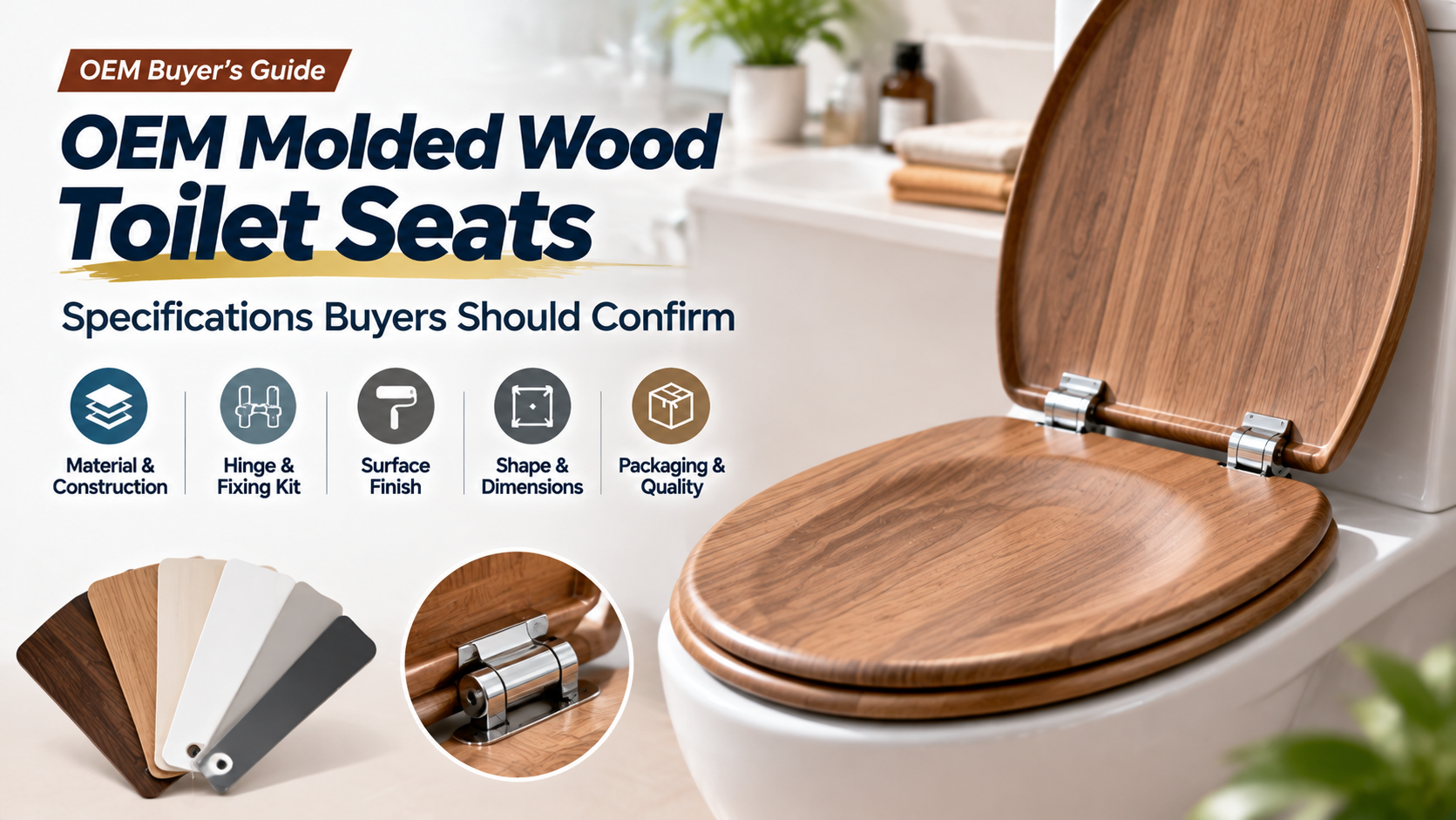
OEM Molded Wood Toilet Seats: Specifications Buyers Should Confirm
Molded wood toilet seats can provide a substantial feel, decorative finish options and a broad private-label packaging opportunity. However, “wooden toilet seat” is not a complete specification.
For an OEM buyer, product performance depends on the board construction, coating system, hinge selection, fixing kit, moisture protection, packaging and approved quality standard. Two seats that look similar in a catalogue can differ significantly in weight, surface appearance, durability and installed stability.
This guide explains the specifications that distributors, retailers and bathroom brands should confirm before sourcing an OEM molded wood toilet seat program.
Confirm What “Molded Wood” Means for the Project
Molded wood toilet seats are commonly produced from engineered wood material shaped under pressure, then coated or finished for bathroom use.
The buyer should ask the supplier to define:
Core material type
Product construction
Seat and lid thickness
Product weight
Surface coating system
Edge sealing method
Bottom-surface finish
Moisture-protection approach
Decorative print or color process
Available shapes
Do not compare only the appearance of the top surface. The construction and finish at edges, mounting areas and underside surfaces can affect long-term performance.
Select the Right Product Shape
The toilet seat must match the intended ceramic bowl.
Confirm:
Round, elongated or D-shape profile
Overall seat length and width
Inner opening dimensions
Mounting-hole spacing
Hinge adjustment range
Rear platform shape
Clearance to cistern or wall
Buffer contact points
Top-fix or bottom-fix installation access
A molded wood seat may be heavier than a standard PP seat, so stable hinge positioning and the correct fixing kit are especially important.
Define the Surface Finish Clearly
Molded wood seats can be supplied in plain colors, gloss finishes, matte finishes, printed designs or wood-effect surfaces.
The specification should identify:
| Finish item | What to confirm |
|---|---|
| Color | Standard color, custom reference or approved physical sample |
| Gloss | Glossy, satin or matte appearance |
| Artwork file, print position and approved proof | |
| Wood effect | Grain style, direction and visual reference |
| Surface coating | Coating process and expected appearance |
| Edge finish | Consistency around the seat and lid perimeter |
| Underside | Whether the underside receives the same finish standard |
For custom colors or prints, approve a physical product sample rather than relying only on a screen image.
Choose Hinges and Fixing Kits as a System
The hinge and fixing kit determine how the seat performs after installation.
Confirm:
Standard-close or soft-close function
Quick-release requirement
Hinge material
Hinge finish
Hinge code
Fixing-kit code
Top-fix or bottom-fix installation
Adjustment range
Hardware bag contents
Buffer configuration
Spare-parts requirement
Avoid descriptions such as “metal hinge” or “soft-close hinge” without a component code or approved sample. The exact hinge system should be included in the purchase order and final inspection checklist.
Review Weight and Installed Stability
A heavier toilet seat can create a different user experience and may place more demand on the hinge and fixing system.
During sample approval, test:
Seat alignment
Lid alignment
Hinge movement
Soft-close movement, if included
Stability after tightening
Lateral movement
Buffer contact
Fixing-kit retention
Hinge-cover fit
Seat and lid closing position
The product should be tested on the intended ceramic or a representative fixture. A seat that appears stable on a display sample may shift if the mounting-hole range or bowl platform differs.
Control Moisture and Cleaning Expectations
A bathroom product is exposed to humidity, cleaning products and repeated use. Buyers should discuss expected care and finish performance before production.
Useful points to confirm include:
Recommended cleaning instructions
Coating appearance after normal cleaning
Edge and underside protection
Requirements for storage in damp conditions
Packaging protection against moisture during transit
Any project-specific chemical-resistance or durability test
Do not make broad claims such as “waterproof” unless the specific product, test method and acceptance standard have been agreed.
Develop Packaging for the Actual Product Weight
Packaging for a molded wood toilet seat must protect both the finished surface and the hinge assembly.
Confirm:
Individual packaging format
Surface protection
Hinge protection
Separate hardware bag
Carton quantity
Carton dimensions
Gross carton weight
Inner supports
Retail artwork
Barcode placement
Instruction sheet
Outer-carton shipping marks
Pallet plan if required
A package designed for a lightweight PP seat may not provide enough protection for a heavier molded wood product.
Define the Quality Standard Before Bulk Production
The buyer and supplier should agree on the key inspection points before production starts.
| Inspection area | Example control |
|---|---|
| Shape and dimensions | Matches approved drawing or sample |
| Surface finish | No unacceptable scratches, bubbles, print defects or coating damage |
| Color | Matches approved sample or reference |
| Hinges | Correct code, appearance and movement |
| Fixing kit | Complete and compatible with selected installation method |
| Soft-close | Smooth, controlled closing where specified |
| Buffers | Correct position and secure attachment |
| Packaging | Correct protection, artwork, labels and carton count |
| Traceability | Batch or production reference where agreed |
The approved sample, product specification and packaging artwork should all be available during final inspection.
Ask the Right Questions Before Quotation
Before requesting an OEM quotation, provide:
Product shape or ceramic drawing
Target material and product position
Surface finish or artwork reference
Hinge and fixing preference
Soft-close and quick-release requirements
Target order quantity
Private-label packaging requirement
Destination market
Required testing or documentation
Expected launch date
Then ask the supplier to confirm:
Factory model
Product weight
Material and coating description
Hinge and fixing-kit codes
MOQ by product, color and packaging
Sample process
Packaging data
Production lead time
Available test evidence
Change-control process for repeat orders
How BOFAN Supports OEM Molded Wood Toilet Seat Programs
BOFAN supports molded wood toilet seat programs for OEM brands, distributors and private-label retailers. Project discussions can include product-shape review, finish selection, hinge and fixing-kit configuration, soft-close options, packaging, sample approval and repeat-order specification control.
CTA: Request a Molded Wood Toilet Seat Quote
Planning a molded wood toilet seat program? Send BOFAN your toilet shape, material target, finish reference, hinge requirements, packaging needs, expected quantity and destination for review.
FAQ
What is the difference between molded wood and solid wood toilet seats?
Molded wood seats are commonly made from engineered wood material formed into a controlled shape and finished with a coating system. The exact construction should be confirmed with the supplier.
Can molded wood toilet seats use soft-close hinges?
Yes, depending on the selected product structure, hinge system and fixing configuration. The exact hinge code and performance requirement should be approved before bulk production.
Are molded wood seats suitable for private-label retail?
They can be suitable for private-label programs when the product specification, surface finish, packaging, barcode, instructions and inspection requirements are controlled.
Why is the fixing kit important for molded wood seats?
Molded wood seats can be heavier than some plastic seats. The correct fixing kit helps maintain alignment and stability after installation.
What should buyers approve before production?
Approve the product shape, material construction, finish, hinge, fixing kit, sample, packaging artwork, labels, instructions and inspection criteria.
Table of Contents
- OEM Molded Wood Toilet Seats: Specifications Buyers Should Confirm
- Confirm What “Molded Wood” Means for the Project
- Select the Right Product Shape
- Define the Surface Finish Clearly
- Choose Hinges and Fixing Kits as a System
- Review Weight and Installed Stability
- Control Moisture and Cleaning Expectations
- Develop Packaging for the Actual Product Weight
- Define the Quality Standard Before Bulk Production
- Ask the Right Questions Before Quotation
- How BOFAN Supports OEM Molded Wood Toilet Seat Programs
- FAQ