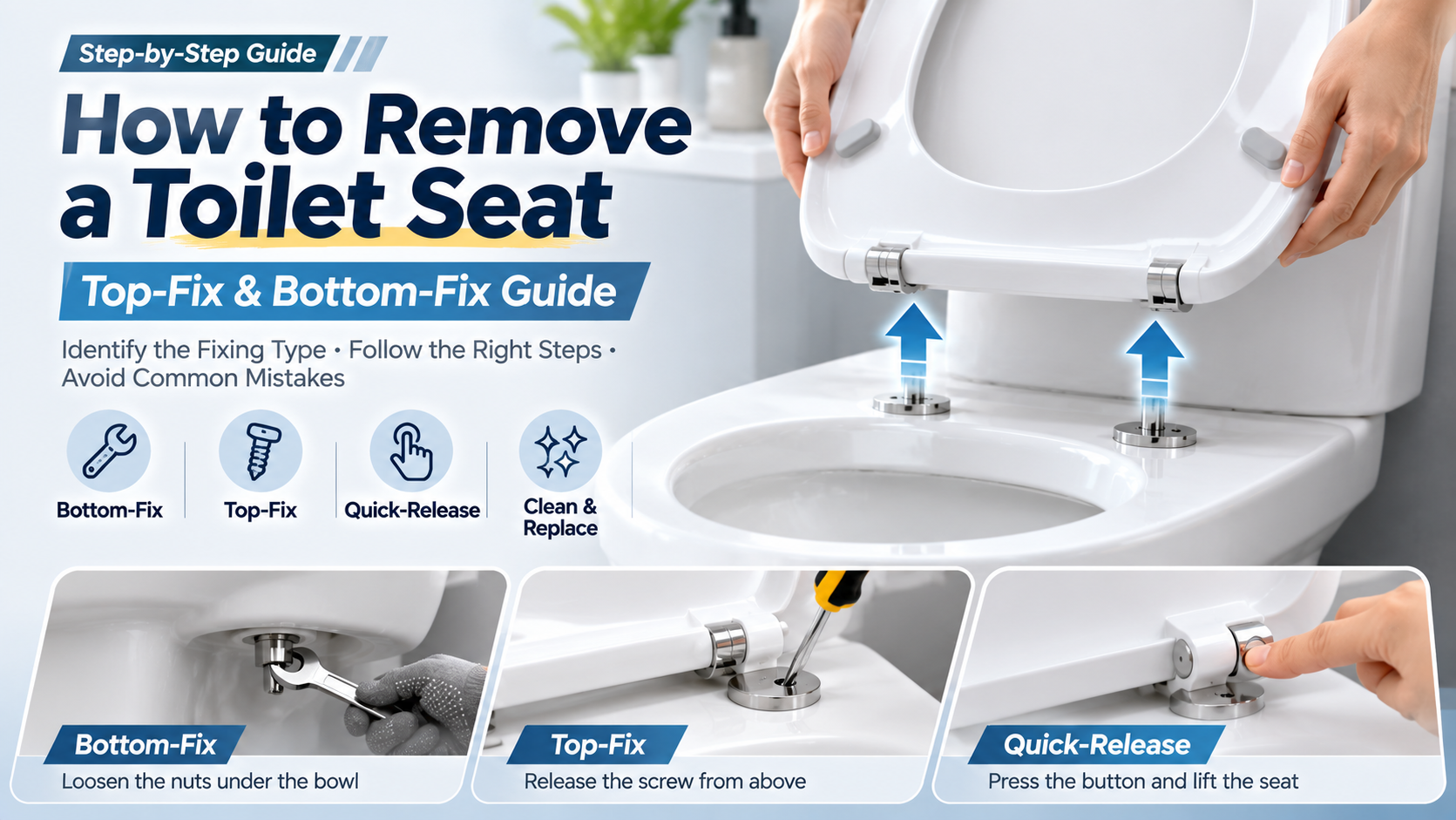
How to Remove a Toilet Seat: Top-Fix & Bottom-Fix Guide
Removing a toilet seat is usually simple once you identify the fixing system. The main difference is whether the bolts can be reached from underneath the toilet bowl or must be released from above.
Most toilet seats use one of three systems:
Bottom-fix hardware with nuts below the ceramic
Top-fix hardware tightened from above
Quick-release hinges that let the seat lift away before the fixing bases are removed
Before starting, inspect the hinge area and avoid forcing any part against the ceramic. A damaged bolt can be replaced; a cracked toilet bowl is a much larger problem.
Tools You May Need
Prepare the tools that match the fixing type:
Flat-head screwdriver
Phillips screwdriver
Adjustable wrench or pliers
Small socket wrench
Gloves
Cloth or towel
Penetrating lubricant for corroded metal nuts
Plastic scraper for old residue
For top-fix seats, a screwdriver or Allen key is often enough. For bottom-fix seats, you usually need access to the underside of the bowl and a tool to hold or turn the nut.
Identify the Toilet Seat Fixing Type
Look at the two hinges at the rear of the seat.
| Fixing type | What you will usually see | Removal approach |
|---|---|---|
| Bottom-fix | Bolts pass through the bowl, with nuts underneath | Hold or loosen the nut below the ceramic |
| Top-fix | Fixing bases tighten inside the mounting holes from above | Open hinge covers and release the top-mounted fasteners |
| Quick-release | Buttons, clips or lift-off hinges at the rear | Remove the seat first, then remove hinge bases if needed |
| Concealed fixing | Decorative hinge covers hide screws or caps | Lift the cover before identifying the hardware |
If the underside of the mounting holes is difficult to reach because of a wall-hung toilet, close-coupled cistern or restricted bathroom layout, the seat may use a top-fix system.
How to Remove a Bottom-Fix Toilet Seat
Bottom-fix seats use bolts that pass through the ceramic mounting holes. The nuts are located below the rear section of the toilet bowl.
Close the toilet lid and seat, then locate the hinge covers.
Lift the hinge covers if they are present.
Open the lid and seat for better access to the bolts.
Reach underneath the rear of the bowl and find the two fixing nuts.
Hold the bolt from above with a screwdriver if it turns together with the nut.
Turn the nut counterclockwise with a wrench, pliers or socket.
Remove the nut, washer and bolt from each side.
Lift the seat and hinge assembly away from the bowl.
Clean the ceramic mounting area before installing a replacement seat.
Plastic wing nuts can often be removed by hand. Metal nuts may need lubricant if they are corroded.
How to Remove a Top-Fix Toilet Seat
Top-fix toilet seats are installed from above. The fixing expands or tightens inside the ceramic mounting hole, so there is no need to reach below the bowl.
Open the seat and lid.
Lift or slide open the hinge covers.
Check whether the fixing uses a screw head, Allen screw or release button.
Turn the screw counterclockwise until the fixing becomes loose.
Remove the bolt or lift the hinge base out of the mounting hole.
Repeat on the second hinge.
Lift the seat and hinges away from the toilet.
Remove any remaining expansion plugs or debris from the mounting holes.
Some top-fix systems use expanding rubber plugs. Others use plastic sleeves, metal toggle mechanisms or captive fixing units. Keep the old hardware together until the replacement seat is installed in case you need to compare sizes.
How to Remove a Quick-Release Toilet Seat
A quick-release seat is designed so the seat and lid can be removed easily for cleaning.
Common release methods include:
Pressing one or two buttons beside the hinges
Pulling the seat upward from the hinge bases
Sliding the seat forward or backward
Releasing a small latch beneath the hinge cover
Once the seat and lid are removed, the hinge bases may remain attached to the toilet. If you are only cleaning the seat, leave the bases in place. If you are replacing the complete product, remove the bases using the top-fix or bottom-fix method that applies.
Do not pull a quick-release seat upward without checking for buttons or clips first. Some hinge systems lock firmly until the release mechanism is activated.
What to Do if the Toilet Seat Bolts Are Stuck
Stuck bolts are common on older seats, especially where metal hardware has been exposed to moisture.
Try these steps:
Apply a small amount of penetrating lubricant to a metal nut.
Wait according to the lubricant instructions.
Hold the bolt from above while turning the nut below.
Use a socket wrench instead of pliers if the nut is difficult to grip.
Use a cloth between tools and ceramic surfaces to reduce accidental scratching.
Replace damaged nuts, washers and bolts rather than reusing them.
Do not apply excessive force directly against the porcelain. If a heavily corroded fixing cannot be removed safely, a plumber or maintenance professional can remove and replace the hardware.
Clean the Mounting Area Before Fitting a New Seat
After removing the old seat, clean the rear mounting platform and the two fixing holes.
Check for:
Dirt around the hinge area
Limescale or old sealant
Cracked plastic washers
Damaged mounting holes
Loose ceramic surfaces
Rust marks from old hardware
A clean, flat mounting area helps the new fixing kit sit correctly and reduces the chance of movement after installation.
Check the New Toilet Seat Before Installation
Before fitting a replacement, confirm:
Round, elongated or D-shape bowl compatibility
Mounting-hole spacing
Top-fix or bottom-fix suitability
Bolt length and adjustment range
Quick-release function, if required
Soft-close function, if included
Fixing-kit contents
Buffer contact with the ceramic
Seat stability after tightening
Do not fully tighten the hardware until the seat is centered and aligned with the bowl. Open and close the seat and lid, then check that the buffers contact the ceramic evenly.
Common Removal Mistakes to Avoid
Assuming every seat uses the same nut size
Forcing a hidden hinge cover open with sharp tools
Pulling a quick-release seat without releasing the latch
Reusing damaged or corroded fixings
Tightening replacement bolts before checking alignment
Using a fixing kit that is too short for the ceramic
Ignoring movement after installation
A stable toilet seat depends on the correct combination of bowl shape, hinge design, fixing kit and installation method.
How BOFAN Supports Toilet Seat Replacement Programs
BOFAN supplies toilet seat programs with top-fix and bottom-fix options across PP, UF and molded-wood product ranges. For OEM, distributor and private-label projects, the team can help review bowl dimensions, hinge requirements, fixing-kit compatibility, quick-release functions and packaging needs.
CTA: Request a Toilet Seat Compatibility Review
Need a replacement or private-label toilet seat program? Send BOFAN your toilet bowl measurements, mounting-hole spacing, product shape, fixing preference and target quantity for review.
FAQ
How do I know if my toilet seat is top-fix or bottom-fix?
Look below the rear mounting holes. If you can see nuts under the bowl, it is usually bottom-fix. If all hardware is tightened from above, it is top-fix.
Can I remove a toilet seat without reaching under the bowl?
Yes. Top-fix seats are designed to be removed from above, making them useful where underside access is restricted.
Why will my toilet seat bolt not turn?
The bolt may be rusted, turning together with the nut or held by a hidden fixing component. Hold the bolt from above and loosen the nut below, or use a suitable lubricant for corroded metal hardware.
Can a quick-release toilet seat be removed for cleaning?
Usually, yes. Press the release buttons or operate the hinge latch according to the product design, then lift or slide the seat away from the hinge bases.
Should I replace the old toilet seat fixing kit?
Replace the kit if bolts, nuts, washers or expansion plugs are damaged, corroded, missing or incompatible with the new seat.
Table of Contents
- How to Remove a Toilet Seat: Top-Fix & Bottom-Fix Guide
- Tools You May Need
- Identify the Toilet Seat Fixing Type
- How to Remove a Bottom-Fix Toilet Seat
- How to Remove a Top-Fix Toilet Seat
- How to Remove a Quick-Release Toilet Seat
- What to Do if the Toilet Seat Bolts Are Stuck
- Clean the Mounting Area Before Fitting a New Seat
- Check the New Toilet Seat Before Installation
- Common Removal Mistakes to Avoid
- How BOFAN Supports Toilet Seat Replacement Programs
- FAQ