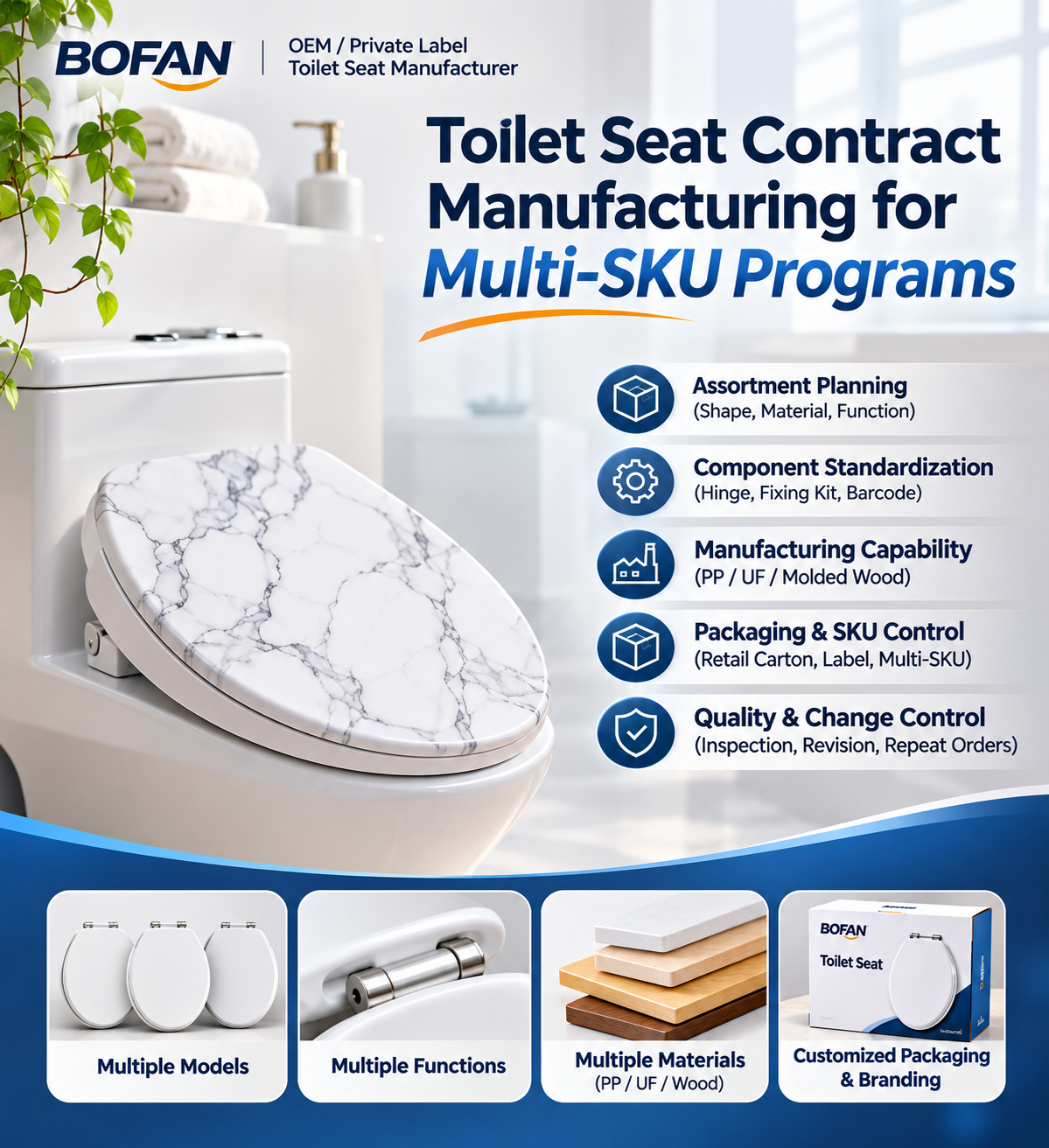
Toilet Seat Contract Manufacturing for Multi-SKU Programs
A multi-SKU toilet seat program is more complex than ordering one product in one color. A distributor or private-label brand may need round and elongated shapes, PP and UF material options, soft-close and standard-close versions, several packaging formats and separate customer SKUs.
The challenge is not only obtaining a competitive quotation. It is creating a controlled manufacturing system that keeps each SKU identifiable, repeatable and commercially viable.
This guide explains what buyers should confirm when building a toilet seat contract manufacturing program across multiple SKUs.
Define the Assortment Before Requesting Prices
Start with the role of each SKU in the assortment.
| SKU role | Typical product decision |
|---|---|
| Entry-level replacement seat | Standard PP, simple fixing kit and cost-focused packaging |
| Mid-range retail SKU | Soft-close hinge, improved finish and retail-ready carton |
| Premium bathroom range | UF or molded wood, refined hinge appearance and branded packaging |
| E-commerce item | Clear compatibility details and stronger parcel protection |
| Commercial replacement SKU | Stable installation, practical carton quantity and repeat availability |
Every SKU should have a purpose. Too many similar products can increase inventory, packaging and component complexity without adding meaningful sales value.
Build One Controlled SKU Master
A SKU name alone is not enough for contract manufacturing.
Create a master specification for each item that includes:
Buyer SKU
Factory model
Product shape
Material
Color and finish
Product dimensions
Hinge code
Fixing-kit code
Soft-close or standard-close function
Quick-release function
Buffer configuration
Product weight where relevant
Packaging format
Barcode
Instruction sheet
Carton quantity
Approved sample reference
Revision history
The purchase order, inspection plan and repeat-order request should all refer to this same record.
Standardize Components Where Possible
A multi-SKU program becomes easier to manage when related products share approved components.
For example, buyers may standardize:
Hinge families
Fixing-kit families
Hardware bag layouts
Instruction-sheet format
Barcode placement
Outer-carton marks
Color references
Carton dimensions for related products
Standardization can reduce purchasing complexity, simplify warehouse replenishment and improve spare-parts continuity. It should not compromise ceramic compatibility or product performance.
Confirm Factory Capacity for the Whole Program
A contract manufacturer should be evaluated on its ability to manage the full assortment, not only one sample.
Ask the supplier:
Which product types are produced in-house?
Which materials are available for each product shape?
Which hinges and fixing kits are compatible with each SKU?
Can production be scheduled across multiple models?
What is the MOQ for each SKU, color and carton?
Can packaging materials be stored for repeat orders?
How are component changes controlled?
How are production batches identified?
What happens if a key component becomes unavailable?
The supplier should explain any differences between prototype capability and normal production capability.
Plan MOQ Around the Entire Assortment
MOQ should be reviewed at SKU level and program level.
| MOQ question | Why it matters |
|---|---|
| Product MOQ | May differ by shape and material |
| Color MOQ | Custom colors can require separate production runs |
| Hinge MOQ | Specialty hinges may have component minimums |
| Packaging MOQ | Printed cartons may have higher minimums |
| Combined order value | Helps assess whether several SKUs can share shipment costs |
| Repeat-order MOQ | Determines replenishment flexibility |
A buyer may choose to use standard packaging or shared components on slower-moving SKUs to keep the assortment commercially practical.
Coordinate Packaging and Barcode Control
Multi-SKU packaging errors create warehouse and customer-service problems quickly.
For every SKU, confirm:
Retail carton artwork version
Product image
Material and feature description
Barcode number
Barcode location
Country-of-origin marking
Instruction sheet
Outer-carton marks
Carton quantity
Pallet label where required
The manufacturer should have a packing verification process to confirm that the correct seat, hardware bag, instructions and carton are matched before shipment.
Set Quality Controls by SKU Family
Not all products need the same inspection focus.
A practical quality plan may include:
| SKU family | Main quality controls |
|---|---|
| PP replacement seats | Fit, surface condition, fixing-kit completeness and installation stability |
| Soft-close products | Hinge code, closing movement, alignment and buffer contact |
| Quick-release products | Release and locking function, hinge fit and user operation |
| UF products | Surface finish, color, hinge appearance and alignment |
| Molded-wood products | Finish quality, edge condition, hinge stability and packaging protection |
| Printed products | Artwork version, print position, color and packaging accuracy |
The supplier should use the approved sample and written specification as the production reference.
Create a Clear Change-Control Process
A small component change can affect several SKUs at once.
Require written approval before changes to:
Material
Color formulation
Hinge
Damper
Fixing kit
Buffer
Product dimensions
Surface finish
Packaging insert
Carton artwork
Instruction sheet
The change notice should state the affected SKUs, reason for the change, sample requirement, approval contact and effective production batch.
Plan Replenishment Before the First Shipment
The first order should establish the data needed for future orders.
Keep:
Approved samples
SKU master specifications
Hinge and fixing-kit codes
Packaging artwork files
Barcode records
Inspection reports
Production batch references
Carton dimensions and CBM
Approved deviations
Spare-parts requirements
This protects the consistency of the range as the program grows.
How BOFAN Supports Multi-SKU Manufacturing Programs
BOFAN supports contract manufacturing discussions for toilet seat programs across PP, UF and molded-wood ranges. Support may include SKU mapping, ceramic-fit review, material and hinge selection, packaging coordination, sample approval, inspection planning and repeat-order change control.
CTA: Discuss a Multi-SKU Toilet Seat Program
Send BOFAN your current SKU list, target material mix, shapes, hinge requirements, packaging needs, annual demand estimate and destination markets for an initial manufacturing review.
FAQ
What is a multi-SKU toilet seat program?
It is a coordinated range of toilet seats with multiple shapes, materials, functions, colors or packaging formats managed under one purchasing and manufacturing plan.
How can buyers reduce complexity in a multi-SKU program?
Standardize suitable components, use controlled SKU specifications, limit unnecessary variants and keep approved records for hinges, fixing kits and packaging.
Can one factory make PP, UF and molded-wood toilet seats?
This depends on the supplier’s production capability. Buyers should confirm which material categories and product platforms are produced and controlled by the factory.
Why is change control important?
A change to a hinge, fixing kit, finish or carton can affect product fit, function, packaging, spare parts and repeat-order consistency.
What should a contract manufacturer provide before quotation?
The supplier should confirm product models, materials, compatible components, MOQ, packaging capability, production lead time, inspection process and change-control approach.
Table of Contents
- Toilet Seat Contract Manufacturing for Multi-SKU Programs
- Define the Assortment Before Requesting Prices
- Build One Controlled SKU Master
- Standardize Components Where Possible
- Confirm Factory Capacity for the Whole Program
- Plan MOQ Around the Entire Assortment
- Coordinate Packaging and Barcode Control
- Set Quality Controls by SKU Family
- Create a Clear Change-Control Process
- Plan Replenishment Before the First Shipment
- How BOFAN Supports Multi-SKU Manufacturing Programs
- FAQ