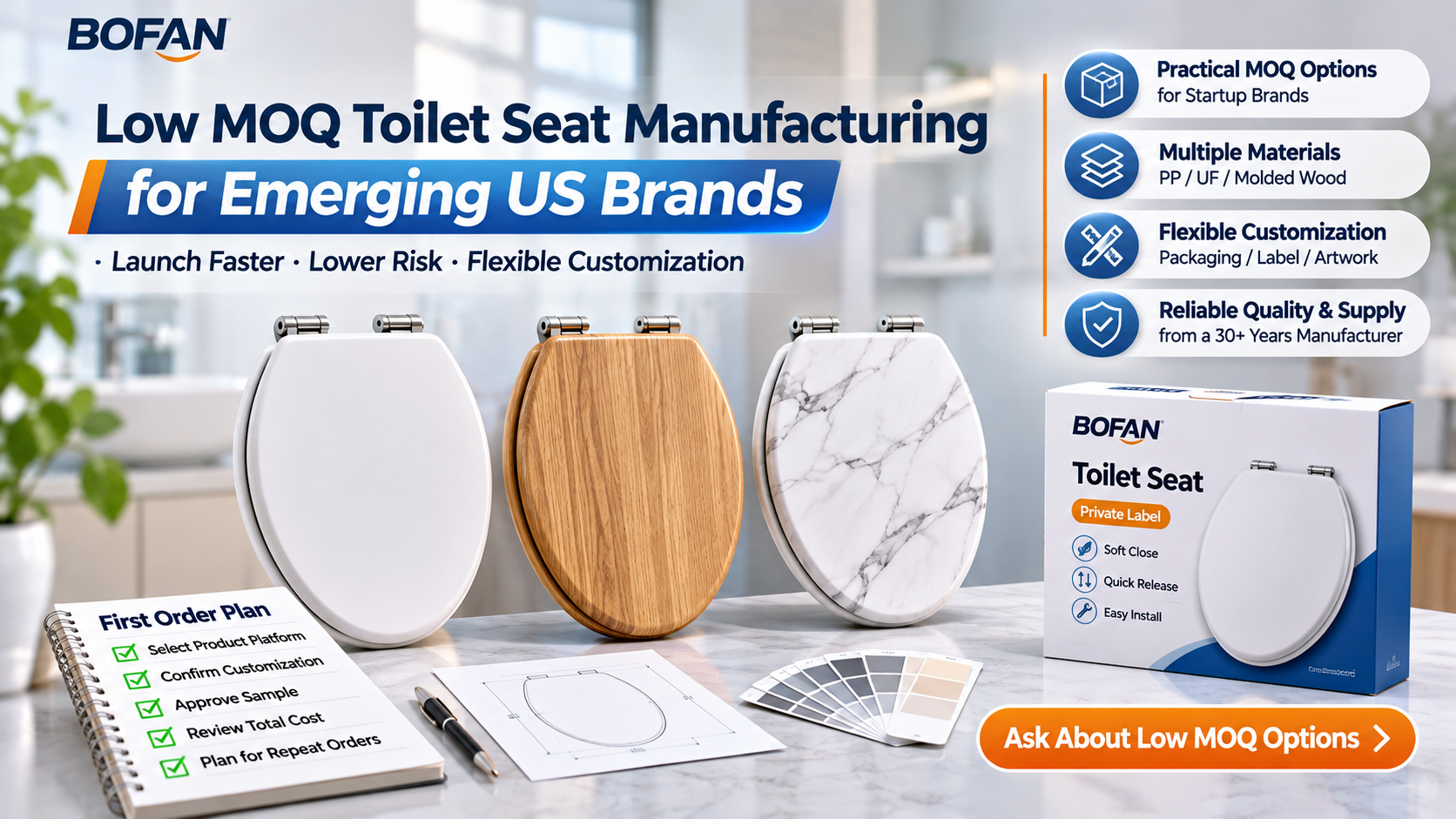
Low MOQ Toilet Seat Manufacturing for Emerging US Brands
For an emerging bathroom brand, a low MOQ toilet seat order can reduce launch risk and preserve working capital. However, low MOQ does not mean every product customization is available at a small quantity.
Material color, hinge selection, retail packaging, printed artwork and special hardware may each have their own minimum order requirements. A buyer who understands these limits can create a practical first order instead of requesting a highly customized program that cannot be produced consistently.
This guide explains how US brands can structure a low MOQ toilet seat project without creating unnecessary cost or repeat-order risk.
Understand What MOQ Actually Covers
MOQ is not always one number for the complete product.
A supplier may have separate requirements for:
| Project item | Why MOQ may apply |
|---|---|
| Toilet seat model | Production setup and molding efficiency |
| Material color | Resin or pigment batch requirements |
| Hinge system | Component supply and assembly planning |
| Fixing kit | Hardware purchasing quantity |
| Retail carton | Print quantity and carton conversion setup |
| Artwork | Printing preparation and proofing |
| Decorative finish | Process setup and material availability |
| Product testing | Sample quantity and project-specific work |
Ask for MOQ by component category. This gives a more realistic picture than asking only, “What is your minimum order quantity?”
Start With an Existing Product Platform
The easiest way to reduce MOQ risk is usually to begin with an existing product model.
An existing platform may allow a brand to select:
Round, elongated or D-shape product
PP, UF or molded-wood material
Standard color
Existing hinge option
Standard fixing kit
Soft-close function
Quick-release option
Standard carton with label customization
Private-label instruction sheet
A completely new shape, custom mold, unique hinge or complex print design usually requires a larger commitment.
Simplify the First Order
A low MOQ launch should focus on the product details that matter most to the customer.
A practical first-order structure may include:
One product shape
One material
One standard color
One hinge configuration
One fixing-kit option
One retail carton design
One destination market
One approved instruction sheet
After the product proves demand, the brand can add colors, decorative collections or additional shapes.
Decide Where to Customize First
Not every customization has the same commercial value.
| Customization route | Low-MOQ suitability |
|---|---|
| Carton label or sticker | Often more practical for first orders |
| Branded instruction sheet | Usually easier than custom product tooling |
| Standard product with private-label carton | Common starting route |
| Existing color with branded packaging | Lower complexity |
| Custom Pantone color | May require higher material MOQ |
| Decorative printing | May require additional setup and approval |
| New product shape | Usually requires new tooling and higher commitment |
| Custom hinge development | Often unsuitable for an initial low-MOQ order |
Choose the feature that helps the product sell, rather than customizing every visible component at launch.
Confirm the Product Specification Before Sampling
Even a small order requires a controlled specification.
Confirm:
Buyer SKU
Factory model
Product shape
Material
Surface finish
Color
Hinge code
Fixing-kit code
Soft-close requirement
Quick-release requirement
Buffer configuration
Packaging format
Barcode
Instruction sheet
Inspection requirements
Small orders can be more vulnerable to substitution or misunderstanding because buyers may assume the product is based on a standard model. A written specification protects repeatability.
Use Samples to Reduce Launch Risk
Before bulk production, order or approve a representative sample.
Check:
Ceramic fit
Product dimensions
Color and finish
Hinge appearance
Soft-close movement
Quick-release operation
Fixing-kit completeness
Installed stability
Packaging protection
Barcode and label placement
Instruction-sheet accuracy
The sample should represent the intended bulk product. If it uses a different hinge, carton or material from the first order, record that difference before approval.
Review Unit Cost and Total Landed Cost
A low MOQ may reduce inventory exposure, but the unit price can be higher than a large-volume order.
Review the full cost structure:
Product unit price
Packaging cost
Artwork setup
Sample cost
Tooling cost, if any
Inspection cost
Freight cost
Customs and destination charges
Warehouse receiving cost
Returns and replacement allowance
A smaller order with high carton volume may have a less favorable freight cost per unit. Buyers should compare product price and landed cost together.
Ask About Future Scale-Up Options
A first order should be designed to support the next order.
Ask the supplier:
What quantity improves the unit price?
Which components become more economical at higher volume?
Can the same hinge and fixing kit be reserved for repeat orders?
Can the same carton artwork be reused?
What is the lead time for replenishment?
Which changes require a new sample?
Are spare parts available?
What happens if a standard component is discontinued?
The right supplier should help the buyer build a path from a test order to a repeatable program.
Avoid Common Low-MOQ Mistakes
Avoid these frequent problems:
Requesting a new mold for a very small first order
Combining many colors and SKUs in one test order
Approving a product from photographs only
Using a generic instruction sheet for a different fixing kit
Printing retail cartons before the product is frozen
Ignoring freight cost per unit
Assuming the first sample represents all future orders
Not recording the approved hinge and fixing codes
Choosing the lowest quote without comparing included components
The best low MOQ project is usually simple, controlled and easy to repeat.
How BOFAN Supports Emerging Brand Programs
BOFAN supports qualified OEM and private-label toilet seat projects using PP, UF and molded-wood product platforms. For emerging brands, the team can discuss existing models, suitable customization routes, sample preparation, hinge and fixing options, packaging and realistic MOQ planning.
CTA: Ask About Low MOQ Toilet Seat Options
Launching a toilet seat brand or testing a new bathroom SKU? Send BOFAN your target product shape, material preference, hinge requirements, packaging plan, estimated first order and target market.
FAQ
What is considered a low MOQ for toilet seats?
It depends on the selected product model, material, color, hinge and packaging. Ask suppliers to separate MOQ by product, color, artwork and carton requirements.
Can a low MOQ toilet seat order include private-label packaging?
Often yes. A simple carton label, branded instruction sheet or standard carton with approved branding may be more practical than a fully custom printed retail box at a very small quantity.
Can buyers order a custom color at low MOQ?
Custom colors may require higher minimums because of pigment, resin and production-batch requirements. Confirm this before approving a product concept.
Is an existing toilet seat model better for a startup brand?
Usually, yes. An existing platform can reduce development time, tooling exposure and technical risk while allowing selected private-label customization.
What should be approved before the first low MOQ order?
Approve the product specification, sample, hinge and fixing configuration, packaging, barcode, instruction sheet, inspection points and any agreed deviations.
Table of Contents
- Low MOQ Toilet Seat Manufacturing for Emerging US Brands
- Understand What MOQ Actually Covers
- Start With an Existing Product Platform
- Simplify the First Order
- Decide Where to Customize First
- Confirm the Product Specification Before Sampling
- Use Samples to Reduce Launch Risk
- Review Unit Cost and Total Landed Cost
- Ask About Future Scale-Up Options
- Avoid Common Low-MOQ Mistakes
- How BOFAN Supports Emerging Brand Programs
- FAQ