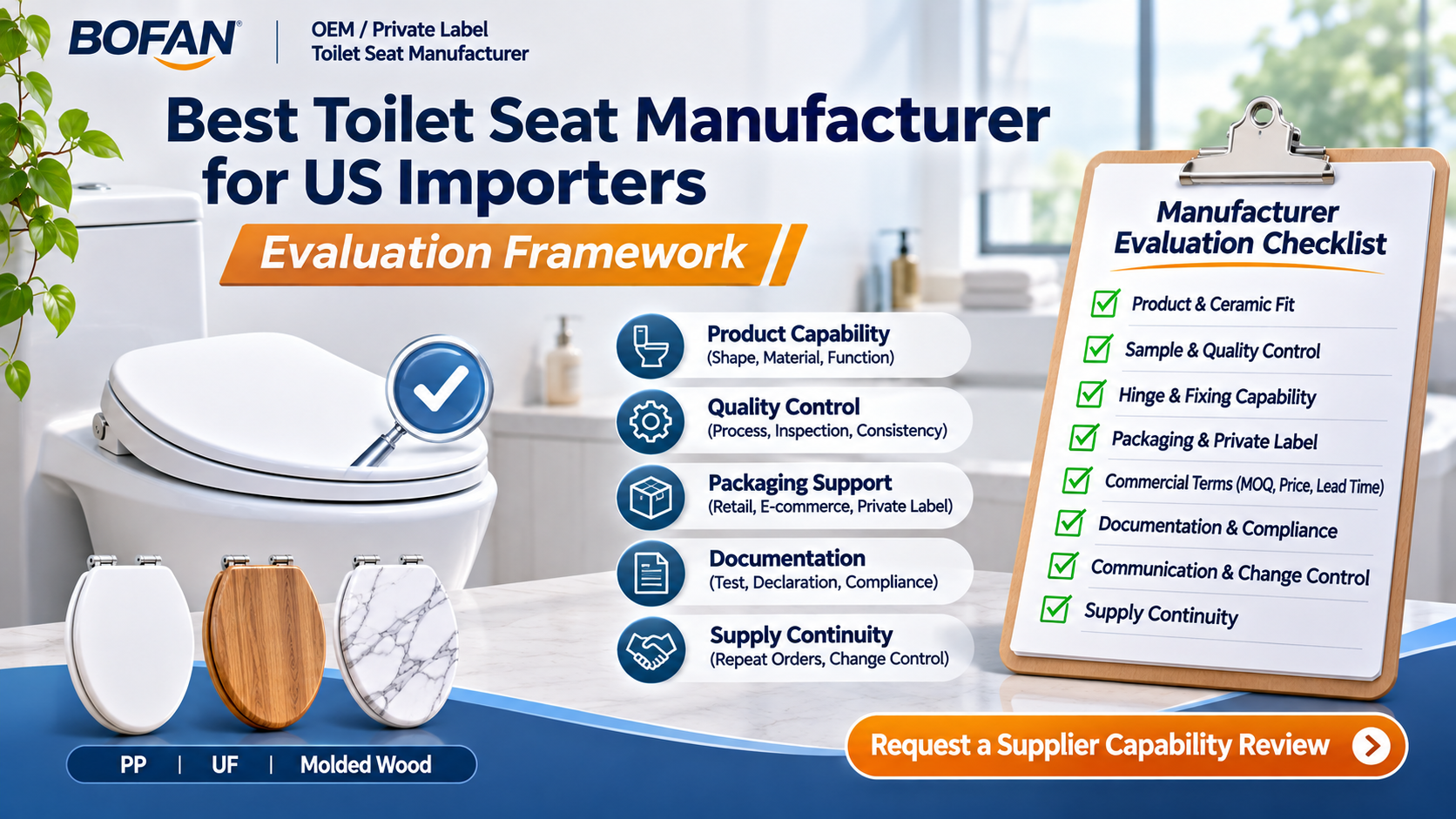
Best Toilet Seat Manufacturer for US Importers: Evaluation Framework
The best toilet seat manufacturer for a US importer is not automatically the factory with the lowest quote, the largest catalogue or the fastest initial reply.
The right supplier must be able to make the selected product consistently, support the intended retail channel, provide usable technical information and manage repeat orders without unapproved changes.
This evaluation framework helps importers, distributors, retailers and private-label brands compare toilet seat manufacturers on the factors that matter before placing an order.
Start With Your Own Product Requirements
A supplier cannot be evaluated properly until the buyer has defined the project.
Prepare a clear brief covering:
Product shape
Intended ceramic compatibility
Material: PP, UF, MDF or molded wood
Surface finish and color
Soft-close requirement
Quick-release requirement
Top-fix or bottom-fix installation
Hinge and fixing expectations
Estimated order quantity
Packaging format
Sales channel
Destination market
Testing or documentation requirements
Target launch timing
This gives each supplier the same basis for quotation and makes comparison more meaningful.
Review Product Capability, Not Only Catalogue Size
A broad catalogue can be useful, but it does not prove that the supplier can make the exact product you need.
Ask:
Which current models fit the intended ceramic?
Which shapes are available in PP, UF and molded wood?
Which hinge systems are compatible with each model?
Can the supplier support soft-close and quick-release options?
Which fixing kits are available?
Can the factory provide top-fix and bottom-fix solutions?
What customization is possible without new tooling?
Which changes require new tooling?
A suitable manufacturer should be able to explain product limitations as clearly as product options.
Compare Quotations on the Same Basis
Do not compare only unit prices.
Use a quotation matrix:
| Comparison item | What to verify |
|---|---|
| Factory model | Exact configuration quoted |
| Material | PP, UF, MDF, molded wood or approved alternative |
| Hinge | Code, material, finish and function |
| Fixing kit | Code and installation method |
| MOQ | Product, color, packaging and artwork minimums |
| Unit price | Included components and trade term |
| Packaging | Retail pack, carton quantity, dimensions and CBM |
| Sample | Cost, lead time and approval process |
| Tooling | Existing mold or new-tooling requirement |
| Production lead time | Start point and shipment readiness |
| Documents | Available declarations, reports and support |
| Payment terms | Standard commercial terms |
A low price may exclude the hinge, packing insert, instruction sheet or quality-control requirement that another supplier has included.
Evaluate Sample Quality on the Intended Ceramic
A sample should be installed and tested before mass production approval.
Check:
Product shape and alignment
Mounting-hole adjustment range
Hinge position
Fixing-kit compatibility
Stability after installation
Seat and lid movement
Soft-close behavior
Quick-release operation
Buffer contact
Surface finish
Color
Packaging protection
A visually good sample that does not fit the intended toilet bowl is not an approved product.
Ask About Quality-Control Process
A buyer should understand how the supplier controls bulk production.
Useful questions include:
How are materials identified and approved?
What does the first-piece check include?
How are hinges and fixing kits verified?
How are soft-close functions checked?
How are product dimensions measured?
How are packaging errors prevented?
Is batch identification available?
Can the buyer arrange third-party inspection?
How are defects recorded and corrected?
What change-control process applies?
The supplier should be prepared to discuss process controls, not simply state that quality is “good.”
Check Packaging and Retail Readiness
The manufacturer should be able to support the actual sales channel.
Confirm:
Retail box, bulk carton or e-commerce packaging options
Inner protection for hinges and finished surfaces
Hardware-bag format
Instruction-sheet capability
Barcode placement
Carton quantity and weight
Palletization options
Outer-carton marks
Private-label artwork approval process
FBA or warehouse-label support where applicable
Packaging problems can create returns, warehouse delays and damaged product even when the seat itself is acceptable.
Review Documentation and Compliance Support
Documentation should match the exact product and market requirement.
Ask the supplier what it can provide for the selected project, such as:
Product material declarations
Test evidence where available
Batch or traceability information
Country-of-origin documentation
Packaging-material information
Factory audit documents where requested
Project-specific testing support
Do not request a generic certificate package without confirming whether it applies to the selected model, material, hinge configuration and destination.
Assess Communication and Change Management
A manufacturer becomes a long-term supplier through communication quality as much as product capability.
Evaluate:
Response clarity
Ability to identify missing technical information
Accuracy of quotation details
Willingness to provide component codes
Artwork review process
Sample feedback handling
Transparency about MOQ and lead time
Process for approving changes
Handling of repeat orders
Speed of issue escalation
A supplier that asks practical clarification questions early may prevent major problems later.
Evaluate Supply Continuity
For a distributor or retailer, the first shipment is only the beginning.
Ask:
Can the factory support repeat production?
Which components are critical to continuity?
Can approved packaging materials be retained?
Are spare hinges and fixing kits available?
What happens if a component is discontinued?
Is there a documented change-notification process?
Can the supplier support a mixed-SKU replenishment order?
How is capacity planned during peak periods?
Supply continuity is particularly important for replacement ranges and private-label programs that depend on matching past orders.
Manufacturer Evaluation Scorecard
| Evaluation area | Weight | Key question |
|---|---|---|
| Product and ceramic fit | 20% | Can the factory make the correct seat for the intended bowl? |
| Sample and quality control | 20% | Can it prove the approved product will be reproduced consistently? |
| Hinge and fixing capability | 15% | Are components identified, compatible and controlled? |
| Packaging and private label | 15% | Can it support the intended sales channel? |
| Commercial terms | 10% | Are price, MOQ and lead time transparent? |
| Documentation support | 10% | Can it provide relevant evidence for the project? |
| Communication and change control | 10% | Can it manage revisions and repeat orders reliably? |
The weighting can be adjusted for your program. An e-commerce brand may assign more weight to packaging, while a project buyer may place greater weight on fitting and technical documentation.
How BOFAN Supports US Importer Evaluation
BOFAN supports importer, distributor and private-label toilet seat projects across PP, UF and molded-wood product categories. Buyers can submit product drawings, ceramic information, hinge requirements, packaging needs and expected quantities for feasibility review before quotation.
CTA: Request a Supplier Capability Review
Send BOFAN your product specification, target material, ceramic dimensions, required function, packaging format and estimated order volume for an initial project discussion.
FAQ
What makes a good toilet seat manufacturer for US importers?
A good supplier can produce the selected product consistently, confirm fit and components clearly, support packaging and documentation needs, and manage repeat-order changes in a controlled way.
Should buyers choose the lowest toilet seat quote?
Not without comparing the complete product configuration. Check the material, hinge, fixing kit, packaging, sample process, lead time and included components.
How can buyers verify toilet seat quality before ordering?
Approve a representative sample, review the quality-control process, define inspection criteria and test the product on the intended ceramic.
Why are hinge and fixing codes important?
They identify the approved components for repeat orders and help prevent unapproved substitutions that can affect function or installation stability.
What should a buyer send to a toilet seat manufacturer first?
Send the product shape, ceramic measurements, material preference, hinge requirements, quantity, packaging needs, destination market and target timeline.
Table of Contents
- Best Toilet Seat Manufacturer for US Importers: Evaluation Framework
- Start With Your Own Product Requirements
- Review Product Capability, Not Only Catalogue Size
- Compare Quotations on the Same Basis
- Evaluate Sample Quality on the Intended Ceramic
- Ask About Quality-Control Process
- Check Packaging and Retail Readiness
- Review Documentation and Compliance Support
- Assess Communication and Change Management
- Evaluate Supply Continuity
- Manufacturer Evaluation Scorecard
- How BOFAN Supports US Importer Evaluation
- FAQ