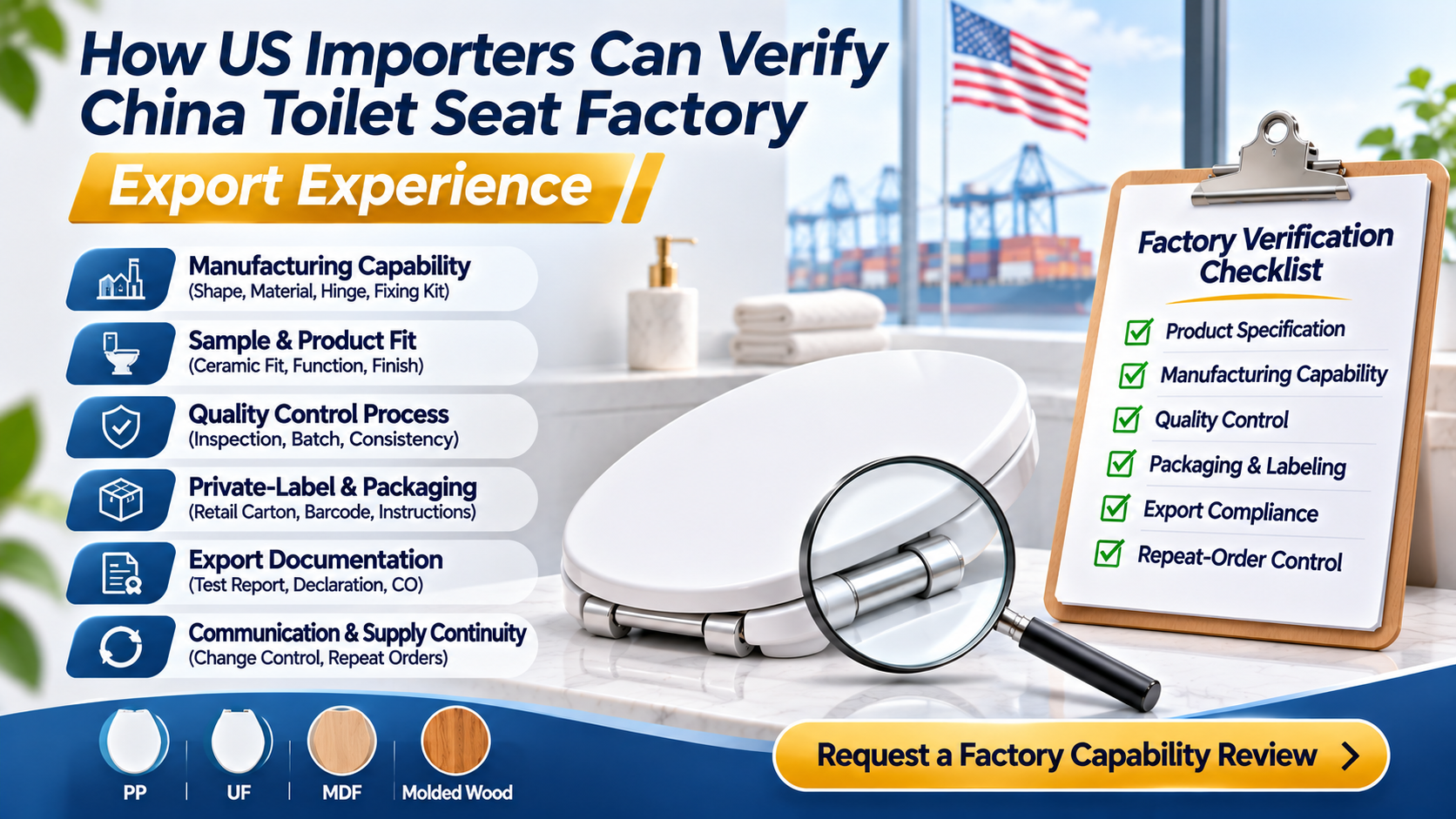
How US Importers Can Verify China Toilet Seat Factory Export Experience
A supplier website, catalogue and low quotation can start a conversation. They do not prove that a toilet seat factory can support a US import program.
A reliable supplier must be able to make the selected product consistently, explain its hinge and fixing configuration, manage private-label packaging, provide relevant documentation and repeat the approved product on future orders.
This guide gives US importers a practical process for verifying a China toilet seat factory before placing an OEM or wholesale order.
Start With the Exact Product Scope
Do not ask a factory only, “Do you export toilet seats to the USA?”
Send a project brief that includes:
Product shape
Ceramic measurements or drawing
Material: PP, UF, MDF or molded wood
Color and surface finish
Soft-close requirement
Quick-release requirement
Hinge preference
Top-fix or bottom-fix installation
Packaging format
Expected quantity
Destination market
Required documentation
Target launch date
A factory’s response to a detailed brief reveals more than a generic company introduction. It shows whether the team understands product fit, components and export requirements.
Verify Product and Manufacturing Capability
Ask for evidence that applies to the product category you need.
Review:
| Verification area | What to request or confirm |
|---|---|
| Product range | Current PP, UF, MDF or molded-wood models |
| Shape capability | Round, elongated, D-shape or custom-fit options |
| Hinge options | Soft-close, standard-close and quick-release configurations |
| Fixing systems | Top-fix, bottom-fix and compatible hardware kits |
| Factory models | Internal model references for quoted products |
| Sample process | Lead time, cost and approval route |
| Production process | How materials, components and finished goods are controlled |
| Packaging | Retail carton, bulk packing and private-label capability |
The factory should be able to explain which parts are standard, which parts can be customized and which changes need tooling or higher MOQ.
Ask for a Representative Sample
A sample is one of the most useful verification tools.
Install the sample on the intended ceramic or a representative fixture and check:
Bowl fit and alignment
Mounting-hole adjustment range
Hinge appearance
Fixing-kit compatibility
Seat stability
Soft-close movement
Quick-release operation
Surface finish
Color
Buffer contact
Packaging protection
A sample should represent the intended bulk product. If it uses a different hinge, fixing kit or packaging format, record the difference clearly.
Review Export Documentation Support
A supplier does not need to provide every document before a product is selected. It should, however, explain what evidence is available and whether it applies to the proposed project.
Ask about:
Material declarations
Product test evidence where available
Country-of-origin documentation
Packing-list and commercial-invoice support
Batch identification
Packaging-material information
Factory audit information where required
Project-specific testing support
Check that the product description, material, date and configuration shown on any report are relevant to the proposed product.
Understand the Quality-Control Process
A serious factory should explain how it controls production.
Key questions include:
How are incoming materials identified?
How are hinges and fixing kits verified?
What is checked at first-piece approval?
How are soft-close functions inspected?
How are dimensions and alignment checked?
How are packaging errors prevented?
Is batch traceability available?
Can a buyer arrange third-party inspection?
How are defects recorded and corrected?
“Good quality” is not a quality-control plan. The buyer needs to understand the actual inspection points.
Check Private-Label and Packaging Capability
For US retail or e-commerce programs, product quality alone is not enough.
Confirm whether the factory can support:
Retail cartons
Private-label artwork
Product barcodes
Instruction sheets
Hardware bags
Outer-carton marks
FBA labels, where required
Pallet labels
Product and carton photos before shipment
Ask who approves artwork, how final versions are controlled and what happens when packaging changes after sampling.
Evaluate Communication Before Ordering
Early communication often predicts project performance.
Assess whether the supplier:
Answers technical questions directly
Identifies missing project information
Provides consistent product details
Explains MOQ clearly
Provides a complete quotation
Records approved changes
Responds to sample feedback constructively
Separates confirmed facts from assumptions
Raises compatibility concerns before production
A supplier that asks practical questions early can reduce expensive corrections later.
Confirm Repeat-Order Controls
The first shipment should not be treated as an isolated transaction.
Ask:
How will the factory identify the approved product in future orders?
Are hinge and fixing-kit codes recorded?
Will packaging artwork versions be retained?
What happens if a component is discontinued?
Is buyer approval required before substitutions?
Can spare parts be supplied?
How are repeat-order colors and finishes controlled?
Can the supplier support a mixed-SKU replenishment order?
Keep the approved sample, factory model, product specification, packaging version and inspection record for every repeat order.
Factory Verification Checklist
Before placing an order, confirm:
Factory identity and contact details
Product models suitable for the project
Material capability
Hinge and fixing options
Ceramic-fit review
Representative sample
Quality-control process
Packaging capability
Relevant documentation support
MOQ and lead-time explanation
Inspection arrangement
Change-control process
Repeat-order plan
How BOFAN Supports Supplier Evaluation
BOFAN supports importers, distributors and private-label buyers with product feasibility review before quotation. Buyers can provide ceramic drawings, product requirements, hinge preferences, packaging needs and target quantities for initial project discussion.
CTA: Request a Factory Capability Review
Send BOFAN your product brief, ceramic information, material preference, required functions, packaging format and expected order volume for review.
FAQ
How can an importer verify a toilet seat factory before ordering?
Review the factory’s product capability, request a representative sample, assess quality controls, confirm packaging support and document approved components for repeat orders.
Is a sample enough to approve a supplier?
A sample is important, but it should be combined with a review of manufacturing controls, packaging capability, documentation support and communication quality.
What should buyers check on a toilet seat sample?
Check ceramic fit, hinge and fixing kit, installation stability, surface finish, functions, packaging and instruction accuracy.
Why are component codes important?
Hinge and fixing-kit codes identify the approved components and help prevent unapproved substitutions in future production.
Can a buyer arrange third-party inspection?
Yes. The inspection scope, timing and acceptance criteria should be agreed before bulk production starts.
Table of Contents
- How US Importers Can Verify China Toilet Seat Factory Export Experience
- Start With the Exact Product Scope
- Verify Product and Manufacturing Capability
- Ask for a Representative Sample
- Review Export Documentation Support
- Understand the Quality-Control Process
- Check Private-Label and Packaging Capability
- Evaluate Communication Before Ordering
- Confirm Repeat-Order Controls
- Factory Verification Checklist
- How BOFAN Supports Supplier Evaluation
- FAQ