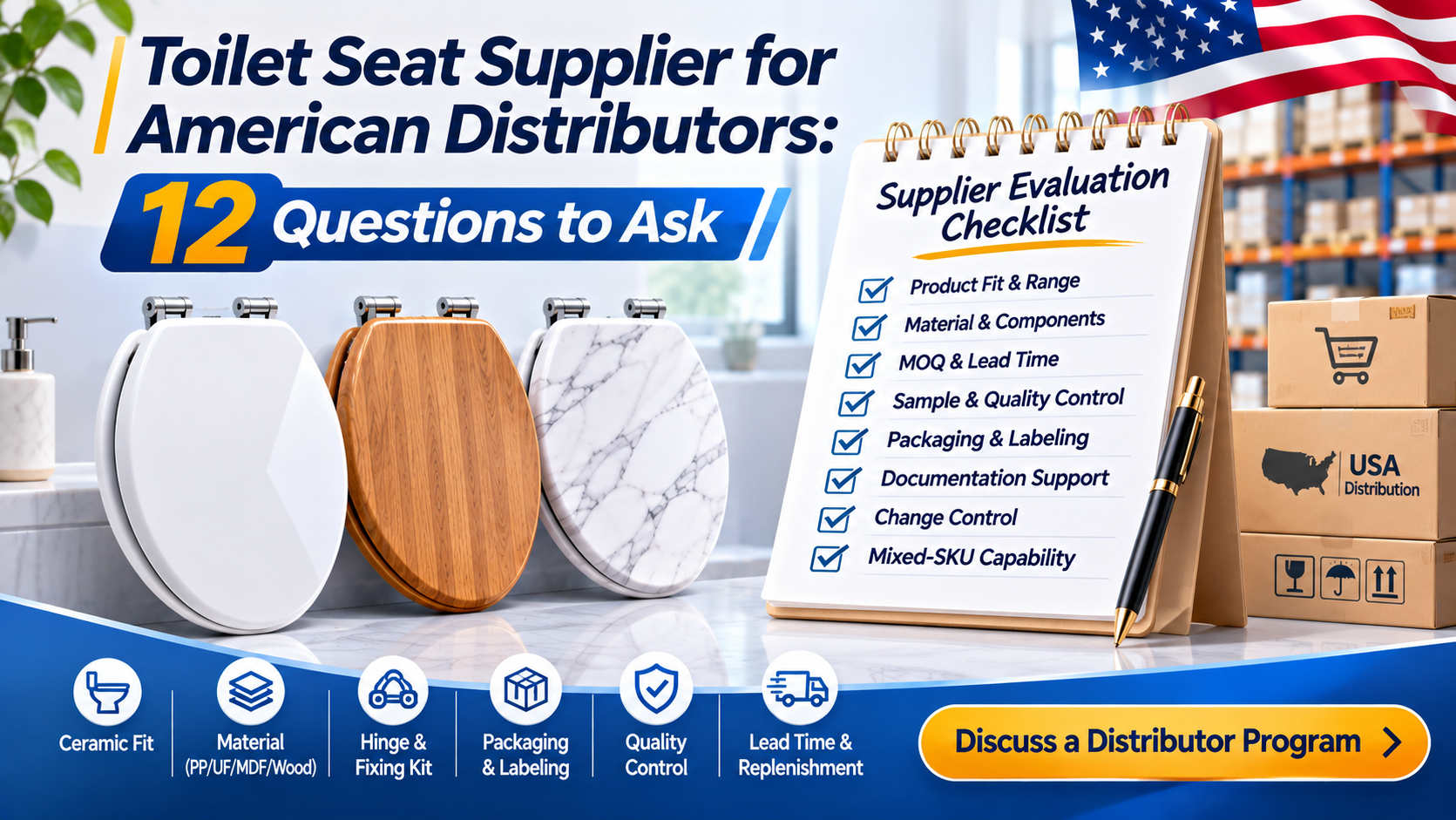
Toilet Seat Supplier for American Distributors: 12 Questions to Ask
Selecting a toilet seat supplier is not only about finding the lowest unit price. American distributors need products that fit the intended toilet bowls, arrive in suitable packaging, can be replenished consistently and do not create unnecessary installation or return problems.
The questions below help a distributor evaluate whether a supplier can support a practical long-term toilet seat program.
1. Which Product Models Fit Our Target Market?
Ask the supplier which models are suitable for your intended customer base.
Confirm:
Round, elongated or D-shape options
Material choices
Relevant price levels
Typical retail or distributor applications
Product dimensions
Mounting-hole adjustment range
Compatibility limitations
The factory should not simply send a catalogue. It should help narrow the product range based on your target ceramic and sales channel.
2. Can You Review Our Ceramic Fit?
A toilet seat must be assessed as part of the toilet bowl system.
Provide:
Bowl length and width
Mounting-hole spacing
Mounting-hole diameter
Rear ceramic platform details
Top or underside fixing access
Photos with measurements
Drawing or physical sample where available
Ask the supplier how it will verify alignment, buffer contact and installation stability before production.
3. Which Materials Are Available for Each Shape?
Material affects product appearance, weight, price, packaging and customer expectations.
Ask which models are available in:
PP
UF
MDF
Molded wood
Then ask whether the shape, hinge and finish options are different for each material.
4. What Hinge and Fixing Kit Will Be Used?
Do not accept generic descriptions such as “soft-close hinge” or “metal fixing.”
Ask for:
Hinge code
Hinge material and finish
Soft-close or standard-close function
Quick-release option
Fixing-kit code
Top-fix or bottom-fix method
Adjustment range
Hardware-bag contents
Spare-parts availability
These details are essential for installation consistency and repeat-order control.
5. What Is the MOQ for Each Product Configuration?
MOQ can vary by more than product model.
Ask for MOQ by:
| MOQ category | Why it matters |
|---|---|
| Product model | Different shapes may require separate runs |
| Material | PP, UF and wood-based products may differ |
| Color | Custom colors may need higher quantities |
| Hinge | Specialty components may have separate minimums |
| Packaging | Printed cartons can have their own MOQ |
| Artwork | Decorative products may require setup quantities |
This helps distributors avoid building an assortment that cannot be replenished economically.
6. Can You Support Our Packaging Format?
Describe the intended sales channel and ask the supplier to confirm its capability.
Possible requirements include:
Retail cartons
Distributor bulk packs
E-commerce protection
Hardware bags
Instruction sheets
Barcodes
Country-of-origin marks
Outer-carton shipping marks
Pallet labels
FBA labels where required
Packaging should protect the hinge, product surface and fixing kit during normal transport and warehouse handling.
7. How Will You Control Product Quality?
Ask the supplier to explain its actual inspection process.
Key points:
Material confirmation
Product dimensions
Hinge and fixing-kit verification
Soft-close checks
Quick-release checks
Surface inspection
Color inspection
Packaging inspection
Final packed-product check
Batch identification
A supplier should be able to describe what is checked, when it is checked and how nonconforming products are handled.
8. Can We Approve a Production-Representative Sample?
The sample should include the intended product configuration as closely as possible.
Check:
Shape and ceramic fit
Surface finish
Color
Hinge appearance
Fixing kit
Soft-close movement
Quick-release function
Installation stability
Packaging
Instructions and labels
Ask whether the sample uses the same materials and components planned for bulk production.
9. What Documentation Can You Support?
Documentation depends on the selected product and market requirement.
Ask what the supplier can provide or support for:
Material declarations
Product test evidence where available
Country-of-origin documentation
Traceability records
Packaging information
Factory audit requirements
Project-specific testing
Verify whether the available evidence applies to the actual model, material and hinge configuration.
10. What Is the Production and Replenishment Lead Time?
Clarify when lead time starts.
Ask the supplier to separate:
Sample lead time
Artwork approval timing
Packaging-material preparation
Production lead time
Inspection timing
Shipment readiness
Repeat-order timing
A reliable distributor program needs a replenishment plan, not only a first-order promise.
11. How Are Changes Controlled?
Ask what happens if the supplier needs to change:
Hinge
Damper
Fixing kit
Material
Color
Buffer
Carton insert
Packaging artwork
Instruction sheet
The answer should include notification, sample review, buyer approval and effective production batch.
12. Can You Support Mixed-SKU Orders?
Distributors often need more than one product in a shipment.
Ask:
Can several SKUs be combined in one order?
What MOQ applies to each SKU?
Can carton sizes be coordinated?
Can pallets be mixed?
How are labels controlled across SKUs?
Can the supplier support slower-moving replacement items?
Is there a process for replenishment forecasting?
Mixed-SKU capability can help a distributor manage assortment breadth without holding excessive inventory.
Supplier Evaluation Table
| Evaluation point | What a distributor should receive |
|---|---|
| Product range | Relevant models with dimensions and material options |
| Ceramic fit | Review of the intended bowl and installation method |
| Components | Hinge and fixing-kit codes |
| Sample | Production-representative product for review |
| MOQ | Product, color, component and packaging requirements |
| Packaging | Carton data, barcode plan and protection method |
| Quality | Inspection points and acceptance process |
| Documentation | Relevant project support and evidence |
| Lead time | Clear timeline from sample to shipment |
| Repeat orders | Change control and replenishment process |
How BOFAN Supports American Distributors
BOFAN supports distributor and private-label toilet seat programs across PP, UF and molded-wood products. Buyers can submit product targets, ceramic information, hinge requirements, packaging formats and estimated demand for an initial range and feasibility review.
CTA: Discuss a Distributor Toilet Seat Program
Send BOFAN your target product range, current SKUs, ceramic information, preferred material, packaging needs and estimated annual volume.
FAQ
What should distributors ask before choosing a toilet seat supplier?
Ask about product fit, material options, hinge and fixing codes, MOQ, sample process, packaging, quality control, documentation, lead time and repeat-order change control.
Why is ceramic compatibility important?
A toilet seat may look suitable but still have poor alignment, limited fixing adjustment or inadequate buffer contact on the intended toilet bowl.
Can distributors order several toilet seat SKUs together?
Often yes, but each SKU may have separate MOQ, packaging and component requirements. Confirm the mixed-order structure before quotation.
Should distributors keep approved samples?
Yes. Keep approved product and packaging samples, specifications, component codes and inspection records for future replenishment orders.
What is the most common supplier-comparison mistake?
Comparing only unit price instead of comparing the full product configuration, included hinge and fixing kit, packaging, MOQ, quality controls and lead time.
Table of Contents
- Toilet Seat Supplier for American Distributors: 12 Questions to Ask
- 1. Which Product Models Fit Our Target Market?
- 2. Can You Review Our Ceramic Fit?
- 3. Which Materials Are Available for Each Shape?
- 4. What Hinge and Fixing Kit Will Be Used?
- 5. What Is the MOQ for Each Product Configuration?
- 6. Can You Support Our Packaging Format?
- 7. How Will You Control Product Quality?
- 8. Can We Approve a Production-Representative Sample?
- 9. What Documentation Can You Support?
- 10. What Is the Production and Replenishment Lead Time?
- 11. How Are Changes Controlled?
- 12. Can You Support Mixed-SKU Orders?
- Supplier Evaluation Table
- How BOFAN Supports American Distributors
- FAQ