Many buyers see the terms OEM and ODM when sourcing toilet seats, but the difference is not always clear.
Both models are common in the toilet seat industry, especially for importers, wholesalers, retailers, and private label brands. However, OEM and ODM are not the same in terms of customization depth, development speed, production process, and brand control.
As a professional toilet seat manufacturer, BOFAN works with buyers on both OEM and ODM toilet seat projects for different markets and product levels. For buyers, understanding the difference between these two models is important because it affects product uniqueness, launch timing, development cost, and long-term brand strategy.
This guide explains the difference between OEM and ODM toilet seats and helps buyers decide which option fits their business best.
What Is an OEM Toilet Seat?
An OEM toilet seat is a toilet seat produced according to the buyer’s requirements.
In an OEM project, the buyer usually has stronger control over the product direction. The buyer may define the material, shape, hinge function, color, branding, packaging, and other specifications based on its own market needs.
In simple terms, the manufacturer produces the product for the buyer’s brand, but the product itself is more buyer-led in terms of requirements and positioning.
Common OEM customization points include:
- material
- shape and size
- hinge type
- color and finish
- logo application
- retail packaging
- accessories and manuals
At BOFAN, OEM toilet seat projects often involve product specification confirmation, sample development, packaging coordination, and bulk production support.
What Is an ODM Toilet Seat?
An ODM toilet seat is based on a design or product structure that already exists at the factory.
In this model, the manufacturer has already developed the product, and the buyer selects from available factory designs. The buyer can usually make some adjustments, such as logo application, packaging, color, or minor finish changes, but the core product structure is generally already established.
This means ODM is usually faster and simpler than OEM because the product base is already ready.
For buyers who want a quicker launch and lower development complexity, BOFAN can also support ODM toilet seat cooperation based on available product structures.
OEM vs ODM Toilet Seat: What Is the Main Difference?
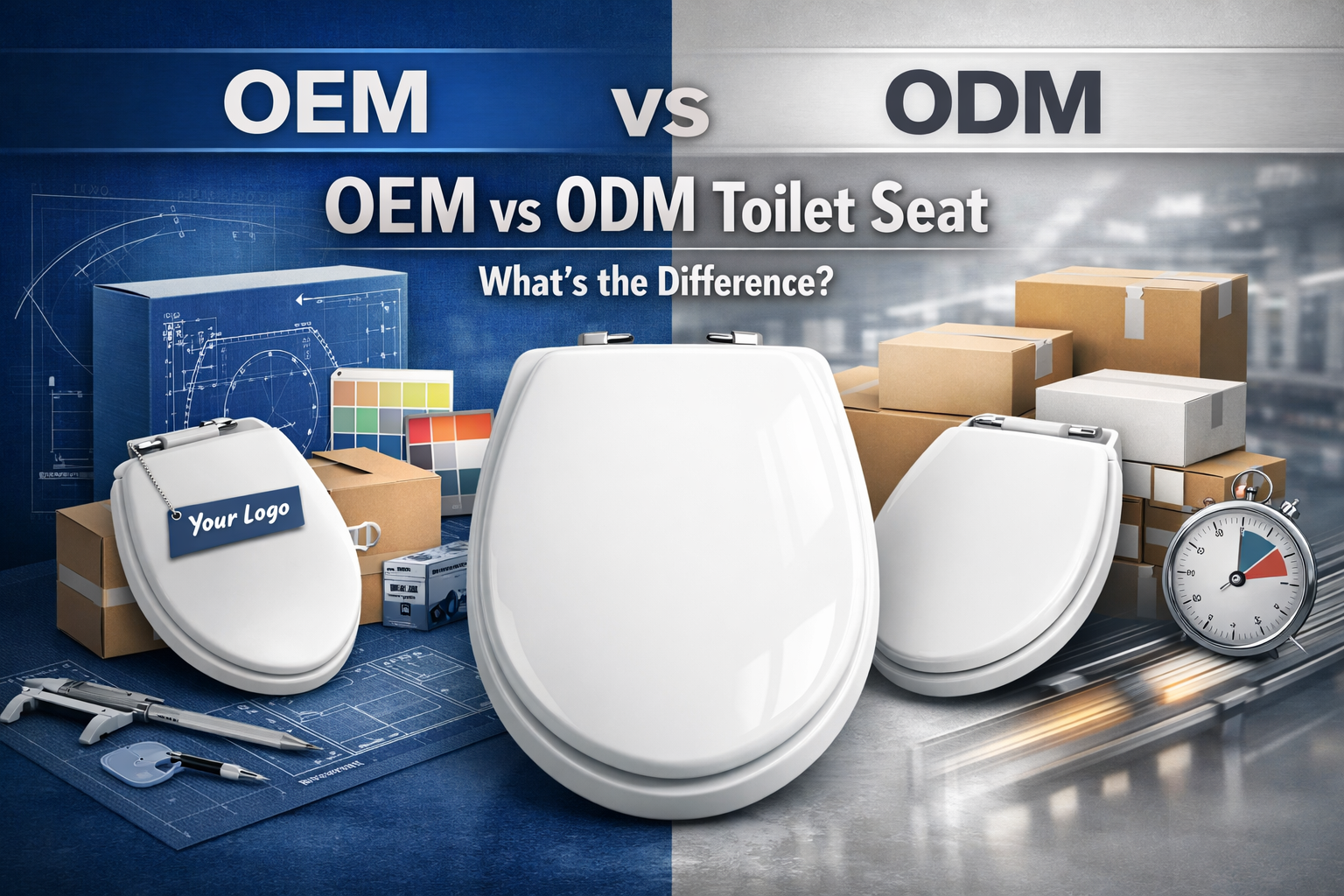
The main difference between OEM vs ODM toilet seat projects is who leads the product direction.
With OEM, the buyer usually leads the requirements. The manufacturer produces according to the buyer’s specifications and brand needs.
With ODM, the manufacturer leads the product base. The buyer selects from existing factory-developed options and makes lighter adjustments.
In simple terms:
- OEM = buyer-led customization
- ODM = manufacturer-led ready design
OEM usually offers more flexibility and stronger product differentiation. ODM usually offers a faster launch and a lower development burden.
In practical sourcing, suppliers like BOFAN may support both models, but the better option depends on the buyer’s timeline, brand positioning, and customization goals.
OEM vs ODM Toilet Seat Compared by Key Factors
Product Development Responsibility
In an OEM project, the buyer usually provides the product requirements, and the manufacturer develops the product accordingly.
In an ODM project, the manufacturer already has the product concept, structure, or mold, and the buyer chooses from existing options.
So, OEM is more buyer-driven, while ODM is more factory-driven.
Customization Level
OEM usually allows deeper customization.
This may include changes to material, shape, hinge, finish, packaging, and full brand presentation. It is a better fit for buyers who want the product to reflect their own market strategy more clearly.
ODM usually allows lighter customization.
Most of the time, it focuses on logo, packaging, and minor appearance adjustments rather than deeper product development.
Speed to Market
OEM projects are usually slower because product details need to be confirmed, samples need to be developed, and packaging often needs more coordination.
ODM projects are usually faster because the product foundation is already prepared. This makes ODM useful for buyers who want to enter the market quickly.
Tooling and Development Cost
OEM may involve more sample work, more development communication, and in some cases higher tooling or preparation cost, depending on how much needs to be changed.
ODM usually reduces the development burden because the product is already available in the factory’s range. This makes it more efficient for buyers with tighter launch timelines or lower development budgets.
Brand Differentiation
OEM is usually stronger for brand differentiation.
Because the buyer has more control over the product, it is easier to build a toilet seat line that feels unique to the brand.
ODM is often more practical for speed and convenience, but it may offer less uniqueness than a deeper OEM project.
Packaging and Branding
Both OEM and ODM can usually support logo and packaging.
However, OEM often gives the buyer more overall control over the final product presentation. That matters for brands that want product, packaging, and positioning to feel fully aligned.
Which Is Better for Different Buyers?
The better option depends on the buyer type and business goal.
For Private Label Brands
For private label brands, OEM is often better when the goal is to build stronger product identity and differentiation.
ODM may still work well if the brand wants to launch quickly and does not need major product changes at the beginning.
For Importers and Wholesalers
For importers and wholesalers, ODM can be practical for fast-moving standard product lines.
OEM is often better when the buyer wants more exclusive supply, stronger control over product details, or a more differentiated offering for the local market.
For Retailers and Supermarket Programs
Retailers and supermarket programs often care about standardization, packaging, product consistency, and launch timing.
ODM can work well when the project needs to move quickly.
OEM is often better when the retailer wants a more exclusive product range or stronger branded presentation.
For Established Sanitary Ware Brands
For established sanitary ware brands, OEM is often the better option because brand consistency, product positioning, and long-term line development matter more.
At BOFAN, buyers are usually guided based on their real market goals, not simply pushed toward one model.
When Should You Choose OEM Toilet Seat Supply?
OEM is usually the better choice when:
- you want a more differentiated product line
- you need deeper customization
- you want more control over specifications
- you care about brand positioning
- you are building a long-term branded product strategy
- you are willing to spend more time on development
If your goal is long-term brand building and stronger market identity, OEM usually offers more value.
When Should You Choose ODM Toilet Seat Supply?
ODM is usually the better choice when:
- you want to launch quickly
- you do not need deep product changes
- you want to reduce development complexity
- you are testing a new market or product line
- you prefer to use a factory’s proven product structure
If speed and simplicity matter more than deep customization, ODM is often the more practical route.
What Should Buyers Confirm Before Choosing OEM or ODM?
Before choosing between OEM and ODM, buyers should confirm several key points.
Product Positioning
Is the product meant to be a standard line, a mid-range branded line, or a more differentiated premium line?
The answer affects whether OEM or ODM is more suitable.
Customization Expectations
How much change is really needed?
Some buyers initially think they need OEM, but later realize they mainly need packaging and logo changes, which may fit ODM better.
Lead Time Requirements
Is a fast launch more important, or is stronger product uniqueness more important?
This question often helps buyers make the right decision more quickly.
Budget and Development Cost
Can the project support OEM development time and cost, or is a lower-complexity ODM route more practical?
Packaging and Branding Needs
Do you only need a logo and retail box, or do you need a fully coordinated branded product line?
That difference matters a lot.
Long-Term Supply Plan
Is this a short-term product test, or a long-term brand strategy?
If the product is meant to grow with the brand, OEM may be the better long-term investment.
How BOFAN Supports Both OEM and ODM Toilet Seat Projects
As a professional toilet seat manufacturer, BOFAN supports both OEM and ODM toilet seat cooperation.
For OEM projects, BOFAN can support:
- material selection
- hinge function choices
- shape and fit confirmation
- finish and appearance adjustment
- logo application
- packaging development
- sample coordination
- bulk production support
For ODM projects, BOFAN can support faster market entry based on existing product options, while still allowing practical brand-related changes such as logo, packaging, and selected finish adjustments.
This helps buyers choose the more suitable cooperation model based on their market, budget, brand plan, and launch timeline.
Conclusion
OEM and ODM toilet seats are both useful, but they serve different business needs.
OEM is usually better for buyers who want stronger customization, stronger brand differentiation, and more control over the final product.
ODM is usually better for buyers who want a faster and simpler route to market with lower development complexity.
As a professional toilet seat manufacturer, BOFAN focuses on helping buyers choose the right cooperation model based on their market strategy, budget, and product goals. The right choice depends on your timeline, brand plan, and customization expectations.