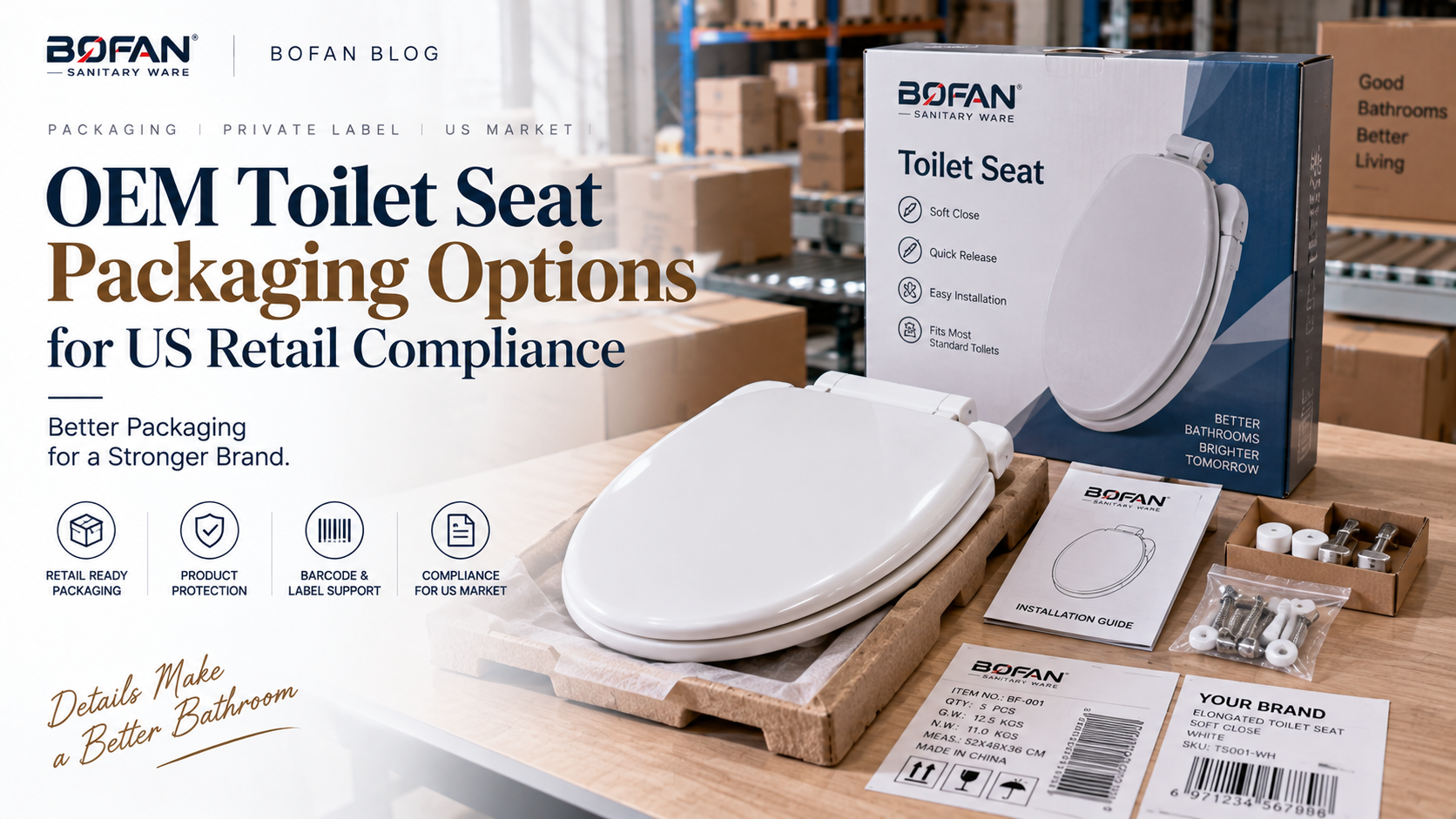
OEM Toilet Seat Packaging Options for US Retail Compliance
Toilet seat packaging is not merely a carton around a product. For a US retail, distributor or e-commerce program, it must protect the seat and hinge system, communicate the correct product information and meet the buyer’s channel-specific labeling and handling requirements.
A product can pass sample approval and still create returns, warehouse issues or retailer rejections if the packaging is incomplete, unclear or unsuitable for transport.
OEM buyers should define packaging early, then approve it as part of the complete sellable product.
Start With the Sales Channel
The packaging requirement depends on where and how the product will be sold.
A toilet seat for a plumbing distributor may use a practical bulk or trade carton. A home-improvement retail product may require branded shelf-ready packaging. An e-commerce program may need stronger protection and channel-specific labels.
State the intended channel:
Home-improvement retail
Hardware chain
Plumbing distributor
Independent bathroom retailer
E-commerce
Marketplace fulfillment program
Hotel, apartment or project supply
Private-label bathroom collection
The supplier should not assume one standard export carton will meet every channel requirement.
Select the Correct Packaging Format
Common formats may include:
| Packaging format | Typical use |
|---|---|
| Individual retail box | Retail display and branded private-label programs |
| Plain individual box | Distributor, project or economical private-label supply |
| Polybag plus master carton | Controlled bulk shipment where retail presentation is not required |
| Shrink-wrap or protective wrap | Additional surface protection in a box or bulk pack |
| Bulk carton | Project, distributor or warehouse supply |
| Palletized shipment | Larger warehouse and retail deliveries |
The appropriate format depends on product weight, material, hinge design, destination and channel handling.
A heavier molded-wood seat may need different internal protection from a lightweight PP product. Quick-release and soft-close components also need protection against impact and movement.
Protect the Product and Hardware
The packaging should protect both visible surfaces and functional components.
Review:
Seat and lid surface protection
Separation between metal parts and the seat
Hinge protection
Hardware-bag security
Buffer protection
Release-button protection
Space to prevent movement inside the box
Carton strength for normal transport handling
Outer-carton stacking arrangement
Product condition after unpacking
After packaging validation, unpack a sample and check the seat, lid, hinge and fixing kit again. Packaging should not create scratches, pressure marks, loose hardware or soft-close damage.
Define the Required Product Information
The individual pack and outer carton may need different information.
Depending on the buyer program, confirm:
Brand name
Product name
Buyer SKU
Factory model reference
Product shape and material
Soft-close or quick-release claim
Color
Barcode format and placement
Country-of-origin marking
Carton quantity
Gross and net weight
Carton dimensions
Handling marks
Batch or traceability code
Required warning or installation labels
Retailer-specific carton marks
Only make function, material or compatibility claims that match the approved product. For example, a carton should not state “soft-close seat and lid” if the selected configuration dampens only one component.
Include Installation Instructions
A toilet seat is often installed by the end user. The instruction sheet is therefore part of the product experience and the packaging compliance review.
The instructions should match the supplied:
Top-fix or bottom-fix system
Hinge arrangement
Washer and plug orientation
Adjustment method
Tightening sequence
Quick-release mechanism
Maintenance guidance
Safety or warning information where required
Ask a person unfamiliar with the product to install it using only the included components and instructions. If the installation process is unclear, revise the instructions before production.
Confirm Barcode and Artwork Control
For a private-label program, artwork should be approved before carton production begins.
The buyer should provide or confirm:
Artwork template
Brand logo
Packaging language
Required claims
Product photographs or illustrations
Barcode number and format
Barcode placement
Country-of-origin wording
Retailer label requirements
Final artwork approval contact
Artwork version number
A barcode that scans correctly on a digital file may still be poorly placed, distorted or covered by tape after packing. Verify the finished packaging sample.
Separate Retail Requirements From General Compliance
The exact documentation and packaging obligations depend on the product, material, destination, retailer and sales channel.
The buyer should identify whether the program requires:
Product-material declarations
Restricted-substance documentation
Country-of-origin documentation
Traceability marking
Timber or wood-material documentation for relevant products
Retailer packaging standards
Fulfillment-center labels
Pallet labels
Packaging-material declarations
Factory-audit information
The supplier should confirm what evidence is available and what must be prepared for the specific project. Do not request a generic “all compliance certificates” package without identifying the applicable requirement.
Approve the Complete Packaging Sample
A packaging artwork PDF is not the same as an approved packed product.
The final packaging sample should include:
Correct toilet seat model
Correct hinge and fixing kit
Correct hardware bag
Final carton artwork
Barcode
Labels
Instruction sheet
Internal protective materials
Outer carton and shipping marks where applicable
Check the sample for visual presentation, accuracy, scannability, product protection and functional condition after unpacking.
Control Packaging Changes After Approval
Small packaging changes can cause significant retail or warehouse problems.
Written approval should be required before changing:
Carton size
Carton board or construction
Internal protective material
Hardware-bag position
Artwork
Barcode
Product claim
Country-of-origin mark
Instruction sheet
Carton quantity
Outer-carton shipping marks
The change-control record should identify the affected SKU, reason for change, sample requirement, buyer approval and first production batch.
OEM Toilet Seat Packaging Checklist
Before production, confirm:
Sales channel is identified.
The selected format protects the exact product.
Hinge and hardware components are secured.
Product claims match the approved configuration.
Individual-box artwork is approved.
Barcode location and scan quality are checked.
Country-of-origin and required labels are included.
Instructions match the fixing kit.
Outer-carton marks are confirmed.
Packed samples are inspected after handling.
Relevant documentation requirements are identified.
Packaging changes require written approval.
How BOFAN Supports OEM Toilet Seat Packaging Programs
BOFAN can support retail, distributor and private-label packaging discussions for approved toilet seat programs.
Depending on the selected project, support may include:
Individual and bulk-pack options
Product-protection review
Hardware-bag and instruction coordination
Private-label artwork discussion
Barcode and carton-mark coordination
Carton-information review
Packaging-sample preparation
Repeat-order version control
Final packaging feasibility, carton MOQ, labeling requirements and transport suitability should be confirmed for the exact product, quantity, sales channel and destination.
CTA: Request a Packaging Solution
Planning a US toilet seat retail program? Send BOFAN your product model, sales channel, packaging format, artwork requirements, barcode information, expected quantity and destination. We can help review a suitable packaging solution.
FAQ
What packaging is suitable for a private-label toilet seat?
Most private-label retail programs use an approved individual box with product protection, instructions, barcode and required labels. The final format depends on the product and sales channel.
Should toilet seat packaging be tested with the final hinge system?
Yes. The final packed sample should use the approved seat, hinge and fixing kit because these components can be damaged by movement or impact.
What should appear on a toilet seat retail carton?
Typical information includes brand, product name, SKU, product claims, barcode, country of origin and required handling or retailer marks. Exact requirements depend on the program.
Can the same packaging be used for retail and e-commerce?
Sometimes, but e-commerce handling may require different protection or labeling. Confirm the requirement for the intended fulfillment route.
When should packaging artwork be finalized?
Finalize artwork after core product details are stable and before bulk packaging materials are ordered.
Table of Contents
- OEM Toilet Seat Packaging Options for US Retail Compliance
- Start With the Sales Channel
- Select the Correct Packaging Format
- Protect the Product and Hardware
- Define the Required Product Information
- Include Installation Instructions
- Confirm Barcode and Artwork Control
- Separate Retail Requirements From General Compliance
- Approve the Complete Packaging Sample
- Control Packaging Changes After Approval
- OEM Toilet Seat Packaging Checklist
- How BOFAN Supports OEM Toilet Seat Packaging Programs
- FAQ