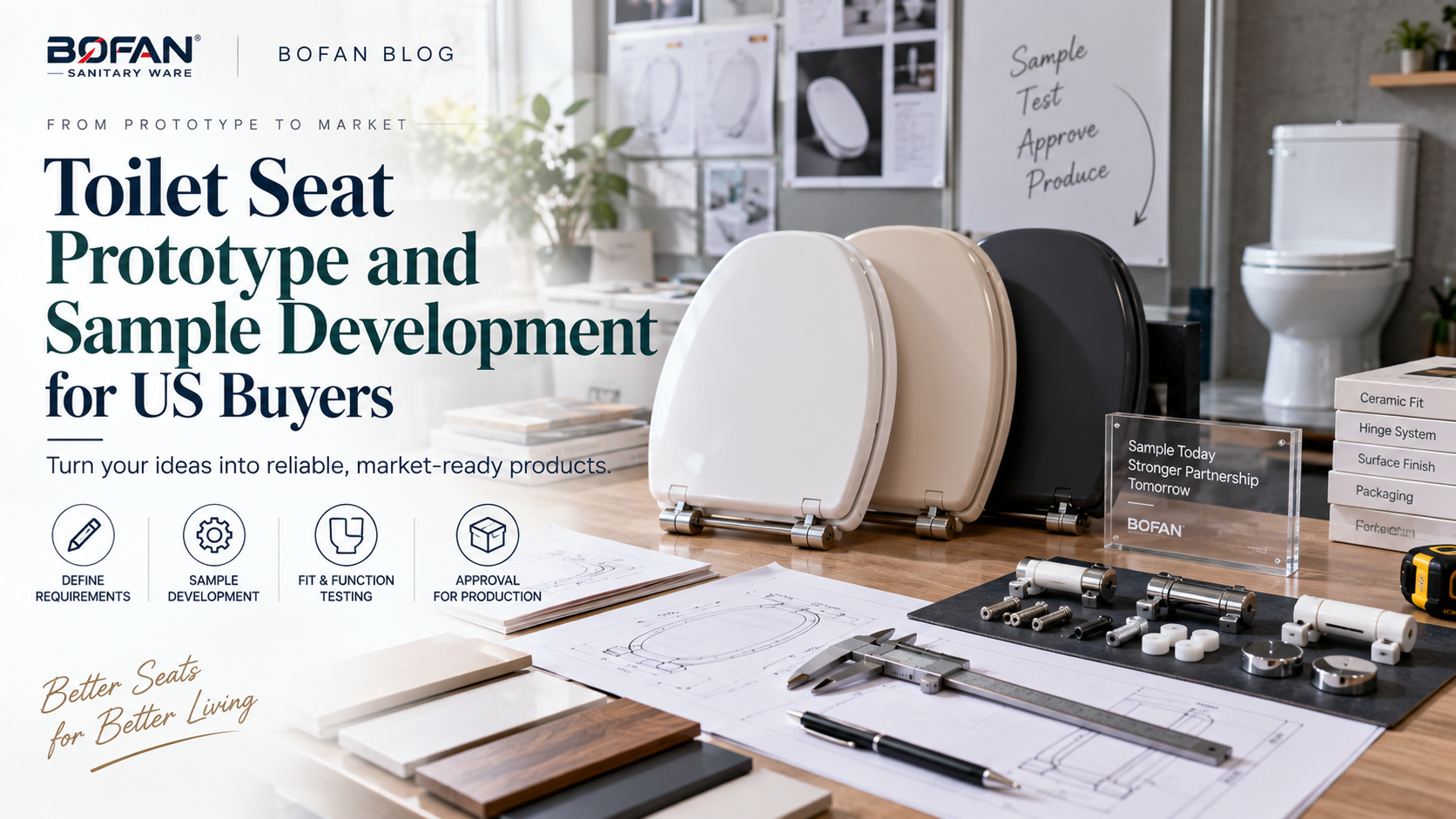
Toilet Seat Prototype and Sample Development for US Buyers
A toilet seat sample should do more than look good in a photograph. For an OEM, private-label or sanitary ware project, it should prove that the selected product can fit the intended ceramic, use the correct hinge system, meet the visual target and move into bulk production without uncontrolled changes.
For US buyers, a structured prototype and sample process reduces the risk of approving a seat that later has alignment, packaging, installation or component problems.
The key is to treat the sample as a controlled product-development stage rather than a simple pre-order formality.
Start With a Clear Product Brief
A manufacturer cannot develop an accurate toilet seat prototype from the words “elongated soft-close toilet seat” alone.
The buyer should provide:
Intended sales channel
Product shape and dimensions
Ceramic drawing, photographs or physical sample
Mounting-hole spacing and diameter
Top-fix or bottom-fix access
Material preference: PP, UF, MDF or molded wood
Required surface finish and color
Soft-close requirement
Quick-release requirement
Hinge appearance and fixing-kit requirement
Target quantity and launch timing
Packaging, barcode and instruction requirements
Reference sample, if an existing product is being replaced
If the buyer has only a reference photograph, identify which details are essential and which can be proposed by the supplier.
Confirm Ceramic Fit Before Finalizing the Product
The toilet bowl is part of the product system. A seat may look suitable but still have poor centering, inadequate buffer contact or insufficient clearance after installation.
For fit review, the factory should receive or confirm:
| Ceramic information | Why it matters |
|---|---|
| Bowl length and width | Checks seat coverage and overhang |
| Bowl shape | Determines visual and functional fit |
| Mounting-hole spacing | Confirms hinge adjustment range |
| Hole diameter | Helps select the fixing kit |
| Rear platform geometry | Affects hinge-base contact |
| Access below the ceramic | Determines top-fix or bottom-fix options |
| Cistern or wall clearance | Checks lid opening space |
Final approval should use the intended ceramic or an accurately controlled representative fixture.
Define Which Sample Is Being Requested
Not every sample has the same purpose. Clarify the sample stage before production begins.
Existing-model confirmation sample
This checks an available model, material, hinge and basic fit before the buyer develops a customized program.
Appearance or color sample
This is used to assess the surface finish, custom color, printing, hinge cover or branded presentation. It should not be treated as final functional approval unless the full configuration is included.
Functional sample
This checks the installed seat, lid movement, soft-close behavior, quick-release mechanism, fixing kit and stability.
Packaging sample
This confirms the complete sellable unit, including carton, hardware bag, instructions, labels and barcode placement.
Prototype from new tooling
This is the development sample for a new shape, ceramic interface or product structure. It may require one or more revision rounds before bulk approval.
Freeze the Hinge and Fixing Configuration
A sample should not be approved with a general description such as “metal soft-close hinge.”
Record the exact:
Hinge code
Damper code where applicable
Hinge-base configuration
Fixing-kit code
Bolt, washer, nut or expansion plug
Buffer configuration
Quick-release mechanism
Hinge-cover color and finish
These components affect installation, stability, closing behavior and future spare-parts supply. A visually similar substitute may not perform in the same way.
Review the Sample as a Complete System
The buyer should inspect more than the top surface of the seat.
Check:
Product shape and dimensions
Ceramic centering
Hinge alignment
Seat and lid movement
Soft-close function
Quick-release engagement
Full closure and opening angle
Fixing-kit completeness
Installed stability
Buffer contact
Surface finish and color
Hinge appearance
Product markings
Instruction-sheet accuracy
Packaging protection
For a private-label retail product, the sample review should eventually cover the complete packed product—not just the seat.
Create an Approval Record
A verbal “looks good” approval is difficult to control during production or repeat orders.
The buyer should issue an approval record with:
Buyer SKU
Factory model
Product description
Material and finish
Ceramic reference
Hinge and fixing-kit codes
Sample photographs
Packaging and artwork version
Required inspection points
Approved deviation, if any
Approval date and contact
Required changes before bulk production
The approved physical sample should be identified and retained as the golden sample.
Manage Sample Revisions Carefully
If a sample does not meet the project requirement, record the exact issue before requesting another version.
Examples include:
Seat is not centered on the ceramic
Lid lacks sufficient wall clearance
Hinge adjustment is unsuitable
Soft close is too fast or does not close fully
Buffers do not contact correctly
Packaging does not protect the hinge
Color or gloss is outside the approved expectation
Installation instructions do not match the supplied hardware
Each revision should state what changes, whether the change affects cost or timing, and whether a new sample is required.
Do Not Release Bulk Production Too Early
Bulk production should begin only after the buyer has confirmed the complete sellable configuration.
Before release, verify:
Product design and dimensions are approved.
Ceramic fit is approved.
Material and finish are confirmed.
Hinge and fixing-kit codes are frozen.
Functional requirements are reviewed.
Packaging artwork is approved.
Labels and barcode placement are confirmed.
Instructions match the product.
Quality-inspection points are agreed.
Change control is documented.
A product photo, a loose hinge or an early development sample is not an adequate substitute for a production-representative approval sample.
How BOFAN Supports Toilet Seat Sample Development
BOFAN can support OEM and private-label toilet seat sample projects across PP, UF and molded-wood ranges.
Depending on the project, support may include:
Existing-model selection
Ceramic-fit review
Hinge and fixing-kit configuration
Soft-close and quick-release options
Custom color and finish discussion
Prototype and sample coordination
Packaging and instruction review
Product-specification control
Bulk-production preparation
Final sample timing, product compatibility and development feasibility depend on the selected model, ceramic, materials, components and project scope.
CTA: Order Samples
Developing a toilet seat for a US program? Send BOFAN your ceramic information, product target, material preference, hinge requirements, quantity and packaging needs. We can help define the appropriate sample stage before bulk production.
FAQ
What information is needed for a toilet seat prototype?
Provide ceramic dimensions or a drawing, product shape, material, hinge function, fixing method, color or finish requirements, expected quantity and packaging requirements.
Should a toilet seat sample be installed before approval?
Yes. Installation on the intended ceramic or representative fixture is important for checking alignment, stability, hinge adjustment and buffer contact.
What is a production-representative sample?
It is a sample that reflects the approved bulk product, including the selected material, hinge, fixing kit, finish and—where applicable—packaging.
Can a sample be changed after approval?
Changes are possible, but they should be documented and reviewed for their effect on fit, function, cost, packaging, testing and lead time.
What should be kept after sample approval?
Keep the approved sample, buyer SKU, factory model, component codes, packaging version, approval record and any agreed revision history.
Table of Contents
- Toilet Seat Prototype and Sample Development for US Buyers
- Start With a Clear Product Brief
- Confirm Ceramic Fit Before Finalizing the Product
- Define Which Sample Is Being Requested
- Freeze the Hinge and Fixing Configuration
- Review the Sample as a Complete System
- Create an Approval Record
- Manage Sample Revisions Carefully
- Do Not Release Bulk Production Too Early
- How BOFAN Supports Toilet Seat Sample Development
- FAQ