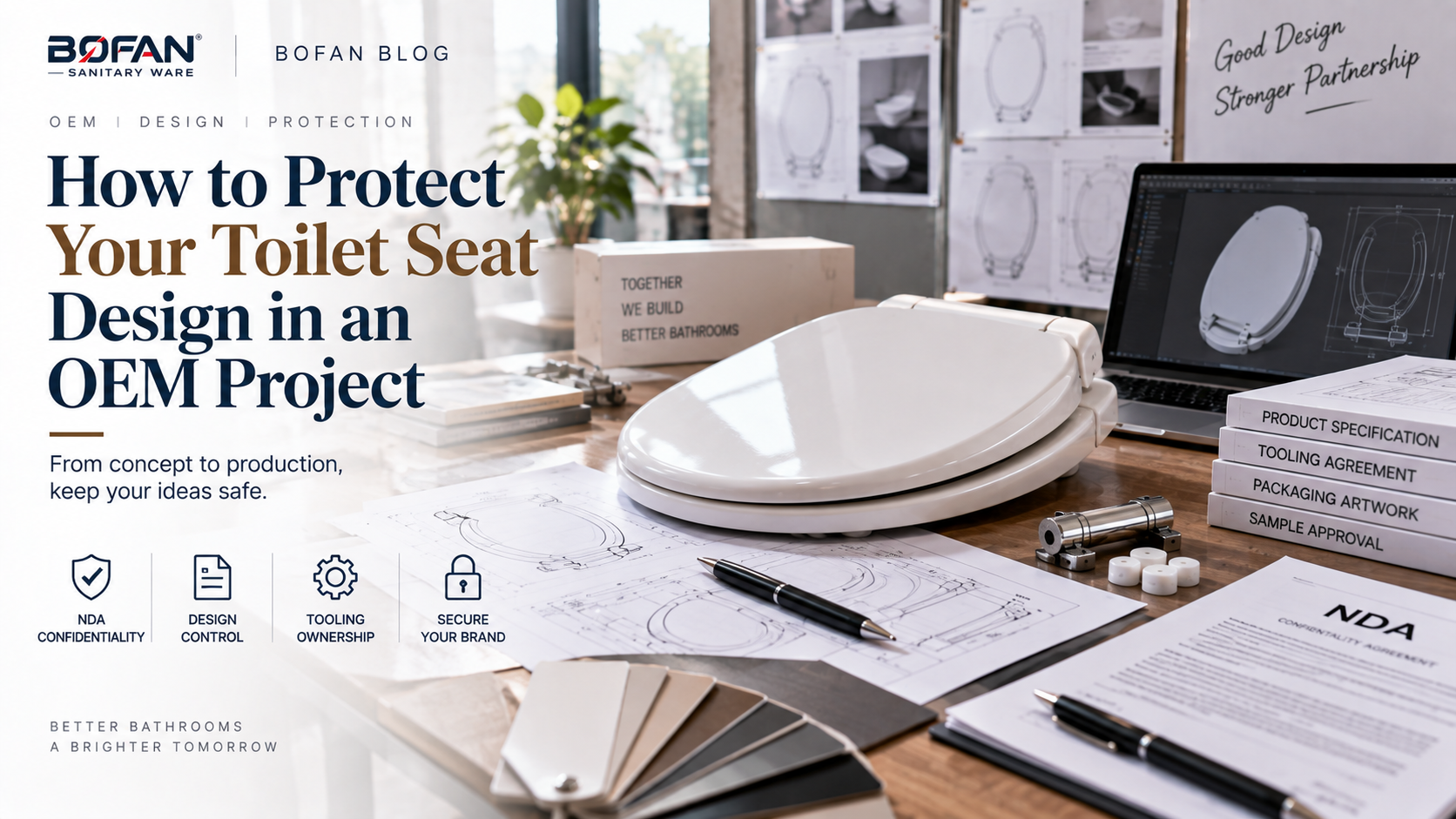
How to Protect Your Toilet Seat Design in an OEM Project
A custom toilet seat program may involve a proprietary shape, a ceramic-specific fit, packaging artwork, a new hinge cover, a surface design or a complete product-development concept.
For buyers, protecting that work starts before samples, tooling and bulk production. The purpose is not simply to sign an NDA. It is to create a controlled record of what belongs to the buyer, what the factory is authorized to make and what changes require written approval.
A clear process also helps prevent practical disputes caused by unclear drawings, uncontrolled component substitutions or different versions of the same project.
Identify What Needs Protection
An OEM project can contain several types of buyer-owned or buyer-controlled assets:
Product drawings and dimensions
Ceramic-fit information
Product shape and structural details
Tooling design and ownership rights
Brand name and logo
Packaging artwork
Printed surface designs
Barcode and SKU data
Product photographs and marketing materials
Hinge-cover design
Product specification and quality requirements
Customer list and commercial information
Not every part of a program has the same legal status. The buyer and supplier should identify the relevant assets clearly instead of assuming that “custom product” covers everything.
Use an NDA Before Sharing Sensitive Information
A non-disclosure agreement can help define how confidential project information may be used.
Before sharing drawings, target prices, customer information or new-product concepts, confirm:
Legal names of the parties
Definition of confidential information
Permitted purpose of disclosure
Who may access the information
Restrictions on disclosure to third parties
Duration of confidentiality
Treatment of documents after the project ends
Governing law and dispute process where required
An NDA is most useful when it is followed by controlled document handling. Do not send multiple conflicting drawings or leave key decisions only in informal chat messages.
Create a Controlled Product Specification
The product specification is the practical foundation of design protection during production.
It should include:
| Control item | What to record |
|---|---|
| Buyer SKU | Buyer’s product identity |
| Factory model | Supplier’s controlled model reference |
| Drawing revision | Current approved product version |
| Material | PP, UF, MDF, molded wood or agreed material |
| Dimensions | Key size and fit requirements |
| Ceramic reference | Intended bowl or compatibility range |
| Hinge and fixing kit | Exact approved component codes |
| Finish and color | Approved visual requirement |
| Packaging | Artwork and version number |
| Golden sample | Physical approval reference |
| Change control | Required buyer approval before changes |
The purchase order, sample approval and final inspection should all refer to the same controlled specification.
Clarify Tooling Ownership Before Payment
If the project needs new tooling, ownership and use rights must be agreed before manufacture begins.
Confirm in writing:
Which tooling is included
Tooling price and payment terms
Tool owner
Tool storage location
Whether the tool is exclusive to the buyer
Whether the supplier may use it for other customers
Maintenance and repair responsibility
Conditions for tool transfer
Process for modifications
Required approval before changes
Tool ownership is different from ownership of a brand, packaging artwork or product concept. The agreement should address each relevant asset separately.
Control Samples and Product Revisions
Samples often pass through several versions. Each version should be identified so that an early prototype is not mistaken for the final approved design.
Record:
Sample date
Product and drawing revision
Material and finish
Hinge and fixing-kit codes
Sample purpose
Approval result
Required revisions
Authorized buyer contact
Keep the final approved physical sample as a golden sample. It provides a practical reference for bulk production and repeat orders.
Prevent Unauthorized Component Substitution
A supplier may consider a hinge, damper, fixing kit, buffer or packaging component “equivalent.” For the buyer, that change may affect product performance, appearance, customer claims or spare-parts compatibility.
Require written approval before changing:
Main material
Product dimensions
Hinge or damper
Fixing kit
Buffer configuration
Surface finish
Color formulation
Printed artwork
Packaging material
Carton dimensions
Instruction sheet
The change record should state the reason, affected SKU, sample requirement, buyer approval and first production batch using the revised component.
Protect Brand and Packaging Assets
Brand names, logos and artwork should be supplied through controlled files.
The buyer should confirm:
Approved logo files
Artwork owner
Permitted use of the brand
Packaging artwork version
Product-photo approval
Barcode ownership and use
Approval contact for future revisions
Do not allow an outdated carton, another customer’s branding or unapproved product photo to be used for a new order.
Keep Information Access Proportionate
The factory needs enough information to produce and inspect the product correctly. It does not necessarily need every commercial detail about the buyer’s retail accounts, pricing strategy or downstream customers.
Share information according to the project stage:
Initial feasibility: product target and ceramic requirements
Quotation: controlled product brief and expected quantity
Sampling: technical drawings, component requirements and artwork
Tooling: approved design files and ownership terms
Bulk production: final specification, packaging and inspection criteria
This approach keeps the project workable while reducing unnecessary disclosure.
OEM Design-Protection Checklist
Before releasing a custom OEM project, confirm:
The supplier’s legal entity is verified.
Confidential information is identified.
An NDA is in place where appropriate.
Product drawings have revision numbers.
Buyer SKU and factory model are linked.
Tooling scope and ownership are defined.
Hinge and fixing-kit codes are frozen.
Samples are identified by version.
Packaging artwork is controlled.
A golden sample is retained.
Component changes require written approval.
Repeat orders refer to the controlled specification.
How BOFAN Supports OEM Design-Control Projects
BOFAN can support structured OEM and ODM toilet seat projects across PP, UF and molded-wood ranges.
Depending on the project, support may include:
Existing-model and custom-development discussion
Ceramic-fit review
Controlled product specifications
Sample version management
Hinge and fixing-kit identification
Packaging artwork coordination
Tooling-scope discussion
Change-control records for repeat orders
Commercial terms, confidentiality arrangements, tooling ownership and IP rights should be confirmed in the applicable project agreement.
CTA: Discuss NDA and IP Protection
Developing a custom toilet seat program? Send BOFAN your project scope, ceramic information, product requirements and expected quantity. We can help define the technical information needed for a controlled feasibility and sample review.
FAQ
Does an NDA protect a toilet seat design by itself?
An NDA helps control confidential information, but practical protection also requires controlled drawings, samples, tooling records, artwork files and change approval.
Who should own custom toilet seat tooling?
Tool ownership and use rights should be agreed in writing before payment. The agreement should also define storage, maintenance, exclusivity and transfer conditions.
How can buyers prevent hinge substitutions?
List the exact hinge, damper and fixing-kit codes in the approved specification and require written approval before any component change.
Why are drawing revisions important?
They prevent the buyer and factory from working from different versions of the product design during sampling or production.
What is a golden sample?
It is the identified physical sample approved as the production reference for the selected product configuration.
Table of Contents
- How to Protect Your Toilet Seat Design in an OEM Project
- Identify What Needs Protection
- Use an NDA Before Sharing Sensitive Information
- Create a Controlled Product Specification
- Clarify Tooling Ownership Before Payment
- Control Samples and Product Revisions
- Prevent Unauthorized Component Substitution
- Protect Brand and Packaging Assets
- Keep Information Access Proportionate
- OEM Design-Protection Checklist
- How BOFAN Supports OEM Design-Control Projects
- FAQ