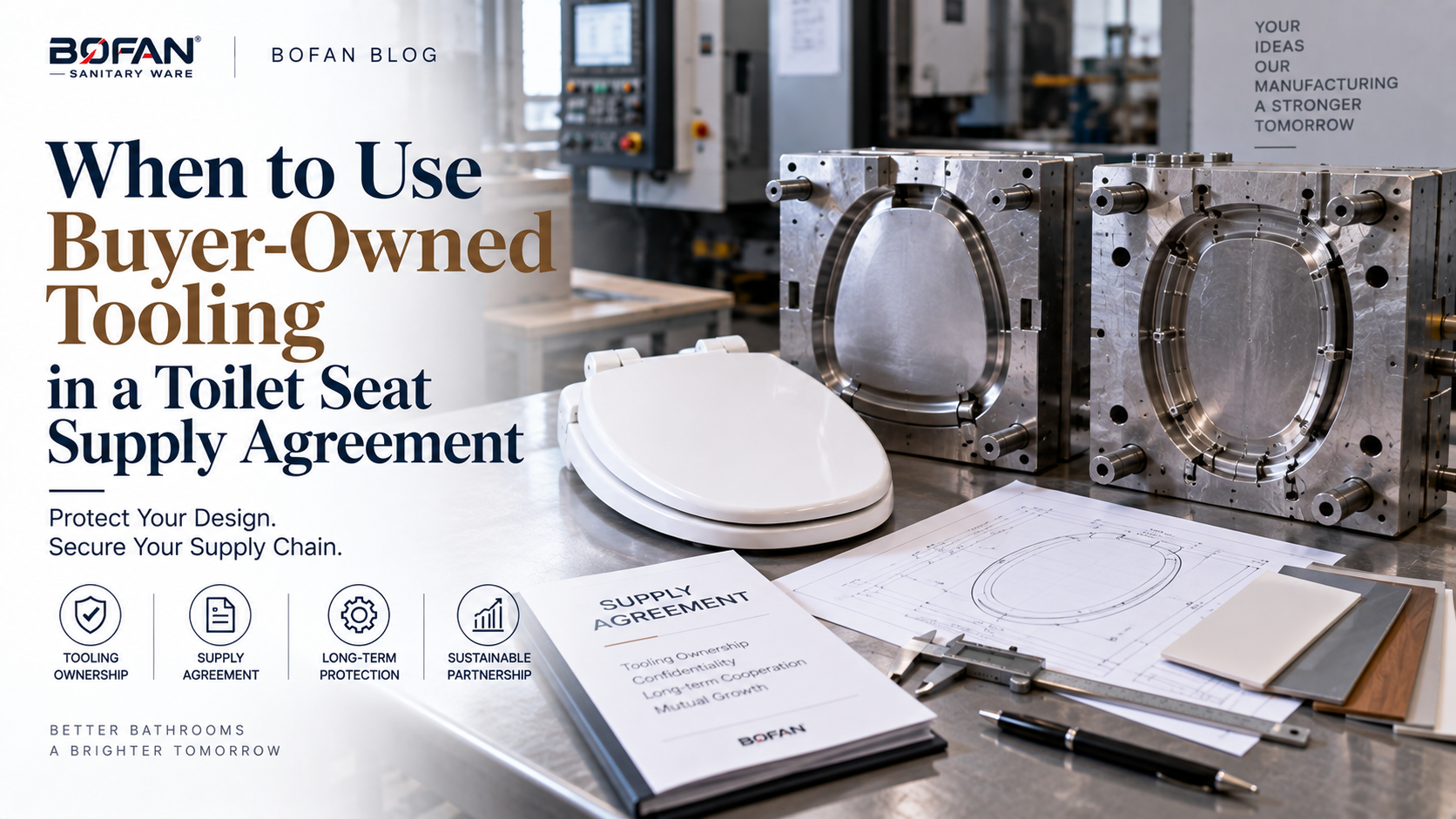
When to Use Buyer-Owned Tooling in a Toilet Seat Supply Agreement
A buyer may invest in tooling to create a proprietary toilet seat shape, a ceramic-specific fit or a differentiated product range. But paying for a mold does not automatically answer the important questions: Who owns it? Who stores it? Can the factory use it for another customer? What happens if the supplier relationship changes?
These points should be agreed before tooling manufacture begins.
Buyer-owned tooling is most useful when the buyer has a long-term product program, a proprietary design or a clear need to control future supply. It may be unnecessary when an existing factory model already meets the project requirements.
When Buyer-Owned Tooling Makes Sense
Consider buyer-owned tooling when the project involves:
A new seat or lid shape
A proprietary ceramic interface
Buyer-funded mold development
A unique hinge cover, buffer or component
A long-term private-label program
Significant planned repeat volume
A product design that must not be shared
A need to move production in the future
For a small trial order based on an existing seat model, a buyer-owned mold may add cost and complexity without creating enough commercial value.
Compare Existing Models First
Before funding a new mold, ask the manufacturer:
Does an existing model fit the intended ceramic?
Can existing tooling support the required material?
Are soft-close and quick-release options available?
Can the product be differentiated through color, packaging or hardware?
Which changes require new tooling?
What MOQ and lead time apply to each option?
An existing platform can reduce development time and risk. New tooling is justified when it solves a fit, function or product-positioning requirement that existing models cannot meet.
Define the Tooling Scope
“Tooling” can mean more than the main seat mold.
The agreement should identify each item:
| Tooling item | Purpose |
|---|---|
| Seat-ring mold | Produces the main seat component |
| Lid mold | Produces the matching lid |
| Hinge-cover tool | Produces a custom visible cover |
| Buffer tool | Produces a custom support component |
| Fixing-component tool | Supports a project-specific installation system |
| Surface or print tool | Supports selected decorative requirements |
Attach the relevant drawings, revision numbers and component descriptions. This prevents disagreement over whether a later component is included in the original tooling payment.
Include Clear Ownership Clauses
A supply agreement should state:
Who pays for each tool
Who owns each tool after payment
Whether ownership transfers after full payment
Whether the tool is exclusive to the buyer
Whether the supplier may use the tool for another customer
Where the tool is stored
Who maintains and repairs it
How the tool is identified
How long the supplier must retain it
Conditions for moving or transferring it
Whether unpaid tooling can be released
The agreement should also distinguish physical-tool ownership from intellectual property rights in the product design, packaging artwork and buyer brand.
Link Tooling to the Approved Product Version
A mold should be connected to a controlled product specification.
Record:
Buyer SKU
Factory model
Tooling reference
Drawing revision
Material
Hinge and fixing-kit codes
Color and finish
Approved sample
Packaging version
Effective production date
Without this record, the buyer may own a tool but still have difficulty confirming which product configuration it is intended to produce.
Control Modifications and Maintenance
Molds wear, need maintenance and may require modifications. These activities can affect product dimensions, surface texture and production consistency.
The agreement should explain:
Who authorizes modifications
Whether the buyer must approve repairs that affect the product
Who pays for ordinary maintenance
How the supplier records maintenance
What happens if the tool is damaged
How sample approval works after a major change
Whether the supplier may modify the tool to improve production
No material design change should be made merely because it is convenient for production. The buyer should assess effects on ceramic fit, appearance, packaging and repeat-order consistency.
Plan for Tool Transfer Before It Is Needed
Transfer arrangements are easiest to agree before a disagreement arises.
Confirm:
Transfer notice period
Condition required for release
Documentation supplied with the tool
Tooling drawings and maintenance records
Packaging and shipping responsibility
Insurance and risk during transport
Whether the buyer may appoint another factory
Confidentiality obligations after transfer
A practical agreement should define a process, not simply state that the buyer “owns the mold.”
Buyer-Owned Tooling Checklist
Before starting tooling, confirm:
Existing models have been reviewed.
Tooling items are listed separately.
Product drawings have revision numbers.
Payment and ownership terms are clear.
Exclusivity is defined where required.
Tool storage and maintenance are assigned.
Modification approval is controlled.
The approved sample is linked to the tool.
Component codes are recorded.
Transfer conditions are agreed.
Confidentiality and design rights are addressed.
Repeat orders use the controlled specification.
How BOFAN Supports Tooling Discussions
BOFAN can support OEM and ODM toilet seat development discussions for PP, UF and molded-wood programs, including existing-model comparisons, ceramic-fit review, sample coordination and controlled product specifications.
Tooling ownership, exclusivity, maintenance, transfer rights and commercial terms should be agreed in the applicable supply agreement for each project.
CTA: Discuss Tooling Ownership
Considering a custom toilet seat program? Send BOFAN your ceramic drawing, product concept, target volume, material and hinge requirements. We can help review whether an existing platform or buyer-owned tooling route is suitable.
FAQ
Does paying for a toilet seat mold mean the buyer owns it?
Not automatically. Ownership, use rights and transfer conditions should be written into the tooling or supply agreement.
Can a supplier use buyer-owned tooling for other customers?
Only if the agreement permits it. Exclusivity should be stated clearly for buyer-specific designs.
Who pays for mold maintenance?
The agreement should separate normal maintenance, repair, damage and buyer-requested modifications.
Should a buyer own tooling for an existing toilet seat model?
Usually not unless the project requires a unique modified component or the agreement specifically transfers ownership.
What records should accompany buyer-owned tooling?
Keep tooling references, drawings, product specifications, sample approvals, maintenance records and component codes.
Table of Contents
- When to Use Buyer-Owned Tooling in a Toilet Seat Supply Agreement
- When Buyer-Owned Tooling Makes Sense
- Compare Existing Models First
- Define the Tooling Scope
- Include Clear Ownership Clauses
- Link Tooling to the Approved Product Version
- Control Modifications and Maintenance
- Plan for Tool Transfer Before It Is Needed
- Buyer-Owned Tooling Checklist
- How BOFAN Supports Tooling Discussions
- FAQ